2025 Cybersecurity Trends: Why Houston Businesses Need to Shift From Reactive to Proactive Defense
How Artificial Intelligence Is Democratizing Cybercrime In 2025 – Business Email Compromise Continues To Target Companies Of All Sizes
2025 Cybersecurity Trends: Why Houston Businesses Need to Shift From Reactive to Proactive Defense
TL;DR: Modern cyberattacks use legitimate tools to bypass traditional security, with 84% of attacks leveraging Living Off the Land techniques. Houston businesses must adopt proactive defense strategies—shrinking their attack surface and hardening environments—while addressing growing talent gaps and burnout among security teams.
The cybersecurity battlefield has fundamentally changed. Gone are the days when attackers relied solely on malicious software to breach networks. Today’s threat actors are logging in instead of breaking in, using stolen credentials and trusted applications to move silently through your systems. For small and medium-sized businesses in Houston and Katy, this shift represents both a critical challenge and an opportunity to rethink security strategies.
A recent global survey of 1,200 cybersecurity professionals reveals that detection alone is no longer sufficient. Organizations must shrink their attack surface proactively—before attackers ever arrive.
The New Attack Reality: Living Off the Land
The most dangerous threats now hide in plain sight. Analysis of over 700,000 cyber incidents shows a disturbing trend:
84% of major cyberattacks now leverage Living Off the Land (LOTL) techniques, using legitimate administrative tools like PowerShell, Windows Management Instrumentation, and Remote Desktop Protocol
These attacks bypass traditional security because they don’t introduce foreign malware—they manipulate tools already present in your environment
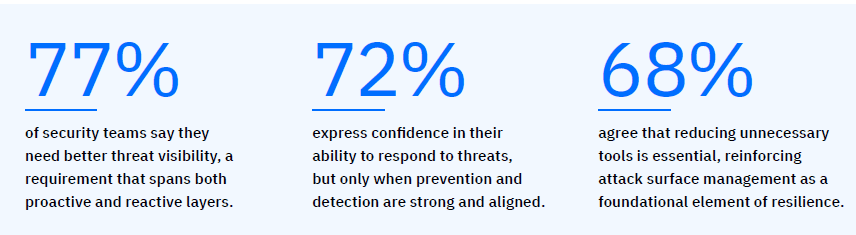
68% of security leaders agree that reducing attack surface by disabling unnecessary tools and applications is now critical
37% cite balancing security and usability as their top challenge in attack surface hardening
Traditional antivirus and firewall solutions struggle to detect LOTL attacks because the tools being exploited are the same ones your IT team uses daily. When PowerShell executes a command, how does your system know whether it’s a legitimate administrator or a threat actor who stole credentials?
The Widening Gap Between Leadership and Reality
The report shows a perception gap between C-level executives and mid-level managers. I should highlight this in a way that helps Houston business owners understand the disconnect and its implications.
Perhaps more concerning than external threats is the disconnect emerging within organizations themselves. The research reveals a troubling perception gap:
45% of C-level executives report feeling “very confident” in their organization’s cyber readiness, while only 19% of mid-level managers share that confidence
57% of C-level leaders say the cybersecurity skills gap has worsened in the last 12 months,compared to 40% of mid-level management
C-suite priorities focus on adopting AI tools for advanced threat detection (41%), while frontline managers prioritize strengthening cloud security and identity management (35%)
77% of professionals say they lack enough insight into their environment – a fundamental requirement for both proactive and reactive security
This misalignment creates dangerous blind spots. When executives overestimate readiness, they may underinvest in critical areas. When priorities don’t align, teams pull in different directions, slowing progress and leaving vulnerabilities unaddressed.
Artificial intelligence has become a double-edged sword in cybersecurity. While it enhances defensive capabilities, it’s also democratizing cybercrime:
63% of organizations experienced an attack they believe involved AI in the past year
67% report seeing an increase in AI-powered cyberattacks
56% cite AI-powered malware as a significant risk, with 52% concerned about AI-enhanced social engineering
Threat actors now use generative AI to refine ransomware code, craft convincing phishing emails, and scale attacks with minimal technical skill
The FunkSec ransomware group exemplifies this trend. Starting with limited knowledge and relying on AI to generate basic code, they’ve grown into a global threat targeting organizations across multiple countries. AI isn’t necessarily making elite attackers more powerful—it’s making average ones more dangerous.
While sophisticated techniques grab headlines, Business Email Compromise (BEC) attacks continue to devastate businesses:
66% of respondents report witnessing an increase in BEC attacks
44% of both C-level executives and mid-level managers identify BEC and targeted phishing as the greatest threat to their business in 2025
Organizations worldwide lost more than $55 billion through BEC attacks during the past decade
AI-generated communications make these attacks nearly indistinguishable from legitimate messages, with 65% saying identifying malicious communications is now difficult
For Houston-area businesses, BEC represents an especially dangerous threat. These attacks target companies of all sizes, often impersonating vendors, executives, or business partners to authorize fraudulent wire transfers or steal sensitive data.
Technology alone cannot solve cybersecurity challenges. The research reveals a workforce under enormous strain:
50% say lack of automation hinders their work
49% of cybersecurity professionals report burnout from the constant pressure to monitor and respond to threats
Nearly 40% plan to look for a new role in the next year
31% cite complexity as their biggest challenge with current security solutions
Half of IT and security professionals report the skills gap has widened in the past year
For small and medium-sized businesses that lack the resources to build large security teams, these workforce challenges create critical vulnerabilities. When you’re relying on one or two people to handle all cybersecurity responsibilities, burnout and turnover can leave you dangerously exposed.
Perhaps the most shocking finding relates to breach disclosure:
58% of respondents say they were told to keep a cybersecurity incident confidential when they knew it should be reported—a 38% increase since 2023
69% of C-level executives report being told to stay silent about breaches, compared to 46% of mid-level managers
In the U.S., 74% of security professionals were told to keep breaches quiet
This trend conflicts directly with growing regulatory requirements under GDPR, CCPA, and other frameworks
The pressure to conceal breaches often stems from fear of regulatory fines, reputational damage, and competitive disadvantage. However, the long-term costs of concealment—if discovered—are far steeper than transparent disclosure and rapid remediation.
True cyber resilience requires a fundamental shift in approach. Rather than relying solely on detection and response, organizations must adopt a layered strategy:
Proactive prevention and hardening shrinks the attack surface by removing unnecessary access, restricting unused applications, and establishing behavioral baselines for every user
Reactive detection and response ensures real-time threat identification, rapid investigation, and precise containment when something does slip through
Structured recovery includes data restoration, continuity plans, and compliant breach disclosure protocols to minimize impact and accelerate return to normal operations
The most successful organizations pair intelligent automation with human expertise, layering these capabilities over a hardened, well-managed infrastructure.
How CinchOps Can Help Protect Your Houston Business
At CinchOps, we’ve built our managed IT services around the principle that cybersecurity must be proactive, not just reactive. We understand that Houston and Katy area businesses need protection that scales with their growth without breaking their budgets.
Our approach addresses the key challenges identified in this research:
Attack Surface Reduction: We analyze your environment to identify and eliminate unnecessary access points, over-privileged users, and dormant applications that create risk
24/7 Monitoring and MDR Services: Our team provides continuous threat monitoring and managed detection and response capabilities without requiring you to hire, train, and retain specialized cybersecurity staff
Network Security and SD-WAN: We implement multi-layered network defenses that protect against both external threats and insider risks, with intelligent routing that maintains performance
Cloud Security: As more businesses move to cloud environments, we ensure your cloud infrastructure receives the same rigorous protection as your on-premises systems
Compliance Management: We help Houston businesses navigate complex regulatory requirements including HIPAA, PCI-DSS, and industry-specific frameworks, automating compliance reporting to reduce administrative burden
Identity and Access Management: We implement granular controls that give users the access they need while preventing credential abuse and lateral movement by attackers
Security Awareness Training: Your employees are your first line of defense against BEC attacks and social engineering—we provide ongoing training that keeps security top-of-mind
We’re not a faceless national provider – we’re your neighbors in the Houston area. When you need support, you reach a real person who understands your business and responds quickly. That local presence makes all the difference when minutes matter during a security incident.
The cybersecurity challenges facing Houston businesses are significant, but they’re not insurmountable. With the right combination of proactive defense, intelligent automation, and expert human oversight, you can build true cyber resilience. CinchOps brings you that combination, tailored to the needs and budgets of small and medium-sized businesses.
Contact CinchOps today to schedule a complimentary security assessment for your Houston or Katy business. Let’s work together to shrink your attack surface, strengthen your defenses, and give you the confidence to focus on growing your business—not worrying about the next cyberattack.