


Houston Leads the Nation in Growth – What It Means for Your Managed IT
Houston’s #1 Growth Ranking Demands #1 IT Infrastructure – What Houston’s Census Growth Numbers Mean for Business IT Planning
Harris County just crossed 5 million residents. Here's why that makes your IT infrastructure the most critical investment you'll make this year.
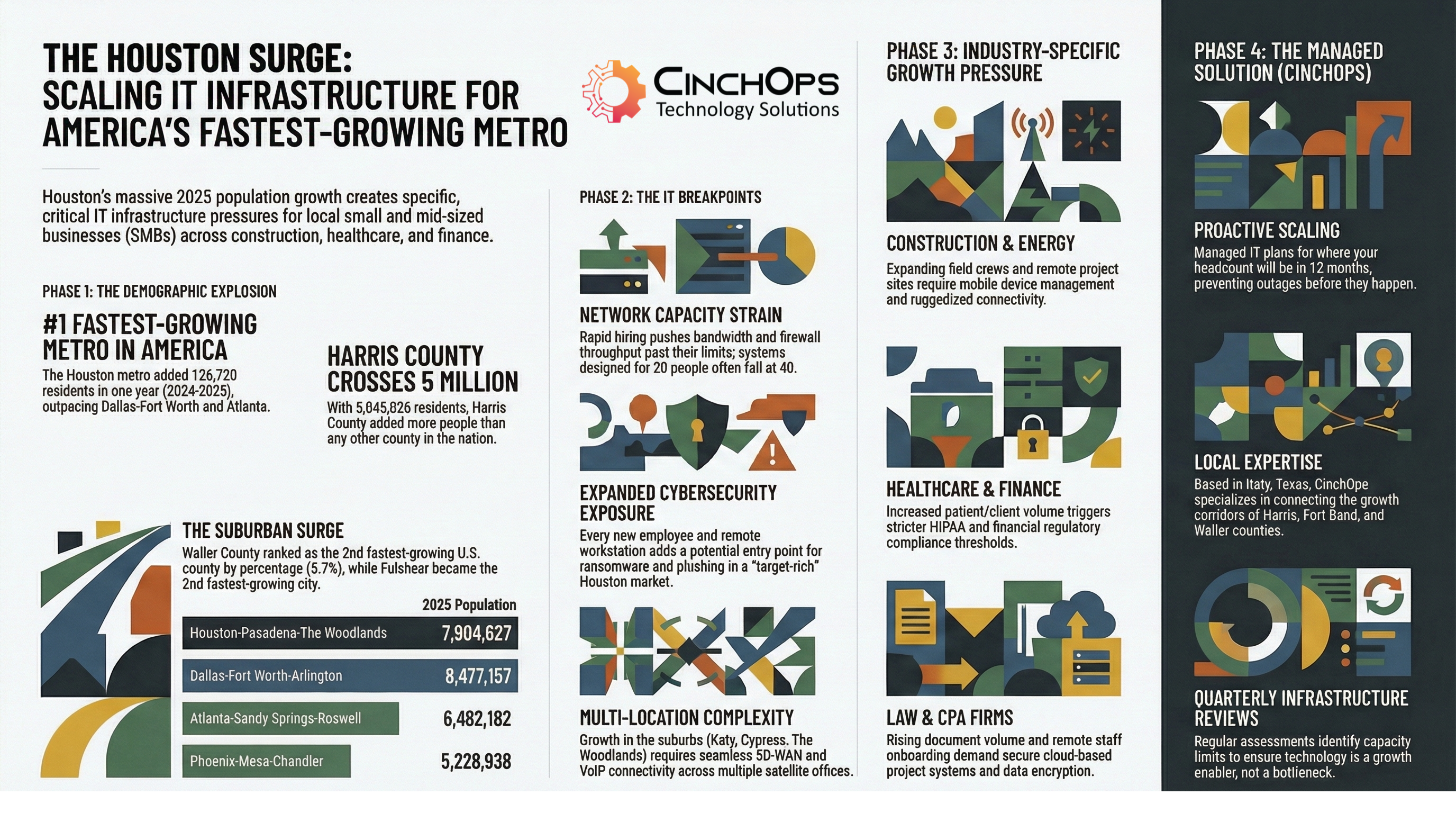
The U.S. Census Bureau released its Vintage 2025 population estimates on March 26, 2026, and the headline for Houston is hard to miss: the Houston-Pasadena-The Woodlands metro area added 126,720 people between July 2024 and July 2025. That's the largest numeric increase of any metro area in the country, edging out Dallas-Fort Worth by roughly 3,000 people.
Harris County itself crossed the 5 million mark for the first time in its history, hitting 5,045,026 residents and adding 48,695 people - more than any other county in America. For businesses across Houston, Katy, Sugar Land, and the surrounding metro, these aren't just demographic curiosities. More people means more market opportunity, but it also means more IT complexity, more cybersecurity risk, and more pressure on the systems that keep your business running.
CinchOps is a managed IT services provider based in Katy, Texas, serving small and mid-sized businesses across the Houston metro area. CinchOps specializes in cybersecurity, network security, managed IT support, VoIP, and SD-WAN for businesses with 10-200 employees.
The raw numbers tell a clear story. Between July 1, 2024, and July 1, 2025, the Houston metro outpaced every other metro area in America for total new residents. That's not a one-year fluke. Between 2023 and 2024, Houston added nearly 198,000 people - the second-largest increase nationwide. The pace has slowed somewhat due to reduced international migration, but the region still stands alone at the top.
| Metro Area | July 2024 Pop. | July 2025 Pop. | Numeric Growth | Rank |
|---|---|---|---|---|
| Houston-Pasadena-The Woodlands, TX | 7,777,907 | 7,904,627 | +126,720 | #1 |
| Dallas-Fort Worth-Arlington, TX | 8,353,600 | 8,477,157 | +123,557 | #2 |
| Atlanta-Sandy Springs-Roswell, GA | 6,420,229 | 6,482,182 | +61,953 | #3 |
| Phoenix-Mesa-Chandler, AZ | 5,169,873 | 5,228,938 | +59,065 | #4 |
| Charlotte-Concord-Gastonia, NC-SC | 2,884,708 | 2,938,830 | +54,122 | #5 |
Harris County's growth is even more striking when you look at what's happening around it. Four of the top 10 counties in the nation for numeric growth are in the Houston metro:
- Harris County: +48,695 residents (#1 nationally)
- Montgomery County: +30,011 residents (#4 nationally, now at 781,194)
- Fort Bend County: +24,163 residents (#8 nationally, pushing toward 1 million at 975,191)
The 44th Kinder Houston Area Survey from Rice University found that nearly half of residents who moved to greater Houston as adults came for a job opportunity. Another 26% came for family reasons. People aren't just passing through - they're putting down roots. That means more businesses opening, more offices expanding, and more demand for reliable managed IT support across the region.
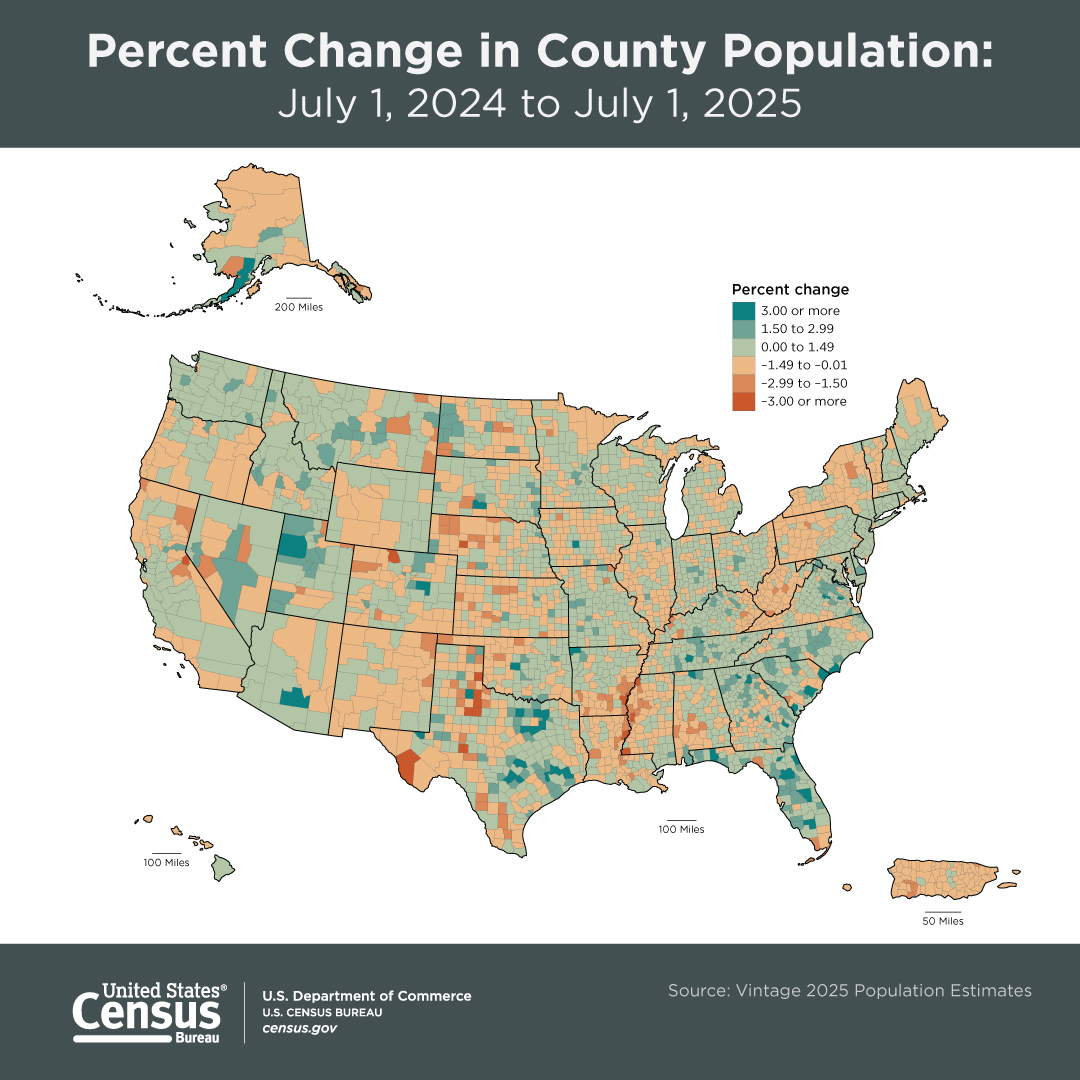
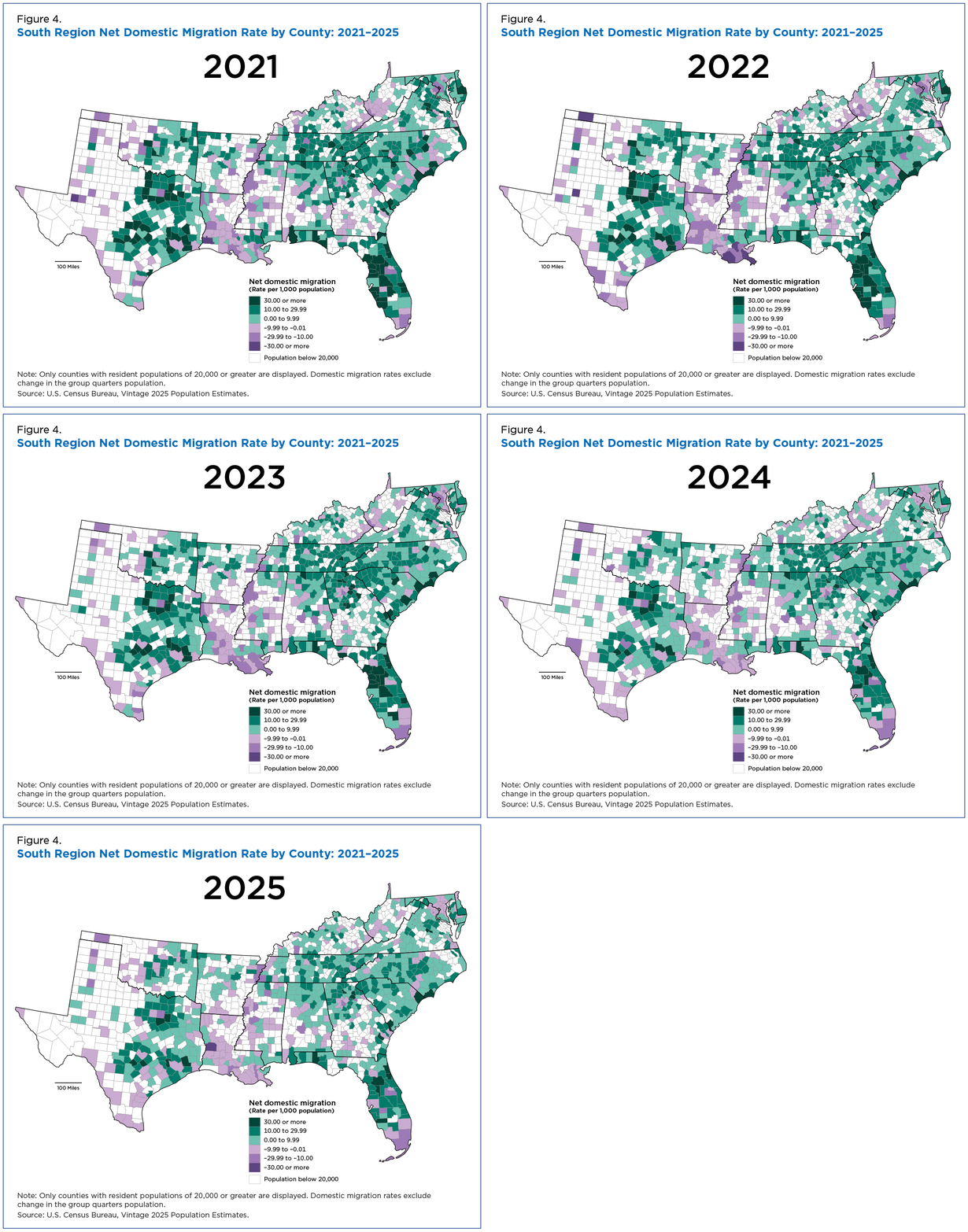
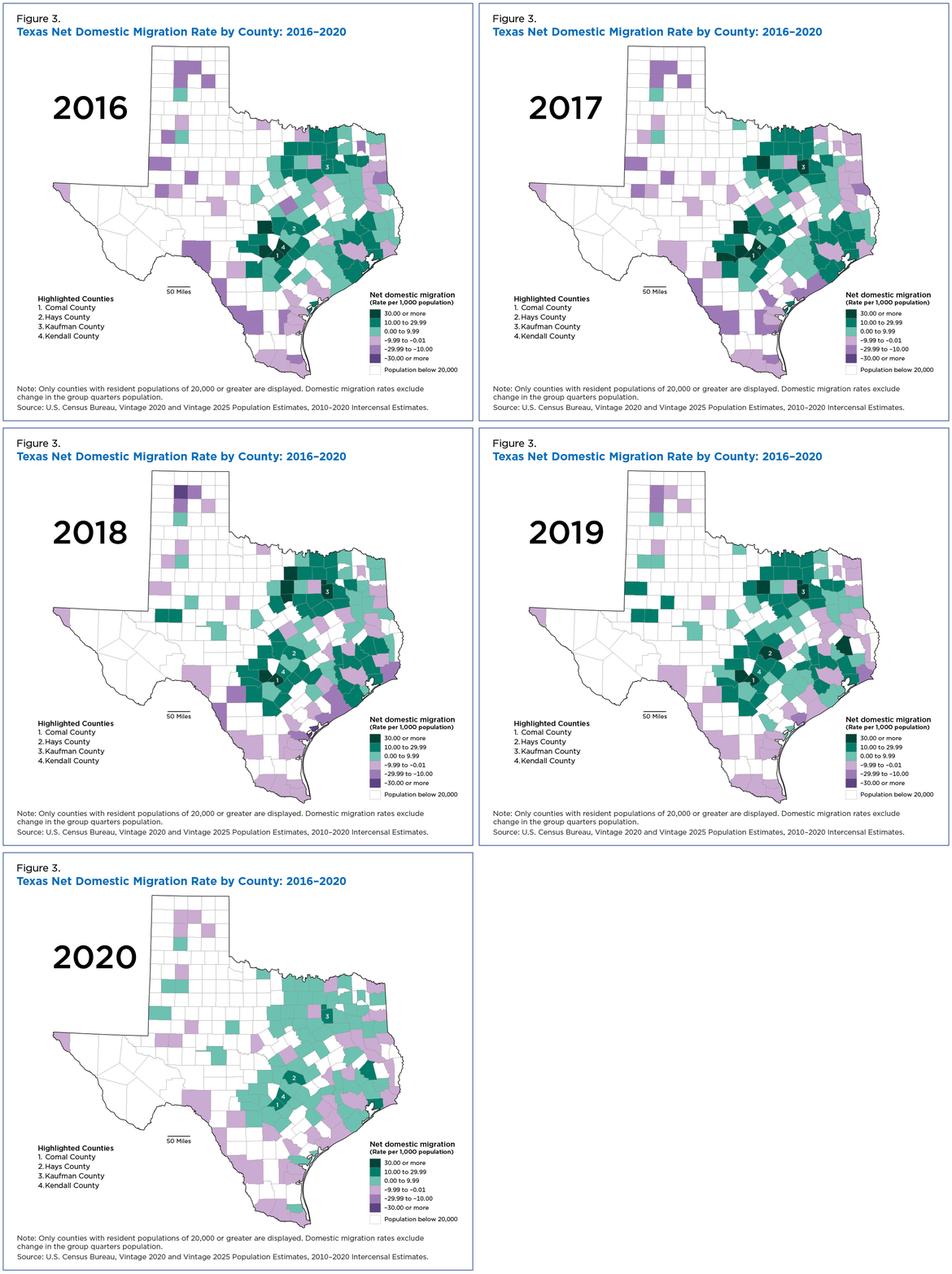
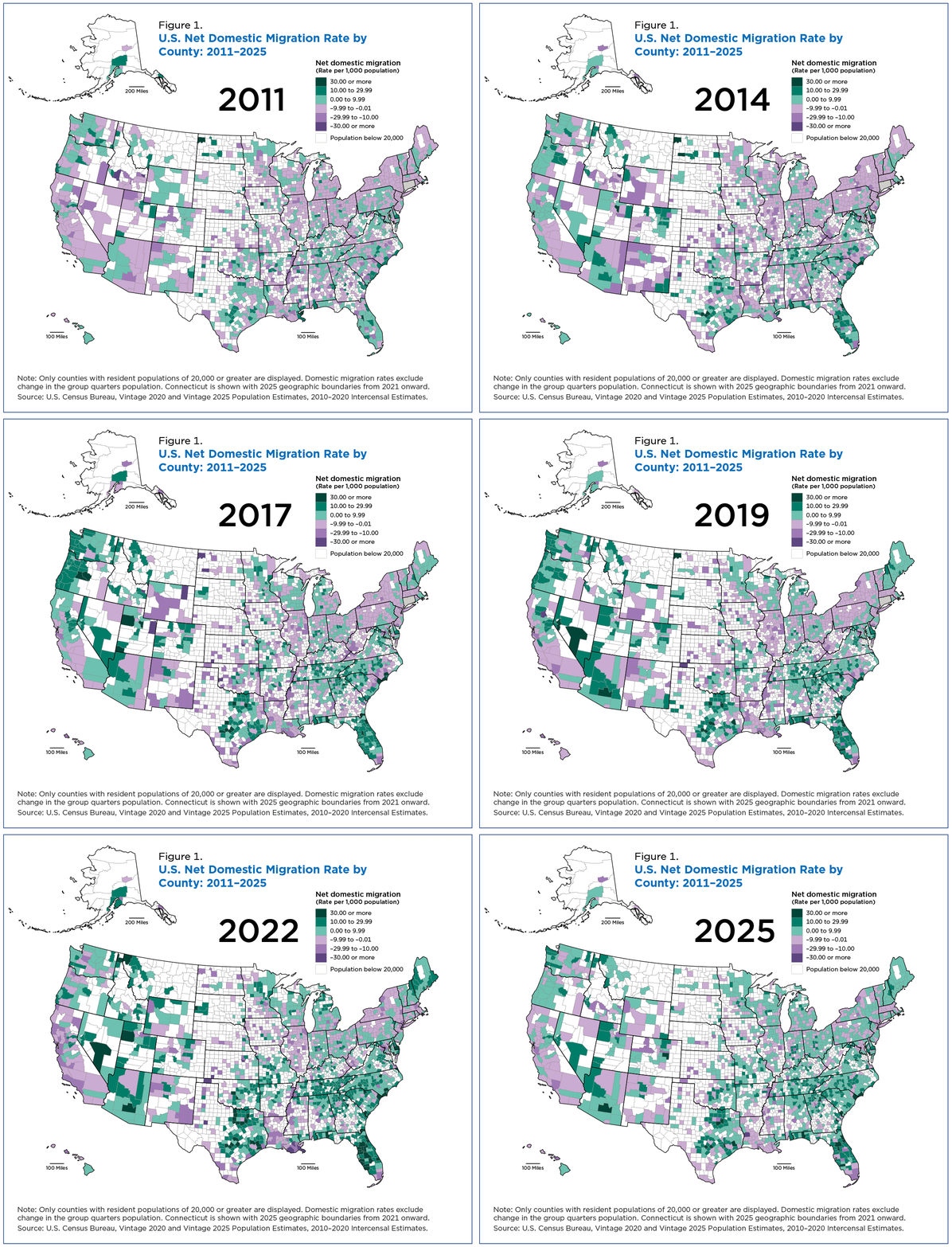
Here's the part that matters most if you run a business in west Houston, Katy, or the surrounding suburbs: the Census Bureau specifically noted that the fastest-growing counties nationwide tend to be on the outer edges of major metros, and this pattern is especially pronounced in Texas.
Waller County - right next door to Katy - was the second-fastest-growing county in the entire United States by percentage, with a 5.7% population increase. Liberty County hit 4.4% growth, placing it in the national top 10. Fort Bend County, which includes Sugar Land and Fulshear, is knocking on the door of 1 million residents.
Vince Yokom, executive director of the Waller County Economic Development Partnership, pointed to proximity to Houston and a decade of deliberate economic development planning as the key drivers. Waller County Judge Trey Duhon credited highway access to Houston, Austin, and College Station for attracting national and international companies.
Rice University's Kinder Institute found that Fulshear in Fort Bend County was the second-fastest-growing city in the U.S. in both 2023 and 2024, now home to roughly 55,000 residents. Montgomery County, which includes Conroe and The Woodlands, exceeds Denver's city population. Fort Bend County trails the city of Austin by only about 35,000 people.
"When you're adding employees, opening a second location, or onboarding remote workers in these fast-growing suburban markets, your IT has to be ready before the people arrive - not three months after."
| Houston-Area County | July 2025 Pop. | Growth 2024-2025 | % Growth | National Rank (Numeric) |
|---|---|---|---|---|
| Harris County | 5,045,026 | +48,695 | 1.0% | #1 |
| Montgomery County | 781,194 | +30,011 | 4.0% | #4 |
| Fort Bend County | 975,191 | +24,163 | 2.5% | #8 |
| Waller County | 69,858 | +3,761 | 5.7% | Top 10 (% growth) |
| Liberty County | 121,364 | +5,073 | 4.4% | Top 10 (% growth) |
Is Your IT Keeping Up With Your Growth?
Get a free assessment of your current IT infrastructure from a local Houston managed IT provider.
Schedule Your Free AssessmentPopulation growth and business growth are directly linked. More residents means more customers walking through doors, more employees needing workstations, more transactions hitting your network, and more data that needs protecting. A CPA firm in Sugar Land that handled 400 returns three years ago might be handling 650 now. A construction company in Katy that ran 4 project sites is suddenly managing 8. A wealth management firm in The Woodlands that onboarded 200 new clients needs systems that can keep pace.
The IT breakpoints show up in predictable ways:
- Network capacity: When you add 10-15 employees over a 12-month stretch, your bandwidth, access points, and firewall throughput need to scale. Most SMB networks were designed for the headcount three years ago, not today.
- Cybersecurity exposure: More endpoints mean more attack surface. Each new employee device, cloud application, and VPN connection is another potential entry point. Houston businesses are already a target-rich environment for ransomware and phishing attacks.
- Multi-location complexity: The suburban growth pattern creates businesses that operate across multiple sites - a main office in Houston's inner loop, a branch in Katy, a satellite in Cypress. That demands SD-WAN, unified communications, and consistent security policies across every location.
- Compliance strain: Growth often means crossing thresholds that trigger new regulatory requirements. A healthcare practice that adds a second location may face different HIPAA audit standards. A financial services firm that crosses employee or revenue thresholds may need tighter controls.
In 35 years of managing IT for businesses, the pattern I see most often is companies that grow faster than their technology. The network that worked fine for 25 people starts dropping connections at 40. The server that handled your data two years ago can't keep up. The IT guy who was "good enough" when you had one office can't manage three. That's the gap where managed IT support turns from a nice-to-have into the thing keeping the lights on.
Growth-Related IT Failures Are Preventable
The Kinder Institute projects the Houston region will add millions more people by 2050, with Fort Bend County alone expected to grow by over 527,000. If your business is scaling alongside this growth, proactive managed IT services can prevent the network outages, security gaps, and productivity losses that catch growing companies off guard.
Learn about managed IT for growing Houston businesses →Population growth doesn't hit every industry the same way. A law firm in Houston adding 5 new attorneys has different IT needs than a manufacturing operation in Brookshire adding a second shift. Here's where the growth pressure lands hardest across the sectors we work with every day.
| Industry | Growth-Driven IT Pressure | Critical Managed IT Need |
|---|---|---|
| Construction | More projects, more remote sites, field crews needing connectivity across Harris, Fort Bend, Montgomery counties | SD-WAN for multi-site, mobile device management, cloud-based project systems |
| CPA Firms | Client base expanding with population; tax season volume climbing; remote staff onboarding | Secure remote access, data encryption, compliance-ready backup and disaster recovery |
| Law Firms | More cases, more document volume, more client data to protect as Houston legal demand grows | Document management security, email encryption, privilege-compliant data backup |
| Wealth Management | Portfolio growth tracks population growth; fiduciary compliance requirements scale with client count | Endpoint protection, compliance monitoring, secure client communications via VoIP |
| Oil & Gas / Energy | Workforce expansion, suburban operations centers, field-to-office connectivity across growing service areas | OT/IT convergence security, network monitoring, business continuity planning |
| Manufacturing | Production scaling to meet regional demand; new facilities in growth corridors like Waller and Liberty counties | OT security, uptime monitoring, network infrastructure for new floor space |
| Healthcare | Patient volume growth in suburban markets; new clinic locations to serve expanding populations | HIPAA-compliant infrastructure, telehealth support, secure multi-location networking |
The common thread across every industry: growth exposes IT weaknesses that were hiding when things were smaller. A network that "mostly works" at 20 employees doesn't mostly work at 45. A backup system that recovered one server can't recover three. The businesses that handle growth best are the ones that scaled their IT before the headcount forced the issue.
IT Growth Readiness Self-Assessment
- Can your current network handle 25% more users without performance degradation?
- Do you have a documented plan for onboarding new employees' devices and access within 24 hours?
- Is your cybersecurity coverage consistent across all office locations, including remote workers?
- Could your current backup and disaster recovery system restore operations if you doubled in size this year?
- Do you have a managed IT provider reviewing your infrastructure quarterly for capacity limits?
When your market adds 126,720 potential customers in a single year, your technology has to be a growth enabler, not a bottleneck. CinchOps works with 10-200 employee businesses across Houston, Katy, Sugar Land, Cypress, The Woodlands, and the surrounding metro to build IT infrastructure that scales with your business, not against it.
- Scalable managed IT support that grows with your headcount - we plan for where you'll be in 12 months, not where you were last year
- Multi-location network design using SD-WAN to connect offices across Harris, Fort Bend, Montgomery, and Waller counties with consistent performance and security
- Proactive cybersecurity that expands endpoint protection, email security, and monitoring as your employee count climbs
- VoIP and unified communications that let you add phone lines and collaboration tools without ripping out existing systems
- Business continuity and disaster recovery designed to protect a growing data footprint - because the cost of downtime goes up with every customer and employee you add
- Quarterly infrastructure reviews that identify capacity limits before they become performance problems or outages
Houston's growth isn't slowing down. Fort Bend and Montgomery counties are projected to add over a million combined residents by 2050. The businesses that position their technology for this growth now are the ones that will capture the opportunity instead of scrambling to catch up.
Frequently Asked Questions
How does Houston's population growth directly affect my small business IT needs?
Houston's population growth increases customer volume, employee headcount, and data traffic for businesses across the metro area. A managed IT services provider can help Houston businesses scale their network infrastructure, cybersecurity coverage, and cloud capacity to match this growth without the capital expense of building an internal IT department from scratch.
Which Houston-area counties are growing fastest and what IT challenges does that create?
Waller County grew 5.7% in 2025, making it the second-fastest-growing county in the United States. Montgomery County added over 30,000 residents and Fort Bend County nearly 25,000. Businesses operating across these fast-growing suburban counties need multi-location SD-WAN connectivity, consistent cybersecurity policies, and managed IT support that covers every office location reliably.
What is managed IT support and why do growing Houston businesses need it?
Managed IT support is a service where a third-party provider handles all technology management for a business, including network monitoring, cybersecurity, helpdesk support, and infrastructure planning, for a flat monthly fee. Growing Houston businesses need managed IT because scaling internal IT staff to keep pace with rapid employee and location growth is both expensive and slow compared to partnering with a local managed services provider.
How many people did the Houston metro area add in 2025?
The Houston-Pasadena-The Woodlands metropolitan area added 126,720 residents between July 2024 and July 2025, according to U.S. Census Bureau Vintage 2025 estimates. This made the Houston metro the number one metro area in America for numeric population growth, surpassing Dallas-Fort Worth, Atlanta, Phoenix, and Charlotte for total new residents added in that 12-month period.
How can a Katy-based managed IT provider help businesses in Houston's growth corridors?
CinchOps is based in Katy, Texas, at the center of Houston's western growth corridor where Waller, Fort Bend, and Harris counties converge. A locally based managed IT services provider understands the specific infrastructure challenges of suburban Houston businesses, from multi-site connectivity along I-10 and the Grand Parkway to supporting remote employees spread across the 10-county metro region.
Resources
Discover More
Sources
- U.S. Census Bureau - Vintage 2025 Population Estimates: Slow Growth Impacts Nation's Largest Counties Hardest (March 26, 2026)
- U.S. Census Bureau - Some Like It Hot: County Domestic Migration Trends From 2011 to 2025 (March 26, 2026)
- Texas Tribune - Texas Suburbs Lead U.S. for Population Growth as International Migration Slows (March 26, 2026)
- Rice University Kinder Institute - Houston's 15-Year Growth in Three Charts (March 2025)
- Rice University Kinder Institute - Houston Region Projected to Attract Millions More Residents by 2050


