The AI Pushback: What Houston Businesses Need To Know About Governance & Internal Resistance
Governance, ROI, And Security: The 2026 AI Research Explained – AI Governance Basics For Houston Small And Mid-Sized Businesses
The AI Pushback: What Houston Businesses Need To Know About Governance & Internal Resistance
Writer's new 2,400-person study exposes the AI governance gap already costing companies real money. Here's how Houston SMBs can close it without a Fortune 500 budget.
Writer, working with research firm Workplace Intelligence, surveyed 2,400 knowledge workers in December 2025 and January 2026: 1,200 C-suite executives and 1,200 employees across nearly 30 industries. Every respondent was actively using generative AI at work. The report is called AI Adoption in the Enterprise, and the numbers are rough.
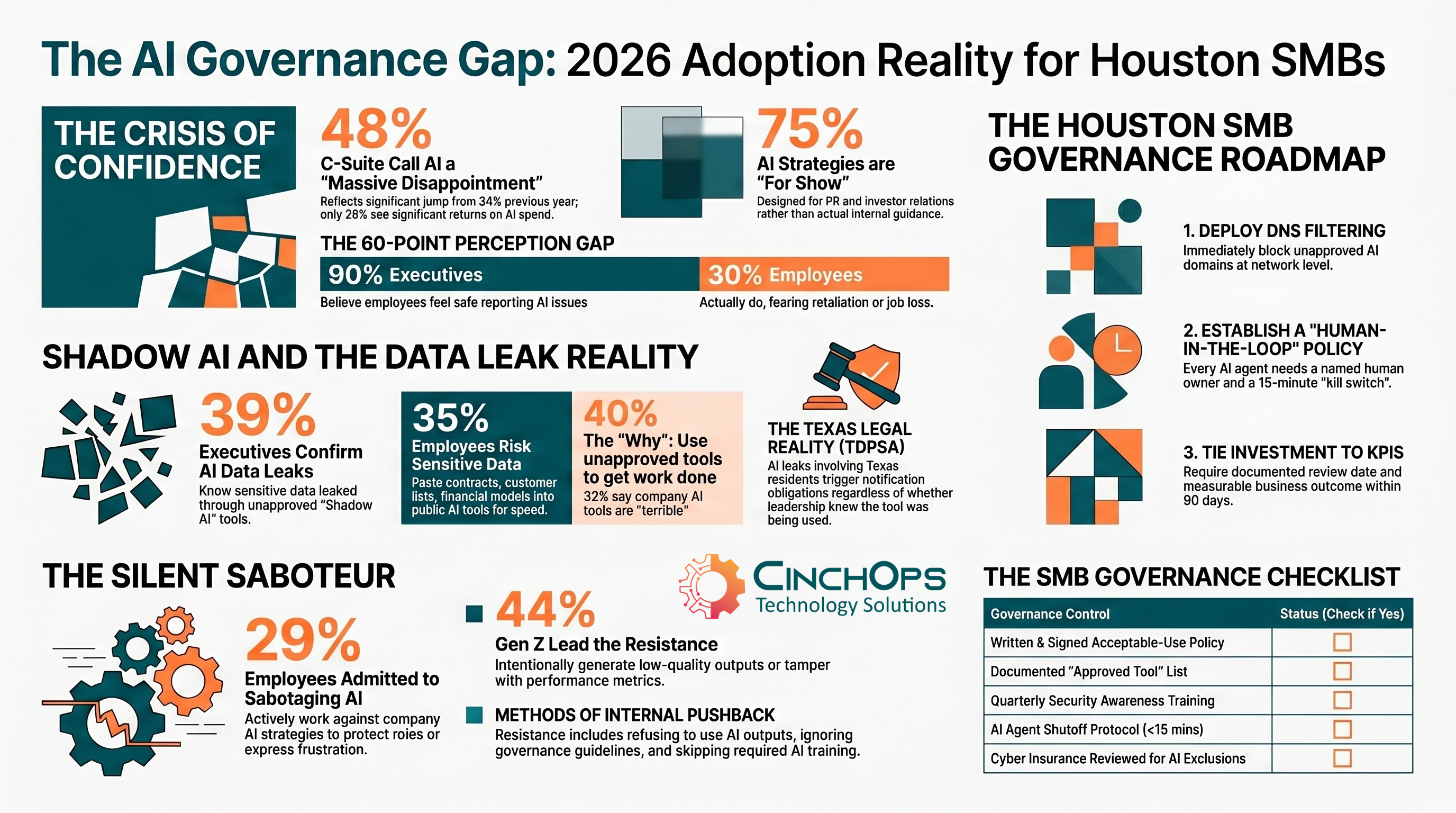
Seventy-nine percent of organizations have hit at least one serious obstacle adopting AI. Thirty-nine percent of executives say they know for a fact their company has already had a data leak from an employee using an unapproved AI tool. Forty-eight percent of the C-suite now describe their own AI adoption as a massive disappointment, up from thirty-four percent last year. Seventy-eight percent say AI has created real tension between IT and the rest of the business.
Those numbers come from Global 2000 companies with dedicated AI budgets and in-house IT teams. If the enterprise is struggling this hard, the small and mid-sized businesses across the Houston metro (the ones without a CISO or a governance committee) are on much thinner ice. That's where managed IT Houston becomes the structural answer. CinchOps is a managed IT services provider based in Katy, Texas, serving small and mid-sized businesses across the Houston metro area with cybersecurity, managed IT support, network security, VoIP, and SD-WAN for companies with 10 to 200 employees.
Shadow AI is the use of generative AI tools at work without IT approval or oversight. Employees paste contracts, customer lists, financial models, and client PII into whatever chatbot they like, and that data becomes training material or sits on an unknown vendor's servers. Writer's numbers on this are worse than last year's, not better.
The "why" behind the behavior is the part business owners rarely see. When Writer asked employees why they use unapproved AI tools, the top answer was "I'll use whatever it takes to get my work done" at 40%, followed by "the company-approved tools are terrible" at 32%, and "the rules aren't being enforced anyway" at 26%. Twenty-one percent said their own manager unofficially encourages it.
In 35 years doing IT, I have never seen a single category of risk move from fringe to pervasive this fast. A Houston CPA firm that would never email a client's K-1 in plain text will paste the same data into ChatGPT to draft a summary. A law firm paralegal will drop privileged discovery into an unvetted agent to speed up review. These are not hypotheticals. We see the artifacts of this behavior sitting in browser histories during nearly every new-client onboarding.
The Fortune 500 answer is a dedicated AI governance committee and an enterprise platform with IT guardrails. The CPA firm or law firm with 40 employees in Sugar Land cannot staff that. What they can do is put four simple controls in place through their cybersecurity stack: DNS filtering that blocks unapproved AI domains, at least one approved AI tool that actually works (so the "approved tools are terrible" excuse goes away), a written acceptable-use policy, and quarterly training that shows staff what a safe AI interaction looks like.
The Houston Angle
Every industry with regulated data (legal, medical, financial, energy sector with export-controlled technical specs) is a target. Texas enforces the Texas Data Privacy and Security Act, and a shadow AI leak involving Texas residents triggers notification obligations whether leadership knew about the tool or not.
Fifty-nine percent of companies are investing at least one million dollars per year in generative AI. Only twenty-nine percent say they have seen significant ROI from it. The number drops to twenty-three percent for AI agents specifically. Sixty-four percent of executives now say payback will take at least three years.
Most Houston SMBs will not write million-dollar AI checks, but the same structural mistake shows up at $3K per month. Companies buy the tool, skip the measurement plan, and nobody can answer the question "what did this actually do for us?" six months in.
Writer's first recommendation in their "Activating AI" playbook is to tie every AI investment to a measurable business outcome: revenue growth, cost efficiency, productivity gains, or risk reduction. That advice sounds obvious until you look at how many SMB AI rollouts have no owner, no KPI, and no review date. A fractional CTO engagement or a disciplined managed IT provider is the cheapest way to install that accountability layer without hiring a full-time executive.
The $1M AI Investment Reality Check
The pattern we see most often at Houston companies: a tool gets purchased by one department (usually marketing), licenses proliferate, three other departments buy overlapping tools, and 18 months later there are six AI subscriptions and no consolidated view of what any of it produced. A quick license audit and a use-case inventory usually cuts spend 20 to 40 percent before any new strategy work happens.
"AI adoption at scale is no longer a technology challenge. It's a leadership one."
AI agents are autonomous systems that take actions on your behalf to achieve defined goals, not just chat responses. Fifty-two percent of employees say they have used AI agents in the past year. Ninety-seven percent of executives say their company has deployed AI agents. Seventy-five percent of executives expect AI agents to be part of their company's C-suite within the next five years.
Twenty-eight percent of employees have already seen an AI tool produce a result that was dangerously wrong, unethical, or biased. Worse, thirty percent of employees say they would not feel safe reporting it to their employer (they fear retaliation). Meanwhile ninety percent of executives believe employees would feel safe reporting. That sixty-point gap between what executives assume and what employees actually do is where real incidents go unreported until they're lawsuits.
The 60-Point Perception Gap
Writer's ranking of the biggest governance challenges in adopting AI agents is a useful checklist for any Houston SMB thinking about agent deployment:
- Security (45%): protecting data and systems from the agent itself and from how it handles inputs.
- Employee Education (35%): staff who know what agents should and should not be asked to do.
- Transparency (31%): understanding how an agent arrived at a decision.
- Explainability (30%): being able to defend an agent's decision to a customer, regulator, or court.
- Observability (29%): logs of every action an agent took, with timestamps and data sources.
"I've watched this pattern for 35 years across every new technology wave. The companies that actually deliver are the ones doing the unglamorous work: governance, measurement, accountability."
For a Houston company without in-house IT, the shutoff protocol alone is worth the cost of a managed provider. If an agent starts sending bad emails to your top ten customers at 2 AM, you want somebody's phone to ring.
Seventy-five percent of executives say their company's AI strategy is more for show (PR and investor relations) than for actual internal guidance. Thirty-nine percent of companies doing layoffs because of AI do not even have a formal strategy to drive revenue from these tools. Twenty-nine percent of employees (forty-four percent of Gen Z) admit to actively sabotaging their company's AI strategy.
That 78% IT-vs-business tension number is the single most telling statistic in the report for anyone choosing a Houston managed IT provider. When AI rolls in and the IT relationship is transactional, the two sides split into camps: IT saying no, the business finding workarounds, and nobody building an approved path. The executives Writer surveyed flatly said IT is not delivering real value on AI (53%), not working with employees (57%), and not working with other lines of business (55%) to adopt it. Sixty percent expect their board to intervene over a botched AI strategy.
Year over year, confidence in AI efforts is falling on both sides of the org chart, and the gap between what leadership sees and what employees experience is widening. The share of C-suite who describe their AI approach as well-controlled and highly strategic dropped from 73% to 63%. Among employees, the same number fell harder, from 47% to 31%. On whether their company has been successful adopting AI over the past 12 months, C-suite confidence slid from 75% to 63%; employee confidence collapsed from 45% to 25%. That's a 38-point gap between what leadership thinks is working and what the people actually using the tools every day think.
The honest fix here has very little to do with technology. It is a communication discipline. People need to know which use cases AI is taking over, which tasks are being redesigned around AI, and what the growth path looks like. Writer calls this "closing the strategy-execution gap."
AI Governance Self-Assessment for Houston SMBs
- We have a written acceptable-use policy for AI tools that every employee has signed.
- We maintain an approved list of AI tools and a documented process to add new ones.
- DNS filtering or similar controls block known unapproved AI tools on the corporate network.
- Every AI agent in production has a named human owner accountable for its behavior.
- We can shut down any AI agent in under 15 minutes, including nights and weekends.
- Every AI investment has a documented KPI and a review date within 90 days.
- We have conducted security awareness training on shadow AI risks in the last 6 months.
- Employees know exactly how to report an AI tool behaving badly, without fear of retaliation.
- Our cyber liability insurance policy has been reviewed for AI-specific exclusions.
Twenty-nine percent of employees admit to sabotaging their company's AI strategy in at least one way. Among Gen Z, that figure jumps to forty-four percent. Seventy-six percent of the C-suite call employee sabotage a serious threat to their company's future.
Writer asked employees to describe the specific ways they push back. The behaviors span the full range from passive to deliberate:
- Entering Proprietary Data Into Public Tools: security violation as a form of protest.
- Using Non-Approved AI Tools: routing around the approved stack on purpose, not by accident.
- Refusing To Use AI Tools Or Outputs: ignoring the mandate and doing the work the old way.
- Ignoring Guidelines And Best Practices: engaging with AI but skipping the governance controls.
- Intentionally Generating Low-Quality Outputs: feeding the tool bad prompts to produce bad answers.
- Refusing To Take AI Training: skipping the learning that would make them proficient.
- Tampering With Performance Metrics: actively manipulating the data to make AI look like it isn't working.
That last one is worth re-reading. A nontrivial share of employees are not just avoiding AI. They're cooking the books to make leadership conclude AI itself is the problem.
In 35 years, every major technology shift has produced some version of this pattern. ERP rollouts, cloud migrations, mobile device policies, each had quiet resistance from the employees whose work felt most threatened by the change. The difference with AI is the sheer number of tools available to actively work against a rollout. A paralegal who didn't want to learn a new document management system in 2012 couldn't download a competing one during their lunch break. Today they can paste privileged discovery into any of six public AI tools before their coffee cools off, and nobody in IT would know.
The reasons employees give for the pushback tell you where the fix has to come from:
Self-preservation tops the list, but three of the top six reasons are execution complaints: poor strategy, bad tools, added workload. That's the half of the problem a Houston SMB can actually fix. You can't reason a 25-year-old employee out of fearing for his job. You can fix a lousy approved-tool stack, a confused rollout plan, and a process that piles AI on top of existing work rather than replacing parts of it.
This reframes shadow AI entirely. A meaningful share of shadow AI is not about employees being lazy or impatient. It's employees deliberately routing around tools they don't trust or roles they feel threatened by. DNS filtering alone will not fix that. The harder work is bringing employees into the rollout conversation early enough that they have a stake in the outcome, giving them approved tools that genuinely do the job, and making the strategy clear enough that they can see how their role changes rather than disappears.
Writer's report frames effective vendors around three pillars: platforms that offer both speed and control, technology grounded in the specific business, and partners who commit to the transformation, not just the deployment. One blunt finding from the same section: executive satisfaction with AI vendor security dropped 17 points in a single year, and less than half of executives now rate their vendors as "excellent" on any factor measured. That is the environment Houston SMBs are buying into. For a Houston business choosing a managed IT Houston provider in 2026, those same three pillars apply to the MSP itself.
Every factor Writer measured dropped year over year. The steepest declines hit exactly where a Houston SMB feels the pain most:
- Security And Data Governance: 71% rated excellent in 2025, 54% in 2026, a 17-point drop.
- Easy Integration: 57% to 42%, down 15 points.
- Level Of Support From The Vendor: 54% to 41%, down 13 points.
- Accuracy And Reliability: 53% to 41%, down 12 points.
- User Experience: 57% to 45%, down 12 points.
- Cost-Effectiveness: 56% to 45%, down 11 points.
Translation: the tools got more complicated, the vendors got less supportive, and the integration work got harder. A Houston SMB without internal IT staff is walking into a market that the Fortune 500 is already struggling with.
| Pillar | What It Means in Practice | Red Flag If You're Not Getting It |
|---|---|---|
| Speed And Control | Your MSP lets business users move fast with AI while IT keeps guardrails. Allowed lists, DNS filtering, MFA on AI tools, logging. | The answer to every AI request is either "yes, go ahead" (no governance) or "no, we haven't looked at it" (bottleneck). |
| Grounded In Your Business | Your provider knows your industry's regulatory exposure: HIPAA, TDPSA, bar rules, energy-sector export controls, PCI. | You get generic recommendations that would be the same whether you were a law firm in Katy or a manufacturer in Cypress. |
| Partner In Transformation | Your provider helps you measure AI outcomes, adjusts policies as risks evolve, and pushes back when a request is a bad idea. | Your MSP is reactive only. You call when something breaks. They never bring you anything new. |
None of this requires enterprise AI platforms. It requires discipline and an MSP willing to enforce it. The Houston-area businesses that will do best with AI over the next 24 months are not the ones that bought the most tools. They are the ones who put governance in place before the first real breach.
How CinchOps Can Help
The Writer report describes a structural gap between AI ambition and AI execution. For Houston SMBs, that gap closes faster with the right managed IT partner than with another tool purchase. CinchOps builds the governance, visibility, and discipline that most small and mid-sized businesses can't staff internally, across the Houston metro from Katy to Sugar Land to Cypress.
- Shadow AI Discovery And Blocking: we inventory the AI tools already in use, then deploy DNS filtering and endpoint controls to block unapproved ones through our cybersecurity stack.
- AI Governance Policy And Training: we draft your acceptable-use policy, vet the tools worth approving, and deliver quarterly security awareness training so staff understand shadow AI risks.
- Agent Governance Setup: we help you define named owners, access scopes, logging, and a tested shutoff protocol for any AI agent in production.
- Strategic IT Guidance: fractional CTO/CIO services to tie AI investments to KPIs and review dates, so you stop buying tools that nobody can justify six months later.
- 24/7 Managed IT Support: a real phone number that rings when an AI agent starts doing something it shouldn't, backed by our full managed IT services.
- Business Continuity Planning: BCDR protocols that include AI incident scenarios alongside ransomware and hardware failure.
- Industry-Specific Compliance: tailored guidance for law firms, CPA firms, oil and gas companies, and other regulated Houston-area industries.
Based in Katy, Texas with 35 years of IT experience behind the work, CinchOps gives Houston SMBs the structural layer the Writer report says most enterprises still don't have. Contact CinchOps at 281-269-6506 or schedule a conversation about what AI governance looks like for your business.
FAQ: AI Adoption for Houston SMBs
Discover More
Resources