


Winds of Change: A 2022 Talk That Hits Differently in 2026
What Role Compression Looks Like In Houston Businesses – Cross-Domain Experience As Competitive Advantage
Winds of Change: A 2022 Talk That Hits Differently in 2026
Four years ago I drove up to College Station to give a freshman business org at Texas A&M a talk about preparing for change. Eight months later, ChatGPT shipped. Re-reading those slides now, the warnings weren't bold enough.
The phone rang in early March 2022. My youngest daughter Madison was leading a freshman org at Texas A&M, and the professor who had agreed to give their next session bailed out on very short notice. She needed someone to step in. I said yes before she finished the ask.
A few days later I was in College Station with a deck I'd titled Winds of Change. (Looking back, Storm Winds of Change would have been the more accurate title.) The theme: rapidly changing markets, and how a freshman steps into one without getting flattened. I quoted Heraclitus, Plato, Benjamin Franklin, and Taylor Swift. I showed the young adults a list of companies that I had worked for over the past 30 plus years that no longer existed or were acquired and absorbed into other businesses. I told them, "You're next."
That talk was eight months before ChatGPT launched on November 30, 2022. Four years on, the predictions in those slides feel underbid. Not by a little. By a lot.
The ask itself was straightforward. The professor had committed, then bowed out with little notice, and the freshman org needed a "seasoned" professional to give them something useful. I'd been in software development and IT leadership for thirty plus years by that point, including a stint as CTO at NinjaOne at that time, and I welcomed the opportunity to pass on some hard lessons learned to 18 and 19 year olds.
What stuck with me was the timing. I was watching the early signs of a different kind of disruption hit my industry, and I wanted to put it in front of students who still had time to absorb it. I built the deck around one idea: the only constant in life is change, and the rate of that change has been doubling on you since you started high school.

Businesses or Business Units That No Longer Exist or Absorbed Into Other Businesses
The body of the talk was a Top 10 list I'd put together to capture what I was watching across the technology sector. I'll quote it directly because I think it holds up better than any paraphrase:
- Number 10: Intellectual capital is more important than physical or monetary capital.
- Number 9: Boundaries are blurred.
- Number 8: New products can be created more cheaply and faster than ever before.
- Number 7: Markets are getting bigger.
- Number 6: Markets are getting smaller.
- Number 5: Markets are faster and more efficient.
- Number 4: The lifespan of even the most successful products is shorter than ever.
- Number 3: The lifespan of companies is shrinking.
- Number 2: Every industry, company, and product will undergo significant change or face disruption.
- Number 1: You're next.
| |
I remember finishing item number one and watching the room. Most of the freshmen smiled. Many had questions. The talk closed with parting advice that I still believe in: there are two kinds of team members - energy takers and energy givers - be the latter. Never stop learning. It's not going to be easy and honestly, it's going to be more difficult for you than it was for me. Help others along the way. The way you advance in your career is by making others better.
That advice still stands. The mechanism for executing on it has changed completely.
I told a room of 18 and 19 year olds in 2022 that every industry would face disruption and that they were next. Eight months later, ChatGPT shipped. That the rate of change was increasing was obvious. The rate at which it accelerated, not even close.
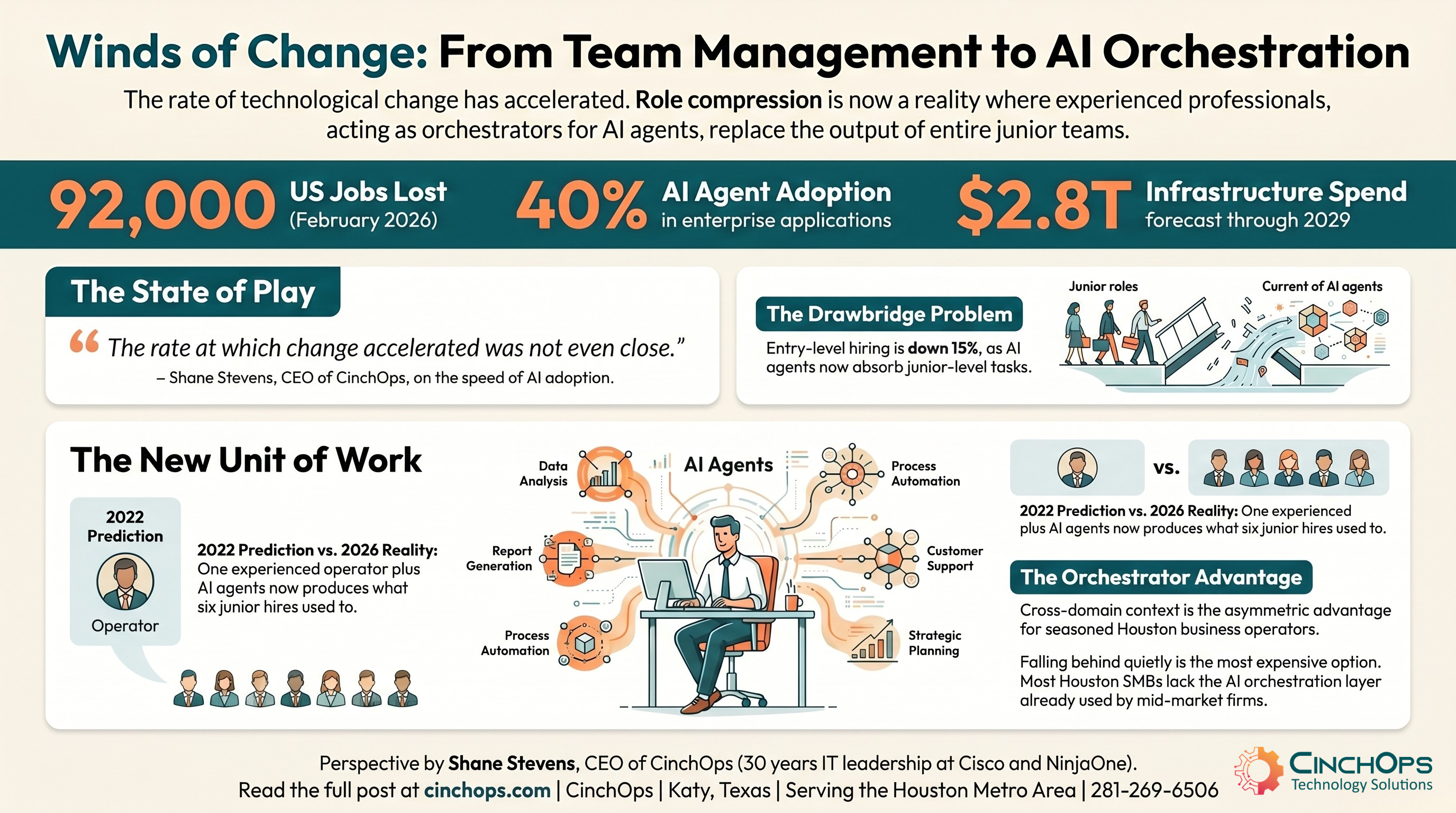
Walk into a Houston small business today and you'll see something that wasn't possible four years ago. A single experienced operator running output that used to require a team of five. Drafts are written by AI. Specs are prompted, not authored. Tickets are filed by agents. The work product still ships, but the org chart that produced it doesn't exist anymore.
This isn't speculation. Gartner forecasts that nearly half of enterprise applications will integrate task-specific AI agents by the end of 2026, up from less than 5% in 2025. That's an eightfold jump in twelve months. As of 2025, 57% of companies already claim AI agents in production.
The pattern repeats across roles:
- Product managers who used to synthesize feedback and write specs manually now prompt models for drafts, run analysis through AI, and dispatch agents to file tickets.
- Legal teams compress weeks of contract review into hours.
- Finance professionals build projections in days using tools like Claude in Excel.
- Customer success agents handle 80 to 95% of initial inquiries before a human ever touches the conversation.
The single largest infrastructure project in human history is happening right now. Big tech AI capex hit roughly $0.5T in 2025 and is expected to exceed that in 2026. Amazon, Microsoft, Google, Meta, and Oracle have collectively planned $2T plus in AI infrastructure assets over four years. When the largest companies on earth commit that kind of capital, the trajectory isn't a guess.
| Dimension | 2022 Prediction | 2026 Reality |
|---|---|---|
| Product Lifespan | Shorter than ever | Specific AI tool knowledge has a half-life under 18 months |
| Company Lifespan | Shrinking | Solo operators with AI replace teams of 10 in some segments |
| Industry Disruption | Universal | Healthcare, legal, finance, engineering, customer success all repriced |
| Career Ladders | Faster, less linear | Two to three year promotion ladders compressed to months |
| Entry-Level Path | "You're next" | Entry-level hiring down 15% versus pre-pandemic baseline |
Is Your Houston Business Ready
for the Shift?
The businesses navigating this best are pairing experienced operators with the right tools and a managed IT partner who understands both.
Talk to CinchOpsThis is the part of the story that worries me most. I have two daughters in their twenties. I am not detached from this.
Entry-level work used to be how juniors got their reps. Junior analysts pulled reports. Junior developers fixed bugs. Junior associates reviewed contracts. Those tasks built the pattern recognition that translated into senior judgment over a decade. AI agents now handle most of that work at near-zero marginal cost.
The data is stark. Entry-level hiring is down 15% versus the pre-pandemic baseline. Senior developer salaries dropped roughly 10% year over year. A widely shared example: a former Google engineer named John Marcus reportedly submitted 3,700 applications and 2,200 founder emails after a layoff and received zero offers, eventually getting evicted. Surveys of laid-off tech workers show 70% still unemployed six months later, with more than half encountering scams during their search.
February 2026 saw 92,000 tech jobs lost against an expected gain of 59,000. Goldman estimates AI is contributing to 5,000 to 10,000 net monthly losses in exposed industries. The drawbridge looks like this: seniors are inside the castle, AI is doing what juniors used to do, and the kids who took out loans for computer science degrees can't get a foothold on the wall.
Without an on-ramp for junior workers, the pattern recognition that turns into senior judgment doesn't get built. The pipeline for tomorrow's experienced operators is being cut off in real time. This is a problem that won't show up for five to ten years, and by then it will be too late to fix easily.
Here is the part of the story that doesn't get enough airtime. The same compression that's punishing new entrants is creating an unprecedented force multiplier for seasoned workers.
Decades of experience used to be priced as deep specialization. Twenty years in front-end design or fifteen years in back-end systems. That kind of narrow depth has lost a lot of its premium because AI can simulate it in a prompt. What hasn't lost value, and is in fact appreciating fast, is wide-ranging context. People who have lived inside multiple industries, sat in different chairs, watched cycles play out, and know what good looks like across multiple disciplines.
That kind of breadth is what lets you do the high-leverage work in an AI-driven environment:
- Specify outcomes correctly the first time. Knowing what to build is harder than building it. Most AI failures are specification failures.
- Direct an army of specialized agents. When you can describe the work in software-shaped intent, you can deploy agents the way a general contractor deploys subs.
- Validate end results. Pattern recognition about what good looks like is the only thing AI can't fake without context.
- Iterate on judgment, not just output. Knowing when something is wrong and why takes years that can't be compressed.
I came up walking beams and pouring concrete on Houston-area construction sites with my father while at the same time learning to code. That kind of cross-domain experience used to be a quirky resume note. Now it's the entire ballgame. The person directing the work is becoming more valuable than any single producer of it, AI or human alike.
If you're a seasoned operator in Houston, Katy, or Sugar Land sitting on twenty or thirty years of context across multiple industries, you have leverage you didn't have five years ago. That leverage doesn't run on autopilot. Experienced professionals will need to learn new skills and apply new techniques to proven learning and experience. The tools change every quarter, but the judgment behind them is what holds value. The question isn't whether your career is over. The question is whether you're going to spend the next five years writing the prompts or having someone else write them about you.
This is also the most exciting time to start or run a small business in the Houston metro that I've seen in my career. The same forces that compress corporate jobs unlock small business operators in ways that weren't possible before.
A solo operator in Katy with the right tooling and twenty years of pattern recognition can now run accounting workflows, marketing, and customer service that used to require hiring three people. A construction firm in Cypress can run project intake, document review, and bid analysis with one experienced project manager and a stack of agents. A law firm in Sugar Land can compress contract review from weeks to hours.
The companies winning this are the ones that:
- Treat AI Tooling as a Force Multiplier. AI works on the operator's experience, not as a replacement for thinking. The judgment layer stays with the human.
- Stand Up the Right Managed IT and Security Backbone. AI tools widen your attack surface. The ones that win build the underlying infrastructure first so the tools don't become liabilities.
- Build Practical Training into the Org. Experienced operators stay current on the tooling, not just the theory. Hands on the keyboard beats reading articles about hands on the keyboard.
- Don't Wait for the Dust to Settle. It isn't going to. The businesses pacing themselves out of urgency are the ones falling behind quietly.
CinchOps is a managed IT services provider based in Katy, Texas, serving small and mid-sized businesses across the Houston metro area. CinchOps specializes in cybersecurity, network security, managed IT support, VoIP, and SD-WAN for businesses with 10 to 200 employees. The team has supported construction firms, oil and gas operators, law firms, accounting practices, and engineering shops across Houston, Katy, Sugar Land, Cypress, The Woodlands, Richmond, Missouri City, and the surrounding service areas.
Here's what we do for businesses trying to use AI tooling without becoming a story in a future blog post:
- Practical Tooling Strategy. Our CTO and CIO services help you decide which AI tools belong in your stack and which are noise, with someone who has actually run the deployments before.
- Security Backbone for AI Tools. AI tools widen your attack surface. We harden the perimeter, identity, endpoints, and data layers so that adopting new tooling doesn't expose your business to credential theft, prompt injection, or data leakage.
- Workflow Automation. Our business process automation work helps you turn experienced operators into orchestrators of agent-driven workflows.
- Reliable Managed IT. Day-to-day managed IT services that keep the underlying infrastructure stable while you experiment.
- Local Presence. A team based in Katy with people who know what a Houston-area business actually looks like across the verticals we serve.
You don't need a corporate IT department to run modern AI-driven workflows. You need a partner who has been through enough cycles of disruption to know which tools will still matter twelve months from now and which ones won't.
Frequently Asked Questions
Discover More From CinchOps
Resources
Sources
- Gartner forecast on enterprise AI agent integration by end of 2026 (Gartner Press Release, August 2025)
- Citigroup forecast on Big Tech AI infrastructure spending crossing $2.8 trillion by 2029 (Reuters, September 2025)
- Block (Square) February 2026 layoff details and Jack Dorsey shareholder statements (CNN Business, February 2026)
- CodeRabbit study analyzing 470 GitHub pull requests on AI-generated code defects (CodeRabbit Research)
- Goldman Sachs analysis on AI substitution and augmentation effects on US monthly payroll growth (Goldman Sachs Research)
- February 2026 nonfarm payroll decline of 92,000 against expected 59,000 gain (US Bureau of Labor Statistics)
- Oracle $300 billion cloud computing deal with OpenAI and investor concerns about AI capex (Bloomberg, December 2025)


