Chinese Companies Behind State-Sponsored Hacking Tools: A Growing Cyber Threat to Houston Businesses
Chinese Cybersecurity Industry and Government Coordination – Understanding Chinese State-Sponsored Cyber Activities and Business Impact
Chinese Companies Behind State-Sponsored Hacking Tools: A Growing Cyber Threat to Houston Businesses
A recent investigation from SentinelLABS has revealed the extensive network of Chinese companies developing sophisticated hacking tools for state-sponsored cyber operations. These private firms, operating under the guise of legitimate cybersecurity businesses, have been creating and selling powerful intrusion capabilities to Chinese government agencies, particularly the Ministry of State Security (MSS) and the Ministry of Public Security (MPS).
Description of the Threat
The threat involves a complex ecosystem of Chinese companies that develop and patent advanced cyber espionage tools while maintaining plausible deniability for the Chinese government. These firms create everything from encrypted endpoint data collection tools to Apple device forensics capabilities and remote access systems for routers and smart home devices. The most concerning aspect is how these companies blur the line between legitimate cybersecurity research and offensive cyber weapons development.
Key players in this ecosystem include companies like i-Soon (also known as Anxun Information Technology), Shanghai Firetech, and Shanghai Heiying Information Technology. These firms have filed over 15 patents for various intrusion and forensics tools, demonstrating the depth and sophistication of their capabilities.
Severity of the Issue
This represents a critical threat to global cybersecurity that far exceeds typical cybercriminal activities, representing nation-state level threats with strategic implications for national security.
Several factors contribute to the high severity rating of this threat:
State-sponsored groups like Silk Typhoon have leveraged these capabilities to compromise over 60,000 U.S. entities
More than 12,700 organizations have been successfully victimized in major campaigns
Recent high-profile incidents include breaches of the U.S. Treasury Department and major telecommunications providers
Attacks have targeted critical infrastructure, healthcare systems, government agencies, and defense contractors
Chinese state-sponsored cyber activities doubled to over 330 attacks between 2023-2024
The tools enable persistent access and long-term espionage operations rather than quick financial gains
The scale and sophistication of these operations demonstrate a coordinated effort to compromise critical systems and steal sensitive information across multiple sectors and geographic regions.
How the Threat is Exploited
These Chinese firms operate through a sophisticated multi-layered approach that combines legitimate business operations with advanced offensive capabilities, making detection and attribution extremely difficult.
The exploitation methodology involves several sophisticated techniques and capabilities:
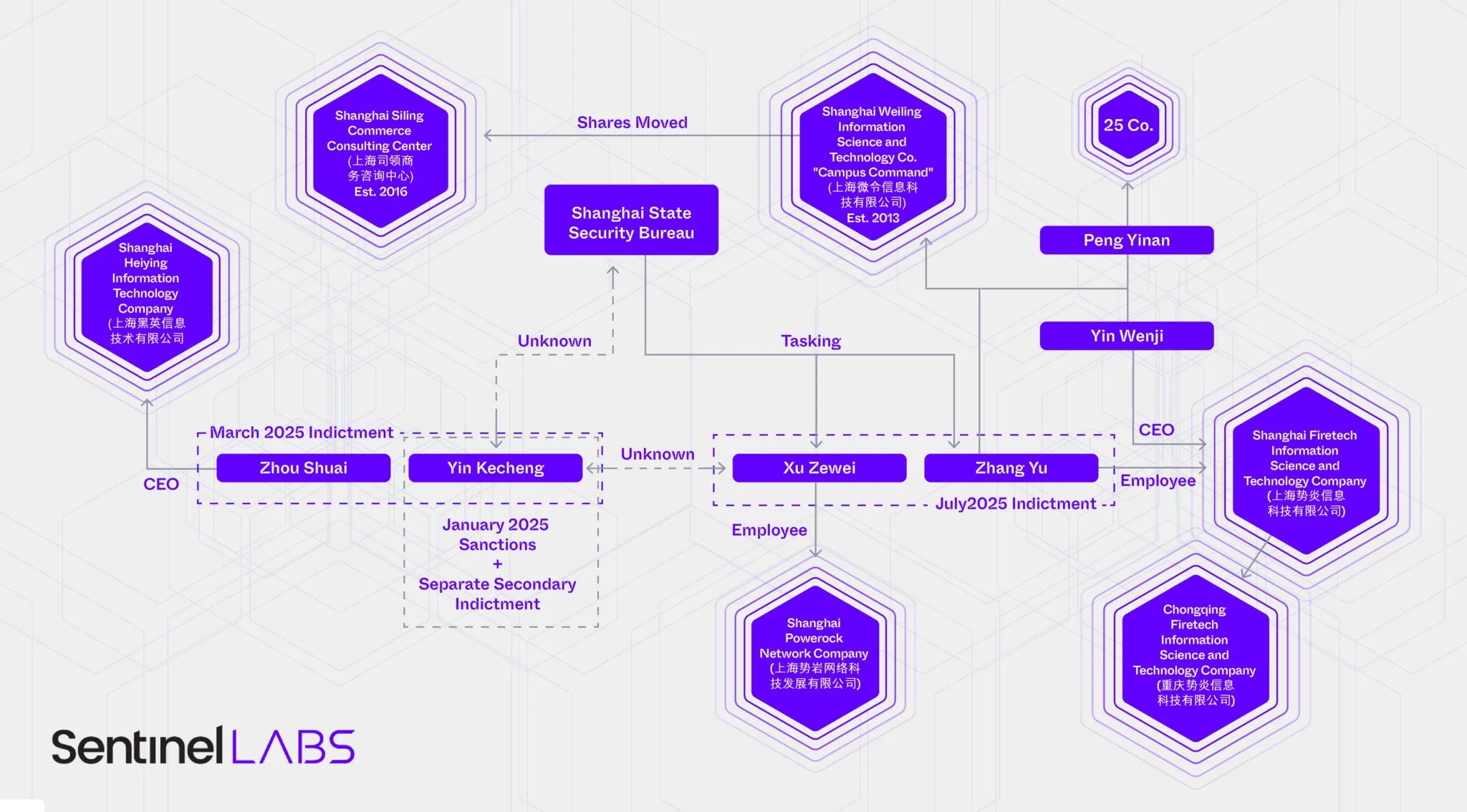
Tiered operational structure where top-tier firms like Shanghai Firetech receive direct tasking from Shanghai State Security Bureau officers
Exploitation of zero-day vulnerabilities, including the 2021 Microsoft Exchange Server ProxyLogon vulnerabilities that affected over 60,000 organizations
Advanced forensics capabilities including Apple FileVault decryption, router intelligence collection, and smart home device infiltration
Potential insider access or close-access operations to obtain vulnerability research before public disclosure
Custom tooling for “remote automated evidence collection” and “computer scene rapid evidence collection”
Long-range network control capabilities for targeting home computers and intelligent appliances
Mobile device forensics and remote cellphone evidence collection software
Coordination between multiple companies to share access, tools, and intelligence through data brokers
Use of legitimate cybersecurity research and patents to develop and refine offensive capabilities
Deployment of web shells and persistent backdoors that remain active even after initial vulnerabilities are patched
This comprehensive approach demonstrates how these organizations blur the lines between defensive cybersecurity research, commercial forensics tools, and offensive cyber weapons, making their activities difficult to distinguish from legitimate business operations.
Who is Behind the Issue
The primary actors include several categories of entities working in a sophisticated tiered system that allows the Chinese government to maintain operational control while providing plausible deniability through private contractors.
The key players in this multi-tiered ecosystem include:
Top-tier contractors – Shanghai Firetech and Shanghai Powerock work directly under Ministry of State Security direction, particularly the Shanghai State Security Bureau
Mid-tier contractors – Companies like Chengdu404 provide stable business operations and serve as prime contractors for multiple offices
Lower-tier contractors – i-Soon and similar firms operate on low-paying contracts with poor morale, often subcontracting to better-funded organizations
Data brokers – Zhou Shuai’s Shanghai Heiying facilitates the sale of stolen intelligence and access between different parties
Individual hackers – Xu Zewei, Zhang Yu, and Yin Kecheng carry out operations while employed by these private firms
Government handlers – Shanghai State Security Bureau officers provide specific tasking and operational direction to trusted contractors
Front companies – Multiple shell companies registered by defendants to obscure true ownership and relationships
Academic connections – University researchers provide technical expertise and potential recruitment pathways
This coordinated structure allows the Chinese government to benefit from advanced offensive capabilities while maintaining distance from direct attribution, creating a robust ecosystem that can adapt and scale operations as needed.
(An organization chart for people and businesses known to be associated with Hafnium – Source: SentinelLABS)
Who is at Risk
The scope of potential targets is extremely broad, encompassing multiple sectors and geographic regions as these sophisticated threat actors cast a wide net in their espionage operations.
Organizations and entities at highest risk include:
Government agencies – Federal, state, and local levels, particularly defense, intelligence, and critical infrastructure oversight
Educational institutions – Universities conducting research in sensitive areas like medical research or advanced technologies
Critical infrastructure – Power grids, water systems, transportation networks, and communications infrastructure
Small and medium-sized businesses – Increasingly targeted through supply chain attacks on managed service providers
Cloud service companies – Targeted to gain access to downstream customers and their data
Intellectual property holders – Companies with valuable trade secrets, research data, or proprietary technologies
Individuals in sensitive positions – Government officials, researchers, journalists, and activists
Any organization that maintains valuable intellectual property, sensitive data, or critical infrastructure components should consider themselves potential targets in this expanding threat environment.
Remediation Strategies
Organizations must implement comprehensive security measures to defend against these sophisticated threats that operate with nation-state level resources and capabilities.
Essential security measures to implement include:
Rigorous patch management programs with particular attention to edge devices, VPN appliances, and cloud services
Zero-trust architecture implementation with strong identity verification and access controls to limit lateral movement
Advanced threat detection and response capabilities that can identify sophisticated persistent threats and unusual network behaviors
Regular security assessments and penetration testing focused on internet-facing systems and cloud configurations
Incident response plans specifically designed for nation-state level attacks, including coordination with government agencies
Network segmentation to limit the scope of potential breaches and contain threat actor movement
Multi-factor authentication enforcement across all systems and applications
Employee training programs emphasizing recognition of sophisticated phishing and social engineering attempts
Continuous monitoring of network traffic and user behavior for anomalous activities
Regular backup and recovery testing to ensure business continuity in case of compromise
These proactive security measures create multiple layers of defense that make it significantly more difficult for sophisticated adversaries to gain and maintain access to critical systems and data.
How CinchOps Can Help Secure Your Business
As a seasoned managed services provider with decades of experience in the IT security field, CinchOps understands the evolving threat environment and the sophisticated techniques employed by state-sponsored adversaries. We recognize that small and medium-sized businesses face the same threats as large enterprises but often lack the resources to implement comprehensive security programs.
Our cybersecurity experts can help protect your organization through:
24/7 security monitoring and threat detection services that identify suspicious activities before they become full-scale breaches
Comprehensive vulnerability management programs that ensure your systems are patched against the latest threats
Advanced endpoint protection and response capabilities designed to detect and stop sophisticated malware and intrusion attempts
Cloud security assessments and configuration management to protect your organization’s expanding digital footprint
Incident response planning and testing to ensure your team is prepared for advanced persistent threats
Regular security awareness training to help your employees recognize and respond to social engineering attempts
Network segmentation and access control implementation to limit potential breach impact
Continuous compliance monitoring to ensure your security posture meets industry standards
Threat intelligence integration to stay ahead of emerging attack techniques and indicators
CinchOps combines deep technical expertise with practical understanding of business needs, ensuring that your cybersecurity investments provide maximum protection while supporting your operational goals and helping you stay ahead of these evolving nation-state level threats.