


Houston Area Cybersecurity: What Business Owners Actually Need to Know
The Defense Guide For Business Owners Who Don’t Have Time For Theory – Real Cyber Security For Cinco Ranch And Energy Corridor SMBs
Houston Area Cybersecurity: What Business Owners Actually Need to Know
A defense guide for Houston area SMBs, written by a Katy-based MSP that has cleaned up the aftermath of these attacks more times than we'd like to count.
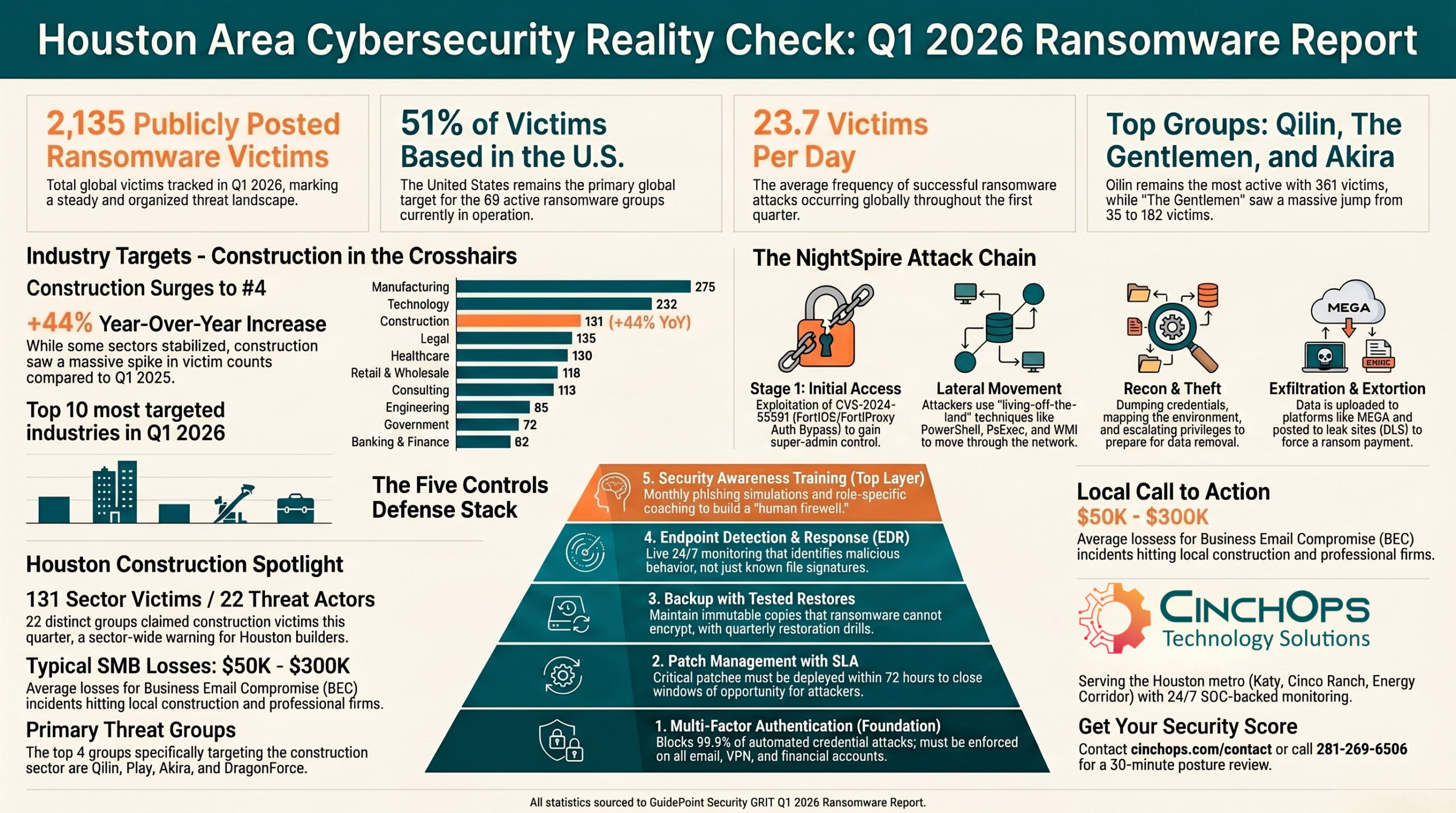
GuidePoint Security's GRIT Q1 2026 Ransomware Report tracked 2,135 publicly posted ransomware victims worldwide in the first three months of 2026, with 68 active ransomware groups in operation. The United States absorbed 51% of all victims, the highest share globally. For Katy small and mid-sized businesses, this isn't an abstract data point. It's a quarterly reminder that the threat is steady, the attackers are organized, and the United States remains the world's primary target.
What the GRIT data shows over and over is that the businesses getting hit aren't outmatched by clever adversaries. They're caught on missed patches, weak credentials, and exposed perimeter devices. If your business sits between Cinco Ranch and the Energy Corridor and you have an internet connection, you are already on someone's target list. The question is whether your defenses are configured to slow attackers down enough for someone to notice.
CinchOps is a managed IT services provider based in Katy, Texas, serving small and mid-sized businesses across the Houston metro area. CinchOps specializes in cybersecurity, managed IT support, network security, VoIP, and SD-WAN for businesses with 10 to 200 employees. We work with Katy companies the same way we would work with our own business, no long-term contracts, no hidden fees, no cancellation penalties.
The GRIT Q1 2026 report identified Qilin as the most active ransomware group with 361 claimed victims, followed by The Gentlemen (182 victims, a major jump from 35 in Q4 2025) and Akira (176). Manufacturing remained the most-targeted industry. Healthcare, technology, and construction filled out the top four. Construction specifically saw 131 victims in Q1 2026, a 44% year-over-year increase that pushed the sector from sixth to fourth in GRIT's industry rankings.
That's the macro picture. For Katy SMBs, four threat patterns translate that data into real exposure:
- Business Email Compromise (BEC). A spoofed email from an apparent vendor or executive triggers a wire transfer or change in payment routing. Construction firms and professional services practices are among the most-targeted SMB verticals per FBI IC3 reporting. Average reported loss for SMB BEC incidents runs between $50,000 and $300,000.
- Credential-Based Account Takeover. Employee passwords leak through a third-party breach, an attacker tests them against Microsoft 365 or Google Workspace, and they're inside before anyone notices. The attacker then uses that mailbox to launch BEC attacks against the business's clients.
- Ransomware Via Edge Device. A perimeter firewall or VPN appliance with an unpatched vulnerability gets exploited, attackers establish persistence over weeks, and ransomware encrypts everything on a Friday evening. GRIT documented NightSpire, a financially-motivated group with 175 victims since 2025, gaining initial access through CVE-2024-55591, a critical FortiOS and FortiProxy authentication bypass that gives unauthenticated attackers full super-admin control. Hundreds of thousands of internet-facing Fortinet devices were exposed at disclosure.
- Phishing-Driven Malware. A staff member clicks a link, runs a fake update, or pastes a ClickFix CAPTCHA command into Run, and an infostealer harvests every saved password in their browser within minutes.
The common thread isn't sophistication. It's opportunism. Attackers run automated scans against every business in the Houston metro looking for missed patches, weak passwords, and missing MFA. Whoever shows up first in the results gets hit first.
There's a misconception that Katy SMBs fly under the radar because they're not Fortune 500 names. The opposite is true. Three local factors stack the odds against you:
- Concentration Of Cash-Rich Verticals. Katy and West Houston host a high density of construction firms, oil and gas service companies, CPA practices serving Energy Corridor clients, wealth management offices, and medical practices around Houston Methodist West. Attackers know this. They scrape Katy ISD vendor lists, Energy Corridor business directories, and chamber memberships to build target lists.
- Reliance On One IT Person Or No IT Person. Most Katy businesses between 10 and 100 employees have either a single internal IT staffer wearing five hats, a part-time contractor, or a break-fix shop that responds when something breaks. None of these models support 24/7 monitoring, threat hunting, or rapid patch deployment.
- Shared Software Supply Chain. When a regional software vendor or managed file transfer service gets hit, every Katy customer using that product is exposed at the same time. The CL0P ransomware group built an entire business model around this in 2023 and 2024.
The GRIT Q1 2026 report tracked 22 distinct threat actors claiming construction victims in a single quarter. Construction was one of the few industries that grew in victim counts QoQ while the overall ransomware ecosystem stayed flat. For Katy and Houston's construction-heavy economy, that's a sector-wide signal, not background noise.
Not Sure Where You Stand?
A 30-minute review of your current cybersecurity posture against the five controls below, with no obligation.
Request a Houston Area Security ReviewMost cybersecurity advice for small businesses reads like a 200-item checklist that no one will ever finish. Strip away the noise and the controls that actually move the needle for a Katy business with 10 to 200 employees come down to five:
- Multi-Factor Authentication On Everything. MFA on email, financial accounts, remote access, line-of-business apps, and admin accounts. Microsoft's own data shows MFA blocks over 99% of automated credential attacks. If your business hasn't enforced MFA across the board yet, this is the single highest-impact change you can make this week.
- Patch Management With A Defined SLA. Critical vulnerabilities get patched within 72 hours, high severity within seven days, the rest within 30. Without an SLA and the tooling to enforce it, patching becomes whatever the IT person gets around to. Attackers exploit known vulnerabilities within hours of public disclosure now.
- Backup With Tested Restores. Three copies of your data, two different storage media, one offsite, plus immutable copies that ransomware cannot encrypt. Test restores quarterly. A backup you've never restored from isn't a backup, it's a hope.
- Endpoint Detection And Response (EDR). Traditional antivirus catches known malware. EDR watches behavior and catches the rest, including the fileless attacks that infostealers and ransomware affiliates use to bypass legacy AV. Combined with 24/7 monitoring, this is where most successful intrusions actually get stopped.
- Security Awareness Training Tied To Phishing Simulations. Annual training is theater. Monthly simulated phishing that triggers immediate, role-specific coaching when someone clicks is what changes behavior. Track click rates over time, not training completion.
That's the stack. Five controls. No silver bullets, no AI-powered miracle products. Most Katy SMBs that get breached skipped two or three of these.
"In 30 years working IT for Houston-area businesses, I've seen one pattern repeat. SMBs don't get breached because the attackers are clever. They get breached because the basics weren't done. MFA, patching, backups, EDR, training. That's the whole game for 90% of Katy businesses." - Shane Stevens, CEO of CinchOps
Generic cybersecurity advice ignores the fact that a Katy construction company and a Cinco Ranch CPA firm face different attacks, different compliance pressures, and need different first moves. Here's the breakdown for the verticals we serve most heavily in the Katy and Houston market:
| Industry | Top Threat | Compliance Pressure | First Move |
|---|---|---|---|
| Construction | Ransomware (Qilin, Play, Akira, DragonForce), BEC, project data extortion | Insurance requirements, client master service agreements | MFA on email and banking, mobile device management, edge-device patching |
| CPA Firms | Tax client data theft, BEC, ransomware during filing season | IRS Pub 4557, FTC Safeguards Rule | Written Information Security Plan (WISP), encrypted email |
| Law Firms | Client data exfiltration, BEC, trust account fraud | Texas Bar duty of competence, attorney-client privilege | Data loss prevention, privileged access management |
| Healthcare | Ransomware, PHI theft, third-party breaches | HIPAA, HHS OCR enforcement | Immutable backups, access logging, BAA review |
| Oil & Gas Services | OT/ICS attacks, IP theft, ransomware | API standards, customer security requirements | IT/OT network segmentation, incident response plan |
| Wealth Management | Phishing, account takeover, deepfake voice fraud | SEC Reg S-P, FINRA Rule 4530 | MFA, callback verification protocols, identity governance |
If your industry isn't on this list, that doesn't mean you're safe, it means your compliance picture is just less prescribed. The threats are still the same five patterns from earlier.
The 10-Question Cybersecurity Reality Check
- MFA is enforced on every employee's email, VPN, and financial accounts, including the owner.
- Patches are deployed on a defined schedule, not when someone remembers.
- Backups are tested at least quarterly with an actual restore drill.
- Immutable backup copies exist that ransomware cannot encrypt or delete.
- EDR is running on every endpoint, not just basic antivirus.
- Phishing simulations go out monthly with click-rate tracking.
- Admin accounts are separate from daily-use accounts for IT staff.
- An incident response plan exists on paper, and at least one person has read it this year.
- Cyber insurance is in force and you know what it actually covers.
- Someone is watching alerts outside of business hours, weekends, and holidays.
If you checked fewer than seven of these, you have gaps that an opportunistic attacker can exploit. That's not a sales pitch, that's just how the math works.
CinchOps is a managed IT services provider based in Katy, Texas, serving small and mid-sized businesses across the Houston metro area. CinchOps specializes in cybersecurity, managed IT support, network security, VoIP, and SD-WAN for businesses with 10 to 200 employees. We work with Katy companies the same way we would work with our own business, no long-term contracts, no hidden fees, no cancellation penalties.
For Katy businesses serious about cybersecurity, here's what we deliver:
- 24/7 SOC-Backed Monitoring. Real eyes on your alerts at 2 AM on a Sunday, not just an inbox that fills up overnight.
- Enforced MFA, Patch Management, And EDR. The five controls above, deployed and maintained, not just recommended.
- Tested Backup And Disaster Recovery. Immutable backups with documented restore drills, not just nightly job logs.
- Security Awareness Training With Simulation. Monthly phishing tests, role-specific coaching, and click-rate reporting your insurance underwriter will actually accept.
- Local Response. When something happens, we drive to your office in Katy, Cypress, Sugar Land, Fulshear, or anywhere across Houston. We don't outsource the hard part.
- Vertical-Specific Expertise. Whether you run a law firm, an oil and gas service company, or anything in between, we have worked your industry.
If you're a Katy business owner wondering whether your current setup is enough, the honest answer is that we won't know until we look. Most reviews take 30 minutes. Common findings range from missing MFA on critical accounts to backups that have never been tested - the kind of gaps that surface during incident response when it's too late to fix them cleanly.
Frequently Asked Questions
What does cybersecurity mean for a Katy small business?
Cybersecurity for a Katy small business means the combined set of technology controls, processes, and employee practices that protect company data, finances, and operations from digital attacks. For most Katy SMBs, this comes down to multi-factor authentication, patch management, tested backups, endpoint detection and response, and ongoing security awareness training.
How much does cybersecurity cost for a Katy SMB?
Cybersecurity costs for a Katy SMB typically run between $75 and $200 per employee per month when delivered through a managed services provider, depending on industry, compliance requirements, and risk profile. A 30-person Katy law firm under FTC Safeguards Rule sits at the higher end. A 15-person construction company without regulatory pressure sits lower.
Does a Katy business need a cybersecurity policy?
Yes. Any Katy business handling client data, processing payments, or carrying cyber insurance needs a written cybersecurity policy. Insurance carriers now require one to renew coverage, the FTC Safeguards Rule mandates one for any business handling financial information, and state-level rules under the Texas Data Privacy and Security Act apply to most businesses with 100 or more employees.
What's the most common cyber attack against Katy businesses?
Business Email Compromise (BEC) is the most common attack against Katy businesses in 2026, followed closely by credential-based account takeover and phishing-driven malware. BEC attacks typically target invoice payment workflows in Katy construction and professional services firms, with average losses between $50,000 and $300,000 per incident.
How do I know if my Katy business has already been hacked?
Common indicators include unusual email forwarding rules, logins from unexpected geographic locations in Microsoft 365 or Google Workspace audit logs, vendor payment changes you did not authorize, slow or freezing endpoints, and unfamiliar accounts appearing in your systems. A proper security assessment will surface these in 30 to 60 minutes if they exist.
Discover More
Resources
Sources
- GuidePoint Security GRIT Q1 2026 Ransomware and Cyber Threat Insights Report, source for Q1 2026 victim counts (2,135 total, 68 active groups), top threat actor activity (Qilin, The Gentlemen, Akira), construction sector data (131 victims, 44% YoY increase, 22 distinct actors), and NightSpire / CVE-2024-55591 FortiOS exploitation
- Verizon 2025 Data Breach Investigations Report, SMB share of breaches and median time-to-ransomware-deployment data
- IBM Security 2025 Cost of a Data Breach Report, average breach cost and SMB impact analysis
- Microsoft Identity Security Research, multi-factor authentication blocks 99.9% of automated credential attacks
- CISA Cybersecurity Advisories on SonicWall, Fortinet, and Ivanti edge device mass exploitation campaigns
- FBI Internet Crime Complaint Center (IC3) Annual Reports, Business Email Compromise loss statistics for U.S. SMBs

