


How to Choose an IT Provider That Understands CPA Firms (2026 Guide)
Run Every Provider Through The Same Eight Questions – The One Question That Sorts The Room Fastest
How Houston accounting firms should evaluate providers on compliance, security, and tax-season readiness.
Choosing an IT provider for a CPA firm comes down to 8 criteria, and the two that predict the outcome best are whether the provider can describe FTC Safeguards Rule controls without a brochure, and what they do differently between January and April.
CinchOps provides managed IT specifically for CPA firms across the Houston metro at $100 to $250 per user per month, with help desk requests answered in under 15 minutes (typically faster). Most providers will promise fast support and proactive monitoring. Very few can explain what a Written Information Security Plan is or why your firm needs one.
An accounting firm's provider is not just fixing computers. They are handling the technical controls behind your regulatory obligations, securing Microsoft 365, and keeping the firm productive during the 10 weeks that produce most of the year's revenue.
Does an IT provider need CPA firm experience?
What industry familiarity actually buys you.
A provider with CPA firm experience understands that a two-hour outage in March costs far more than the same outage in July, and that tax preparation software, document management, and client portals each break in their own way.
Generic competence covers a lot. It does not cover knowing that CCH Axcess, UltraTax CS, Lacerte, Drake Tax, and ProSeries behave differently over remote connections, or that a firm's file structure has retention implications, or that seasonal staff onboarding is a recurring workload rather than an exception.
The practical test is whether the provider asks you questions about your practice before proposing anything. If the first meeting is a product walkthrough, they are selling a stack rather than solving your problem.
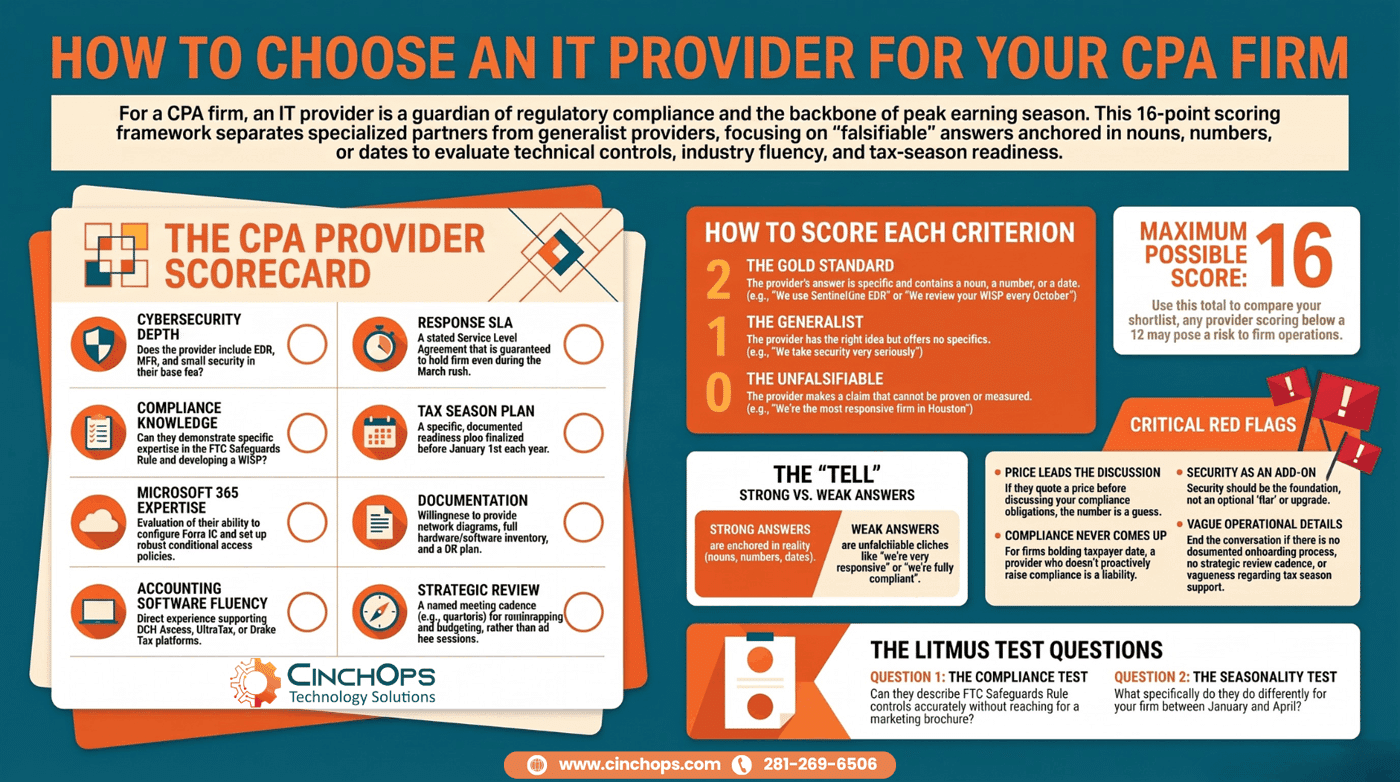
What are the 8 criteria for evaluating a CPA firm's IT provider?
A scoring framework you can apply to any shortlist.
Score every provider on cybersecurity depth, compliance knowledge, Microsoft 365 expertise, accounting software fluency, response commitments, tax-season planning, documentation quality, and strategic review cadence.
| Criterion | What to ask | A weak answer sounds like |
|---|---|---|
| Cybersecurity depth | What security is in the base fee? | "We can add that on." |
| Compliance knowledge | How do you support FTC Safeguards Rule work? | "We're fully compliant." |
| Microsoft 365 expertise | How do you configure conditional access? | "It's all set up already." |
| Accounting software fluency | Which tax platforms have you supported? | "We support all software." |
| Response commitments | What is the SLA, and does it change in March? | "We're very responsive." |
| Tax-season planning | What do you do differently in Q1? | "We handle whatever comes up." |
| Documentation | Can we see a sample network diagram? | "It's all in our system." |
| Strategic review | How often do we meet about roadmap and budget? | "Any time you need us." |
The pattern in that right-hand column is worth naming. Weak answers are unfalsifiable. Strong answers contain a noun, a number, or a date.
What questions should a CPA firm ask before hiring an IT provider?
The short list that separates candidates quickly.
Ask how the provider secures Microsoft 365, whether they have built a Written Information Security Plan before, when they last restore-tested a backup for a firm your size, and what changes operationally during filing season.
- How do you secure Microsoft 365? Look for conditional access, Entra ID, Defender policy, and audit logging by name.
- Have you built a WISP? If they have not seen one, they cannot help you maintain one.
- When did you last test a restore? Ask for a date and a client size, not a policy statement.
- What is the response commitment in writing? Then ask whether it differs in March.
- Which tax platforms have you actually supported? Named products, not "all of them."
- Is Microsoft 365 licensing in your quote? The most common reason two quotes are not comparable.
- Who do we reach, and how? Whether messages route to a queue or to someone accountable.
- What does onboarding include? Documentation, security review, backup validation, and a roadmap, or just an agent install.
How should a provider prepare a CPA firm for tax season?
The work that has to happen before January.
Tax-season preparation should begin in the fall: hardware replaced before December, backups verified, remote access load-tested, software updates staged, and support coverage confirmed in writing for January through April.
A provider who has supported accounting firms will already have this as a repeatable process rather than an idea. Ask what their Q4 checklist looks like. If the answer is improvised in the meeting, you are the first accounting firm they have handled at scale.
The failure mode is consistent and avoidable. Firms discover in February that the remote access solution sized for 8 concurrent users does not hold 30, or that the laptop refresh they deferred in October is now a two-week procurement problem during their busiest month.
Evaluating providers right now?
Run us through the same 8 criteria you are using on everyone else. That is the point of publishing them.
Talk to CinchOpsWhat are the red flags when evaluating a CPA firm IT provider?
Signals worth ending the conversation over.
Be cautious of any provider who leads with price, never raises compliance, cannot describe their onboarding process, or treats cybersecurity as an optional upgrade.
- Price leads the conversation. Before they know your compliance obligations, the number is a guess.
- Compliance never comes up. For a firm holding taxpayer data, a provider who does not raise it is telling you something.
- Security is an add-on tier. The headline price is not the price you will pay.
- No onboarding detail. If they cannot describe the first 30 days, they do not have a process.
- No strategic cadence. Reactive support with no scheduled review is break-fix with a subscription.
- Vague about tax season. The one operational reality unique to your business, and they have not thought about it.
- Product-first meetings. A stack walkthrough before any question about how your firm runs.
What we typically see when CPA firms switch providers
The reasons behind most accounting-firm transitions.
Firms rarely leave over a single incident. They leave after a filing season where response times slipped, followed by a compliance question their provider could not answer.
What the incoming firm usually finds is unexciting: MFA partially deployed, SharePoint sharing never reviewed, no restore test on record, no roadmap. Our CinchOps Houston Area Security Scorecard scan of 763 Houston-area CPA firms found 55.5 percent scoring D or F on external posture, which is roughly what you would predict from that pattern.
In 35+ years doing this, the best signal I know for whether a provider fits an accounting firm is how specific they get when you ask what goes wrong. Vague answers mean they have not been there.
Ask any provider what they do differently between January and April. If they have supported accounting firms, you will get a checklist. If they have not, you will get a sentence about being responsive. That one question sorts the room faster than anything else on the list.
Compliance questions do not wait for a convenient quarter
Cyber insurance renewals and client security questionnaires arrive on their own schedule. Our cybersecurity services put the controls and the documentation in place before someone asks for evidence.
See CinchOps cybersecurity services →How CinchOps Can Help Your CPA Firm
CinchOps is a managed IT services provider based in Katy, Texas, serving small and mid-sized businesses across the Houston metro area. CinchOps specializes in cybersecurity, network security, managed IT support, VoIP, and SD-WAN for businesses with 10 to 200 employees.
- Through managed IT support, accounting firms get a stated response commitment that does not quietly change during filing season.
- Our cybersecurity services cover the technical controls the FTC Safeguards Rule expects, with the documentation to evidence them.
- vCIO and CTO services supply the strategic review cadence that separates a partner from a help desk.
- Our CPA firm IT services are built around accounting workflows, tax-season load, and the platforms firms run.
- We support firms across Houston, Katy, Sugar Land, and Cypress.
Take the 8 criteria into every meeting on your shortlist and score them the same way. The exercise usually eliminates half the field in the first conversation, because the providers who have never supported an accounting practice cannot fake specificity about March. Ask us the same questions you ask everyone else, then compare the answers side by side. If that is where you are, talk to CinchOps.
Frequently Asked Questions
What does an IT provider cost for a CPA firm in Houston?
Managed IT for a Houston CPA firm costs $100 to $250 per user per month. A 10-user firm pays $1,000 to $2,500 monthly, a 25-user firm $2,500 to $6,250, a 50-user firm $5,000 to $12,500, and a 100-user firm $10,000 to $25,000. Compliance scope and security depth set placement.
Should a CPA firm choose a provider that specializes in accounting?
Specialization helps but is not mandatory. What matters is demonstrated understanding of FTC Safeguards Rule obligations, tax-season workload patterns, and how accounting applications interact with your network and Microsoft 365. A generalist who can speak to all three is a better fit than a specialist who cannot.
Is response time or cybersecurity more important?
Both matter, but they fail differently. Slow support costs hours during filing season. Weak security can cost client data, regulatory exposure, and the firm's reputation. Preventing incidents generally delivers more value than responding quickly after one has already happened.
How often should a CPA firm meet with its IT provider?
Quarterly works for most firms, with an additional session in the fall focused specifically on tax-season readiness. Those meetings should cover cybersecurity posture, compliance status, budget, hardware refresh timing, and planned projects rather than reviewing recent tickets.
What should onboarding with a new IT provider include?
A real onboarding includes documentation of the environment, a security review, Microsoft 365 assessment, hardware inventory, user and permission verification, backup validation with a test restore, and a written technology roadmap. If the plan is only installing monitoring agents, that is not onboarding.
Discover More
Sources


