


How Much Does Managed IT Cost for a CPA Firm? (2026 Pricing Guide)
Budgeting Technology For An Accounting Practice – Cost By Firm Size, From 10 Users To 100
What Houston accounting firms actually pay per user, what moves the price, and what the fee covers.
Managed IT cost for a CPA firm in the Houston metro runs $100 to $250 per user per month, and the spread inside that range is driven almost entirely by compliance obligations and cybersecurity depth rather than headcount.
CinchOps provides managed IT specifically for CPA firms across Houston, Katy, and Sugar Land at $100 to $250 per user per month, with help desk requests answered in under 15 minutes (typically faster). That number is worth publishing plainly, because most accounting firms comparing providers never get a straight figure until the third meeting.
The reason CPA pricing sits above general small-business IT is not mystery overhead. It is the FTC Safeguards Rule, the IRS expectation of a written data security plan, and the fact that a firm holding several thousand Social Security numbers is a materially different security problem than a firm holding a customer list.
What does managed IT cost for a CPA firm in Houston?
Per-user pricing with the monthly math by firm size.
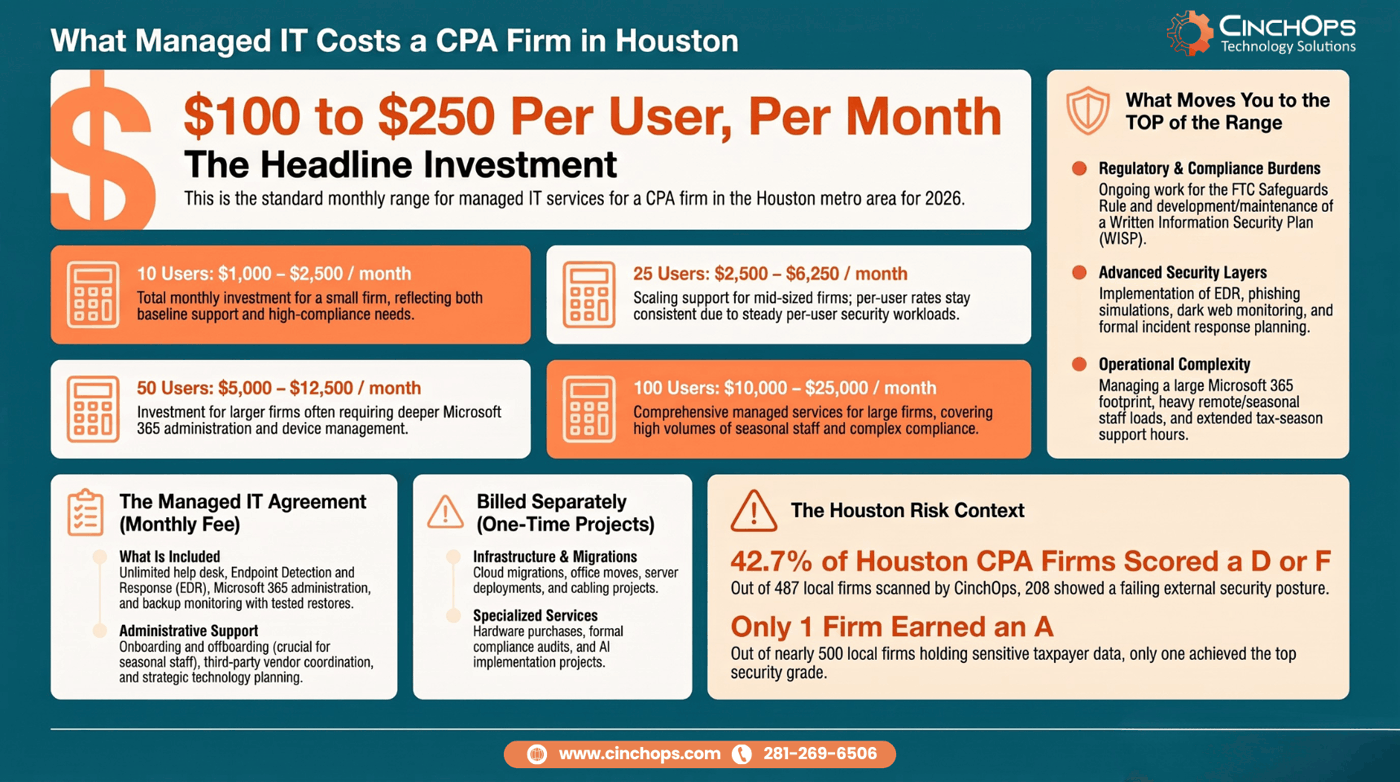
Managed IT for a CPA firm costs $100 to $250 per user per month. At 10 users that is $1,000 to $2,500 monthly. At 25 users, $2,500 to $6,250. At 50 users, $5,000 to $12,500. At 100 users, $10,000 to $25,000.
Those are straight multiplications on purpose. Firms hear about volume discounts constantly, and the honest answer is that the per-user rate does not drop much with size, because the per-user work does not drop much with size. A 50th user needs the same endpoint protection, the same license, the same onboarding, and the same monitoring as the fifth.
| Firm Size | Monthly Range | Annual Range |
|---|---|---|
| 10 users | $1,000 - $2,500 | $12,000 - $30,000 |
| 25 users | $2,500 - $6,250 | $30,000 - $75,000 |
| 50 users | $5,000 - $12,500 | $60,000 - $150,000 |
| 100 users | $10,000 - $25,000 | $120,000 - $300,000 |
Where a firm lands inside the band is the real question, and it is answerable. Read the next section as a scoring exercise on your own practice.
What moves a CPA firm to the top or bottom of the range?
Five factors account for most of the spread.
Compliance scope, cybersecurity depth, Microsoft 365 footprint, remote-work load, and tax-season coverage are what separate a $100 per user firm from a $250 per user firm.
- Compliance scope. A firm that needs FTC Safeguards Rule work, a Written Information Security Plan, documented risk assessments, and annual policy review sits high in the range. A firm that already has those and needs them maintained sits lower.
- Cybersecurity depth. Endpoint detection and response, enforced MFA, email security, and security awareness training are baseline. Add dark web monitoring, phishing simulation, and formal incident response planning and the number climbs.
- Microsoft 365 footprint. Firms running Exchange Online, SharePoint, Teams, OneDrive, Entra ID, Intune, and Defender need all of it configured and watched. Licensing may or may not be inside the fee, which is the single most common apples-to-oranges error when comparing quotes.
- Remote and seasonal staff. Hybrid work is standard in accounting now. Secure identity, device management, and conditional access for people working from three counties add real cost.
- Tax-season coverage. Extended hours between January and April are not free. Ask whether they are included or billed as overtime, because the answer differs sharply between providers.
What is included in a CPA firm's managed IT agreement?
The services that should already be inside the monthly fee.
A managed IT agreement for an accounting firm should include unlimited help desk, endpoint protection, patch management, Microsoft 365 administration, backup monitoring, onboarding and offboarding, vendor coordination, and documented strategic planning.
- Unlimited help desk. Per-ticket billing during tax season is a bad trade for an accounting firm and a good trade for the provider. Watch for it.
- Endpoint detection and response. Not antivirus. EDR watches behavior and can isolate a machine mid-incident.
- Microsoft 365 administration. Identity, permissions, mail flow, and Defender policy, actively managed rather than set once at onboarding.
- Backup monitoring and restore testing. A backup nobody has restored is a theory. Ask for the date of the last successful test restore.
- Onboarding and offboarding. Seasonal staff make this a real workload for accounting firms in a way it is not for most businesses.
- Vendor coordination. Your provider should be the one on the phone with the tax software vendor, not your office manager.
- Strategic planning. A named review cadence with the firm's leadership, not an annual sales call.
What do CPA firms usually get billed for separately?
The project work that sits outside the monthly agreement.
Most managed IT agreements price cloud migrations, office moves, server deployments, cabling, hardware purchases, formal compliance audits, and AI implementation as separate projects rather than including them in the monthly fee.
None of that is unreasonable. What is unreasonable is finding out in month four. Read the exclusions section of the agreement before the pricing section, because the exclusions are where two quotes that look 20 percent apart turn out to be identical, or where the lower-priced one turns out to cost more.
The item most often missed on CPA quotes is Microsoft 365 licensing. Some providers fold it into the per-user rate and some bill it straight through. On a 40-person firm that difference is thousands of dollars a year, and it is invisible unless you ask directly.
Not sure where your firm lands in that range?
A short conversation about your compliance obligations and Microsoft 365 setup usually gets you to a real number.
Talk to CinchOpsWhat we typically see when a CPA firm calls us
The pattern behind most accounting-firm switching conversations.
Accounting firms rarely change IT providers over price. They change after a tax season where the response times did not hold, or after a compliance question nobody could answer.
The calls cluster into a handful of shapes. A partner asks for the firm's Written Information Security Plan and discovers there is not one. Someone finally checks whether the backups restore and finds out they have not been tested. MFA is on for most people but not for the two who complained loudest. The provider does not know what CCH Axcess, UltraTax CS, Lacerte, or Drake Tax actually do, so every application question turns into a three-way call. Nobody has drawn a technology roadmap past this quarter.
Our own scanning data lines up with that. The CinchOps Houston Area Security Scorecard scanned 763 CPA firms across the Houston metro and found 55.5 percent of them scoring a D or an F on external security posture. Exactly one firm earned an A. These are practices holding tax returns and Social Security numbers.
In 35+ years of doing this, the thing that separates firms that come through a bad February from firms that do not is boring: someone tested the restore, someone enforced MFA on everyone, and someone wrote down what happens when the internet drops on April 12.
Every CPA firm I talk to wants to know the monthly number first. Fair enough. But the firms that get burned are the ones who bought on the number without asking what happens when a partner clicks a link at 9pm on April 13. That answer is worth more than the twenty dollars a user you saved.
What should a CPA firm ask before signing an IT agreement?
Seven questions that separate providers faster than a price sheet.
Ask what cybersecurity is included in the base fee, how the provider supports FTC Safeguards Rule compliance, when backups were last restore-tested, and what happens during a tax-season emergency.
- What security is in the base fee? If EDR, MFA, and email security are add-ons, the headline price is not the price.
- How do you support FTC Safeguards Rule work? They should be able to describe the technical controls without reaching for a brochure.
- Have you built a WISP before? A provider who has never seen a Written Information Security Plan will not help you maintain one.
- When did you last test a restore for a client our size? A date, not a policy.
- What is your response commitment, and is it different in March? Get it in writing.
- Is Microsoft 365 licensing inside this number? The single biggest source of quote confusion.
- Who do we actually reach? Ask whether messages route to a queue or to someone accountable.
Most CPA firms fail the same three security checks
Untested backups, incomplete MFA, and no written security plan show up together far more often than they show up alone. Our cybersecurity services start by finding out which of the three apply to you.
See CinchOps cybersecurity services →How CinchOps Can Help Your CPA Firm
CinchOps is a managed IT services provider based in Katy, Texas, serving small and mid-sized businesses across the Houston metro area. CinchOps specializes in cybersecurity, network security, managed IT support, VoIP, and SD-WAN for businesses with 10 to 200 employees.
- Through managed IT support, accounting firms get unlimited help desk with responses in under 15 minutes, plus the Microsoft 365 administration that most firms are quietly doing themselves.
- Our cybersecurity services cover the controls the FTC Safeguards Rule expects: enforced MFA, endpoint detection and response, email security, encryption, and security awareness training.
- Business continuity and disaster recovery includes geo-redundant backups held outside the Gulf Coast flood zone, which matters more here than it does most places.
- Our CPA firm IT services are built around accounting workflows, tax-season load, and the applications firms actually run.
- We support firms across Houston, Katy, and Sugar Land.
If your current agreement is at the bottom of the range, that is worth understanding rather than celebrating. Low cost usually means security is an add-on you have not bought yet, and for a firm holding several thousand taxpayer records that is a strange place to economize. Get a real number, understand what it covers, then decide. If you want a second read on what you are paying for now, talk to CinchOps.
Frequently Asked Questions
What does managed IT cost for a CPA firm in Houston?
Managed IT for a Houston CPA firm costs $100 to $250 per user per month. A 10-user firm pays $1,000 to $2,500 monthly, a 25-user firm $2,500 to $6,250, a 50-user firm $5,000 to $12,500, and a 100-user firm $10,000 to $25,000. Compliance scope and cybersecurity depth determine placement in that range.
Why do CPA firms pay more for IT than other small businesses?
Accounting firms hold tax returns, Social Security numbers, payroll files, and banking details, which raises both the security requirement and the regulatory one. The FTC Safeguards Rule and IRS written-security-plan expectations add risk assessments, documented policies, employee training, and vendor oversight that a typical small business does not carry.
Are Microsoft 365 licenses included in the monthly fee?
Sometimes. Some providers fold licensing into the per-user rate and others bill Microsoft separately at cost. This is the most common reason two quotes appear far apart when they are not. Ask directly, and compare quotes only after you know which model each one uses.
Should cybersecurity be a separate line item?
No. For a firm covered by the FTC Safeguards Rule, endpoint detection and response, enforced MFA, email security, and security awareness training are baseline rather than upgrades. A quote that itemizes them as optional is showing you a lower number than the one you will actually pay.
Does a CPA firm still need internal IT staff?
Most Houston accounting firms between 10 and 50 employees outsource fully. Above roughly 50, firms often keep one internal person for daily operations and use a provider for cybersecurity, Microsoft 365 administration, compliance support, and planning. That co-managed split is common and works well.
Discover More
Sources

