

Construction IT in Houston: The Grand Parkway Segment B-1 Buildout
Put IT In The Dirt, Then Lock It Down – Five-Year Schedules. Five-Year IT Plans.
Construction IT in Houston: The Grand Parkway Segment B-1 Buildout
Two Grand Parkway projects worth a combined $1.6 billion are about to reshape every construction company tied to the corridor. The IT side is the part nobody talks about until it breaks.
Construction IT is the set of systems a builder relies on every working day - jobsite Wi-Fi, project management software, BIM and CAD platforms, mobile devices, VoIP, cloud storage, and the security around all of it. For Houston-area firms, the stakes just changed.
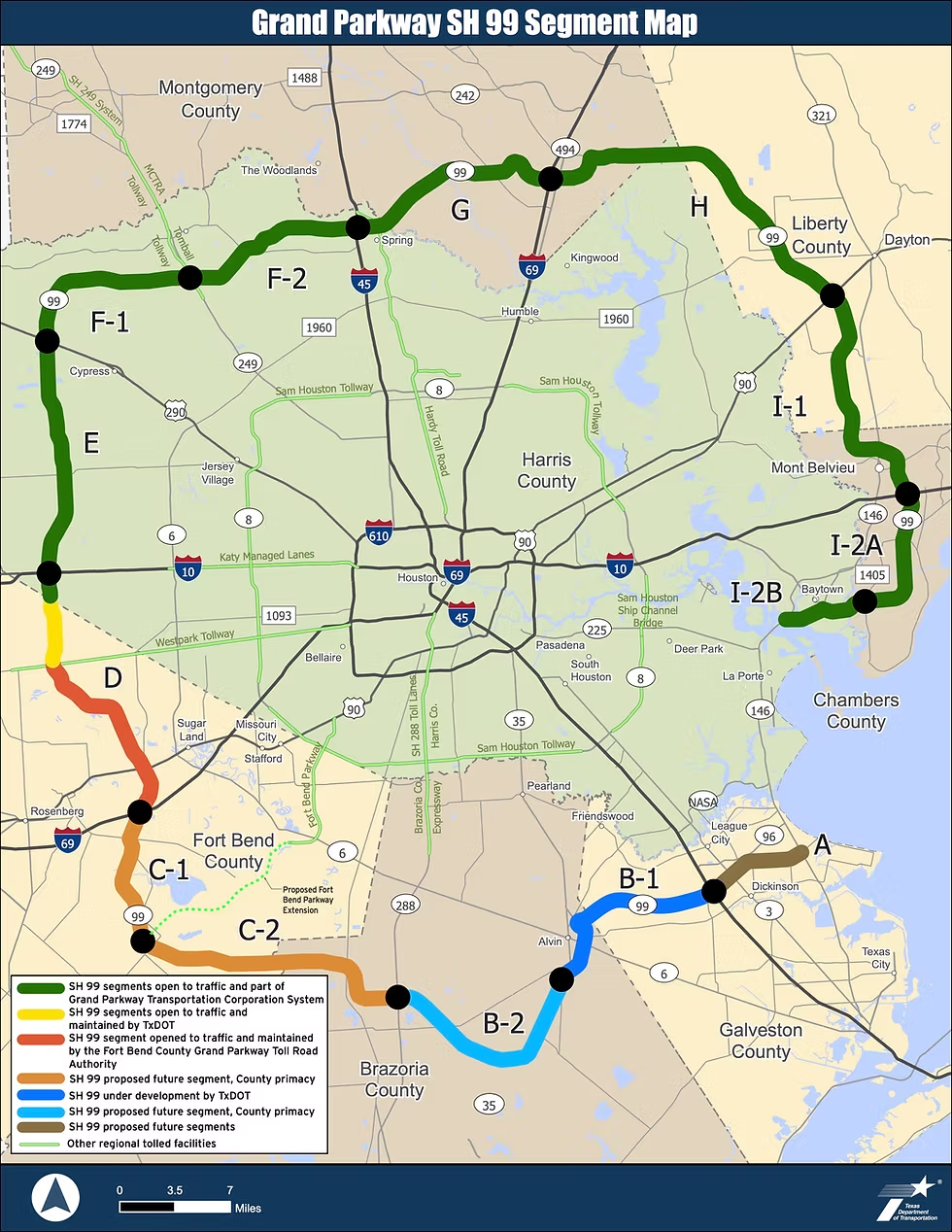
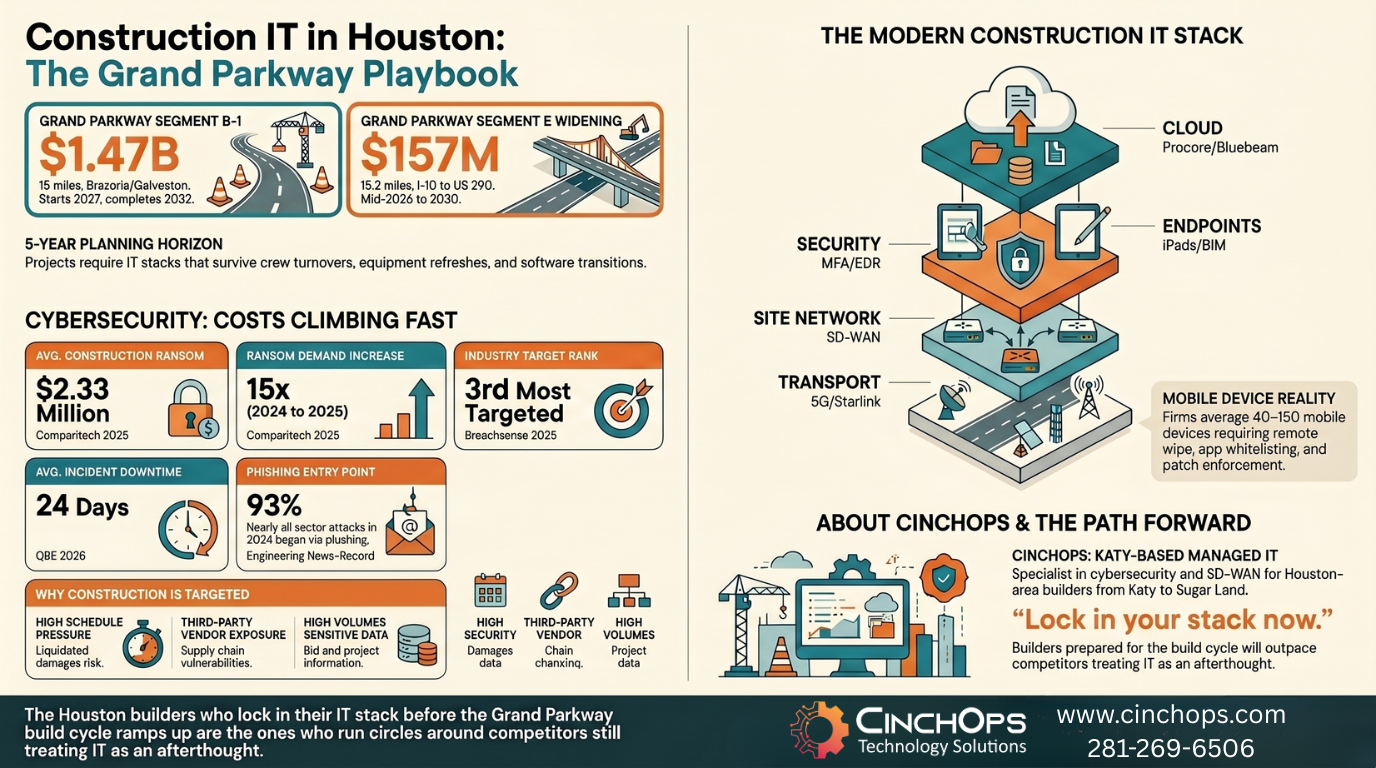
TxDOT awarded Ferrovial a $1.47 billion design-build contract for SH 99 Grand Parkway Segment B-1 in May 2026, a nearly 15-mile corridor through Brazoria and Galveston counties with final completion targeted for winter 2031-2032. A second, separate $157 million widening of Segment E between Katy and Cypress moves into construction this summer and is expected to take roughly four years.
Both projects pull in tier-one general contractors, subcontractors, surveyors, materials suppliers, traffic-control firms, drone operators, engineering consultants, and dozens of trade companies headquartered across the corridor in Katy, Cypress, Fulshear, Brookshire, and Sealy. If your business sits anywhere in that supply chain - or competes for adjacent commercial work as Bridgeland, Grange in Katy, and the League City growth continues - your IT stack is about to carry more weight than it was built for.
CinchOps is a managed IT services provider based in Katy, Texas, serving small and mid-sized construction companies and other businesses across the Houston metro area. CinchOps specializes in cybersecurity, network security, managed IT support, VoIP, and SD-WAN for businesses with 10 to 200 employees, including firms working out of Katy, Houston, Sugar Land, and Cypress.
Segment B-1 covers a nearly 15-mile stretch from FM 646 to south of FM 2403 through Alvin, League City, and the Gulf Coast corridor. TxDOT selected the Ferrovial Construction-Webber 99 joint venture from a pool of three applicants. The contract scope includes four new tolled lanes, discontinuous frontage roads, direct connectors at SH 35, six miles of operational improvements along SH 35, and a 15-year capital maintenance term. The design-build contract value sits at $1.47 billion, while the total project cost estimate runs to roughly $1.96 billion - most of it funded through toll revenue. Pre-construction begins this summer and major construction is expected to start in 2027. The project is also formally designated as a hurricane evacuation route.

Ferrovial brings direct corridor experience. The same parent company previously led the Grand Parkway Infrastructure joint venture that completed Segments H, I-1, and I-2 across 52.5 miles northeast of Houston under a $1.28 billion contract awarded in 2017 and opened in 2022 - prior work that won Engineering News-Record Best Projects recognition. For Houston-area construction firms tracking the buildout, local industry groups including the Greater Houston Builders Association, AGC Houston, and the Texas A&M Department of Construction Science remain reliable signals for sub-contracting pipelines and workforce demand.
The Katy-to-Cypress project is smaller in dollar value but closer to home for many CinchOps clients. The $157 million widening of Segment E adds one main lane in each direction across 15.2 miles between I-10 and US 290, with construction targeted to start mid-2026 and stretch to roughly 2030. The corridor runs straight through Bridgeland, the new Grange community in Katy, and the Cypress employment centers.
For small and mid-sized construction firms working the Katy-to-Cypress corridor, the planning window is now. Pre-construction begins this summer. The subs and suppliers who lock in their IT, jobsite connectivity, and cybersecurity posture before the first traffic-control plan goes live will spend the next four years executing instead of catching up. The ones who don't will be doing both - and one of those two slows the other down.
What that means for your IT side:
- Longer Engagements. Five-year project schedules mean five years of jobsite trailers, contract crew turnover, and devices coming on and off the network. The IT plan you wrote in 2024 won't survive that.
- More Connected Endpoints. GPS-enabled equipment, drones, weather-monitoring rigs, surveying gear, security cameras, IoT sensors, and BIM tablets are now standard. Each one is an attack surface.
- Bigger Data, Tighter Contracts. TxDOT prime contracts impose data-handling and security requirements that flow down to subs. Failing one of those audits can kill your eligibility for the next bid.

Construction firms working on highway and infrastructure projects with multi-year terms need IT planning that survives crew changes, equipment refreshes, software updates, and at least one major Windows version transition. Plan for five years, not five months.
I spent years on heavy civil projects before I ever managed a server, and the lesson never changed: if your foreman cannot access data on his tablet, the day stops. That problem hasn't gone away. It's just gotten worse, because everything from RFI tracking to time-card submissions now lives in the cloud.
A working jobsite connectivity setup for Houston construction firms typically pulls in:
- Cellular-First Networking. A commercial 5G router with failover to a second carrier handles 90% of trailer traffic without trenching a fiber drop to a temporary structure.
- Starlink For Remote Sites. Where cellular coverage thins out - rural stretches of the Segment B-1 corridor, isolated laydown yards, or fresh dirt before service is provisioned - Starlink gives crews a high-bandwidth backup that can stand up in under an hour and runs off a generator if needed.
- SD-WAN For The Office. If your main office is running on a single ISP, the day it goes down is the day payroll is due. SD-WAN handles multi-link failover automatically.
- Outdoor-Rated Access Points. Crew Wi-Fi for laydown yards and concrete pours has to live outside. Indoor APs in a weatherproof box are a fire-and-forget mistake.
- VPN Or Zero Trust Access. Your project management portal should never be open to the public internet. Crews authenticate, period.
For engineering firms running BIM and CAD coordination across multiple jobsites, the bandwidth math gets ugly fast. A single Revit model sync can saturate a small trailer connection for half an hour. We've seen Houston engineering firms end up with crews waiting on file syncs that should have been background tasks. Network design matters here more than people realize.
"Houston builders have a real edge right now. The connectivity and security tools that used to cost six figures are now within reach of any small or mid-sized firm. The ones who lock in their IT stack before the Grand Parkway build cycle ramps up are going to run circles around competitors still treating IT as an afterthought."
For years, construction firms assumed cybercriminals went after banks and hospitals. That's no longer true. According to the Breachsense 2025 Annual Ransomware Report, construction ranked third among targeted industries with 418 victims in 2025, behind only healthcare and manufacturing. Per Comparitech's 2025 end-of-year roundup, average ransom demands against construction firms jumped to $2.33 million, fifteen times higher than 2024.
The 2026 numbers picked up where 2025 left off. BlackFog's Q1 2026 State of Ransomware report recorded roughly 220 undisclosed ransomware attacks against construction firms in the first three months of the year - second only to manufacturing and services. The same report found 96% of ransomware attacks now involve data exfiltration, the average disclosed ransom demand was $1,028,214, the average data haul was 743 GB per incident, and only 1 in 9 attacks ever becomes public. For deeper Houston-area context, see the CinchOps breakdown of the BlackFog Q1 2026 numbers.
Three reasons construction is now on the menu:
- Schedule Pressure. A two-week shutdown blows your liquidated damages clause. Attackers know this and price ransoms accordingly.
- Third-Party Exposure. Construction projects involve dozens of subcontractors, suppliers, and consultants with varying levels of security. One compromised vendor inbox in your accounting workflow is enough to redirect a payment.
- Sensitive Data Volume. Bid documents, employee tax records, banking info, project drawings, and government contract data all sit in one place. Per Engineering News-Record, 93% of construction sector attacks in 2024 started via phishing.
The Play, Akira, and Qilin ransomware groups have all named construction targets in public leak sites throughout 2025 and into Q1 2026, joined by newer groups like The Gentlemen, Sinobi, and Shiny Hunters. Per a QBE European Operations 2026 sector report, the average ransomware incident in 2025 caused 24 days of downtime. For a road builder running a 60-month contract, 24 days is enough to trigger contract penalties and lose preferred-bidder status with TxDOT.
Practical defenses that actually move the needle for construction firms:
- Multi-Factor Authentication On Email. Microsoft 365 with MFA blocks the overwhelming majority of credential-stuffing attacks. If you don't have it on every account, that's the first call.
- Endpoint Detection Beyond Antivirus. Construction laptops are notoriously full of pirated CAD plugins and questionable PDF tools. EDR catches what signature-based AV misses.
- Backup You Can Actually Restore. Daily backups with quarterly restore drills - because untested backups are stories you tell yourself. Business continuity and disaster recovery for construction means restoring blueprints and project files in hours, not weeks.
- Vendor Email Verification. Train AP staff to pick up the phone before changing a wire instruction. This one process catches more fraud than any technical control.
A typical Houston-area construction firm running a $50M backlog has somewhere between 40 and 150 mobile devices distributed across project teams. iPads with PlanGrid or Procore, ruggedized Android tablets for surveying, smartphones for foremen, and a fleet of laptops in trucks. Without mobile device management, you have no idea which of those devices is patched, which has been lost, or which one is sitting unlocked at a job trailer overnight.
Mobile device management for construction typically needs to handle:
- Remote Wipe. Lost tablet at the Grand Parkway Segment B-1 jobsite? Wipe it remotely before lunch. Without MDM, you're calling the insurance company instead.
- App Whitelisting. Crews should run project software, not personal apps that introduce malware. MDM enforces the line without micromanaging the user.
- Patch Enforcement. Unpatched iPads from 2022 are still in service. MDM forces updates on a schedule instead of waiting for a worker to feel like rebooting.
- Geo-Restrictions And Conditional Access. Devices that connect from outside the U.S. without prior approval get flagged. Useful for catching stolen hardware before it leaks data.
The compare table below shows where construction overlaps with two other CinchOps verticals - CPA firms and law firms - and where the priorities diverge. If you sit on the leadership team for a Houston-area construction firm and you're benchmarking your IT stack against neighbors in other industries, this is a useful starting frame.
| IT Priority | Construction | CPA Firm | Law Firm |
|---|---|---|---|
| Top Threat | Ransomware + vendor email fraud | Phishing during tax season | Client data extortion |
| Mobile Workforce | Heavy. Crews live in the field. | Moderate. Hybrid office. | Moderate. Mostly office-based. |
| Compliance Driver | TxDOT, government contracts, OSHA reporting | IRS, FTC Safeguards Rule, state CPA boards | Attorney-client privilege, state bar rules |
| Connectivity Need | Trailer Wi-Fi, BIM bandwidth, redundant carriers | Stable office + secure remote access | Stable office + e-discovery throughput |
| Data Sensitivity | Project files, banking, employee records | Tax returns, financial records, PII | Privileged communications, case files |
| Downtime Tolerance | Hours before schedule slip | Hours during tax season, days otherwise | Hours during active litigation |
A few things jump off the page. Construction's mobile workforce is heavier than most other professional verticals. Compliance pressure on construction is increasingly driven by government contract requirements that cascade from primes like Ferrovial down through every sub. And downtime tolerance for active jobsites is measured in hours - because a stalled crew costs money every minute it sits.
Construction IT Self-Check
- Can every foreman pull the current set of plans from their tablet within 30 seconds, on cellular, anywhere in Harris County?
- If a $50,000 wire request landed in AP today claiming to come from a known vendor, what would have to be true before it got paid?
- How long would it take to fully restore your project file server if it were encrypted tomorrow morning?
- How many devices on your network have you never personally seen? If the answer is "I don't know," that's the answer.
- Does your IT setup meet the security clauses in your last three TxDOT or municipal contracts?
How CinchOps Helps Houston Construction Firms
CinchOps was built on a "Put It In The Dirt" mindset. Shane Stevens spent years on Houston freeway projects before moving into IT leadership at Cisco, NinjaOne, and other enterprise security companies. That means CinchOps understands what a jobsite trailer actually needs - not what an IT brochure says it should need. We support construction firms across Katy, Houston, Sugar Land, Cypress, and the surrounding service areas with a flat-fee model and no long-term contract penalties.
- Jobsite Network Design And Deployment. Cellular routers, outdoor Wi-Fi, SD-WAN failover, Starlink backup, and VPN access - sized for the project, not the brochure.
- Construction-Grade Cybersecurity. MFA enforcement, endpoint detection and response, email security, data exfiltration monitoring, and 24/7 SOC visibility tuned for the way construction firms actually work.
- Mobile Device Management. Full lifecycle management for tablets, phones, and laptops across project teams. Remote wipe, patching, app control, and inventory you can actually use.
- Business Continuity Planning. Backup, recovery, and tabletop exercises so the next ransomware call doesn't kill your schedule.
- VoIP And Communications. Phone systems that follow crews to whichever site they're working that week.
- Vendor And Compliance Support. Help meeting the security clauses in TxDOT primes, municipal contracts, and cyber insurance applications.
If you're competing for work tied to the Grand Parkway buildout - or you're already a sub on a TxDOT project - the IT plan you have today probably isn't the IT plan you need for the next five years. We'd rather help you sort that out before the first crew shows up than after the first incident does.
Frequently Asked Questions
What is construction IT?
Construction IT is the combined set of technology systems a construction firm uses to run its business - office networks, jobsite Wi-Fi, project management software, BIM and CAD tools, mobile devices, VoIP, cloud storage, and the cybersecurity around all of it. Effective construction IT keeps crews productive in the field and protects the data that contracts depend on.
How does the Grand Parkway expansion affect Houston construction companies?
Two simultaneous TxDOT projects - the $1.47 billion Ferrovial-led Segment B-1 in Brazoria and Galveston counties and the $157 million Katy-to-Cypress Segment E widening - extend across multi-year schedules and pull in subcontractors, suppliers, and engineering firms across the corridor. That means more devices, more jobsites, more data, and tighter contract-level security requirements.
Why are construction firms being targeted by ransomware?
Construction firms have schedule pressure that makes them likely to pay, dozens of third-party connections that create attack paths, and sensitive data in one place. Per Comparitech, construction ransom demands averaged $2.33 million in 2025, fifteen times higher than 2024. The Play, Akira, and Qilin groups have all named construction targets in public 2025 attacks.
What does jobsite IT actually need?
A typical Houston-area construction jobsite needs cellular-first networking with carrier failover, outdoor-rated Wi-Fi for crews, secure remote access to project files, mobile device management on tablets and phones, and email security to block phishing. Office side adds SD-WAN, endpoint detection, backup, and 24/7 monitoring.
How much does managed IT cost a Houston construction firm?
Managed IT pricing for a Houston construction firm typically runs $100 to $200 per user per month, depending on device count, project complexity, and security level. The variable isn't the price tag - it's what's included. CinchOps quotes flat-fee with no hidden charges and no long-term cancellation penalties so businesses can budget without surprises.
Discover More
Resources
Sources
- SH 99 Grand Parkway Segment B-1 awarded to Ferrovial in $1.47 billion contract, 15-mile corridor in Brazoria and Galveston counties, winter 2031-2032 completion target - Construction Review Online, May 14, 2026
- TxDOT selects Ferrovial for $1.47bn SH 99 Grand Parkway project - Yahoo Finance / World Construction Network, May 14, 2026
- Major Houston highway project gets $1.47B contract boost - $1.96 billion total design-build cost estimate, Ferrovial Construction-Webber 99 selected from a pool of three applicants - Chron / Houston Chronicle, Molly Wilhelm, May 2026
- Grand Parkway expansion to cut through Galveston County - The Daily News (Galveston), May 13, 2026
- TxDOT $157M Grand Parkway widening, Katy to Cypress, construction mid-2026 - Community Impact, August 8, 2025
- Construction ransom demands average $2.33 million in 2025, 15x higher than 2024 - Comparitech Worldwide Ransomware Roundup, January 13, 2026
- Construction third-most-targeted industry with 418 victims in 2025 - Breachsense State of Ransomware 2025 Annual Report, February 2026
- Q1 2026 ransomware data: 264 disclosed and 2,160 undisclosed attacks, 96% data exfiltration rate, $1,028,214 average disclosed ransom, 743GB average exfiltration, construction sector ~220 undisclosed incidents - CinchOps analysis of BlackFog Q1 2026 State of Ransomware report, May 13, 2026
- 93% of construction sector attacks in 2024 started via phishing - Engineering News-Record, March 10, 2026
- Average ransomware downtime of 24 days in 2025, sector resilience report - QBE European Operations, 2026


