


Can a Houston Manufacturer Pass CMMC Without a Compliance Hire?
CMMC Level 2 For Houston Manufacturers Explained – How Katy And Houston Manufacturers Reach Level 2
A 2026 plan for Houston and Katy shops facing DFARS flow-down clauses without a full-time compliance hire.
CMMC compliance for Houston manufacturers stopped being a someday problem on November 10, 2025. That is the day the DFARS acquisition rule took effect and CMMC clauses began appearing in new DoD solicitations. If a prime contractor just flowed a Level 2 requirement into your PO renewal, you are not late - but you are not off the hook either. The DoD suspended the Phase 2 third-party mandate on July 13, 2026, while a reform task force reviews the program, and the Level 2 self-assessment requirements it left standing are in solicitations right now.
The reflex most owners have is to price a compliance hire. That reflex is expensive and usually wrong. CMMC Level 2 is 110 specific security requirements from NIST SP 800-171 - almost all of them operational IT work, not policy work. CinchOps delivers CMMC-aligned managed IT and cybersecurity specifically for manufacturers in Houston and Katy with 10 to 200 employees, at a flat monthly rate per user, and the pattern we see in onboarding is consistent: shops that treat CMMC as an operations project pass; shops that treat it as a hiring problem stall.
CMMC Level 2 Is 110 Requirements, Not a Mystery
What the program actually demands from a small manufacturer, and when each phase of it reaches your contracts.
CMMC (Cybersecurity Maturity Model Certification) is the Department of Defense's program for verifying that contractors and subcontractors actually protect federal contract information (FCI) and controlled unclassified information (CUI). For a Houston machine shop or fabricator, Level 2 means implementing the 110 security requirements of NIST SP 800-171 and proving it.
The requirement reaches you through flow-down. Your prime carries the DFARS 252.204-7021 clause, and the clause obligates them to push CMMC down to every subcontractor that touches FCI or CUI - drawings, specs, part files, delivery schedules. You do not need a direct DoD contract to be caught by it. A purchase order for machined parts is enough if a controlled drawing rides along with it.
| CMMC status | Who needs it | How it is assessed | When it hits contracts |
|---|---|---|---|
| Level 1 (Self) | Shops handling only FCI - basic contract information, no controlled technical data | Annual self-assessment against 15 basic requirements, plus an affirmation in SPRS | Phase 1 - appearing in solicitations since November 10, 2025 |
| Level 2 (Self) | A limited set of CUI-handling contracts where the DoD allows self-assessment | Triennial self-assessment against all 110 NIST SP 800-171 requirements, plus annual affirmations | Phase 1 - appearing in solicitations since November 10, 2025 |
| Level 2 (C3PAO) | Most manufacturers handling CUI - controlled drawings, ITAR-adjacent part files, defense specs | Triennial certification assessment by an accredited third party (C3PAO), plus annual affirmations | SUSPENDED July 13, 2026, pending the reform review - was scheduled to begin November 10, 2026 |
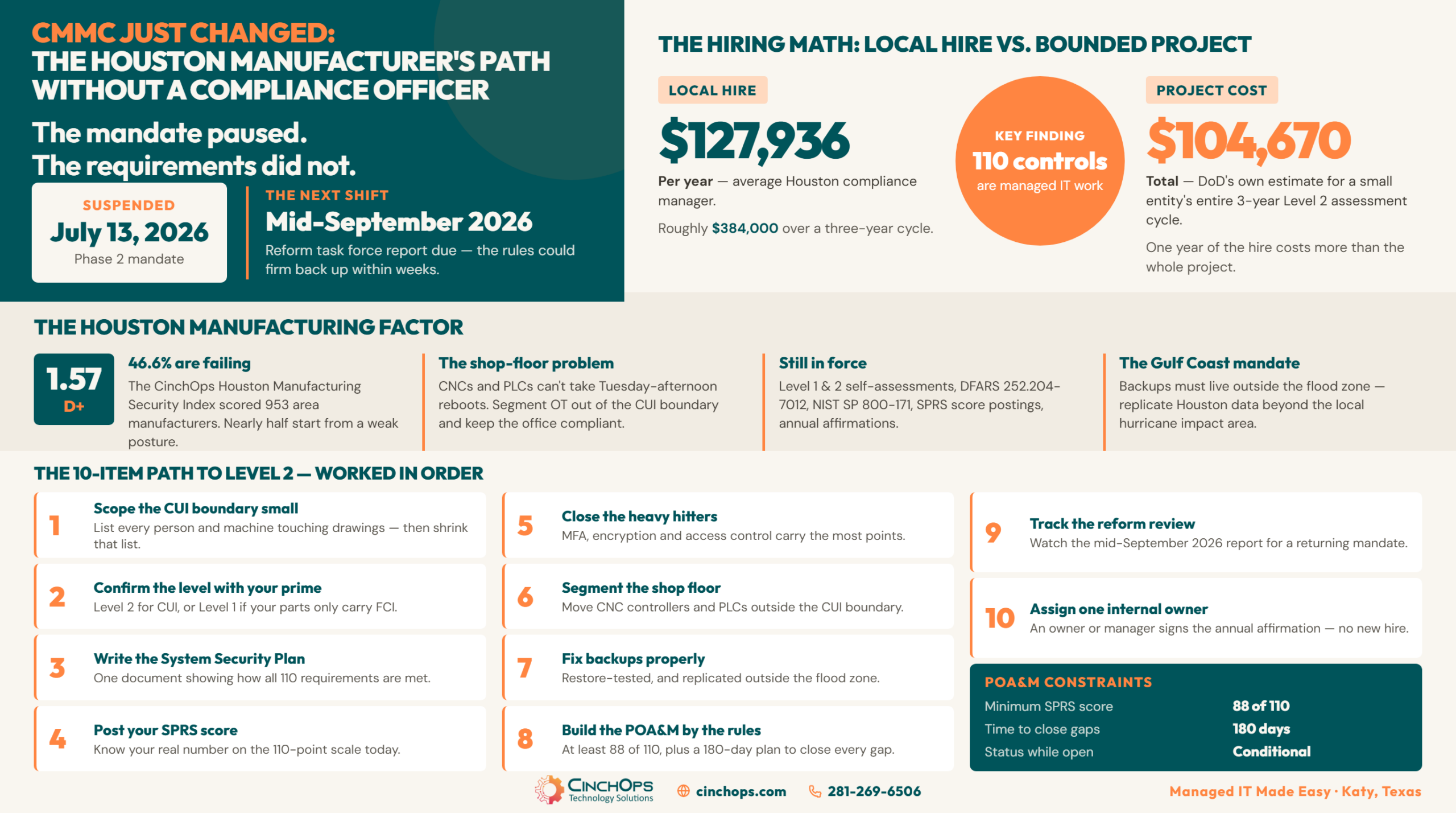
The third-party half of that table just moved. On July 13, 2026, the Department of War suspended Phase 2 - the mandate that would have made C3PAO certification a condition of award starting November 10, 2026 - and stood up a CMMC Reform Task Force whose recommendations are due around mid-September 2026. During the suspension, contracting officers may only include Level 1 or Level 2 self-assessment requirements in solicitations. Suspension is not cancellation: DFARS 252.204-7012, NIST SP 800-171 implementation, SPRS score postings, and annual affirmations all remain in force, and the review lands in weeks, not years.
The Hiring Math: $127,936 a Year Against a Bounded Project
The DoD published its own cost estimates. Put them next to a Houston compliance salary and the answer falls out.
A full-time compliance manager in Houston averages $127,936 a year (Salary.com, May 2026). The DoD's own CMMC rule estimates a small entity's Level 2 certification cycle - the assessment, reporting, and affirmations across 3 years - at $104,670. The recurring hire costs more every single year than the DoD expects the entire 3-year assessment cycle to cost.
That comparison is imperfect in an important way: the DoD figure covers assessment activities, not the remediation work of actually implementing the 110 controls. But look at what those controls are. Multi-factor authentication. Patching. Access control. Log review. Encrypted, tested backups. Network segmentation. That is not a compliance officer's job description - it is a managed IT provider's Tuesday. The genuinely compliance-shaped work that remains - the System Security Plan, the evidence binder, the annual affirmation - is a bounded project plus a few hours a month, not a desk.
In 35+ years doing this, I have never seen a small manufacturer fail an assessment because it lacked a job title. The shops that struggle are short a system: nobody scoped where CUI actually lives, so the whole network is in play, and 110 requirements suddenly apply to the shipping PC and the break-room laptop.
Work These 10 Items in Order
The sequence matters - scoping before spending, score before assessor. Most shops are further along than they think.
The path to CMMC Level 2 without a compliance officer is a 10-item checklist worked in order, because each item shrinks the cost of the one after it.
- 1. Scope the CUI boundary first. List every machine, share, mailbox, and person that touches controlled drawings or specs. Then shrink it. An enclave of 6 workstations is a fraction of the cost of certifying the whole shop.
- 2. Confirm the level with your prime. Ask which clause and which phase applies to your work. Some part families carry only FCI - that is Level 1 and a far shorter list.
- 3. Write the System Security Plan (SSP). One document that says what is in scope and how each of the 110 requirements is met. Assessors start here; so should you.
- 4. Self-assess against NIST SP 800-171 and post your SPRS score. The scale runs to 110. Knowing your real number today tells you the size of the gap and whether a POA&M is even available to you.
- 5. Close the heavy hitters: MFA, encryption, access control. These carry the largest point weights and show up in nearly every failed assessment.
- 6. Segment the shop floor. Put CNC controllers, PLCs, and anything that cannot take a mid-week reboot on its own network segment, outside the CUI boundary. IT/OT segmentation shrinks scope and protects production at the same time.
- 7. Fix backups properly. Encrypted, geo-redundant, replicated outside the Gulf Coast flood zone, and restore-tested - not a NAS in the server closet.
- 8. Build the POA&M by the rules. Conditional status requires a score of at least 88 of 110, some requirements can never be deferred, and everything on the plan must close within 180 days or the status expires (32 CFR 170.21).
- 9. Track the reform review, not the old deadline. The Phase 2 third-party mandate was suspended July 13, 2026, and the task force report is due around mid-September 2026. Until it lands, self-assessment is the requirement - and shops with a clean SPRS score can book a C3PAO fast if the mandate returns.
- 10. Assign one internal owner for affirmations. Someone senior signs the annual affirmation in SPRS. That is a duty an owner or ops manager carries - it is not a hire.
Why Is CMMC Harder for a Houston Shop Floor?
The local baseline is weak, the equipment is unforgiving, and the geography adds a requirement most guides skip.
The CinchOps Houston Manufacturing Security Index scored 953 area manufacturers on externally observable security posture and found an average grade of 1.57 - a D+ - with 46.6% failing outright. The average Houston shop is not starting CMMC from a strong baseline, which is exactly why the scoping step matters more here than the spending step.
Houston adds 2 complications that a generic CMMC guide written for an office business never mentions. First, the shop floor: CNC controllers, PLCs, and test rigs run production, and they cannot take a Tuesday-afternoon reboot for patching the way a desktop can. The answer is not to exempt them - it is IT/OT segmentation, so production equipment sits on its own network outside the CUI boundary while the office side carries the controls. Second, the geography: a hurricane on the Gulf Coast that takes out both your server closet and your local backup drive takes out your CUI protection evidence with it. Backups for a Houston manufacturer need to replicate outside the Gulf Coast flood zone, and that choice happens to satisfy the 800-171 recovery requirements at the same time.
There is also a quiet double exposure in this market. A large share of Houston-area manufacturers build for the energy sector, and many of the same machine shops that cut for oilfield-services primes also cut for defense primes. One controlled drawing in the inbox puts the shop in scope - and the shops that solve it once get a security posture their energy customers are starting to ask about too, in vendor questionnaires we now see on both sides.
CMMC doesn't ask whether you have a compliance officer. It asks whether 110 specific things are true about your network. Those are operations questions - and operations is a system you run, not a person you hire.
A CMMC clause just landed in your PO renewal?
CinchOps builds the CUI boundary, runs the 110 controls, and preps the evidence binder for Houston manufacturers - as part of managed cybersecurity, on a flat monthly rate, with no long-term contract.
See how CinchOps handles compliance security →How CinchOps Can Help Houston Manufacturers Pass CMMC
CinchOps is a managed IT services provider based in Katy, Texas, serving small and mid-sized businesses across the Houston metro area. CinchOps specializes in cybersecurity, network security, managed IT support, VoIP, and SD-WAN for businesses with 10 to 200 employees.
Owners comparing cybersecurity providers for Houston manufacturing usually need 3 things at once: someone to run the recurring controls, someone who understands a shop floor, and a bill that doesn't move. Here is how that maps:
- Through managed IT support, CinchOps runs the day-in, day-out control work CMMC actually grades - patching, MFA, access control, monitoring - with an under-15-minute help desk response.
- Through managed cybersecurity, CinchOps hardens the CUI boundary against NIST SP 800-171 and keeps the evidence an assessor asks for.
- For manufacturing clients, that includes IT/OT segmentation for the shop floor and support for the ERP platforms Houston shops actually run, including SAP, Oracle, Epicor, and SYSPRO.
- Through business continuity and disaster recovery, backups replicate geo-redundantly outside the Gulf Coast flood zone and get restore-tested - a CMMC requirement and a hurricane-season requirement in one.
- CinchOps serves manufacturers across the metro through managed IT in Houston and managed IT in Katy.
The reform report lands in weeks, and the self-assessment requirements never paused. If a flow-down clause has already reached your shop, the cheapest move you can make this quarter is a scoping conversation, not a job posting. Bring the clause and your current SPRS score if you have one - talk to CinchOps and find out how small your CUI boundary can actually be.
Frequently Asked Questions
What does CMMC compliance support cost for a Houston manufacturer?
CinchOps prices managed IT and security at a flat monthly rate per user, typically $100 to $250 per month, so a scoped 50-employee shop knows its number before signing. The assessment itself is separate: the DoD estimates a small entity's Level 2 certification cycle at $104,670 over 3 years.
Do we need a CMMC compliance IT provider in Katy, Texas, or a full-time compliance officer?
For a 10-to-200-employee manufacturer, a provider almost always wins the math. The 110 Level 2 requirements are operational IT controls a managed provider already runs, while a Houston compliance manager averages $127,936 a year. Keep one internal owner - an ops manager or the owner - to sign the annual SPRS affirmation.
Can we win the contract first and fix the gaps on a POA&M later?
Only partly. Conditional CMMC status requires scoring at least 88 of 110, certain requirements can never be deferred to a POA&M, and every open item must close within 180 days or the conditional status expires under 32 CFR 170.21. Treat the POA&M as a short runway, not a parking lot.
Discover More
Resource
Sources
- 32 CFR 170.17 - CMMC Level 2 certification assessment and affirmation requirements (eCFR)
- 32 CFR 170.21 - Plan of Action and Milestones requirements (eCFR)
- DFARS 252.204-7021 - Contractor Compliance With the CMMC Level Requirement (eCFR)
- Department of War - CMMC Phase II suspension release (July 13, 2026)
- DoW CIO - Implementing the Suspension of CMMC Phase II (memo, PDF)
- DefenseScoop - Pentagon's published CMMC implementation cost estimates
- Salary.com - Compliance Manager salary, Houston, TX (May 2026)
- CinchOps Houston Manufacturing Security Index - 953 Houston-area manufacturers scored; average grade 1.57 (D+); 46.6% failing


