


Technical Integrator: The Role Houston Businesses Are Missing
Your MSP Keeps The Lights On. Who Is Building The Business? – The Missing Role That Is Quietly Capping Your Growth
Why growing Houston and Katy businesses stall, and the technical integrator role that gets them moving again.
A technical integrator is the role most growing Houston businesses are missing: the person or partner who makes technology execute the business plan instead of just keeping it online.
Here is a pattern that shows up constantly with growing Houston and Katy businesses. The owner knows exactly where the company should be in 3 years. They just cannot get the day to day to move in that direction. Look closely and technology is usually part of why. The network is fine. The laptops work. The real problem is that the systems do not reflect the vision, and nobody in the building owns closing that gap.
That gap has a name. In a lot of businesses it is the difference between a visionary and an integrator, and in a modern business the integrator's job is increasingly a technical one.
The Symptoms Look Like Growing Pains. They Are Actually an Ownership Gap.
The signs that technology has stopped executing the vision are familiar, and none of them show up as an outage.
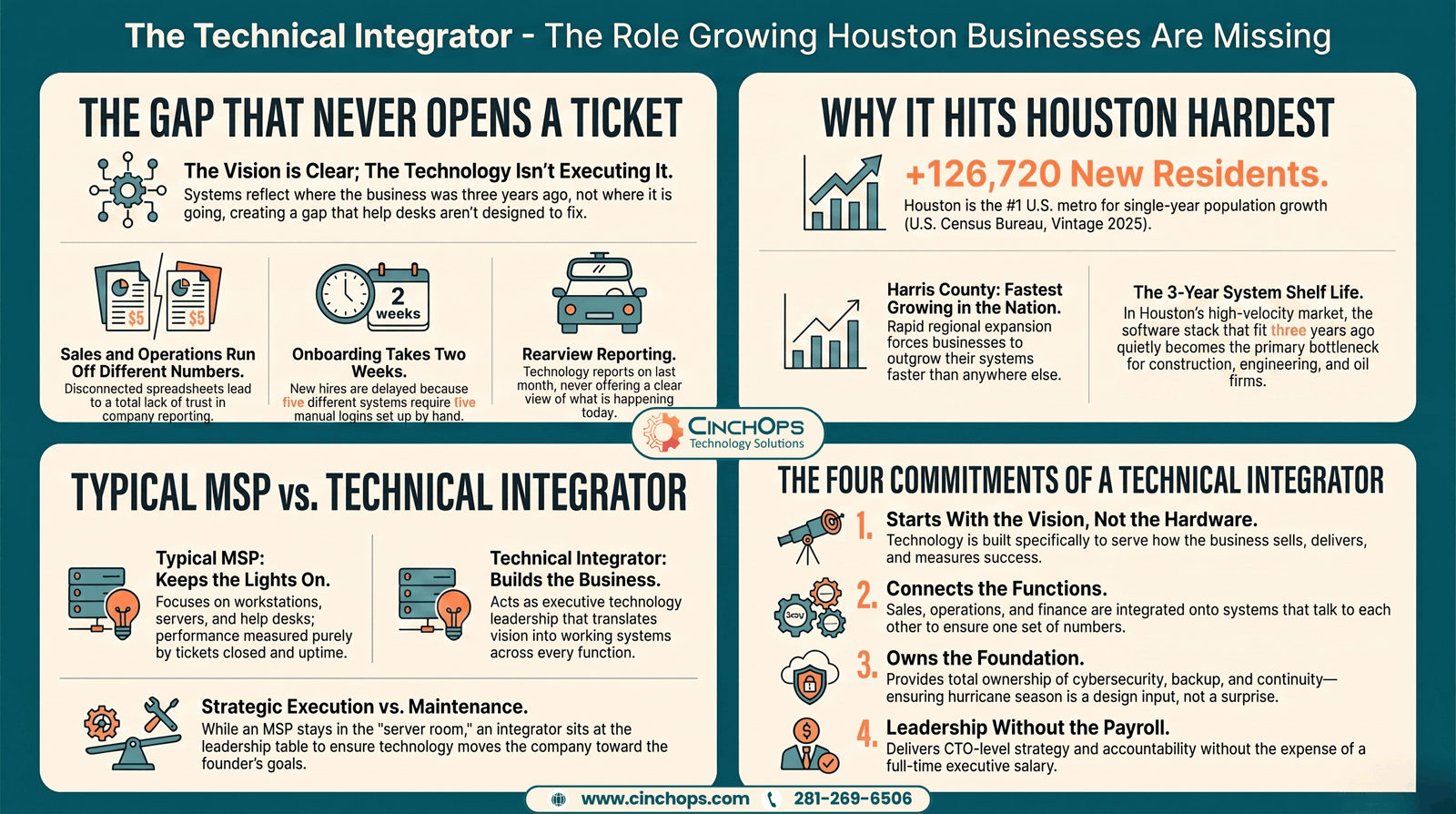
When technology stops executing the business plan, the symptoms are operational, not technical: sales and operations work off different numbers, onboarding a new hire takes 2 weeks because 5 systems need 5 logins set up by hand, and reporting says what happened last month but never what is happening today.
None of that is an IT problem in the way most people mean it. Nothing is down. No ticket gets opened. Which is exactly why it never gets fixed: the help desk was never asked to own it, and the leadership team assumes somebody technical is on it. Nobody is.
Houston makes this gap show up faster than most markets. The U.S. Census Bureau's Vintage 2025 population estimates put the Houston metro at the top of the country for single-year growth, adding 126,720 residents, with Harris County the fastest-growing county in the nation. Growth like that pulls businesses forward whether their systems are ready or not. A construction firm adds a second and third crew, an engineering practice opens a Katy office, an oil and gas services company takes on a bigger operator contract, and the software stack that fit the company 3 years ago quietly becomes the bottleneck. In the fastest-growing metro in America, businesses outgrow their technology faster than anywhere else.
The Visionary Sets Direction. The Integrator Makes It Real.
A quick refresher on the leadership model many founders already run their companies on.
The visionary and integrator model pairs the idea-driven founder (the visionary) with a counterpart who runs the day to day, holds the leadership team accountable, and connects sales, operations, and finance so the whole company moves as one (the integrator). A lot of founders already run their companies on it.
Most founders are visionaries. Direction, energy, relationships, appetite for risk. The visionary walks in with 10 ideas, and maybe 2 of them are gold. The integrator figures out which 2, then turns them into a plan with owners and deadlines. That is the relationship that takes a company off a plateau.
Here is the part that does not get said enough. In a modern business, the vision gets executed through technology. Which means the integrator's job is, more and more, a technical job. And most small and mid-sized companies have no one filling it.
Your Vision Runs on Four Systems, Whether You Manage Them That Way or Not.
Strategy does not execute itself. It executes through the specific technology your team touches every day.
A business plan executes through 4 technology layers: the CRM is how you sell, automation is how you deliver, data is how you decide, and security and continuity are what keep the doors open when something goes wrong. If those systems do not match the vision, the vision stalls, no matter how good the plan is.
This is why the question "who owns our technology" matters more than "is our technology working." Plenty of vendors will keep systems running. Very few will take ownership of whether those systems are building the business the founder is trying to build. The matrix below is how CinchOps frames it with Houston owners: reliability ownership on one axis, strategy-execution ownership on the other. Most businesses have the left half covered and assume that is the whole picture.
Most MSPs Maintain Infrastructure. They Were Never Asked to Execute Strategy.
This is not a knock on managed services. It is a scope problem.
A typical managed services provider is very good at a specific thing: keeping infrastructure running. Workstations, servers, the network, a help desk that answers when something breaks. That work is real, and no business should go without it. But it is maintenance. It was never scoped to ask whether the technology is executing the business plan.
The typical MSP relationship is measured in tickets closed and uptime percentages. Useful numbers. They tell you nothing about whether your systems are moving the company toward where the founder wants it to go. That is the ceiling of the commodity model: the MSP stays parked in the server room, positioned as a cost center, while the real question, "is our technology building the business we are trying to build," goes unanswered.
What a Technical Integrator Actually Does
Strip away the label and the work breaks into 4 commitments.
A technical integrator starts with the vision rather than the hardware: before touching a firewall, the questions are where the business is headed, how it sells, how it delivers, and how it measures. The technology gets built to serve that, and it gets held accountable to the plan the way a good integrator holds a leadership team accountable.
It means connecting the functions. Sales, operations, finance, and customer support should run on systems that talk to each other. When they do not, people spend their days copying data between tools and arguing about whose spreadsheet is right. Integration and automation are the fix, and integration is in the name of what we do.
It means owning the foundation. Cybersecurity, network security, VoIP, SD-WAN, backup, and business continuity. The vision only works if the systems stay up and stay safe. A founder should not have to think about ransomware, and on the Gulf Coast, continuity planning also means hurricane season is a design input, not a surprise.
And it means executive-level technology leadership without the executive-level payroll. Most companies with 10 to 200 employees do not need a full-time CTO. They need the function: the strategy and the seat at the leadership table, backed by a team that delivers on it. That is the technical integrator.
One honest caveat. The visionary and integrator model is a lens, not a law, and technology is not the only reason a business plateaus. Sometimes the problem is the plan, or the people, or the market. A good technical partner should tell you when technology is not your bottleneck, and we do. But when the pattern fits, and for growing Houston companies it usually does, filling the technical integrator gap is one of the highest-impact moves an owner can make. It gets the founder back to being the visionary, and it puts someone accountable for turning that vision into systems that run.
The visionary walks in with 10 ideas, and 2 of them are gold. Somebody has to figure out which 2 and turn them into systems that actually run. After 35 years in systems integration, I can tell you that in most growing businesses, nobody owns that job.
Executive Technology Leadership, Without the Executive Payroll
CinchOps CTO and CIO services put a technical integrator at your leadership table, backed by a Houston-area team that builds and runs what gets decided there.
Explore CTO/CIO Services →How CinchOps Fills the Technical Integrator Role for Houston Businesses
CinchOps is a managed IT services provider based in Katy, Texas, serving small and mid-sized businesses across the Houston metro area. CinchOps specializes in cybersecurity, network security, managed IT support, VoIP, and SD-WAN for businesses with 10 to 200 employees.
Anyone can claim a bigger title, so here is the basis for this one. Shane Stevens has spent 35 years in technology systems integration and business process workflow, including standing up technology foundations for startups and the harder job of modernizing established companies that had outgrown their systems after an acquisition, a restructure, or a pivot. Companies in that spot need technology that catches up fast, and most MSPs are not built for that kind of change. That is the work we like most. And because CinchOps is local, we can sit across the table from a Houston founder and understand the specific pressures on the business, because we are down the road, not in another time zone.
- Through CTO and CIO services, CinchOps fills the technical integrator role: technology strategy and leadership-table accountability without full-time executive payroll.
- Through managed IT support, the reliability layer stays covered: workstations, servers, network, and a help desk that answers.
- Through business process automation, disconnected sales, operations, and finance systems get connected so the company runs on one set of numbers.
- Through cybersecurity and business continuity and disaster recovery, the foundation stays up and stays safe, hurricane season included.
- CinchOps serves construction, oil and gas, and engineering firms across the metro, with local teams for IT support in Houston and IT support in Katy.
If you are a founder or on an executive team, ask yourself one question: does our technology reflect where we are trying to take the business, or where we were 3 years ago? If you are not sure, that is worth a conversation. No ticket counts, no jargon, just a clear read on where you stand and what it would take to close the gap. Every visionary needs an integrator, and for your technology, that is what we do. Talk to CinchOps.
Frequently Asked Questions
What is a technical integrator?
A technical integrator is the person or partner who translates a company's business vision into working systems: CRM, automation, reporting, security, and continuity. The term adapts the integrator role from the visionary-integrator leadership model to technology. Where a traditional MSP maintains infrastructure, a technical integrator owns making the technology execute the business plan.
What is the difference between a technical integrator and a managed services provider?
A managed services provider keeps infrastructure running: workstations, servers, network, and help desk. A technical integrator does that work and also owns strategy, translating leadership's direction into connected systems across sales, operations, and finance. CinchOps delivers the role for Houston businesses by pairing CTO and CIO services with a managed IT support team.
Does a small business in Houston need a technical integrator?
Most Houston businesses with 10 to 200 employees do not need a full-time CTO, but they do need the function once systems span sales, operations, and finance. If leadership sets direction and the technology never moves that way, the gap is executive ownership, and a technical integrator fills it without executive payroll.
Discover More
Resource
Sources
- U.S. Census Bureau, Vintage 2025 Population Estimates - Houston metro led the nation in single-year population growth (+126,720 residents), with Harris County the fastest-growing county in the U.S.

