


Healthcare IT Support for Houston’s Senior Surge
Houston’s 65+ Growth and the Case for Managed Healthcare IT
Houston added 226,918 residents aged 65 and older in five years, and the practices treating them are outgrowing their technology.
If you run a medical practice, home-health agency, or senior-care business in the Houston area, your demand just got bigger, and your need for steady healthcare IT support in Houston grew right along with it.
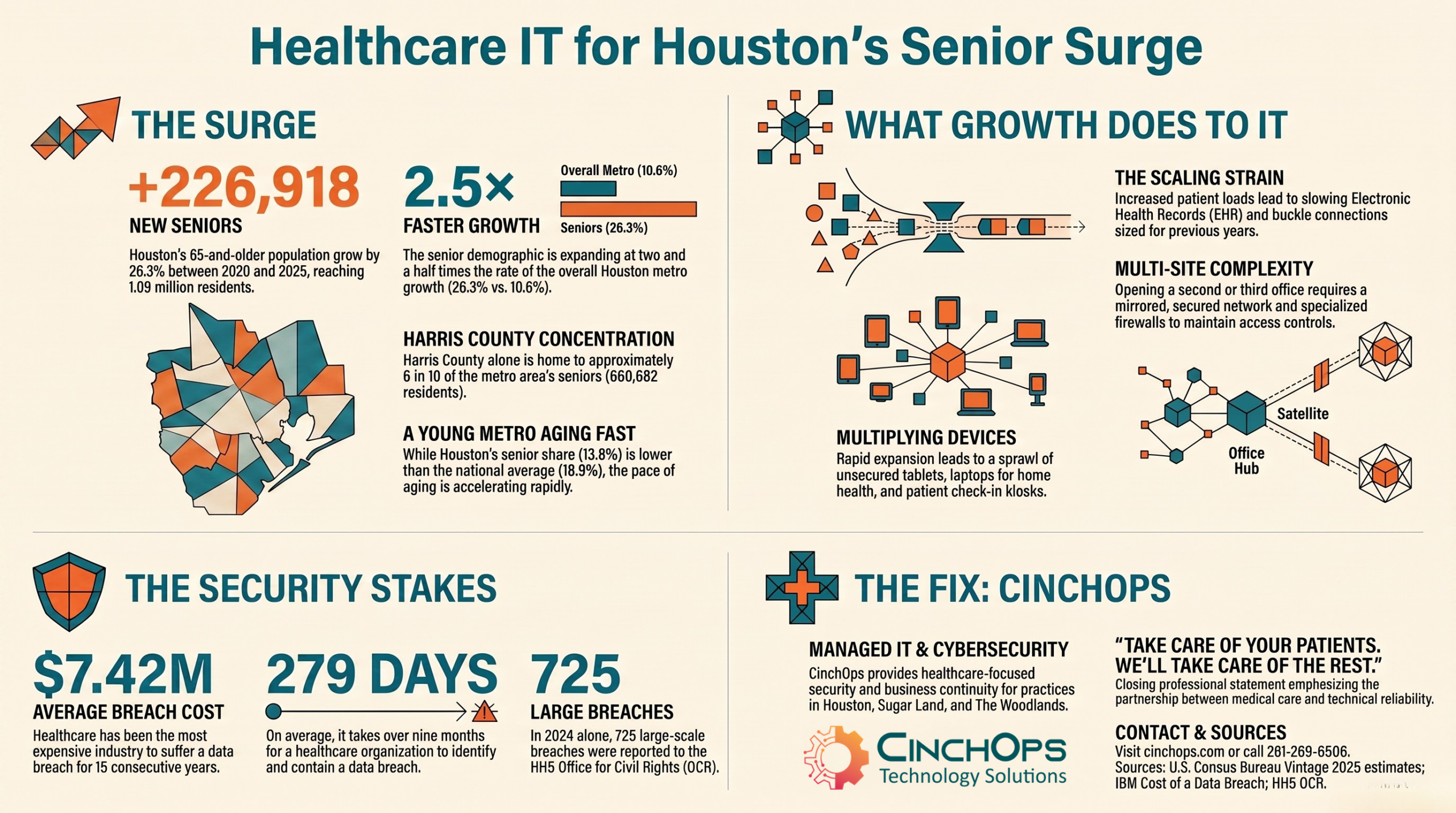
The reason is sitting in the latest Census numbers. The Houston metro's population aged 65 and older grew by 226,918 people between 2020 and 2025, a 26.3% jump and roughly two and a half times the rate the metro grew overall. More seniors means more patient visits, more home-health hours, more prescriptions, and more billing, and almost none of that happens without working technology behind it.
Why Is Houston's Healthcare Demand Growing So Fast?
The driver is demographic, and it is bigger than most owners realize.
Houston's 65-and-older population is its fastest-growing age group by a wide margin, and older patients use far more healthcare than younger ones.
Across the 10-county Houston metro, the number of residents 65 and older went from about 862,000 in 2020 to roughly 1.09 million in 2025. That is the +226,918 figure, and it works out to 26.3% growth in five years while the metro as a whole grew 10.6%. Seniors now make up 13.8% of the region. People in that age band see doctors more often, manage more chronic conditions, fill more prescriptions, and depend more on home health and senior care.
The pressure is not spread evenly. Some Houston-area counties are aging faster than others, which tells you where the demand for clinics, home health, and assisted living is concentrating:
- San Jacinto County is the oldest in the metro, with a median age of 45.0 and 23.8% of residents already 65 or older.
- Austin County (Bellville and Sealy) runs a median age of 41.9, with 22.3% over 65.
- Galveston County sits at 18.1% over 65, the highest share among the metro's larger counties.
- Fort Bend and Montgomery, the two biggest growth counties, are adding seniors in raw numbers even though their populations skew younger.
What a Patient Boom Does to a Practice's IT
Healthcare technology fails quietly, then all at once.
A practice that doubles its patient load does not just need more exam rooms. It needs an EHR, a network, and a security posture that can carry the extra weight.
In 35 years around IT, the pattern we see most with growing Houston practices is the same: the technology that ran fine for one location and three providers starts cracking when you add a second office in Sugar Land or The Woodlands and four more clinicians. The electronic health record gets slow at the worst possible time. The Wi-Fi drops in the new exam wing. Patient-portal logins pile up at the front desk. And the person who "handles the computers" is now a full-time job that nobody actually hired for.
Here is where the strain shows up first as a practice scales:
- Electronic health records. More patients and more providers mean more concurrent EHR sessions, and a server or connection sized for last year buckles under this year's load.
- Devices everywhere. Tablets at the bedside, laptops for home-health visits, and check-in kiosks all have to be secured, patched, and tracked, not just handed out.
- Second and third locations. A new office is a new network, a new firewall, and a new set of access controls that have to match the main site exactly.
- Front-desk overload. Scheduling, portal resets, and billing software questions become a daily drag on staff who should be helping patients.
Healthcare Is the Most Expensive Industry to Get Breached
Growth makes a practice a bigger, slower-moving target.
HIPAA does not care how busy you are, and attackers actively prefer healthcare because the data is valuable and the downtime is unbearable.
Healthcare has been the most expensive industry to suffer a data breach for more than a decade running, according to IBM's Cost of a Data Breach Report. Patient records sell for more than credit cards on criminal markets because they cannot be canceled, and a clinic that loses access to its EHR cannot simply close for the afternoon. The U.S. Department of Health and Human Services publishes every breach affecting 500 or more people, and the healthcare sector logs hundreds of them every year.
A growing practice raises its own risk in three ways. Each new device and login is one more door. Each new hire is someone who has not been trained yet on phishing and password rules. And each rushed expansion tends to leave a gap, an open remote-access tool or a shared password, that an attacker is happy to find. We see this twice a month with Houston-area businesses, healthcare and otherwise, and the medical ones carry the heaviest compliance penalty when it goes wrong.
- Ransomware shuts down scheduling, charting, and billing at once, which for a clinic means turning patients away.
- HIPAA penalties stack on top of the breach itself, and "we were growing fast" is not a defense the Office for Civil Rights accepts.
- Business associate risk grows with every new vendor, billing service, and cloud tool a scaling practice signs up for.
Outgrowing your IT faster than you can fix it?
If your practice has added patients, providers, or locations this year, it is worth a second set of eyes on the technology underneath it.
Talk to CinchOpsTelehealth Only Works If the Network Does
Remote and in-home care raised the stakes on uptime.
An older patient base leans heavily on telehealth and home visits, and both depend on a connection and a backup plan that hold up under load.
The senior surge did not just fill waiting rooms. It pushed a lot of care into homes and onto screens, where the margin for technical error is thin. A telehealth visit that freezes, a home-health tablet that cannot sync, or a phone system that drops a patient call is not a minor annoyance in healthcare. It is a missed appointment, a billing problem, and sometimes a safety issue. For practices serving older patients across spread-out counties like Galveston, Montgomery, and Fort Bend, reliable connectivity and a tested recovery plan stop being nice-to-haves.
- Connectivity that does not quit. A second internet line and smart routing keep visits and charting up when one circuit goes down.
- Tested backup and recovery. If the EHR goes dark, the question is how fast you are back, not whether you have a backup somewhere.
- Phones that follow the patient. A modern phone system keeps front-desk and on-call lines working across every location.
Your IT was sized for the business you were, not the business you're becoming. That gap stays invisible right up until the morning it isn't.
Lock down patient data before the practice gets bigger
HIPAA exposure grows with every new device, hire, and location. CinchOps hardens your network, trains your team, and watches for trouble so a growth year does not turn into a breach year. See our cybersecurity services built for Houston SMBs.
Explore CinchOps cybersecurity →How CinchOps Can Help Houston Healthcare Practices Scale
CinchOps is a managed IT services provider based in Katy, Texas, serving small and mid-sized businesses across the Houston metro area. CinchOps specializes in cybersecurity, network security, managed IT support, VoIP, and SD-WAN for businesses with 10 to 200 employees.
- Through managed IT support, your EHR, devices, and new locations are kept patched, monitored, and ready for the next wave of patients instead of patched up after they break.
- With cybersecurity and healthcare-focused security, we close the gaps that fast growth opens and keep you on the right side of HIPAA.
- Our business continuity and disaster recovery means a ransomware hit or outage does not turn into a day of turned-away patients.
- We support practices across Houston, Sugar Land, and The Woodlands, the same counties adding seniors the fastest.
Houston's aging boom is good news for the practices ready to serve it, and a quiet liability for the ones whose technology is already stretched. If your patient load has grown faster than your IT, the fix is not a bigger fire drill, it is a partner who treats your network and your patient data as seriously as you treat the patients. When you want a straight answer on where you stand, talk to CinchOps.
Frequently Asked Questions
Why is healthcare demand growing so fast in Houston?
The Houston metro's population aged 65 and older grew by 226,918 people from 2020 to 2025, a 26.3% increase and about two and a half times the metro's overall growth rate. Older residents use far more healthcare, which is filling medical practices, home-health agencies, and senior-care businesses across the region.
What IT problems hit a medical practice first when it grows?
The electronic health record slows under heavier load, new locations need their own secured networks, and devices like tablets and check-in kiosks multiply faster than anyone can track them. The front desk also gets buried in portal resets and software issues, which pulls staff away from patient care.
Why is healthcare such a big cybersecurity target?
Patient records are worth more than credit cards on criminal markets because they cannot be canceled, and clinics cannot afford downtime. Healthcare has been the most expensive industry for data breaches for more than a decade, per IBM's Cost of a Data Breach Report, and HIPAA penalties stack on top of the breach itself.
Does HIPAA still apply if my practice is growing quickly?
Yes. HIPAA obligations do not pause for a busy year, and the Office for Civil Rights does not accept fast growth as an excuse. Every new device, login, hire, and vendor adds risk, so a scaling practice needs access controls, training, and monitoring that keep pace with its size.
What does CinchOps do for Houston healthcare businesses?
CinchOps provides managed IT, cybersecurity, healthcare-focused security, and business continuity for small and mid-sized practices across Houston, Sugar Land, The Woodlands, and the surrounding counties. The goal is technology that scales with your patient load while keeping patient data secure and HIPAA obligations met.
Discover More
Resource
Sources
- Methodology: Original CinchOps analysis. We summed the population aged 65 and older across the 10 counties of the Houston-Pasadena-The Woodlands metro (CBSA 26420) from the Census Bureau's Vintage 2025 county estimates - the April 1, 2020 base versus the July 1, 2025 estimate - and computed every share, growth rate, and county ranking shown here from that source data. National comparisons use the same Vintage 2025 release.
- U.S. Census Bureau, Vintage 2025 Population Estimates (Houston-Pasadena-The Woodlands metro, age data by county)
- IBM, Cost of a Data Breach Report (healthcare as the costliest breached industry)
- U.S. Department of Health and Human Services, Office for Civil Rights Breach Portal
- U.S. Department of Health and Human Services, HIPAA


