


Houston Cybersecurity by the Numbers: the Gaps You Cannot See From Inside
The Houston Cybersecurity Gaps You Cannot See From Inside
We scanned 2,420 Houston-area businesses from the outside. The two categories they fail hardest are both pure configuration, and both are quick fixes.
Cybersecurity in Houston has a measurement problem: most owners judge their security from the inside, where everything looks fine, while attackers judge it from the outside, where the holes are obvious.
To close that gap, CinchOps ran the Houston Area Security Index, an external scan of 2,420 small and mid-sized businesses across twelve Houston-area cities and three industries, law firms, CPA practices, and manufacturers, using an external attack-surface assessment platform.
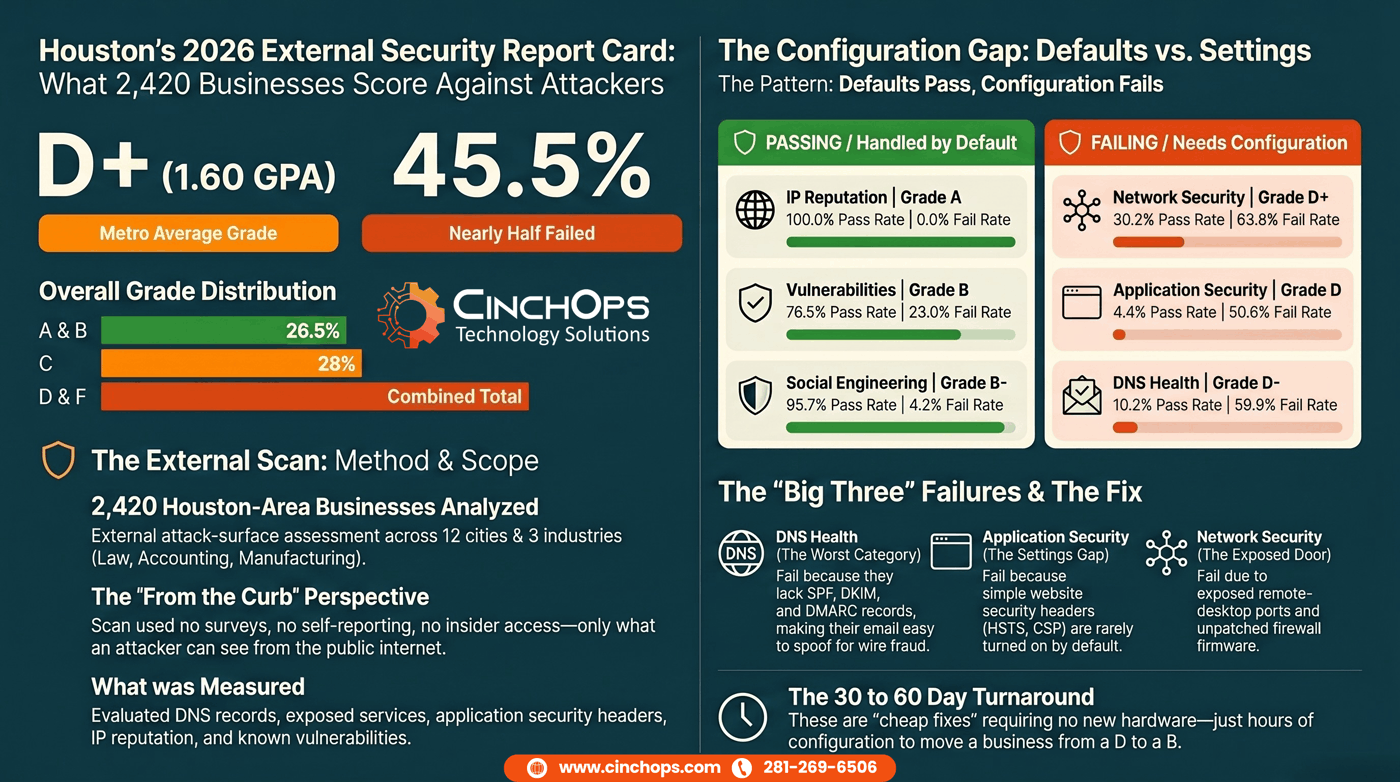
We did not use surveys, self-reporting, or insider access. We measured what any threat actor can see from the public internet: DNS records, exposed services, application security headers, IP reputation, and known vulnerabilities. The result was a D+ average across the metro, and a clear pattern underneath it. The index covers those three industries today, and we will keep expanding it with new industries across the Greater Houston area.
How are 45.5% of Houston businesses failing their security scan?
The metro-wide grade, before we break it into categories.
Across 2,420 businesses in the Houston Area Security Index, 45.5% earned a D or F, 27.9% earned a C, and only 26.5% earned a passing A or B. The metro average is a D+, or a 1.60 on a 4.0 scale.
Let's give the numbers some perspective. Put ten Houston business owners in a conference room and four or five of them have publicly visible security problems an attacker can see right now, without sending a single phishing email or stealing a single password. The holes are visible from the curb. The owners just have not walked outside to look.
| Security category | Grade (GPA) | Pass rate | Fail rate |
|---|---|---|---|
| IP Reputation | A (3.94) | 100.0% | 0.0% |
| Vulnerabilities | B (3.12) | 76.5% | 23.0% |
| Social Engineering | B- (2.91) | 95.7% | 4.2% |
| Network Security | D+ (1.95) | 30.2% | 63.8% |
| Application Security | D (1.55) | 4.4% | 50.6% |
| DNS Health | D- (1.25) | 10.2% | 59.9% |
The average grade is the least interesting part. The useful finding is what happens when you split the overall score into the six categories we measured. Some are nearly perfect across the whole metro. Others are a wreck. The difference between the two groups is not money. It is whether a setting got turned on.
Why do DNS health and application security fail when everything else passes?
One pattern explains nearly the whole table.
The categories Houston businesses pass are the ones their providers handle by default. The categories they fail are the ones that require someone to make a decision and change a setting.
Look at the top of the table. IP reputation is a clean A because hosting providers and internet service providers keep their address ranges off spam blacklists for you. Vulnerabilities score a B because Microsoft, Apple, and Adobe push patches automatically. Social engineering scores a B- because it flags public phishing exposure, leaked employee emails and lookalike domains, and most small firms have little for it to find. None of that took a local business owner doing anything. It came in the box.
Now look at the bottom. DNS health, application security, and network security all collapse, and they share one trait: they only get better when a person actively configures them. SPF, DKIM, and DMARC records do not write themselves. Content Security Policy and HTTP Strict Transport Security headers do not appear on a website by magic. An exposed remote-desktop port stays open until someone closes it. The metro is not failing because attacks got smarter. It is failing because the unglamorous setup work never got done.
This is the good news hiding in a bad average. A configuration failure is the cheapest kind of failure to fix. Nobody has to buy new hardware or rebuild a network. Someone just has to do the setup that should have happened on day one.
What does a failing DNS health score actually mean?
The single worst category in the entire Houston index.
DNS health is the lowest-scoring category in the Houston Area Security Index, with 59.9% of businesses failing and only 10.2% passing. In plain terms, most local companies have not set up the email records that prove their messages are really from them.
Want to see your own grade?
We will run the same external scan on your business and walk you through every failing category in plain language. No pitch, no obligation.
Talk to CinchOpsSPF, DKIM, and DMARC are three DNS records that tell the rest of the internet which servers are allowed to send email using your domain. Without them, anyone can spoof your address. A scammer can email your bookkeeper as the owner, ask for a wire transfer, and the message sails through because nothing on your domain says it is fake. The boss-email gift-card scam and the fake-invoice wire fraud both ride this exact gap. We see it constantly with Houston firms that never knew the records existed.
- SPF lists the mail servers allowed to send for your domain. Missing or wrong, and spoofed mail looks legitimate.
- DKIM signs your outbound mail so a receiving server can verify it was not tampered with in transit.
- DMARC tells receivers what to do with mail that fails SPF or DKIM, and reports who is sending as you. This is the one almost nobody has set to enforce.
- DNSSEC signs your DNS records so resolvers can trust they have not been tampered with, and it is commonly missing on a failing score.
The fix is a few hours of work, not a project. Publishing correct SPF, DKIM, and DMARC records, then moving DMARC from monitoring to enforcement, pulls a Houston business from a failing DNS grade to a passing one in under a week. There is no equipment to buy. It is one of the highest-return security tasks a small business can do, and most of the metro has simply never done it.
What is an application security failure, and why is it so common?
Why only 4.4% of Houston businesses pass this category.
Application security measures how your public website is configured, and it is the second-worst category in the index: 50.6% of Houston businesses fail and just 4.4% pass. This is almost always a website-settings problem, not a code problem.
When an external scan grades application security, it is checking the headers and encryption your site sends to every visitor's browser. Things like Content Security Policy, HTTP Strict Transport Security, and a clean modern TLS configuration. Today's hosting platforms support all of it, but the secure values are rarely switched on by default. A marketing agency builds the site, it works, it looks good, and nobody ever touches the security headers. Years later an external scan lights up red.
The thing that gets me about these scores is how straightforward the fixes are. DNS records and a few website headers are an afternoon of work, and they are sitting at the bottom of the list for almost every business in town. Nobody is failing because security is expensive. They are failing because nobody owns the setup.
Because the pass rate is so low across the whole metro, this is not a few sloppy outliers. It is the norm. The flip side is that it moves fast. A short audit of the site's headers and TLS settings, handed to whoever runs the marketing site, usually pulls the score from a D to a C or B within one billing cycle. The work is measured in hours, and it does not require rebuilding the website.
Your external grade is already public
Every gap in this article is visible to attackers right now, from outside your network. CinchOps fixes the configuration failures that drag Houston businesses down, starting with our cybersecurity services.
Explore CinchOps cybersecurity →How CinchOps Can Help With Cybersecurity in Houston
CinchOps is a managed IT services provider based in Katy, Texas, serving small and mid-sized businesses across the Houston metro area. CinchOps specializes in cybersecurity, network security, managed IT support, VoIP, and SD-WAN for businesses with 10 to 200 employees.
- Through cybersecurity services, we fix DNS health with correct SPF, DKIM, DMARC, and DNSSEC records, and fix application security with HSTS, the right security headers, and a clean TLS configuration, moving both from a D to a B.
- With managed IT support, we close exposed remote-desktop ports, patch firewall firmware on a schedule, and retire VPN appliances that have aged out, which is where the network security category goes wrong.
- With business continuity and disaster recovery, we keep backups immutable, off-site, and tested, so the day something does get through is a bad afternoon and not a closed business.
- We do this work for firms across Houston and Katy, with deep experience in law firms, CPA practices, and manufacturing.
If your business is one of the 2,420 in the Houston Area Security Index, your grade is already in there, and the failing categories are almost certainly the configuration ones. That is the best news a small business can get, because it means the fix is fast and affordable rather than a six-figure rebuild. If you want a straight read on where you stand and a short list of what to fix first, talk to CinchOps and we will show you exactly what an attacker sees.
Frequently Asked Questions
What is the Houston Area Security Index?
The Houston Area Security Index is a public dataset of external security scores for 2,420 small and mid-sized businesses across twelve Houston-area cities and three industries. CinchOps built it from external attack-surface scans of each business. Every grade reflects only what an attacker can see from the public internet, with no insider access.
Why do Houston businesses fail DNS health so badly?
DNS health is the worst category, with 59.9% of Houston businesses failing. It requires active configuration. SPF, DKIM, and DMARC records do not appear by default, so most companies that set up email years ago never published them. The fix takes a few hours and no new hardware.
Is a bad external security score expensive to fix?
Usually no. The two worst categories in the Houston index, DNS health and application security, are configuration problems. Publishing email records and correcting website security headers is hours of work, not a budget project. Most businesses move from a D to a B within 30 to 60 days.
How can my Houston business find out its own score?
Request a free external assessment from CinchOps. We run the same external scan used in the Houston Area Security Index, then walk you through each category in plain language and hand you a short, prioritized fix list. There is no obligation and no sales pressure.
What does CinchOps fix first on a failing score?
CinchOps starts with the cheapest, highest-return gaps: DNS records (SPF, DKIM, DMARC), website security headers and TLS, then exposed network services like open remote-desktop ports and aging VPN appliances. Immutable, tested backups round it out so a breach becomes recoverable rather than fatal.
Discover More
Resource
Sources
- CinchOps — Houston Area Security Index (2,420 external attack-surface scans across twelve cities and three industries; category, region, and overall grades)


