


Intelligence Is Now Manufactured, and AI Tokens Are the New Industrial Commodity
Token Consumption Patterns For Houston Businesses – Why Token Economics Belong On The CFO Dashboard
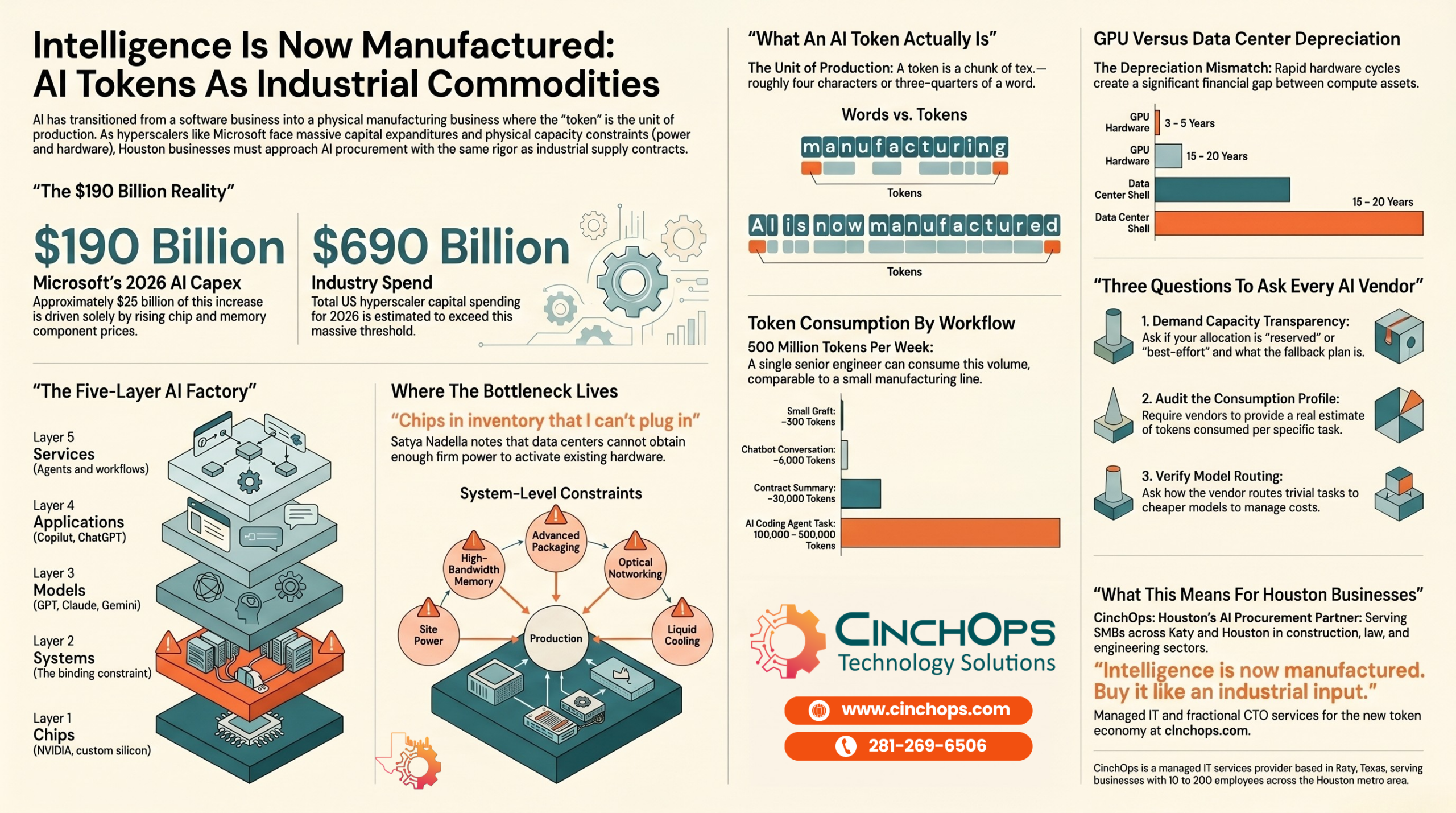
Microsoft will spend $190 billion in calendar 2026 and still expects to be capacity-constrained. AI is no longer a software business. It is a manufacturing business, and the unit of production is the token.
On April 29, 2026, Satya Nadella told Microsoft investors the company would spend $190 billion on capital expenditure this calendar year. In the same call, he said Microsoft expected to be capacity-constrained through year end. The most valuable software company on the planet, with $190 billion to spend, cannot manufacture enough AI capacity to meet its own demand.
Read that again. Then ask yourself what that means for your business when you sit down to buy an AI tool, sign a vendor contract, or roll out Microsoft 365 Copilot to your team in Houston, Katy, or Sugar Land. The rules changed. The way you buy AI in 2026 looks more like how a Houston construction firm orders steel for a project at the Texas Medical Center than how it buys QuickBooks.
An AI token is a chunk of text that an AI model reads or writes. A token is usually shorter than a word, and every token in and every token out costs money on someone's bill, including yours.
The word "manufacturing" gets broken into three or four tokens depending on the model. A short sentence might be 15 tokens. A long contract might be 20,000.
Tokens come in two flavors:
- Input Tokens. What you send to the AI: your prompt, the document you uploaded, the chat history the model has to read again every turn.
- Output Tokens. What the AI sends back: the answer, the summary, the code, the email draft. Output tokens usually cost four to five times more than input tokens because generating new text is harder than reading existing text.
OpenAI's documentation explains tokens this way: in English, one token is roughly four characters of text, or about three-quarters of a word. The model does not see words. It sees tokens. When you pay for an API call, you pay for the tokens in and the tokens out. When you pay for a Copilot seat or a Claude subscription, the vendor is paying for tokens on the back end and rolling the cost into your monthly bill.
The seat license you signed last quarter is a wrapper. Underneath, the vendor is buying token capacity from a hyperscaler. If hyperscaler capacity gets tight, your vendor either pays more for the same tokens or has to ration them. That cost or that rationing eventually shows up in your service.
Token consumption is wildly uneven across workflows. A short email might cost 500 tokens. An autonomous coding agent can chew through half a million for a single task, and most CFOs have zero visibility into the difference.
Asking Copilot to draft a one-paragraph email might consume 500 tokens. Running a single chatbot conversation might consume 5,000. Pointing an AI at a 50-page contract and asking for a summary can run 30,000 tokens. Modern coding agents that read your repo, plan a change, run tests, fix errors, and try again can easily consume 100,000 to 500,000 tokens for one task.
Token consumption is not linear with how impressive the output looks. A short, well-aimed prompt that produces a thoughtful answer might use 2,000 tokens. A vague prompt that triggers the model to think out loud, ask clarifying questions, and produce a sprawling response might use 20,000 to do the same work badly.
One detail from a recent conversation about AI procurement makes the point sharp. A senior engineer reported his personal token consumption over a single week: nearly 500 million tokens. One developer. One week. That is the volume of a small manufacturing line, and it is happening on laptops across the country right now without most CFOs having any visibility into the number.
Three things drive consumption inside your business:
- Context Length. Longer documents, longer chat histories, and bigger codebases all mean more tokens per call.
- Agent Loops. AI that calls itself in a loop, runs tools, and checks its own work multiplies token use quickly. One human task can trigger dozens of model calls.
- Retry And Concurrency. When the model fails or the user is impatient, the system retries. Every retry is a fresh token bill.
If your AI vendor cannot tell you which workflows in your business consume the most tokens, you are flying blind. That used to be a developer concern. In 2026 it is a board-level number.
NVIDIA describes modern AI as a five-layer cake: chips, systems, models, applications, and services. Each layer adds cost. Each layer can become a bottleneck. And each layer has to do its job for a token to make it from a prompt in your browser back to an answer on your screen.
- Layer One, Chips. The logic dies that do the math. GPUs from NVIDIA, custom silicon from Google, Amazon, and Microsoft. This is the layer people fixate on, but in 2026 it is rarely the binding constraint.
- Layer Two, Systems. Chips packaged with high-bandwidth memory, mounted on substrates, connected by optical and copper networking, racked in liquid-cooled cabinets, powered by megawatts of electricity, housed in purpose-built data centers. This is where the real bottleneck lives.
- Layer Three, Models. The trained AI models themselves. GPT, Claude, Gemini, Llama, Phi, the open-weight ecosystem. Cheaper to serve per token every quarter, but cheaper tokens drive more usage, and the demand on Layer Two keeps climbing.
- Layer Four, Applications. The software your team touches. Copilot, ChatGPT, the customer service bot on a vendor's site, the AI plugin in your CRM. Every application is a token consumer.
- Layer Five, Services. The agents, workflows, and end-to-end automations that string applications together. This layer consumes tokens fastest because services run in loops without a human waiting.
When you sign a contract with a vendor at Layer Four or Five, you are also signing up for the constraints of Layers One, Two, and Three whether you realize it or not. The vendor cannot deliver more service than the factory floor underneath them can manufacture.
On Microsoft's Q3 FY2026 earnings call, Satya Nadella did not just say the company was spending $190 billion. He attributed roughly $25 billion of that increase to higher memory and chip component prices alone, and made a comment that should be on every CIO's whiteboard.
"You may actually have a bunch of chips sitting in inventory that I can't plug in. In fact, that is my problem today."
Chips in warehouses. No power to plug them in. That is not a software bottleneck. That is a manufacturing and grid-capacity bottleneck.
Hyperscaler capital spending is tracking toward $690 to $725 billion across the top players in calendar 2026. Microsoft alone grew AI capacity 80 percent in fiscal 2026 and added one gigawatt of capacity in the March quarter. Azure AI hit a $37 billion annual run rate, up 123 percent year over year. Demand is not theoretical. Demand is breaking the factory.
Where the supply chain is actually getting squeezed:
- High-Bandwidth Memory. The fast memory chips that sit next to the GPU. Without enough HBM, the GPU sits idle. In 2025, a handful of AI chip designers consumed roughly 90 percent of global HBM supply.
- Packaging And Substrates. The process that physically integrates the logic die with the HBM stacks. You can have die, you can have memory; if you cannot package them together, you have nothing usable.
- Optical Networking. Once a cluster grows past hundreds of thousands of accelerators, copper hits limits on heat and distance. Optics is supply-constrained too.
- Firm Site Power. A national power surplus does not help if the data center site cannot get the gigawatt-scale interconnection it needs on a timeline that matches the chip delivery schedule.
- Liquid Cooling. Modern AI racks generate far more heat than the air-cooled designs most data centers were built for. Retrofits and new builds both take years.
Building a 500-plus megawatt AI campus from greenfield through transmission interconnection often takes three to five years. That timeline does not flex to match a viral product launch. It is industrial capacity, and industrial capacity has industrial lead times. The Greater Houston Partnership tracks data center buildouts in the region for exactly this reason: power, water, and land are now strategic regional assets, not just utility line items. Your cloud services strategy and your AI strategy are now the same conversation. The cloud you buy is the factory your AI runs in.
Most Houston SMBs are buying AI tools the same way they used to buy SaaS, and that math no longer works. The vendors are buying token capacity off a strained factory and packaging it as a seat license. Ask what is behind the seat before you sign the next one.
Software-as-a-service had a clean financial story: per-seat fee times headcount. AI breaks every step of that math, and CFOs need new vocabulary.
- Token Utilization. Hyperscalers measure how efficiently their accelerators are converting electricity and capex into served tokens. Low utilization means depreciation is burning while the asset sits half-idle. GPU depreciation runs three to five years. Data center shells run fifteen years or more. That mismatch matters.
- Reserved Versus Best-Effort Capacity. Cloud contracts used to be elastic in the marketing sense. AI contracts in 2026 increasingly include explicit capacity tiers. If your AI vendor will not tell you which bucket you are in, assume best-effort.
- Per-Token Pricing Pressure. Cost per token is falling rapidly because of efficiency gains, but total spend keeps climbing because token consumption per workflow keeps growing. Cheaper tokens make new use cases viable. New use cases generate more workflows. The bill goes up even as the unit price goes down.
- Hidden Human Supervision. Some AI products demo well because humans are quietly cleaning up the model's output behind the scenes. When that supervision goes away, product quality drops. Ask vendors what fraction of output is reviewed or corrected by humans today.
Need a translator between token economics and your operating budget?
Most Houston SMBs do not have a full-time CTO or CIO to run AI vendor diligence. CinchOps does this work as a fractional engagement, sized to your business.
Talk To CinchOpsBuilding applications from scratch used to mean hiring developers and paying salaries. That math is shifting. The raw material on the new bill of materials is tokens, and the cost is climbing fast.
Engineers now build software by typing English to an AI and reviewing what comes back. The 500-million-tokens-per-week engineer is not an outlier anymore. He is the early indicator of a pattern. When AI is good enough to ship production code from a description, every developer becomes a small factory. The factory's input is tokens. The factory's output is software. The factory's cost shows up not in a tooling line item but in a fast-growing AI services bill that nobody in finance is forecasting yet.
For a Houston SMB, the scratch-app reality lands in three places:
- Internal No-Code Apps. The internal app your operations team built with a no-code AI tool is consuming tokens every time it runs.
- Embedded AI Features. The "free" AI feature inside your line-of-business software is metered somewhere, and the vendor will pass that cost on.
- Custom Vertical Workflows. The custom workflow your CPA firm or law firm built to summarize client documents is racking up tokens per page, per matter, per month.
None of this is a reason to slow down AI adoption. The productivity gains are real. It is a reason to budget honestly, instrument consumption from day one, and treat token spend as a line item that needs the same governance as software licenses or payroll.
The temptation is to keep treating AI like software. Do not. Houston business owners running a 30-person law firm, a 60-person engineering shop, or a 120-person CPA practice are all about to face the same procurement reality Microsoft is facing at the hyperscaler level, just in miniature.
CinchOps is a managed IT services provider based in Katy, Texas, serving small and mid-sized businesses with 10 to 200 employees across the Houston metro area. CinchOps provides managed IT support, cybersecurity, cloud services, and fractional CTO and CIO advisory for businesses across Houston, Katy, Sugar Land, and the broader West Houston corridor. We work with verticals across construction, CPA firms, engineering firms, and wealth management whose AI cost profiles look nothing like a global hyperscaler, and our approach reflects that.
Three Questions To Ask Every AI Vendor Before Signing
- Capacity Allocation. What is my capacity allocation, and what happens if you get squeezed? Push for written terms on reserved versus best-effort, and ask for a concrete fallback plan if upstream capacity tightens.
- Workflow Token Profile. What is the token consumption profile of my actual workflows? Ask for a real estimate of tokens per task for your top three use cases. If they can show you, they understand their own product. If they cannot, you are buying a black box.
- Model Routing Strategy. How do you route my workflows to cheaper models when appropriate? Most vendors run every task through their most expensive model by default. Good vendors route trivial tasks to cheaper models without degrading the user experience.
Houston SMB AI Procurement Self-Check
- Allocation Type. Do you know whether your AI vendor is giving you reserved or best-effort capacity, in writing?
- Token Visibility. Can you see token consumption by workflow and by user across your AI tools right now?
- Routing Policy. Does your vendor route trivial work to cheaper models, or run every prompt through the most expensive one?
- Fallback Plan. If your primary AI vendor gets capacity-constrained next quarter, what is your operational plan B?
- Human Supervision Audit. Have you asked which workflows in your AI tools still rely on hidden human reviewers behind the scenes?
- Budget Governance. Is AI token spend on your CFO's monthly dashboard, alongside payroll, software, and rent?
Intelligence is now manufactured. The vendors who serve it are running factories. Your business is buying factory output. Buy it like an industrial input.
CinchOps treats AI like the industrial input it has become. We help Houston business owners get visibility into where token spend is going, structure vendor contracts that hold up when capacity tightens, and build the cloud and network foundation that AI workflows actually need to deliver.
Five places where a managed IT services provider with experience across construction, CPA firms, law firms, engineering, and wealth management adds real value:
- AI Vendor Diligence. Before you sign or renew, CinchOps reviews vendor contracts for reserved-versus-best-effort terms, allocation guarantees, and the written fallback plan that should kick in when upstream capacity tightens.
- Token Consumption Audits. We instrument your existing AI tools so finance and operations can see which workflows, which users, and which agents are driving the token bill, before it lands as a surprise on the credit card.
- Fractional CTO And CIO Strategy. For SMBs without a full-time technology executive, CinchOps provides the senior judgment to make AI procurement, vendor selection, and capacity planning decisions through our CTO and CIO services.
- Cloud And Network Foundation. Your AI strategy is now a cloud capacity strategy. CinchOps makes sure your cloud services, identity, and SD-WAN can actually deliver what your AI vendors promise.
- Industry-Specific Workflows. Token economics look different in a law firm than in a construction company. CinchOps configures AI tooling to your vertical's document, client-data, and compliance realities.
You do not need to become an AI procurement expert overnight. You need a partner who is already running these vendor conversations and watching the factory underneath.
Frequently Asked Questions
What is an AI token?
An AI token is a small chunk of text that an AI model reads or generates, usually shorter than a word. In English, one token is roughly four characters. AI vendors price by the token, charging separately for input tokens (what you send) and output tokens (what the model writes back, typically four to five times more expensive than input tokens).
Why is AI capacity-constrained when there seem to be enough GPUs?
The bottleneck sits below the GPU. AI accelerators need high-bandwidth memory, advanced packaging, optical networking, gigawatt-scale power, and liquid cooling to run useful workloads. Satya Nadella said on Microsoft's Q3 FY2026 earnings call that chips sit in inventory because data centers cannot get firm power to plug them in. The constraint is the full manufacturing stack.
How does the five-layer cake model help Houston businesses think about AI?
The five-layer cake (chips, systems, models, applications, services) gives business owners a map of where AI cost and risk live. When you buy a Layer Four application like Copilot, you inherit constraints from Layers One, Two, and Three. Knowing the layers helps you ask better vendor questions about capacity, routing, and fallback plans before signing a contract.
What should Houston SMBs ask their AI vendors about capacity?
Ask three questions. First, whether your capacity is reserved or best-effort, with a written fallback plan if supply tightens. Second, what the token consumption profile looks like for your specific workflows. Third, how the vendor routes work to cheaper models without degrading the user experience. If a vendor cannot answer these, treat the contract as higher-risk.
How can a managed IT services provider help with AI token costs?
A managed IT services provider with fractional CTO and CIO advisory can translate token economics into procurement language for the CFO, audit current AI tool spend, instrument token consumption across workflows, and run vendor due diligence before contracts get signed. For Houston SMBs, this is faster than hiring a full-time IT executive to handle AI strategy.
Discover More
Resources
Sources
- Microsoft Q3 FY2026 Earnings Call Transcript, April 29, 2026
- CNBC, Microsoft (MSFT) Q3 Earnings Report 2026
- Tom's Hardware, Microsoft Attributed $25 Billion of Its Record AI Budget to Memory and Chip Costs
- Fortune, Microsoft Meta and Google Just Announced Billions More in AI Spending
- Introl, Hyperscaler CapEx Hits $690 Billion in 2026
- NVIDIA Blog, AI Is a Five-Layer Cake
- OpenAI Help Center, What Are Tokens and How to Count Them
- NVIDIA Blog, What Are AI Tokens? The Language and Currency Powering Modern AI
- Deloitte Insights, AI Tokens: How to Navigate AI's New Spend Dynamics
- NVIDIA Technical Blog, Building Token-Metered AI Services on Telco AI Factories


