


How CinchOps Moved a Houston Manufacturer to a New Plant With Zero Downtime
Two Plants. One Network. Zero Downtime – A Phased, Zero-Downtime Plant Migration
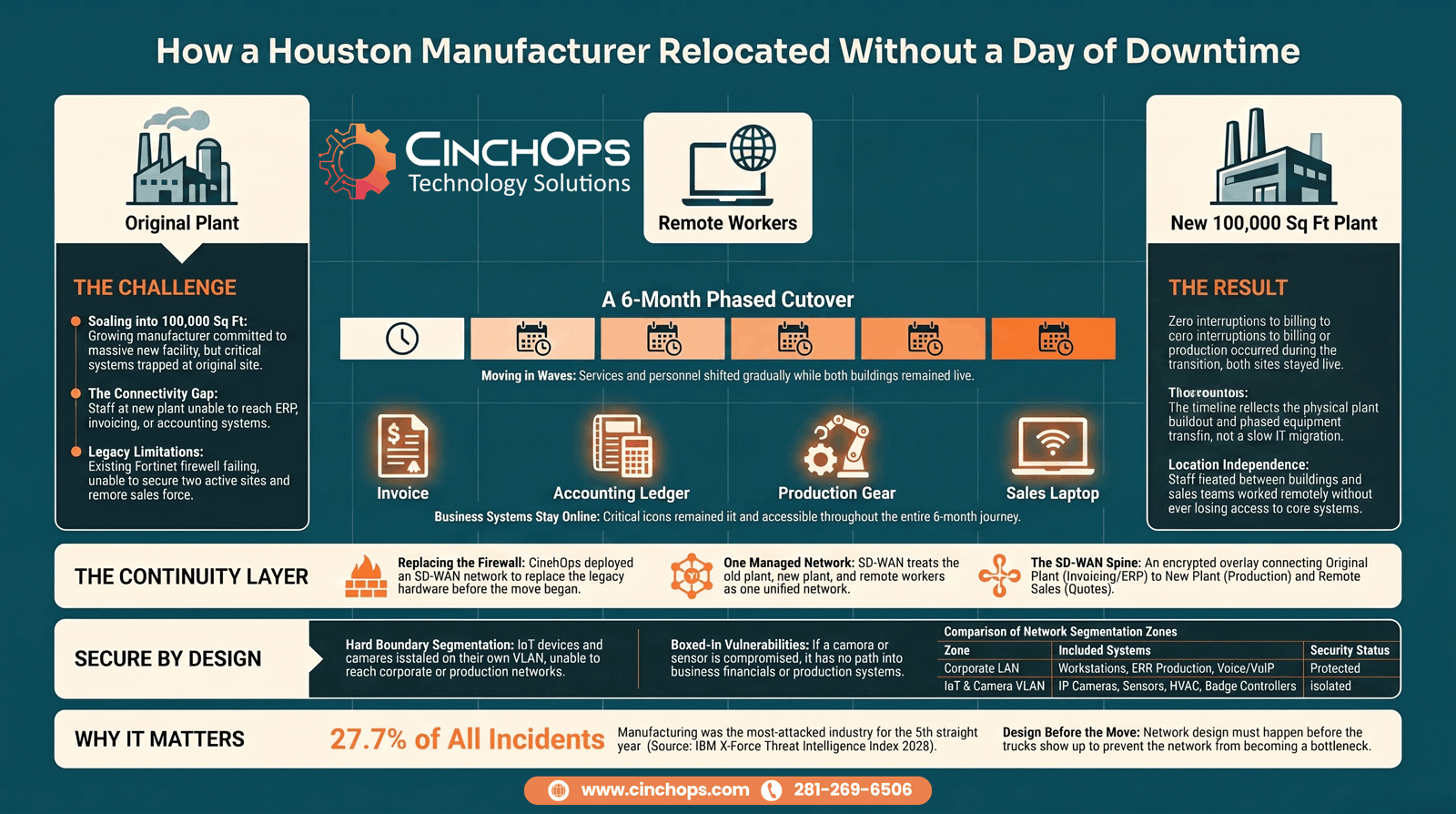
How a Houston manufacturer moved into a new 100,000 sq ft plant without stopping invoicing, production, or the sales team.
SD-WAN for manufacturing is what lets a company run two plants as one network while it physically moves from one building to another. That was the exact problem in front of a Houston-area manufacturer outgrowing its space and standing up a new 100,000 sq ft facility.
The company had signed a much larger building and started building out production at the new site. The catch: the people working at the new plant could not reach the systems that actually ran the business. Invoicing, accounting, and order entry all lived back at the original building. A new sales team was coming on at the same time, and they needed that same access to quote jobs and look up product. A single SD-WAN decision sat underneath all of it.
Why Couldn't A Growing Manufacturer Just Move Into Its New Plant?
A bigger building does not help if the systems that run the business are stuck in the old one.
The hard part of a plant move is not the forklifts. It is that the business has to keep running on systems that only exist at the building you are leaving.
This manufacturer was scaling up, not shutting down. Production was being built out at the new 100,000 sq ft site while the original plant kept shipping. People needed to be in both places, and the systems they depended on did not follow them across town. Here is what was actually blocking the move:
- No access to office systems across sites. Staff setting up the new plant could not reach invoicing, accounting, or order entry, because those systems still ran back at the original building.
- A new sales team with nowhere to connect. Incoming salespeople needed to reach the financial and accounting systems to build quotes and look up product, from the new site or on the road.
- A firewall that kept causing problems. The existing Fortinet firewall had been a recurring source of trouble, and it was never built to stitch two active sites together with reliable secure remote access.
- No room for an outage. Invoicing and production had to keep running the entire time. A hard cutover that took either site dark was off the table.
We see the same pattern with Houston manufacturers more than people expect: the building gets all the attention and the network gets none, right up until the first morning nobody at the new site can print a packing slip.
What Is SD-WAN, And Why Replace A Firewall With It?
A firewall guards one door. This company needed both buildings and a mobile sales team on one network.
SD-WAN, or software-defined wide area network, is a way to connect multiple business locations and remote workers into one managed network, with the same security policy applied across all of them.
A traditional firewall secures the edge of a single location. The Fortinet box at the original plant was doing that job and doing it badly, and it was never designed to be the thing that held two live sites and a remote sales force together through a months-long move. That is a different problem, and it needs a different tool.
SD-WAN treats the old plant, the new plant, and every remote salesperson as one network instead of three islands. That is what made a staged move possible. For this manufacturer it delivered:
- One Network Across Both Sites. Old-site systems stayed reachable from the new plant, so people could work from either building.
- Consistent Security Policy. The same rules applied everywhere, instead of separate configs drifting apart on separate boxes.
- Always-On, Zero-Trust Remote Access. The sales team connected to office systems with every user and device verified first.
- Built-In Segmentation. The network could be split into zones, which set up the security work in the next stage.
One thing SD-WAN did not do here, to be straight about it: this build was about site-to-site connectivity and secure remote access, not dual-internet failover. The goal was to move the business without stopping it, and the design was scoped to exactly that.
How Do You Move A Plant To A New Site Without Going Dark?
Not by flipping a switch. By moving services and people in stages while both sites stay live.
The plant buildout, physical move, and phased transfer of manufacturing equipment ran about 6 months. The IT side was not a 6-month migration - CinchOps set up the SD-WAN network up front so both sites stayed connected and the business kept running while the relocation moved in waves.
Spreading the relocation over months sounds slower, and it is. It is also the only version where the invoices keep going out while the manufacturing operation physically moves. The network setup that carried the business through it was deliberate:
- Replace The Firewall. Pull the troubled Fortinet and deploy SD-WAN at both locations.
- Link The Two Sites. Connect the buildings so systems at the original plant stayed reachable from the new one.
- Segment The Network. Carve out zones so production and office traffic stayed separate from cameras and IoT.
- Turn On Secure Remote Access. Stand up always-on zero-trust access for the remote sales team.
- Roll Services And Move People. Shift systems and personnel across in waves, with both sites operating at once.
- Stand Up The New Plant, Then Close The Old One. Move production over, migrate office systems last, and wind the original site down.
Opening a second site or relocating?
The time to design the network is before the move, not after the trucks show up. CinchOps plans multi-site cutovers that keep your business running.
Talk to CinchOpsHow Does Segmentation Keep Cameras And IoT Off The Production Floor?
By putting the gear that should never touch your business systems on a network of its own.
Network segmentation splits one physical network into separate zones, so a problem in one cannot spread into the others.
Manufacturing is not a low-risk target. IBM's X-Force Threat Intelligence Index 2026 found manufacturing was the most-attacked industry for the 5th year running, at 27.7% of all incidents. Cameras, sensors, and other connected devices are some of the weakest points on any plant network, which is exactly why they should not share a network with your financials.
So CinchOps built this on an exception model. One primary LAN carries the corporate, IT, production, and voice traffic. IoT devices and cameras sit on their own VLAN that cannot reach that LAN at all. If a camera or a sensor is ever compromised, it stays boxed in and has no path into business or production systems.
This is the same boundary CISA recommends in its Layering Network Security Through Segmentation guidance: put a wall between IT and the operational gear that has no business reaching it. For a plant, that wall is the difference between a nuisance and a shutdown.
How Does A Remote Sales Team Stay Connected During A Site Move?
By putting them on the same secure network as the office, wherever they happen to be working.
Always-on, zero-trust remote access put the new sales team on the same network as the office, from the new plant, the old plant, or the road.
The sales hires could not wait for the move to finish. They needed to quote jobs and look up product on day one, which meant reaching the accounting and financial systems no matter where those systems physically lived that week. The SD-WAN network gave them that, with every connection verifying the user and the device before granting access.
What Did The SD-WAN Migration Actually Deliver?
Two sites running as one network, and a move that the business never had to feel.
The new plant is fully operational, and the entire move happened without a single outage to billing or production.
Here is where things stand now that production has shifted to the new 100,000 sq ft site:
- Zero Downtime. Invoicing, accounting, and production kept running through the whole 6-month move.
- Both Sites Live At Once. Staff worked across the old and new buildings on the same systems while the new plant came online.
- Production Moved In Stages. Manufacturing equipment and operations transferred site to site without a hard stop.
- Sales Never Lost Access. The new team quoted and looked up product from day one, on-site or remote.
- A Stronger Security Posture. IoT and cameras are walled off from the business and production network.
- Final Stage In Progress. Office systems are migrating now, and the few staff still at the original site stay connected over the same SD-WAN as it winds down.
The move is not fully finished, and that is the point. A 6-month plant relocation that the business never had to feel, with invoices going out, production running, and sales quoting throughout, is what business continuity actually looks like.
You don't move a factory by shutting everything off on Friday and hoping it's back Monday. You build one network across both buildings, move services in stages, and the business never feels it. The invoices keep going out the entire time.
One network for every site, plant, and remote worker
CinchOps designs and manages SD-WAN networks that connect all your locations with consistent security and segmentation built in, so a move or a new site does not mean a new set of problems.
Explore SD-WAN with CinchOps →How CinchOps Can Help Houston Manufacturers
CinchOps is a managed IT services provider based in Katy, Texas, serving small and mid-sized businesses across the Houston metro area. CinchOps specializes in cybersecurity, network security, managed IT support, VoIP, and SD-WAN for businesses with 10 to 200 employees.
- Through SD-WAN and network design, we connect multiple sites and remote teams into one secure, segmented network.
- With managed IT support, we keep the office and the production floor running on one plan instead of two providers pointing at each other.
- Our cybersecurity and network segmentation work keeps IoT, cameras, and production systems isolated from each other.
- We support manufacturers across Houston, Katy, and Sugar Land on both sides of the IT and OT boundary.
A site move is the moment your network either proves itself or becomes the reason the move drags on for months. Plan it as a phased cutover on one network and the business keeps running; treat it as an afterthought and you spend the first weeks in the new building unable to send an invoice. If you are relocating or opening a second location, talk to CinchOps before the lease is signed, not after.
Frequently Asked Questions
What is SD-WAN for a multi-site manufacturer?
SD-WAN, or software-defined wide area network, connects a manufacturer's locations and remote workers into one managed network with consistent security. For a company running two plants during a move, it lets both buildings and the sales team work off the same systems, with segmentation and secure remote access built in.
Can you relocate a manufacturing plant without downtime?
Yes. The new plant buildout and the phased move of manufacturing equipment took about 6 months. CinchOps stood up one SD-WAN network up front so both sites stayed live the entire time, keeping invoicing and production online. The IT systems were not migrated over 6 months; the network ensured business continuity throughout.
Why replace a firewall with SD-WAN during a site move?
A traditional firewall secures one location's edge. It was never built to stitch two active sites together with reliable connectivity and always-on remote access. SD-WAN treats every building and remote user as one network, applies the same security policy across all of them, and makes a staged, multi-site move possible.
How does network segmentation protect manufacturing IoT and cameras?
Segmentation splits one network into separate zones. CinchOps put corporate, IT, production, and voice on the main LAN, and isolated IoT devices and cameras on their own VLAN that cannot reach it. A compromised camera or sensor stays contained and cannot pivot into business or production systems, which CISA recommends for IT and OT boundaries.
How do remote salespeople securely reach office systems during a move?
Through always-on, zero-trust remote access tied to the SD-WAN network. The sales team reached accounting and product systems to build quotes from the new site, the old site, or the road. Every connection verifies the user and device first, so access stays secure no matter where someone is working.
Discover More
Resource
Sources
- IBM, X-Force Threat Intelligence Index 2026: manufacturing the most-attacked industry for the 5th consecutive year, at 27.7% of incidents.
- CISA, Layering Network Security Through Segmentation: guidance on boundaries between IT and OT networks.


