


Houston Industry AI Adoption: Which Sectors Lead and Which Lag
Houston’s Field Industries And The AI Opportunity – Why Oil, Gas, And Construction Trail On AI
New U.S. Census data shows tech and finance racing ahead while Houston's signature industries, oil and gas and construction, sit near the bottom. Here is why that is an opening.
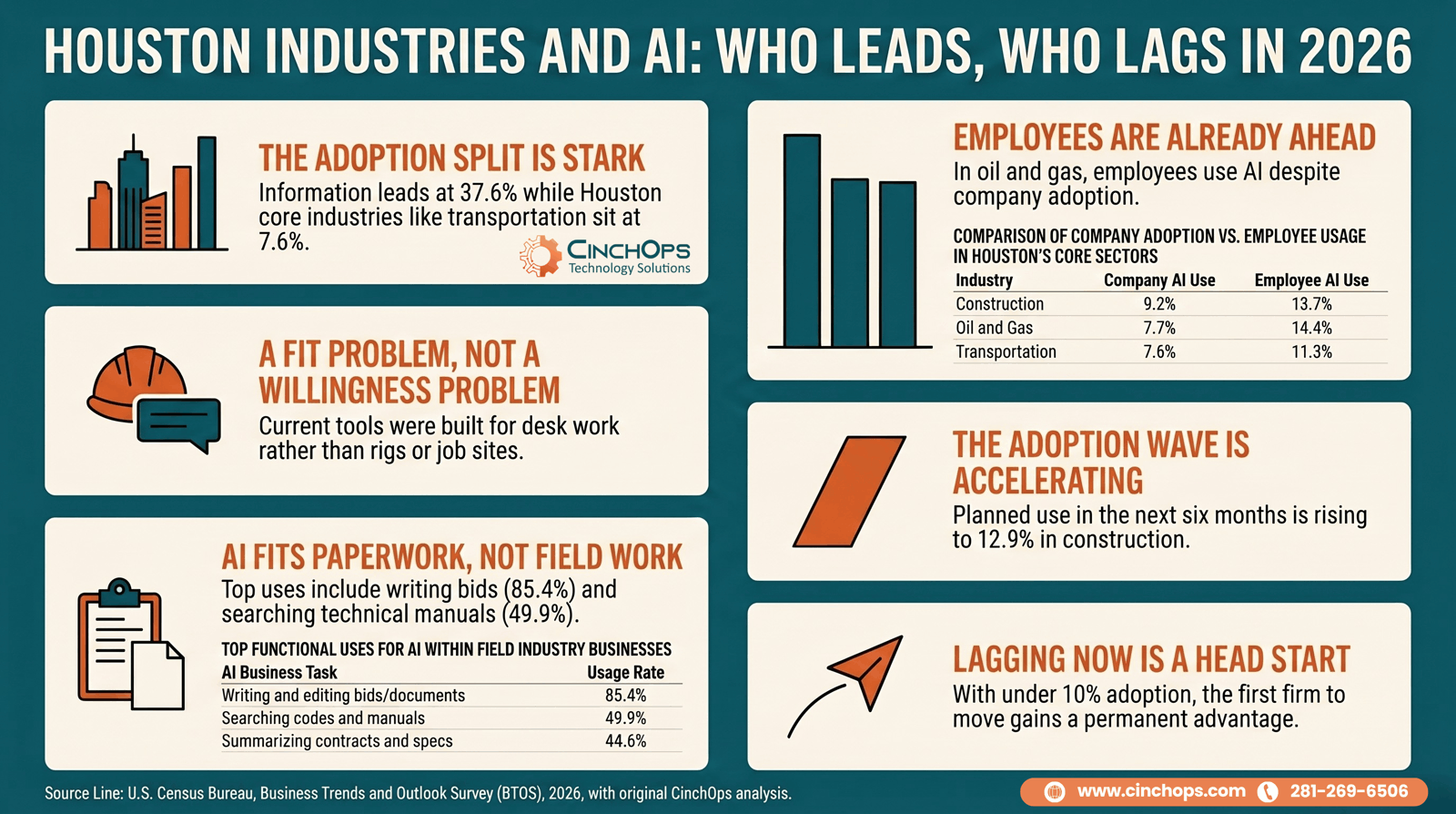
Houston industry AI adoption splits hard by sector. The Information industry leads the country at 37.6%, while oil and gas extraction at 7.7% and construction at 9.2%, two industries that built Houston, sit among the slowest in the nation. Those numbers come from the U.S. Census Bureau's Business Trends and Outlook Survey for 2026.
This is the industry view of a bigger finding. Our 2026 Houston Small Business AI Report showed the metro overall sits 18th of the 25 largest, and a big part of why is the mix of industries that power the local economy. Houston runs on energy, construction, and logistics, and those are exactly the sectors moving slowest on AI.
CinchOps is a managed IT services provider based in Katy, Texas, serving small and mid-sized businesses with 10 to 200 employees across the Houston metro area. We run managed IT, cybersecurity, and automation for oil and gas, construction, energy and utilities, manufacturing, and engineering firms, so we read this data through the eyes of the field businesses we work with.
Which Houston Industries Use AI, and Which Do Not
Knowledge-work sectors race ahead. Energy, construction, and logistics sit near the bottom.
AI adoption by industry runs from 37.6% at the top to under 8% at the bottom. The leaders are Information at 37.6%, professional, scientific, and technical services at 34.2%, and finance and insurance at 30.4%. The laggards are the industries that define Houston: oil and gas extraction at 7.7%, transportation and warehousing at 7.6%, and construction at 9.2%.
The pattern is not random. The sectors at the top run on documents, data, and screens, which is exactly what today's AI tools were built to handle. The sectors at the bottom run on job sites, rigs, trucks, and shop floors. Health care lands in the middle at 20.7%, and manufacturing at 12.4%, both held back by the same gap between desk work and real-world work.
- Leaders: Information 37.6%, professional and technical services 34.2%, finance and insurance 30.4%.
- Middle: health care 20.7%, wholesale 13.6%, retail 12.6%, manufacturing 12.4%.
- Houston's core, near the bottom: construction 9.2%, oil and gas extraction 7.7%, transportation and warehousing 7.6%.
Why Oil, Gas, and Construction Lag on AI
It is a fit problem, not a willingness problem. The popular tools were built for desk work.
Houston's field industries are behind on AI because the most common tools, ChatGPT, Copilot, and Gemini, were built for office work first. A framing crew, a pump technician, or a dispatch team does not spend the day at a keyboard, so a generic chatbot does not obviously fit their work.
The leaders adopted fast because the fit was easy. A marketing team or an accounting firm can point AI at emails, reports, and spreadsheets on day one. A construction or oil and gas company has to do more work to connect AI to estimating, scheduling, inspection reports, and compliance paperwork. The value is there, but someone has to translate the tool into the trade, and most owners are too busy running jobs to do that themselves.
In 35 years working with field businesses around Houston, the pattern we see is not resistance. It is a backlog. Owners know AI matters, but it sits behind the bid that is due Friday and the crew that is short two people. The gap is real, and it is an execution gap, not an attitude gap.
Why Lagging Now Is a Head Start, Not a Loss
Almost nobody in these trades has moved, and the usage is already on the ground.
Being early in an industry that is mostly waiting is a competitive advantage. When fewer than 1 in 10 oil and gas or construction firms use AI company-wide, the first one in a trade that does it well stands out to customers, partners, and the best hires.
| Houston-core industry | Companies using AI | Employees already using AI |
|---|---|---|
| Oil & Gas Extraction | 7.7% | 14.4% |
| Construction | 9.2% | 13.7% |
| Transportation & Warehousing | 7.6% | 11.3% |
Intent is moving the right way too. Construction firms expecting to use AI in the next six months rose to 12.9%, oil and gas to 9.9%, and transportation to 10.7%, each above where they are today. The wave is coming to these trades whether or not any single owner plans for it. The choice is whether you lead it in your market or follow it.
An oil and gas or construction company in Houston that starts using AI this year is not behind, it is ahead. Almost nobody in the field has moved yet, so the first firm that does gets a head start its competitors cannot buy back later.
Your Crew Already Uses AI. We Help You Make It Count.
The Census shows employees in oil, gas, and construction are already using AI faster than their companies are. Scattered use does not move the business. CinchOps turns it into a managed workflow, matching the right tools to estimating, paperwork, and back-office tasks so the gains are real and repeatable. See how with business process automation for Houston field businesses.
Put AI to work in your trade →Where AI Actually Fits in a Houston Field Business
The fit is in the paperwork and the back office, not the field work itself.
AI fits a field business wherever there is writing, reading, or research to do. Census data shows the top tasks businesses already hand to generative AI are writing and editing documents (85.4%), summarizing documents (44.6%), and searching for information or technical help (49.9%), all of which an oil and gas, construction, or logistics company does every day.
The trick is to skip the hype and pick one task that eats your week. Here is where the data says the value lands for a trade business.
- Bids and proposals. Drafting and editing scopes, cover letters, and proposals is the single most common AI task at 85.4%. For a contractor, that is hours back on every bid.
- Reading the fine print. Summarizing contracts, specs, RFPs, and inspection reports (44.6%) turns a 60-page document into a one-page brief before a job starts.
- Daily logs and compliance paperwork. Information processing and filing (34.7%) covers the safety forms, daily reports, and permit paperwork that pile up on every project.
- Looking things up. Searching codes, standards, equipment manuals, and technical help (49.9%) gets a field tech an answer in seconds instead of a phone call.
- Scoping and research. Researching new methods, materials, or job approaches (30.0%) helps an estimator size up unfamiliar work faster.
None of this replaces the welder, the operator, or the project manager. It clears the paperwork that keeps them off the job. That is the realistic, profitable version of AI for a Houston trade business, and it is available right now.
Run an Oil, Gas, or Construction Shop in Houston?
We will help you find the one or two tasks where AI pays off first, set it up, and keep it running, so you lead your trade instead of chasing it.
Talk to CinchOpsHow CinchOps Helps Houston's Field Industries Adopt AI
We translate AI into your trade, then keep it running and secure.
CinchOps is a managed IT services provider based in Katy, Texas, serving small and mid-sized businesses across the Houston metro area. CinchOps specializes in cybersecurity, network security, managed IT support, VoIP, and SD-WAN for businesses with 10 to 200 employees.
- Through business process automation, we pick the one or two workflows where AI pays off first and wire them into how your crew already works.
- For oil and gas, construction, and manufacturing firms, we match the tools to estimating, reporting, and compliance, not generic office tasks.
- With CTO and CIO services, we give owners the outside leadership to decide where AI belongs without hiring a full-time executive.
- We serve owners across Houston, Katy, and the Energy Corridor, including engineering and energy services firms.
Your trade being slow to adopt AI is not a weakness, it is a window. The owners who move while the field is wide open are the ones who set the pace for everyone else. If you want a partner who has read the data and works with Houston field businesses every day, talk to CinchOps.
Frequently Asked Questions
Which industries use AI the most in 2026?
The Information sector leads at 37.6%, followed by professional, scientific, and technical services at 34.2% and finance and insurance at 30.4%, according to the U.S. Census Bureau's Business Trends and Outlook Survey for 2026. These knowledge-work industries adopted fastest because today's AI tools fit document and screen-based work.
Why do oil and gas and construction lag on AI?
Oil and gas extraction (7.7%) and construction (9.2%) lag because the popular AI tools were built for office work, not field work. A pump technician or framing crew does not work at a keyboard, so connecting AI to estimating, inspections, and compliance paperwork takes extra effort most busy owners have not had time for.
Are Houston's energy and construction firms really behind on AI?
On company-wide adoption, yes. But their employees are already ahead. Census data shows 14.4% of oil and gas businesses have employees using AI versus 7.7% company-wide, and construction shows 13.7% versus 9.2%. The tools are already in use on the ground, just not organized into a managed workflow.
Where can a construction or oil and gas company use AI?
The best fits are paperwork and research, not field work. AI drafts and edits bids and proposals, summarizes contracts, specs, and inspection reports, handles daily logs and compliance forms, and searches codes and manuals. Census data shows writing and editing (85.4%) is the most common business AI task today.
Is it too late for a Houston field business to start with AI?
No. Fewer than 1 in 10 oil and gas or construction firms use AI company-wide, so the field is wide open. A trade business that adopts AI now is early, not late, and stands out to customers and hires. Starting with one high-value task, like bids or reporting, is the fastest way in.
Discover More
Resource
Sources
- U.S. Census Bureau, Business Trends and Outlook Survey (BTOS) 2026 AI Supplement - sector estimates of AI use, employee use, and six-month plans
- CinchOps, The 2026 Houston Small Business AI Report - metro and national analysis of the BTOS AI data
- U.S. Census Bureau, About the Business Trends and Outlook Survey - methodology and survey design


