


Small Business Cybersecurity in 2026: What Houston Owners Decide
Small Business Cybersecurity in 2026: A Decision Guide for Houston Owners – Which Security Controls Are Actually Worth the Money for an SMB?
A plain-English guide to the threats, the controls worth paying for, and whether to build security in-house or hire it out.
Small business cybersecurity is the set of controls, habits, and outside help that keep a 10-to-200-person company from losing its money, data, and time to an attacker. In 2026, for a Houston business, it is no longer optional and no longer just antivirus.
Here is the uncomfortable part most pitches skip. Attackers do not skip you because you are small. They target you because you are small, since smaller firms tend to have weaker controls and thinner IT coverage than the enterprises that get the headlines. A 30-person engineering shop in Katy and a 600-person manufacturer face the same phishing kits, the same ransomware crews, and the same stolen-password marketplaces.
This is a decision guide, not a fear pitch. It walks through the 4 questions a Houston owner actually has to answer in 2026, with named numbers and a clear position on each. No 40-item checklist you will never finish.
What Does Small Business Cybersecurity Actually Mean in 2026?
A working definition, minus the jargon.
Small business cybersecurity is the practice of protecting a company's accounts, devices, data, and money from attackers using a layered set of controls and monitoring, sized for a business with limited IT staff and budget. It is risk management, not a product you install once.
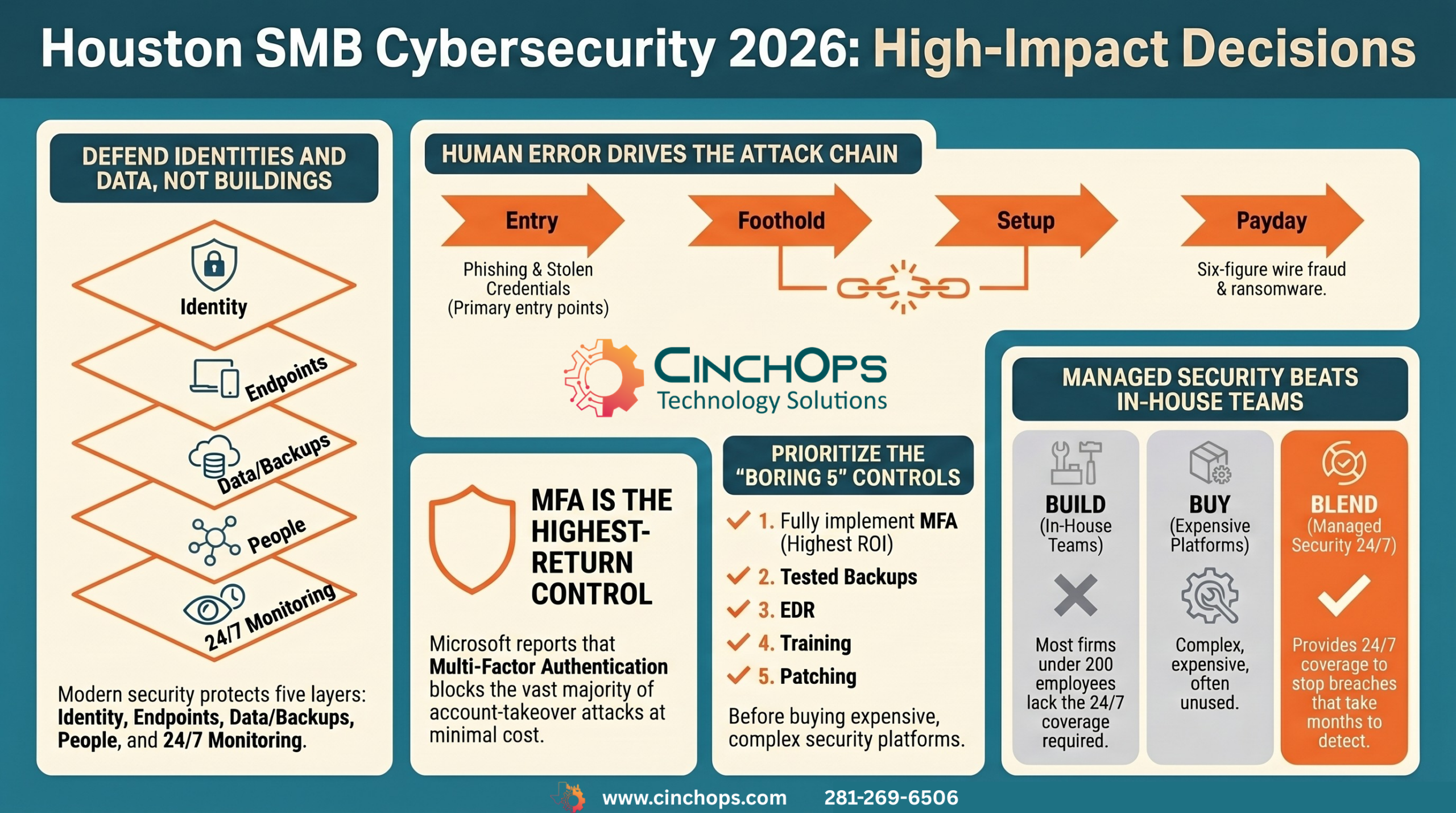
The old model was a firewall and antivirus, set up once and forgotten. That model is dead. Work now happens across laptops, phones, cloud apps, and home Wi-Fi, so the thing you are defending is no longer a building with a server closet. It is a sprawl of identities and logins. The 2026 Verizon Data Breach Investigations Report has tracked for years that stolen credentials and phishing sit near the top of how breaches start, and neither one cares whether you own a firewall.
For a Sugar Land CPA practice or a Cypress contractor, that shift matters. Your most valuable target is not the server anymore. It is the email account your bookkeeper logs into and the Microsoft 365 tenant that holds client files. Security in 2026 means protecting those identities first.
- Identity: who can log in, with what password, and whether a second factor stands in the way.
- Endpoints: the laptops and phones where work and malware both land.
- Data and backups: where files live and whether you can get them back after an attack.
- People: the staff who click, approve, and wire money, and how well they spot a fake.
- Monitoring: someone or something watching for trouble after hours, not just during business hours.
Which Threats Actually Hit Small Businesses?
4 patterns cause most of the damage. The rest is noise.
The threats that actually hit Houston small businesses are phishing, ransomware, business email compromise, and stolen credentials. They are connected: a stolen password or a clicked phishing link is usually the first step toward the ransomware or wire fraud that follows.
You do not need to track 200 threat names. The 2026 Verizon DBIR keeps pointing at the same short list as the way breaches begin for smaller firms, and it is the human side, not some exotic zero-day, that does the work. Here is what each one looks like in practice.
- Phishing: a fake email or text that gets someone to type a password into a fake login page or open a malicious file. Still the most common front door.
- Ransomware: attackers encrypt your files and demand payment, often after quietly stealing data first so they can threaten to leak it.
- Business email compromise (BEC): a criminal gets into or spoofs an email account, then sends a believable request to change banking details or wire money. The FBI ranks BEC among the costliest cybercrimes by total losses.
- Stolen credentials: usernames and passwords bought on criminal markets or reused from old breaches, used to walk straight in through a real login.
The reason these win is speed and cost. The IBM 2026 Cost of a Data Breach report put the global average breach cost in the multimillion-dollar range and found organizations still take months, not days, to identify and contain a breach. For a small business, that gap is the whole ballgame. An attacker sitting in your email for weeks before anyone notices is how a phishing click turns into a six-figure wire fraud.
We see the same pattern across Houston more than people expect: the boss-gift-card text, the fake invoice with new bank details, the password that worked because it was reused from a personal account. None of it is sophisticated. All of it works because nobody was watching.
Not sure which of these you are actually exposed to?
A free security assessment shows where your accounts, devices, and email defenses stand against the threats that hit businesses your size.
Talk to CinchOpsWhich Controls Matter Most for the Money?
5 controls block most of what hits an SMB. Buy these before anything else.
The controls that matter most for a small business budget are multi-factor authentication, tested backups, endpoint detection and response, security awareness training, and disciplined patching. Together they block or blunt the large majority of attacks that actually reach a Houston SMB.
Security spending follows a brutal curve. The first few hundred dollars per user buys most of your protection. The next several thousand buys diminishing returns. So spend in order. Here is the order, ranked by what stops the most damage per dollar.
- Multi-factor authentication (MFA): a second step at login that makes a stolen password nearly useless. Microsoft has reported MFA blocks the overwhelming majority of account-takeover attacks. It is inexpensive, fast, and the single highest-return control you can turn on.
- Tested backups: copies of your data you have actually restored from, kept offline or immutable so ransomware cannot reach them. An untested backup is a guess, not a safety net.
- Endpoint detection and response (EDR): modern protection that watches behavior on laptops and servers, catches what antivirus misses, and can isolate a machine mid-attack.
- Security awareness training: short, regular practice that teaches staff to spot phishing and BEC. Since people are the most-attacked layer, this is one of the lowest-cost real defenses.
- Patching: keeping Windows, browsers, and apps current so known holes get closed before attackers use them. Unglamorous, and it quietly prevents a large share of intrusions.
Notice what is not on the list: expensive appliances, a wall of dashboards, or a tool with "AI" in the name. Those come later, if ever. A Katy law firm that turns on MFA everywhere, tests its backups, runs EDR, trains its people, and patches on a schedule has done more for its security than one that bought a six-figure platform and configured none of it.
| Control | What it stops | Impact | Effort / cost |
|---|---|---|---|
| MFA | Stolen-credential logins, account takeover | Very high | Low |
| Tested backups | Permanent loss from ransomware | Very high | Low to medium |
| EDR | Malware and ransomware on devices | High | Medium |
| Awareness training | Phishing and BEC clicks | High | Low |
| Patching | Exploits of known vulnerabilities | Medium to high | Low to medium |
Most owners think the answer is a bigger budget. It isn't. The companies that get breached usually skipped the basics, MFA and tested backups, while debating an expensive tool they never finished setting up. Do the boring five first, completely, then talk about the rest.
Should You Build Security In-House or Hire a Managed Provider?
The honest answer depends on size, risk, and whether anyone is watching at 2am.
Most Houston businesses under 200 employees are better served hiring a managed provider for security than building an in-house team. Real security needs coverage nights and weekends, specialized skills, and tools that are expensive per seat alone, which rarely pencils out below a certain headcount.
The math is simple once you spell it out. A capable security analyst is hard to hire and costs well into six figures, and you need more than one to cover 24 hours. Attackers do not work 9 to 5. The IBM 2026 report's long breach-identification times exist partly because no one is watching after hours at most small firms. One person who also runs the help desk is not monitoring at 2am on a Saturday.
- Build in-house when: you are large enough to staff a real rotation, your industry demands it, and you can fund the tools and the people who run them.
- Hire a managed provider when: you want round-the-clock monitoring, predictable cost, and access to skills and tooling you cannot justify buying alone. That is most SMBs.
- Co-managed when: you have a capable internal person or team and want a provider to add monitoring, after-hours coverage, and specialized security depth on top.
There is no prize for doing this the hard way. A managed provider spreads the cost of senior people and enterprise tools across many clients, so a 40-person Cypress firm gets coverage it could never staff alone. The question is not whether you are smart enough to run security yourself. It is whether you want your best people doing that instead of the work that makes you money.
The 5 controls, run and watched for you
MFA, tested backups, EDR, training, and patching only protect you if someone keeps them running and watches the alerts. CinchOps delivers all of it as managed cybersecurity for Houston businesses, with monitoring that does not clock out at 5pm.
Explore CinchOps cybersecurity services →How CinchOps Can Help Secure Your Small Business
CinchOps is a managed IT services provider based in Katy, Texas, serving small and mid-sized businesses across the Houston metro area. CinchOps specializes in cybersecurity, network security, managed IT support, VoIP, and SD-WAN for businesses with 10 to 200 employees.
The 4 decisions in this guide are the ones we walk Houston owners through every week. The work is not glamorous, and that is the point: get the high-return controls in place, keep them running, and have someone watching when an attacker tries the door at midnight.
- With managed cybersecurity, we deploy and run MFA, EDR, training, and patching, then monitor the alerts so nothing sits unnoticed.
- Through managed IT support, we keep the systems behind your security fast, current, and reliable.
- For business continuity and disaster recovery, we build and test the backups that turn a ransomware hit into a bad afternoon instead of a closed business.
- Across industries like law firms, CPA firms, and construction, we fit security to the compliance and workflow each business actually has.
- From Houston to Katy and Sugar Land, we cover businesses across the metro.
If you only act on one thing from this guide, turn on MFA everywhere and confirm your backups actually restore. Then decide honestly whether running the rest belongs on your team's plate or someone else's. If you want a straight read on where your business stands before you spend a dollar, talk to CinchOps.
Frequently Asked Questions
What is small business cybersecurity?
Small business cybersecurity is the practice of protecting a company's accounts, devices, data, and money from attackers using a layered set of controls and monitoring, sized for a business with limited IT staff and budget. In 2026 it centers on protecting logins and identities, not just a firewall.
What are the biggest cybersecurity threats to small businesses?
The threats that hit small businesses hardest are phishing, ransomware, business email compromise, and stolen credentials. The 2026 Verizon DBIR points to these human-driven patterns as how most breaches begin. A clicked link or reused password is usually the first step toward wire fraud or ransomware.
What cybersecurity controls give the best value for a small business?
The best-value controls are multi-factor authentication, tested backups, endpoint detection and response, security awareness training, and patching. MFA gives the highest return because it makes stolen passwords nearly useless. Together these 5 block or blunt most attacks that reach a typical Houston SMB, at modest cost.
Should a small business hire a managed security provider or build a team?
Most Houston businesses under 200 employees are better off hiring a managed provider. Real security needs nights-and-weekends coverage, specialized skills, and costly tools that rarely pencil out for a small in-house team. A managed provider spreads those costs across clients and watches around the clock.
How much does a small business cyberattack cost?
Costs vary, but the IBM 2026 Cost of a Data Breach report put the global average breach in the multimillion-dollar range and found organizations still take months to identify and contain a breach. For a small business, that long undetected window is how a single phishing click turns into a six-figure loss.
Discover More
Resource
Sources

