


Cybersecurity Houston Reality Check: The 2026 Verizon DBIR Findings
Houston Industry Breakdown From The 2026 DBIR – The Fundamentals Still Win This Fight
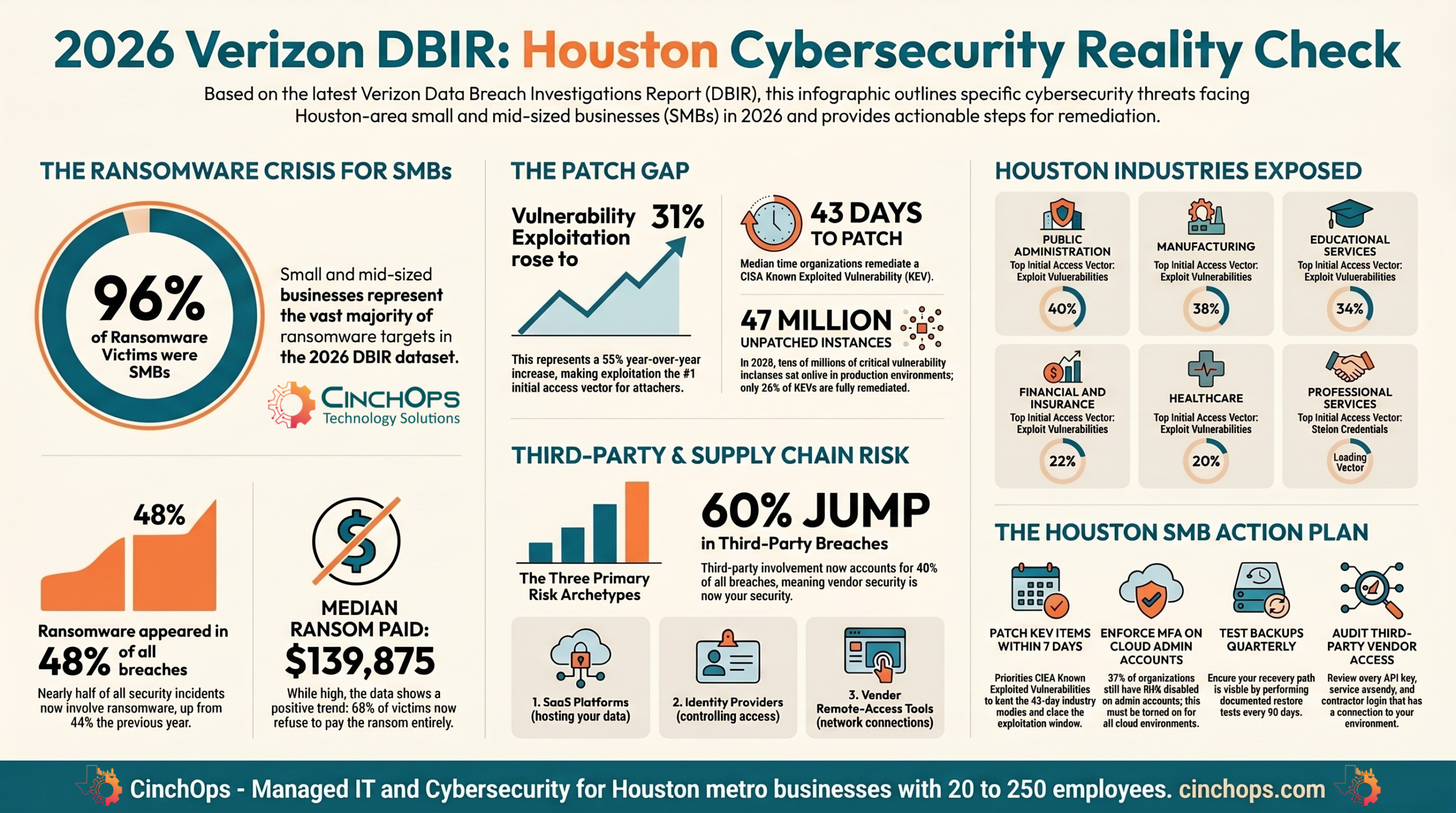
Verizon analyzed more than 22,000 breaches for the 2026 DBIR. Houston SMB owners should pay attention - 96% of ransomware victims in the dataset were small and mid-sized businesses.
Verizon released the 2026 Data Breach Investigations Report this month, and it covers more than 22,000 security incidents from October 2024 through November 2025. For Houston business owners reading this, one finding stands out above all others: 96% of ransomware victims in the dataset were small and mid-sized businesses. That is not a global statistic happening to someone else. That is the bakery in Cypress, the engineering firm in The Woodlands, the law office near the Texas Medical Center.
CinchOps is a managed IT services provider based in Katy, Texas, serving small and mid-sized businesses across the Houston metro area. CinchOps specializes in cybersecurity, network security, managed IT support, VoIP, and SD-WAN for businesses with 20 to 200 employees across Houston, Katy, and Sugar Land.
This post breaks down the four findings that matter most to Houston SMBs, then walks through what the 2026 DBIR shows for each major industry where CinchOps clients operate.
The 2026 DBIR confirms a shift that has been building for two years. Threat actors are spending less time crafting clever phishing emails and more time scanning the internet for unpatched edge devices, VPN appliances, firewalls, and exposed servers. Credential abuse - the previous leader - dropped to 13%.
Why this matters for Houston: most SMBs in the area run at least one piece of edge infrastructure from a vendor that issues monthly or quarterly patches. The 2026 DBIR found that only 26% of vulnerabilities in the CISA Known Exploited Vulnerabilities catalog were fully remediated by organizations in 2025. That is down from 38% the prior year. Median time to full resolution climbed to 43 days.
The Houston-area pattern we see most often:
- Edge Devices Get Forgotten. Firewalls, VPN concentrators, and remote access gateways are installed once and rarely revisited. When the vendor issues a critical patch, no one is watching.
- Patch Cycles Lag the Threat. A 43-day median patching window is longer than the average ransomware dwell time. Threat actors are inside before the patch lands.
- Inventory Gaps Compound the Problem. If a business does not have a current asset inventory, it cannot patch what it does not know it owns.
The 2026 DBIR found organizations had 50% more critical vulnerabilities to patch in this year's dataset compared to the prior year. Patching is not getting easier. It is getting harder, and the gap between disclosure and exploitation is shrinking.
Verizon also analyzed more than 1 billion vulnerability detection records to track the full life cycle of patching. The result is a hard ceiling: between 60% and 70% of CISA KEV vulnerabilities remain open at Day 7 regardless of organizational maturity. By Day 28, 35% are still open. By the long tail, 9% are essentially never going to be patched. For 2025 that translates to roughly 47 million unpatched vulnerability instances sitting in production environments.
| |
The DBIR analysts also looked at resurgent vulnerabilities - the question of whether to patch a fresh CVE with no observed exploitation or an older one that is actively being exploited right now. Their forecasting model showed the probability of resurgent exploitation drops by half at 30 days, again at 90 days, and again around 9 months. After about a year of silence, an old CVE is roughly as likely to resurge as one that was never exploited.
When prioritizing patches, recent exploitation activity matters more than CVE age. A three-year-old vulnerability with confirmed recent activity is a higher-priority patch than a brand-new CVE that has not been seen in the wild. Patch what attackers are actually using right now.
The 2026 DBIR is unambiguous on this point. Ransomware grew again, payments dropped, and SMBs continue to absorb the bulk of attacks. Of the ransomware cases where Verizon had organization-size data, the SMB share was 96%. The median ransom paid fell to $139,875, down from $150,000 the year before, and 69% of victims did not pay at all.
The decline in payment rates is good news. The fact that nearly half of all breaches now involve ransomware is not. For a Houston engineering firm with 35 employees or a Sugar Land medical practice with 80, a ransomware incident is not a news story. It is an existential event - lost project files, locked patient records, payroll on hold.
What the 2026 DBIR shows about SMB ransomware specifically:
- Compromised Credentials Drove 38% of SMB Ransomware Cases. Reused passwords and missing multifactor authentication remain the easiest path in.
- Unpatched Edge Devices Drove 29% of SMB Ransomware Cases. The same vulnerability exploitation trend hits SMBs harder because patch programs are typically informal.
- Internal Data Was Stolen in 97% of SMB Breaches. Even when no ransom is paid, the data extortion damage is done.
- Personal Data Dropped Off the SMB List Entirely. Extortion now focuses on internal business data, plans, and credentials rather than customer PII. The threat model for a Katy engineering firm has shifted from "your customer database" to "your project files and source code."
"The 2026 DBIR data lines up with what we see every week in the Houston area. It is not exotic AI attacks taking small businesses down - it is unpatched edge devices and reused passwords. The fundamentals still win or lose this fight."
Worried about ransomware exposure?
CinchOps can review your patch posture, MFA coverage, and backup integrity in one short call.
Schedule a Quick ReviewThe 2026 DBIR reports that breaches involving a third party increased by 60% year over year. Almost half of all breaches now involve a vendor, software supplier, or service provider in some way. The MFA picture for third parties is worse than most business owners realize.
Verizon's report defines three third-party breach archetypes that every Houston business owner should understand:
- Vendor in Your Software Supply Chain. The data and initial access were inside your environment, but a vulnerability or back door in vendor software made the breach possible.
- Vendor Hosting Your Data. The initial access was against the vendor itself, and your data was sitting in their cloud environment. The 2024 Snowflake credential-theft campaign is the textbook example.
- Vendor With Network Connection to Your Environment. The attacker compromised the vendor, then pivoted across the network connection into your systems. The decade-old Target breach is the canonical case.
According to the report, only 23% of third-party organizations fully remediated missing or improperly secured multifactor authentication on their cloud accounts. Weak passwords and permission misconfigurations took nearly eight months to resolve in 50% of findings.
At a point-in-time snapshot, the 2026 DBIR found 37% of organizations had an admin account with MFA disabled on an IaaS offering. Only 14% had the same problem on Snowflake - clear evidence that customers learned from the 2024 breach campaign. The lesson always gets learned, but it usually gets learned after the breach.
For a Houston SMB, that translates into a real-world question: when your payroll provider, your CRM vendor, or your accounting platform has a security gap, your business is exposed. The Texas Medical Center area is a good example - a single shared SaaS platform across multiple practices can become the entry point for all of them.
- Review Vendor MFA Posture. Every cloud platform your business uses should require MFA on admin and user accounts. Ask vendors for written confirmation.
- Inventory Third-Party Access. Every API key, every shared service account, every contractor login is a potential entry point.
- Treat Vendor Patch Cycles as Your Patch Cycle. When your line-of-business software releases a security update, install it on your schedule, not theirs.
The human element appeared in 62% of breaches in the 2026 dataset. Social engineering is the third most common breach pattern at 16%. The new twist is two-fold: AI assistance and mobile channels.
On the AI side, the median threat actor researched or used AI assistance across 15 different documented techniques. Some actors used as many as 40 or 50. Most AI-assisted malware was associated with well-known attack patterns - meaning AI is not creating exotic new threats so much as accelerating the production of familiar ones.
On the mobile side, the DBIR data is sharper than most reports show. Phishing simulations in mobile vectors (voice and text) had click rates 40% higher than email simulations. Looking at actual SMS phishing detections on managed mobile devices, large organizations face a median of 48 SMS phishing campaigns per year. Smaller organizations face a median of 12. That works out to a campaign roughly every eight calendar days, and those numbers only count managed devices - unmanaged personal phones being used for work are completely invisible to most security tools.
Pretexting - where an attacker builds a trusted relationship through fabricated scenarios - is now a distinct initial access vector. It has become a common entry point for ransomware campaigns specifically.
Pretexting reached 6% of all breaches in the 2026 DBIR and is now tracked as its own initial access vector. Unlike email phishing, pretexting requires a live human on the other end of a phone, text thread, or chat. Email simulation training does not prepare staff for it - voice and text-based pretexting training is a separate discipline.
What this means for the Houston SMB owner:
- Email Awareness Training Is Not Enough. Pretexting via phone and text needs its own training track, particularly for finance staff, IT help desks, and customer-facing teams.
- AI-Generated Phishing Is Polished. The grammatical errors and odd phrasing that used to flag a phishing attempt are largely gone. Train staff to verify identity through a second channel, not to spot typos.
- Mobile Visibility Is a Real Gap. If field crews, sales reps, or executives are using personal phones for work, the business has no view into the SMS phishing they receive every week.
- Shadow AI Is a Data Loss Problem. The 2026 DBIR found 67% of users access AI services from non-corporate accounts on corporate devices. Source code, images, and technical documentation were the top data types leaked to external AI tools.
Despite the marketing around insider threats, the 2026 DBIR shows malicious insiders drive less than 4% of breaches - down from 8% in 2024. End-user mistakes and external attackers cause far more damage than disgruntled employees. The bigger insider-related risk in 2026 is convenience-driven policy violations and Shadow AI, not sabotage.
The 2026 DBIR analyzed breaches across every major NAICS sector. The table below summarizes the top breach pattern, initial access vector, and most-stolen data type for every industry the DBIR covered.
System Intrusion is the top pattern in every sector. The differences come down to how attackers get in and what data they take. The five industries below have dedicated chapters in the 2026 DBIR and represent the bulk of the Houston-area SMB economy.
Houston's three top-DDoS-targeted sectors - Finance, Professional Services, and Manufacturing - are also three of the city's largest employer categories. The median DDoS-targeted organization faces 17 distinct attacks per year, and the largest attacks grew 198% in bits per second year over year. If your business runs a customer portal, an e-commerce site, or remote-access infrastructure, DDoS mitigation is no longer optional.
Healthcare
System Intrusion is the top pattern in Healthcare for the second year running, and Miscellaneous Errors has held a top-three spot every year since 2014. Misdelivery (sending data to the wrong recipient), Loss (unencrypted devices), and Misconfiguration (exposed data stores) remain the chronic error problems. Initial access vectors: Exploitation of vulnerabilities (20%), Phishing (14%), Credential abuse (11%). Third-party involvement: 32%. The 2025 Oracle E-Business Suite zero-day campaign attributed to the Cl0p criminal group hit healthcare organizations hard - a clear reminder that third-party software in the medical supply chain creates two-way exposure.
Manufacturing
Manufacturing breaches grew again this year, driven almost entirely by Ransomware. Malware appeared in 75% of breaches, with Ransomware specifically accounting for 61% of those. Initial access vectors: Exploitation of vulnerabilities (38%) - the highest of any major sector - Phishing (13%), Credential abuse (11%). Use of stolen credentials and Exploit vulnerability each contributed to 41% of Manufacturing breaches. Third-party involvement: 61% - the highest among the verticals with dedicated DBIR chapters. Internal data appeared in 80% of breaches, meaning plans, designs, and operational data are the prize.
Financial and Insurance
System Intrusion has been the top pattern in Financial Services since 2022. Threat actors are 88% external and 98% financially motivated - the cleanest "follow the money" profile in the report. Initial access vectors: Exploitation of vulnerabilities (22%), Phishing (20%), Credential abuse (15%). The Social Engineering pattern remains a close second, with Phishing showing up more than twice as often as Pretexting - though Pretexting is growing fast as an initial access vector for the most damaging campaigns. Third-party involvement: 34%. Human element: 65%.
| Industry (NAICS) | Top Breach Pattern | Top Initial Access | Top Data Stolen |
|---|---|---|---|
| Accommodation (72) | System Intrusion | Stolen Credentials | Credentials, Internal |
| Administrative (56) | System Intrusion | Stolen Credentials | Internal, Personal |
| Agriculture (11) | System Intrusion | Exploit Vulnerabilities | Internal, Credentials |
| Construction (23) | System Intrusion | Exploit Vulnerabilities | Internal, Project Files |
| Educational Services (61) | System Intrusion (52%) | Exploit Vulnerabilities (34%) | Internal (64%), Personal (41%) |
| Entertainment (71) | System Intrusion | Stolen Credentials | Internal, Personal |
| Financial & Insurance (52) | System Intrusion | Exploit Vulnerabilities (22%) | Internal (53%), Personal (43%) |
| Healthcare (62) | System Intrusion | Exploit Vulnerabilities (20%) | Internal (65%), Personal (37%) |
| Information (51) | System Intrusion | Exploit Vulnerabilities | Internal, Credentials |
| Management (55) | System Intrusion | Stolen Credentials | Internal (96%) |
| Manufacturing (31-33) | System Intrusion | Exploit Vulnerabilities (38%) | Internal (81%), Credentials (26%) |
| Mining (21) | System Intrusion | Exploit Vulnerabilities | Internal (74%), Credentials |
| Other Services (81) | System Intrusion | Phishing | Internal (66%), Personal |
| Professional Services (54) | System Intrusion | Stolen Credentials | Internal (80%), Credentials |
| Public Administration (92) | System Intrusion | Exploit Vulnerabilities (40%) | Personal (50%), Internal |
| Real Estate (53) | System Intrusion | Phishing | Internal (63%), Personal |
| Retail (44-45) | System Intrusion | Exploit Vulnerabilities (42%) | Internal (84%), Payment |
| Transportation (48-49) | System Intrusion | Stolen Credentials | Internal (84%), Credentials |
| Utilities (22) | System Intrusion | Exploit Vulnerabilities | Internal (85%), Secrets (68%) |
| Wholesale (42) | System Intrusion | Stolen Credentials | Internal (98%), Credentials |
Educational Services
System Intrusion accounts for 52% of all Education breaches - appearing nearly three times more often than any other pattern. Initial access vectors: Exploitation of vulnerabilities (34%), Phishing (22%), Credential abuse (8%). Web applications are the primary malware delivery vector in 71% of cases. Ransomware appears in 65% of malware-related breaches in this sector. The summer 2025 Oracle E-Business Suite zero-day campaign hit education organizations particularly hard, with a concentration of victims in higher education. Human element: 68%.
Public Administration
System Intrusion, Miscellaneous Errors, and Privilege Misuse top the Public Administration sector. Threat actors split 56% external and 44% internal - the highest internal share of any major industry. Initial access vectors: Exploitation of vulnerabilities (40%) - the highest in the report - Phishing (20%), Credential abuse (8%). The 2026 DBIR notes that 35% of Public Administration breaches involve State-affiliated actors with Espionage motives. The report specifically references the breach of the U.S. Department of Treasury by Silk Typhoon (a Chinese state-affiliated group) that exploited a vulnerability in a third-party cloud support service.
The common thread across every Houston-relevant industry: System Intrusion is the top pattern, vulnerability exploitation and stolen credentials are the top entry points, and Internal business data is what attackers take. The same three controls - patch management, MFA coverage, and tested backup - apply to all of them. Industry differences come down to what data is at stake and how attackers approach the initial breach.
CinchOps works with construction firms, CPA practices, engineering offices, wealth management firms, law firms, and oil and gas companies across the Houston metro area. The 2026 DBIR findings map directly to the work we do for clients every week:
- Patch Management on a 7-Day Cycle (or sooner). Critical CISA KEV vulnerabilities are patched against a 7-day target, not the industry-median 43 days. Critical zero-days and actively exploited vulnerabilities are patched as soon as updates are available and tested - waiting a week is not an option when a CVE is being actively weaponized. Edge devices are reviewed monthly at minimum, with priority given to CVEs showing recent exploitation activity.
- MFA Across the Stack. Email, VPN, file storage, CRM, accounting platform - every system that supports MFA gets it enforced, including third-party vendor logins.
- Tested Backup and Recovery. The business continuity and disaster recovery program includes documented recovery procedures and quarterly restore tests.
- Social Engineering Training Beyond Email. Voice and text-based pretexting training for finance, executive assistants, and help desk staff - the populations the 2026 DBIR shows are most often targeted.
- Mobile Device Visibility. Managed mobile device coverage to surface SMS phishing campaigns and Shadow AI use that personal phones hide.
- Vendor and Third-Party Security Review. Annual review of vendor MFA, access scope, and incident notification commitments.
- Asset Inventory and Edge Device Monitoring. You cannot patch what you cannot see. CinchOps maintains a live inventory and watches for new disclosures against installed versions.
The 2026 DBIR is one of the most honest pictures of the SMB cyber problem published anywhere. The bad news is that breaches are still happening at scale. The good news is that the controls that prevent them are well-understood and within reach for a 30-person Houston business.
Quick Self-Check Before You Call Anyone
- Do you know how many days behind the latest patches your edge devices are right now?
- Is multifactor authentication enforced on every account that supports it - including admin accounts and vendor logins?
- When was the last time you actually restored a file from backup to confirm the backup works?
- Do your finance and help desk staff know what to do if someone calls claiming to be the CEO with a wire request?
- If a ransomware case hit on a Friday afternoon, who do you call first and how fast can they respond?
Frequently Asked Questions
What is the 2026 Verizon DBIR and why should Houston businesses care?
The 2026 Verizon Data Breach Investigations Report is an annual study that analyzed more than 22,000 security incidents from October 2024 through November 2025. Houston businesses should care because the report found that 96% of ransomware victims in the dataset were small and mid-sized businesses - the same size category as most Houston-area firms.
What is the top way attackers break into a business according to the 2026 DBIR?
The 2026 DBIR reports that exploitation of vulnerabilities is now the top initial access vector at 31% of all breaches, up from 20% the prior year. This is a 55% increase. Threat actors are scanning for unpatched firewalls, VPN appliances, and edge devices faster than most SMBs can patch them.
How often should a Houston SMB patch critical vulnerabilities?
The 2026 DBIR found the median time to remediate critical vulnerabilities was 43 days. CinchOps targets 7 days for critical CISA Known Exploited Vulnerabilities and 30 days for other critical patches. Faster patch cycles directly reduce the window of exposure that drives most SMB ransomware cases.
Is paying the ransom a good option if a Houston business gets hit?
The 2026 DBIR found that 69% of ransomware victims did not pay, and the median ransom paid declined to $139,875. Paying does not guarantee data recovery, may violate sanctions rules, and signals to attackers that the victim is willing to pay again. CinchOps focuses on prevention and tested backups so paying never becomes the only option.
How can a small Houston business afford the controls the 2026 DBIR recommends?
The 2026 DBIR findings map to fundamentals that a managed IT services provider can deliver for a flat monthly fee. Patch management, MFA enforcement, backup testing, and security awareness training are standard services for a Katy-based MSP like CinchOps. Most SMBs spend less on managed cybersecurity than they spend on commercial insurance.
Discover More
Resources
Sources


