


Digital Transformation for Houston Small Business: Enterprise Lessons From the 2025 Product Report
Business IT, Not Just IT For Business – Decades Of Billion-Dollar Experience, Distilled For Your Team
ProductPlan's 2025 report studied nearly 400 product teams. Here is what those enterprise findings actually mean for a Houston small business.
Digital transformation for a Houston small business is not about buying the same software a billion-dollar product org uses. It is about borrowing the discipline behind that software, and skipping the decade and the seven-figure budget it took to learn it.
ProductPlan just published its 2025 State of Product Management Report, the tenth edition, built on responses from nearly 400 product professionals surveyed in late 2024. The companies in it are mostly enterprises. The 2024 CPO Insights Report it cites found that 40% of Fortune 1000 companies now have a Chief Product Officer, up from 15% in 2022. If you run a 30-person firm in Katy or Sugar Land, none of that sounds like your Monday.
Read it a second way and the value flips. Strip out the org charts and the job titles, and the report is a list of the habits that separate a company where technology drives the business from a company where technology just keeps the lights on. Those habits scale down. That is the whole job at CinchOps.
Why Strategy Beats Activity, Even at Billion-Dollar Companies
The report's clearest signal: knowing what to work on matters more than how much you work.
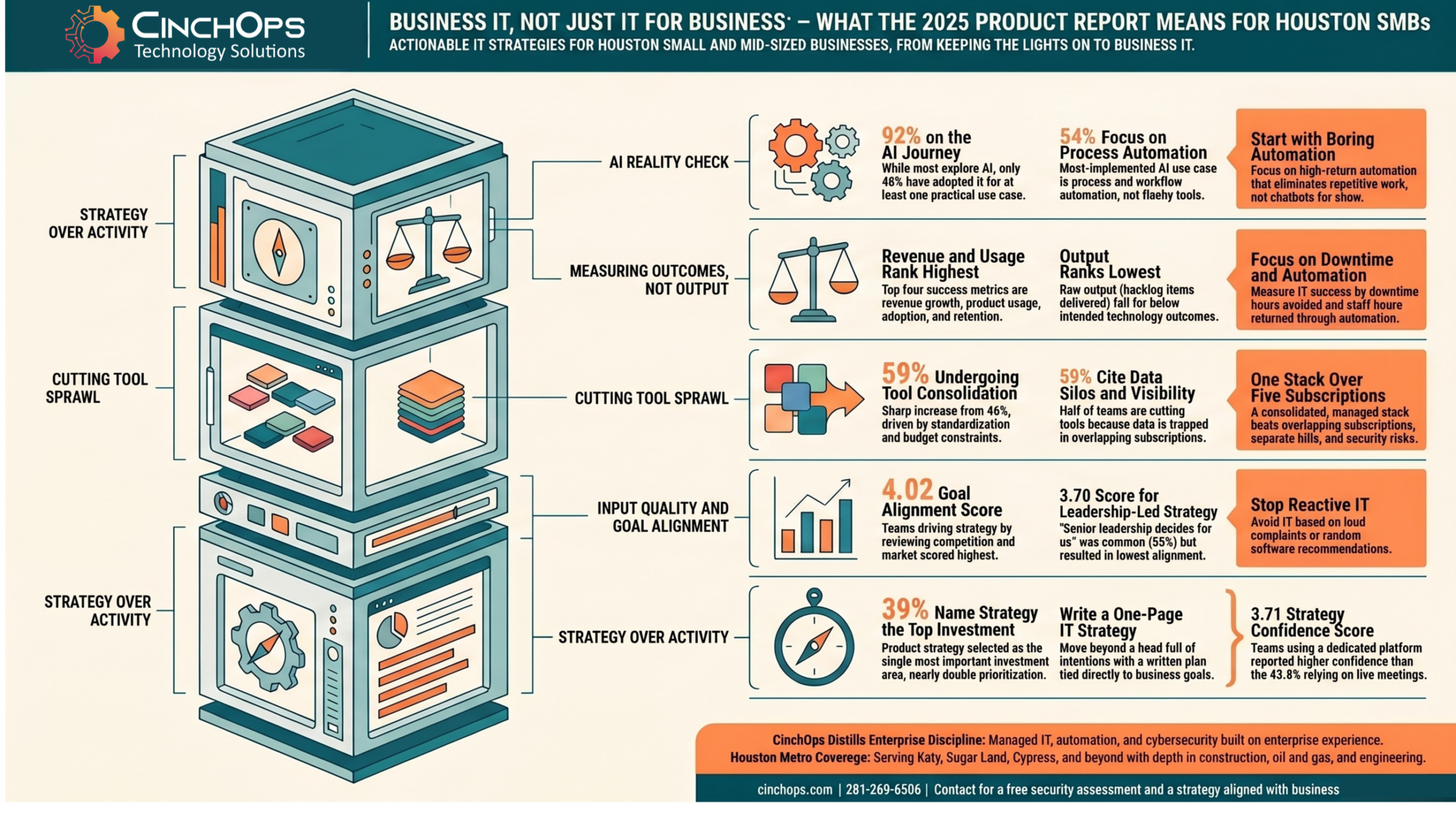
Product strategy was the single most valuable job in the 2025 report. When asked where their organization should invest first, 39% chose product strategy, nearly double the next answer, prioritization, at 20%.
Then comes the finding that should make every business owner pause. ProductPlan measured how well each team's goals lined up with company goals, on a 1 to 5 scale. The teams whose strategy was driven by the least common input, actually reviewing the competition and the market, scored the highest alignment at 4.02. The teams who said "senior leadership decides for us," the most common driver at 36%, scored the lowest at 3.70.
Translation for a Houston SMB: the loudest voice in the room is usually the worst input for what to fix next. Most small companies run their IT exactly the way those low-alignment teams ran their strategy, by reaction. Whoever complains hardest gets the new laptop. Whoever the owner sat next to at lunch picks the software. That is "senior leadership decides for us" at small-business scale, and it produces the same drift.
- Write the strategy down. A one-page IT plan tied to where the business is going beats a head full of good intentions. The report found teams using a product platform to communicate strategy reported the highest confidence that people understood it, 3.71, well above the 43.8% who relied on live meetings.
- Look outward, not just inward. The highest-aligned teams watched the market. For an SMB that means watching what your competitors, your insurers, and your regulators now expect of your technology.
- Review on a cadence. Only 3.4% of respondents never checked progress against their objectives. A quarterly IT review is the small-business version of that habit.
What Tool Consolidation Tells a Houston Small Business
Enterprises spent 2025 cutting their tool sprawl. The reasons are the exact problems an SMB feels every day.
Tool consolidation is the act of reducing overlapping software down to fewer platforms that cover more of the work. In the 2025 report, 59% of teams were going through it, up sharply from 46% a year earlier.
The drivers they named read like a Houston small-business diary: the need to standardize tools across teams (59%), budget constraints (50%), lack of visibility and data silos (50%), and security concerns (23%). Three quarters of respondents picked more than one reason. Big companies hit a wall of too many subscriptions that do not talk to each other. So does the 40-person engineering firm that bolted on a different app every time something broke.
In 35 years of doing this, the single most common thing we walk into at a new Houston client is a stack nobody can draw on a whiteboard. One tool for tickets, another for backup, three for security that overlap, and a spreadsheet pretending to be an asset inventory. Every one of those is a separate bill, a separate login, and a separate door an attacker can knock on.
| What the report's drivers look like for an SMB | Bolt-On Point Tools | Consolidated Managed Stack |
|---|---|---|
| Budget | Five overlapping subscriptions, renewing on five dates | One predictable monthly fee |
| Visibility | Data trapped in each app, no single picture | One dashboard, one source of truth |
| Security | Each tool is its own attack surface to patch | Hardened, monitored, and patched together |
| Accountability | Vendors point fingers when something breaks | One provider owns the outcome |
The enterprises also said which jobs they most wanted combined into one platform: strategy (74.2%), roadmapping (72.8%), and prioritization (72.8%). Same instinct, different scale. A Houston SMB does not need a roadmapping suite. It needs its support, backup, security, and network to live under one roof so the left hand knows what the right hand patched.
Measuring IT the Way Enterprises Measure Product
Counting activity feels productive. The report shows mature teams stopped doing it.
When ProductPlan asked teams to rank their success metrics, revenue growth, product usage, adoption, and retention took the top four spots. "Backlog items delivered," the count of raw output, fell far down the list.
That shift, from how much we shipped to what it changed, is the most useful idea in the report for a small business. Half of respondents (50.6%) said their investment decisions met senior management's expectations, up from 45.4% the year before. The number one reason the misses happened? A lack of a clear company strategy, named by 38.2% and rising. Activity without a strategy to point it at is just expensive motion.
Most Houston SMBs measure IT by the wrong yardstick: "is the email working" and "how fast did they answer the phone." Those are output metrics. They tell you nothing about whether your technology is moving the business. We see this twice a month, a company paying for break-fix support that closes tickets fast and never asks why the same ticket keeps coming back.
- Downtime hours avoided beats tickets closed. One prevented outage at a Cypress job site is worth a hundred fast phone answers.
- Staff hours given back through business process automation is a number you can put in dollars.
- Risk reduced and audits passed is what your cyber insurer and your clients now grade you on.
Not sure what your IT is actually buying you?
A short conversation turns "it mostly works" into outcomes you can measure and a plan tied to where your business is going.
Talk to CinchOpsAI Adoption: The Sober Take Enterprises Took in 2025
The companies with the biggest AI budgets quietly slowed down. There is a lesson in that.
92.4% of organizations in the 2025 report were somewhere on their AI journey, but only 46.4% had adopted AI for even one real use case. The headline is the gap between talking and doing.
The report describes product teams "taking a sober look at AI" and moving away from adopting it for the sake of adopting it. Greg Barrett, CEO of GMB Consulting, put it well in CIO magazine: the conversation has to shift from "ways to implement AI" to "what are the top business needs, and how might we address them using AI." When asked where AI would help most, respondents picked automating repetitive tasks (37%) over flashier answers. The most-implemented use case was process and workflow automation (54%), ahead of generative AI (46%).
So the enterprises with real money concluded the opposite of the hype: start with boring, high-return automation, not a chatbot for show. A Houston small business should take the exact same posture. Before you "do AI," get the unglamorous foundation right, then automate the repetitive work that eats your team's week. That is the order CinchOps recommends, and it is the order the data supports.
"I have led product teams, digital transformations, and platform engineering at companies worth billions. A Houston business owner does not care about that resume, and they are right not to. What they should care about is that we took those lessons, threw out everything that only works at enterprise scale, and kept what actually moves a small business. That is the difference between Business IT and just IT for business."
Automation and AI widen your attack surface. Plan for it.
Every workflow you automate and every AI tool you connect is one more thing to secure. The enterprises in the report named security as a driver of consolidation for a reason. CinchOps builds the DevSecOps discipline in from the start with managed cybersecurity so growth does not quietly become exposure.
Explore CinchOps Cybersecurity →How CinchOps Brings Enterprise Discipline to Houston Small Business
CinchOps is a managed IT services provider based in Katy, Texas, serving small and mid-sized businesses across the Houston metro area. CinchOps specializes in cybersecurity, network security, managed IT support, VoIP, and SD-WAN for businesses with 10 to 200 employees.
Here is the part that matters for this report. The CinchOps team has led product teams, run digital transformations, built business process automation, and stood up DevOps, DevSecOps, and platform engineering programs for multi-billion-dollar companies. On its own, that experience is worth nothing to a Houston small business. A 25-person CPA practice does not need a platform engineering team.
What it needs is the judgment that experience produced, delivered as a fixed-scope service it can afford. That is what CinchOps does: take decades of doing IT for the largest companies and distill it into solutions a Houston business can buy, run, and scale on. Not IT for business. Business IT.
- Through managed IT support, we consolidate the scattered tool stack the report warns about into one accountable, monitored system.
- Through CTO and CIO services, you get the written, outcome-aligned strategy the highest-performing teams in the report used, sized for a small business.
- Through business process automation, we go after the repetitive work first, the same high-return path the enterprises chose over AI for show.
- Through managed cybersecurity, the DevSecOps habits get built in instead of bolted on after a breach.
- We serve businesses across Houston and on out to Katy, Sugar Land, and Cypress, with industry depth for construction, oil and gas, CPA firms, and engineering firms.
Frequently Asked Questions
What is the 2025 State of Product Management Report?
The 2025 State of Product Management Report is ProductPlan's tenth annual study of how product organizations work. It surveyed nearly 400 product professionals in late 2024 on product strategy, prioritization, tool consolidation, success measures, and AI adoption, mostly at mid-sized and enterprise companies.
What does a product management report have to do with my Houston small business?
The report describes the habits that separate companies where technology drives results from companies where it just runs in the background. Those habits, clear strategy, fewer tools, outcome metrics, and careful AI, scale down to a Houston small business directly, even without a product department.
What does "Business IT, not just IT for business" mean?
IT for business keeps systems running. Business IT uses technology to move the business forward, with strategy, measurement, and automation tied to outcomes. CinchOps distills enterprise-grade Business IT, learned at billion-dollar companies, into services a Houston small business can afford and run.
Should a Houston small business adopt AI right now?
Start with automation, not hype. The 2025 report found 92% of organizations on the AI journey but only 46% using it for a real use case, and the top choice was automating repetitive tasks. A Houston SMB should fix its foundation, then automate high-return work first.
How does CinchOps bring enterprise experience to small businesses?
The CinchOps team led product, digital transformation, DevSecOps, and platform engineering at multi-billion-dollar companies. CinchOps keeps the judgment from that work, drops what only fits enterprise scale, and delivers it as fixed-scope managed IT, automation, and cybersecurity for Houston-area businesses with 10 to 200 employees.
Discover More
Resource
Sources
- ProductPlan. 2025 State of Product Management Report (10th Edition). Survey of nearly 400 product professionals, conducted Q4 2024.
- Greg Barrett, CEO of GMB Consulting. Quoted in CIO Magazine on intentional, value-driven AI adoption.


