


IBM Cost of a Data Breach Report 2026: The AI Tipping Point
The 2026 Breach Numbers For Small And Mid-Sized Businesses – Access Controls For AI Models And Applications
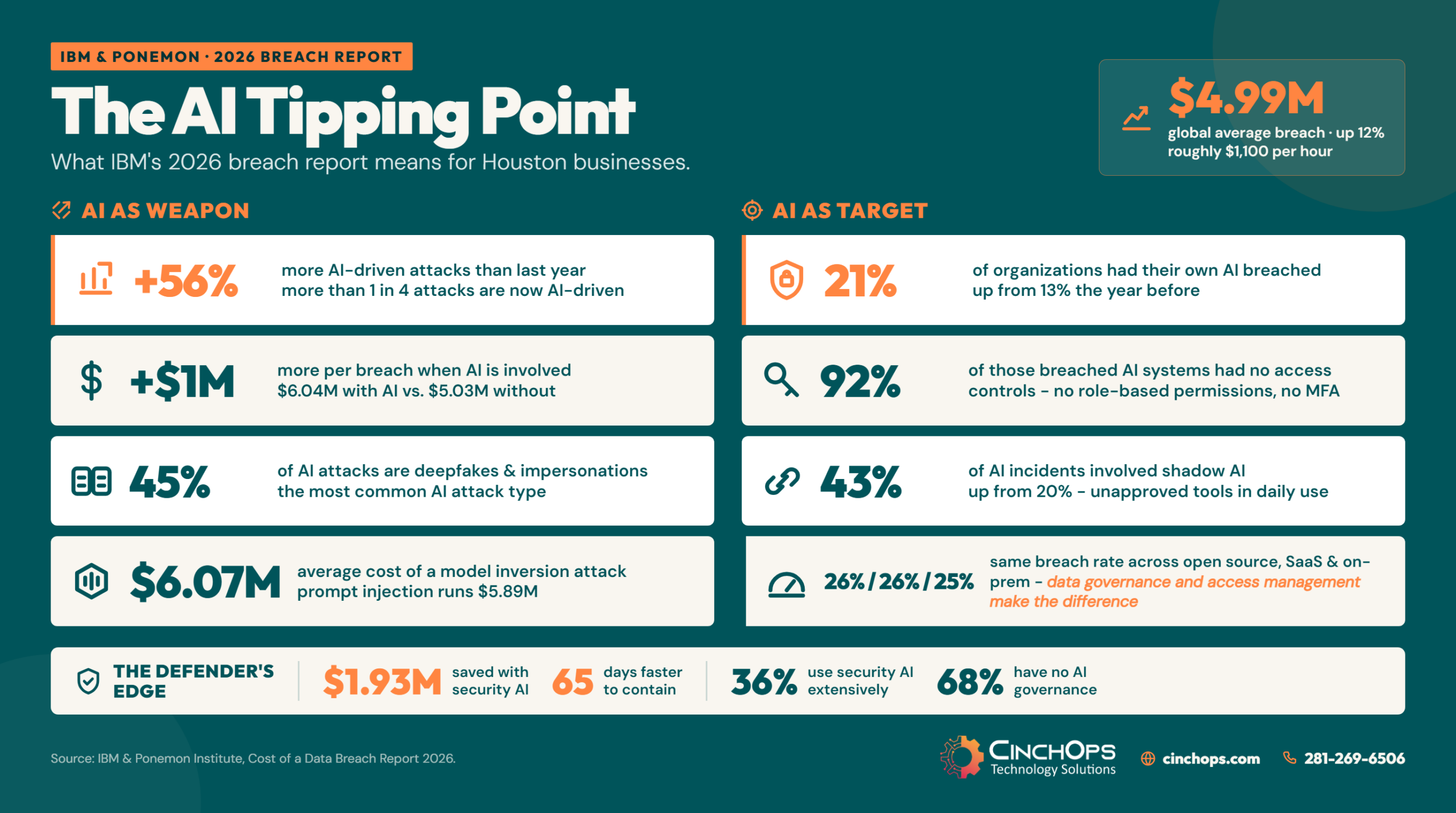
AI-driven attacks rose 56% and added $1 million per breach.
Here is what the 2026 edition means for Houston businesses.
The IBM Cost of a Data Breach Report 2026 is the 21st edition of the study, and it is the first one where AI shows up on both sides of the ledger at scale: as the thing attacking you, and as the thing being attacked.
Ponemon Institute interviewed 3,558 security and business leaders at 602 organizations breached between March 2025 and February 2026, across 16 countries and 17 industries. The global average cost of a breach came in at $4.99 million, which works out to about $1,100 an hour. CinchOps provides managed cybersecurity specifically for small and mid-sized businesses in the Houston metro, with 24/7 monitoring and help desk response under 15 minutes.
What Are the Headline Numbers in IBM's Cost of a Data Breach Report 2026?
Record global cost, record US cost, and a response clock that got slower for the first time in five years.
The global average cost of a data breach reached $4.99 million in IBM's 2026 report, a 12% rise and an all-time high, with detection and escalation plus lost business accounting for 63% of the total.
In the United States the average was $11.5 million, more than double the global figure, driven by higher regulatory fines and business disruption costs. For the sector by sector picture across three editions, see our breakdown of data breach cost by industry. Healthcare held the top spot for a 13th consecutive year at $6.64 million, though it was the only industry whose average declined. Financial services followed at $6.29 million, with industrial and technology tied at $5.50 million.
- Response times reversed. The mean time to identify and contain a breach rose to 247 days, a 2.5% uptick that ended five years of improvement.
- Long breaches cost far more. Incidents lasting more than 200 days averaged $5.65 million against $4.32 million for shorter ones.
- Customer data was the target. Customer personal information was stolen in 52% of breaches at $192 per record. Intellectual property was costliest per record at $196.
- Phishing led again. Voice and SMS phishing was the top initial vector for a fourth straight year at 17% of attacks, and the costliest at $5.29 million.
- Recovery is genuinely improving. 42% of organizations reported full recovery, up from 35% last year and from 12% in 2024.
One number in that list gets glossed over in most coverage. Malicious or criminal attacks caused 55% of breaches, up from 51%, while human error fell to 23% and IT failure to 22%. The share of breaches that are somebody deliberately coming after you keeps growing.
How Are Attackers Using AI, According to the 2026 Report?
Deepfakes lead by volume. The cost premium is about $1 million per breach.
More than one in four organizations that suffered a malicious attack in IBM's 2026 study reported it was AI-driven, a 56% increase over the previous year, and those breaches averaged $6.04 million against $5.03 million for non-AI attacks.
The breakdown by attack type is the part worth reading twice. Deepfake and impersonation attacks accounted for 45% of AI-driven incidents. AI-enabled malware was 19%. AI-generated phishing and other communications made up 17%. Generative AI has made convincing social engineering cheap to produce and hard to spot, and the volume figures reflect exactly that.
Targeting is concentrated. A combined 62% of AI-driven attacks hit critical infrastructure sectors, with financial services and energy taking the heaviest share. For an energy-heavy metro like Houston, that is not an abstract statistic. Energy breaches averaged $5.24 million in the study, above the global average, and the small engineering, services and supply firms that plug into those operators sit inside the same trust chain.
IBM opens the report with a specific warning: a frontier model announced in April 2026 found thousands of high-severity vulnerabilities, including some in every major operating system and web browser. The report cites research from UC Berkeley published in November 2025 projecting that within two years AI will favor attackers over defenders by 31.7%. Whether or not that exact figure holds, the direction is the point.
Would Your Team Catch a Deepfake Wire Request?
Deepfake impersonation was 45% of AI-driven attacks in IBM's 2026 study. CinchOps builds the training and the approval controls that stop the payment before it leaves.
Talk to CinchOpsAttackers Are Also Targeting the AI You Just Deployed
AI-related breaches jumped to 21%, and almost all of the victims had no access controls on their AI.
Security incidents involving an organization's own AI models or applications grew to 21% of breaches in 2026 from 13% the year before, a 61% increase, and 92% of the affected organizations lacked proper AI access controls such as role-based access or multifactor authentication.
Model inversion attacks, where an attacker extracts sensitive data back out of a trained model, were the most expensive at $6.07 million, roughly 18% above the global average. Prompt injection followed at $5.89 million.
IBM's conclusion about root cause is the useful part for a small business. These incidents were not mostly about which model an organization picked. Breach rates were close to identical across open-source models at 26%, third-party SaaS at 26% and third-party on-premises at 25%. What differed was cost, with open-source deployments averaging $5.63 million and in-house models $4.98 million. The causes were structural: compromised APIs, exposed applications and cloud misconfiguration.
- Shadow AI more than doubled. Unapproved employee AI use was involved in 43% of these incidents, up from 20%, at an average cost of $5.39 million. About one in five drew a regulatory fine.
- Governance is going backwards. 68% of breached organizations had no AI governance to manage AI or detect shadow AI, worse than 63% last year, although 33% said policies were in development.
- Almost nobody connects the two teams. Only 19% of organizations reported any coordination between their governance and security functions.
- The damage is financial first. 51% reported direct financial loss, 44% operational disruption, 44% unauthorized access to sensitive data and 26% reputational damage.
If your staff pasted a client contract into a public chatbot last quarter, you are in the 43%. That is not a technology problem you buy your way out of. It is a policy and access problem.
Every business owner asks me which AI tool is the safe one. That is the wrong question, and this report proves it. Open source, vendor SaaS, on-prem, they all got breached at about the same rate. What separated them was governance: who could reach the tool, and what data it was ever allowed to touch.
Where Are Defenders Winning, and Where Are They Not?
The tools work. The places they get pointed are the problem.
Organizations using security AI and automation extensively averaged $4.00 million per breach against $5.93 million for those using none, a saving of $1.93 million, and contained breaches 65 days faster at 215 days versus 280.
Only 36% of breached organizations were in that extensive-use group, up from 32%. And usage skews hard toward the back half of the security lifecycle. Combined limited and extensive use reached 79% in detection and 77% in investigation, but just 69% in prevention.
The agentic AI numbers show the same tilt more sharply. Half of breached organizations run AI agents in a security operations center. Among those, 56% use agents for threat hunting and 54% for automated response and containment, but only 18% for vulnerability scanning and management.
IBM also isolated 30 factors and measured what each one moved the average by. A DevSecOps approach cut $253,805. Identity and access management cut $225,622. Key lifecycle management tools cut $214,923, encryption cut $213,478, and using a managed security service provider cut $152,929. On the other side, a supply chain breach through a compromised business partner added $227,250, security system complexity added $208,265, and lack of visibility into shadow IT added $201,165.
The service account is where this usually bites a small business. Most networks carry at least one credential created years ago for a line-of-business app or a backup job, holding broad rights and a password that has never rotated. It survives because nothing triggers a review of it: there is no offboarding event for an account that is not a person, and no owner to notice. That is the non-human identity gap the 2026 report put a number on, and it is worth an inventory before it is worth a policy.
Patching Is the Gap the 2026 Report Names
Only 18% of security teams point AI agents at vulnerability management, and that is where frontier models are hunting. CinchOps runs patching and remediation on a schedule as part of managed IT services for Houston-area businesses.
Explore CinchOps managed IT →How CinchOps Can Help Houston Businesses Close These Gaps
CinchOps is a managed IT services provider based in Katy, Texas, serving small and mid-sized businesses across the Houston metro area. CinchOps specializes in cybersecurity, network security, managed IT support, VoIP, and SD-WAN for businesses with 10 to 200 employees.
- Through managed cybersecurity, monitoring and response run 24/7 at a flat monthly rate per user, with no contracts, hidden fees or cancellation penalties.
- Through managed IT support, patching and vulnerability remediation happen on a schedule, plus an inventory of service accounts and API keys so non-human identities stop being invisible.
- Through business continuity and disaster recovery, backups stay geo-redundant outside the Gulf Coast flood zone and restores get tested rather than assumed.
- For oil and gas and manufacturing clients, IT and OT networks are segmented so a phished office account cannot reach SCADA or plant control.
- For law firms and CPA practices, AI usage policy and access control cover the systems the data lives in, from iManage and NetDocuments to CCH Axcess and UltraTax.
- Across Houston, Katy, The Woodlands and Sugar Land, help desk response runs under 15 minutes and every engagement carries a 30-day satisfaction guarantee.
The 2026 report is easy to read as a story about frontier models and hard to act on because of it. Strip the AI framing off and the recommendations are the same four things they have been for a decade: know who can log in, encrypt what matters, patch on a clock, and have somebody watching who is not also answering the phone. AI raised the price of skipping any of them. If you want a straight read on which of those four your business is actually doing, talk to CinchOps.
Frequently Asked Questions
What is the average cost of a data breach in 2026?
The global average was $4.99 million, up 12% and an all-time high across 21 editions of the IBM and Ponemon Institute study. The United States averaged $11.5 million, more than twice the global figure, and healthcare stayed the costliest industry at $6.64 million for a 13th consecutive year.
How much do AI-driven attacks add to the cost of a breach?
About $1 million. IBM's 2026 report found AI-driven attacks averaged $6.04 million against $5.03 million for malicious non-AI attacks. More than one in four organizations hit by a malicious attack said it was AI-driven, a 56% increase over the prior year, with deepfake impersonation the most common type at 45%.
What is shadow AI and why does it raise breach costs?
Shadow AI is employees using AI tools that IT has not approved or monitored. IBM's 2026 report found it involved in 43% of AI-related incidents, up from 20%, averaging $5.39 million. About one in five of those incidents resulted in a regulatory fine, because the data went somewhere nobody could account for.
Does using a managed security provider lower breach costs?
IBM's 2026 data says yes. Breaches identified by a managed security service provider averaged $4.86 million, the lowest of any discovery route, and were contained in 230 days against a 247-day global average. Using an MSSP also showed up as a measured cost reducer worth $152,929 per breach.
What does managed cybersecurity cost in Houston?
CinchOps charges a flat monthly rate per user, so the cost tracks headcount rather than arriving as a surprise. There are no contracts, hidden fees or cancellation penalties, and every engagement includes a 30-day satisfaction guarantee. For most Houston small and mid-sized businesses, monthly cost is a rounding error against the $1,100 per hour IBM measured.
Discover More
Resource
Sources


