


Managed IT in Houston: What It Actually Costs
Cheap Managed IT Is Houston’s Most Expensive Purchase – Four Kinds Of Houston MSPs And What They Really Cost
Real per-user ranges, four kinds of providers you will encounter,
and the questions that separate a $4,000 monthly bill from a $40,000 incident.
Most Houston business owners do not ask what managed IT costs until they have already been burned. The pattern is consistent. A $90 per user provider misses a phishing attempt, a ransomware crew encrypts the file server during a busy week, and the cleanup invoice arrives. The hourly bill makes the original quote look like a rounding error.
This is a straight answer on managed IT pricing for Houston businesses. Real per-user ranges, what is bundled, what is bolted on, and how to spot a deal that is going to cost you later. CinchOps is a managed IT services provider based in Katy, Texas, serving small and mid-sized businesses across the Houston metro area, specializing in cybersecurity, managed IT support, network security, VoIP, and SD-WAN for businesses with 10 to 200 employees. The pricing ranges below come from what we see in our market.
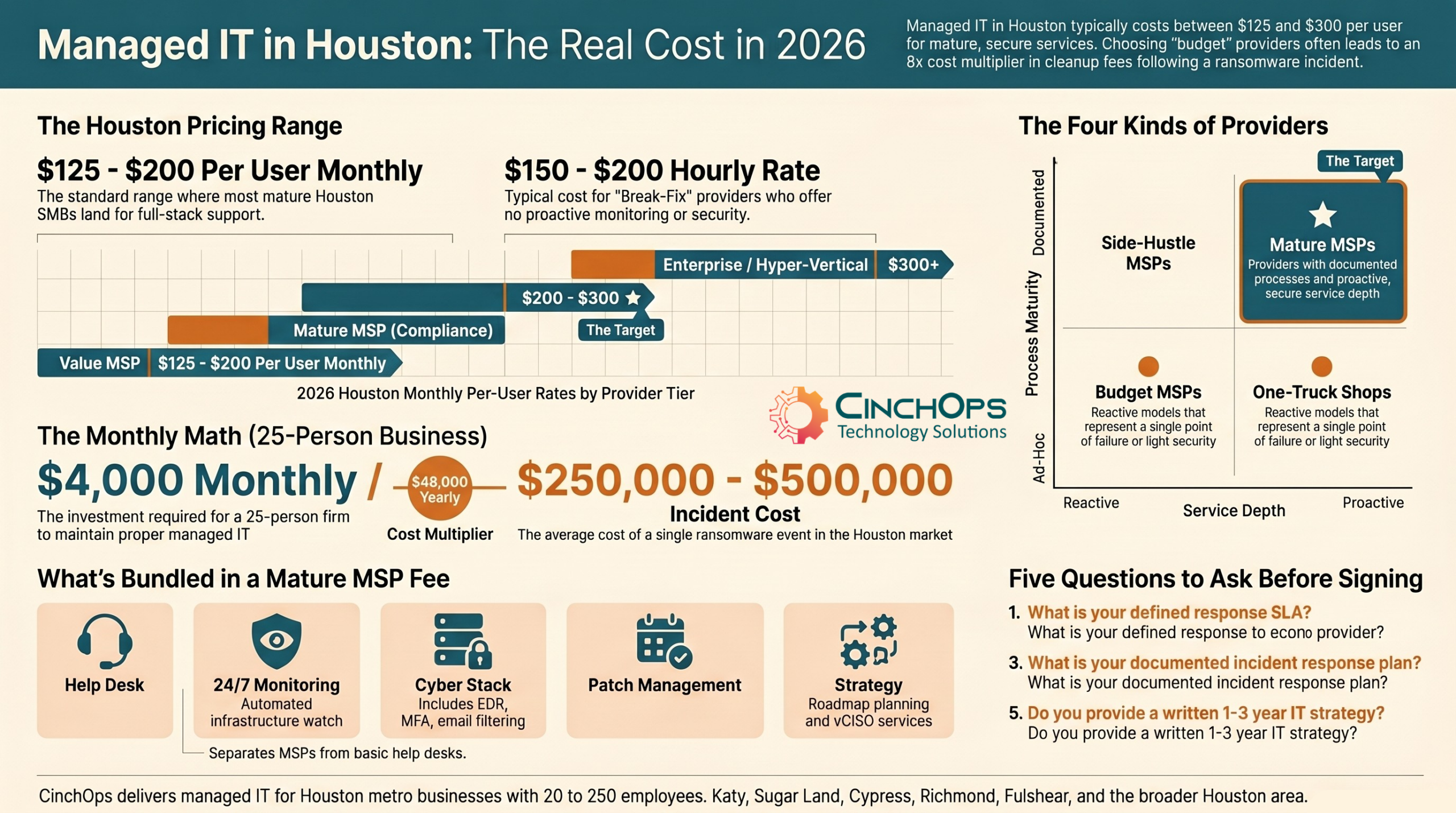
The per-user fee is not paying for a help desk. A mature MSP bundles five categories of work into one monthly number. Understanding what each one costs is how you tell value pricing from bargain pricing.
- Help desk and remote support. Ticket response, user account changes, printer issues, application installs. This is the visible work.
- Endpoint and network monitoring. 24/7 automated monitoring of every server, workstation, firewall, and switch. Most owners never see this work until something fails.
- Cybersecurity stack. Endpoint detection and response, email filtering, multi-factor authentication, security awareness training, dark web monitoring. This is what blocks the $200,000 incident.
- Patch management and lifecycle. Operating system patches, third-party application updates, firmware on routers and switches, license tracking, hardware replacement planning.
- Strategy and account management. Quarterly business reviews, IT budget planning, vendor management, compliance support. This is the work that separates an MSP from a help desk subscription.
When one of these categories is missing from the quote, the monthly number drops. So does the protection.
Mature providers in Houston charge in a tighter range than the public assumes. The numbers below reflect what an SMB with 10 to 200 employees should expect to pay for fully managed IT and security.
| Provider Tier | Per User / Month | What's Included | Onboarding Fee |
|---|---|---|---|
| Break-Fix / Hourly | $0 base + $150-$200/hr | Reactive only. No monitoring, no security stack. | Minimal |
| Value MSP | $90-$125 | Help desk, basic antivirus, limited monitoring | None to $1,500 |
| Mature MSP (Standard) | $125-$200 | Full stack: help desk, monitoring, EDR, MFA, patching, strategy | 1 month of fees |
| Mature MSP (Compliance/Security) | $200-$300 | Standard plus SOC, SIEM, compliance support, vCISO time | 1-2 months of fees |
| Enterprise / Hyper-Vertical | $300+ | Industry-specific compliance, dedicated team | Project-based |
For a typical 25-person Houston business with a mix of office workers and field users, the math lands around $3,125 to $5,000 per month at the mature MSP standard tier. A 75-person engineering firm with compliance requirements lands closer to $15,000 to $22,500 monthly. Microsoft 365 licensing, VoIP minutes, and project work sit outside that recurring fee.
The Houston metro has hundreds of providers calling themselves MSPs. Two-thirds of them are sub-scale shops where the price looks right because there is no security stack underneath it. The other third costs about the same once you compare like for like. Cheap MSP pricing in Houston is almost always math that excludes the work that matters.
"Most Houston owners find out what cheap IT actually costs the morning after an incident. The cleanup bill for one ransomware event in our market runs eight to ten times the annual managed services fee they were avoiding. We have seen it. Repeatedly."
Every Houston MSP shopping cycle surfaces the same four categories of provider. Knowing which one is sitting across the table tells you whether the quoted price is realistic or a trap.
No documented processes, no written security stack. They use the same RMM tools as bigger firms and look the same on a website. The risk shows up when your primary contact goes on vacation or quits, and the institutional knowledge of your environment walks out the door.
Reactive support model dressed up as proactive. The quote is real but it covers help desk, basic antivirus, and not much else. Cybersecurity is sold as an add-on if it is mentioned at all. These shops compete on price because they have to.
Large companies whose actual business is something else - copier sales, telecom, accounting, audio-video - that added managed IT as a recurring revenue line. The IT team is usually small relative to the parent company. Service quality is uneven. Strategy is non-existent because the parent business does not actually understand what an MSP does.
Documented processes, defined SLAs, real security stack, separate departments for support, projects, and account management. Pricing is consistent across clients. Onboarding is a structured process, not a phone call. These are the providers worth comparing against each other.
The trap is that all four can look identical in marketing materials. The differences only show during the discovery process, during onboarding, and during the first real incident.
Owners hit the same wall on every Houston MSP website. No pricing, just a contact form. Three reasons explain it, and only one of them is shady.
- Pricing is environment-dependent. Quoting a per-user number without seeing the network is malpractice. A 30-person CPA firm with a tight Microsoft 365 footprint prices out differently than a 30-person engineering firm with a server room and CAD workstations. A real quote requires a discovery call.
- Competitor shopping is rampant. MSPs send fake leads at competitor websites constantly. Public pricing pages get scraped, repackaged, and used in sales decks across the market. Most mature providers stopped feeding that ecosystem years ago.
- Lowball quotes are a sales tactic. A budget MSP that publishes $95 per user is not really competing with a mature MSP at $200. They are competing for the owners who will not look past the headline number. The hidden costs surface after the contract is signed.
This is also where the local advantage matters. A Houston-based MSP like CinchOps knows what other providers in this market actually charge, what they include, and where the soft spots are in their service delivery. A national provider quoting Houston from a call center in another state is working from market averages, not market knowledge.
Get a Real Houston Pricing Quote
Skip the discovery dance. We will look at your environment and give you a real number.
Schedule a Discovery CallOnboarding fees in Houston run between one and two months of the recurring service fee. For a 25-person business at $4,000 monthly, expect to pay $4,000 to $8,000 for onboarding. Sounds steep until you understand what should happen during it.
- Network and security discovery. An on-site walkthrough, inventory of every device, mapping of switches, firewalls, access points, and servers. Documentation of every line of business application and every cloud service.
- Security baseline. Installation of endpoint detection and response, email filtering, MFA enforcement, vulnerability scanning. The first thirty days catch the security debt that has been quietly accumulating for years.
- Account and identity cleanup. Audit of user accounts, removal of orphaned access from departed employees, password policy enforcement, group permission review. This is where most breaches start. This is where they get prevented.
- Documentation handoff. Network diagrams, asset inventories, vendor contact lists, license tracking, runbooks for the most common issues. Your previous IT provider almost certainly did not give you this.
- Strategic plan. A written 12 to 36 month IT roadmap covering hardware refresh, software lifecycle, security investments, and budget projections. This document is the deliverable that separates a real MSP from a help desk.
An MSP that skips paid onboarding is either subsidizing the work and recouping it in higher recurring fees, or skipping the work entirely. Neither is good for the buyer. Houston business owners working with organizations like the Greater Houston Partnership or the Katy Area Chamber of Commerce hear the same horror stories every quarter from peers who chose on price alone.
These are the questions a mature MSP can answer cleanly and a budget shop cannot. Ask all ten before signing a managed services agreement.
- What is your defined response SLA for critical and standard tickets? Mature MSPs publish specific response time commitments in writing and report against them every month. Vague language like "best effort" or "as soon as possible" is not an SLA.
- What is your formal escalation process when a critical issue exceeds your defined SLA? Mature MSPs have written escalation paths with named senior engineers and timelines. Budget shops escalate to whoever happens to be around at the time.
- What endpoint detection and response platform do you deploy, and is it included in the per-user fee? If EDR is a separate line item or upsell, you are looking at a budget provider.
- Do you require multi-factor authentication on every business application your team uses to access client environments? If the answer is no, walk away. Your data is one credential leak from being public.
- What is your documented incident response plan when one of your clients gets breached? If they cannot describe a defined runbook with named roles and notification timelines, your 2 a.m. phone call will land in voicemail.
- What is your patching cadence and how is it documented? Real answer: critical patches within 72 hours, standard within 30 days, with documented exceptions for compatibility testing.
- Do you provide a written 1-3 year IT strategy as part of onboarding? Yes or no question. If they hesitate, they do not.
- What is your client retention rate over the past five years? Mature shops know this number cold and will share it. Below 90% is a red flag, and a hesitant answer is a worse one.
- Who owns the change management process for my environment? A real MSP has a defined change control process. A budget MSP makes changes on Slack messages.
- What happens to my data, documentation, and accounts when we part ways? Mature providers hand off documentation cleanly. Budget shops hold it hostage.
Are You Overpaying or Underbuying?
- You are paying less than $125 per user per month and you have no EDR, MFA, or written security policy. You are underbuying.
- You are paying more than $300 per user per month and you do not have compliance requirements driving it. You may be overpaying.
- Your current provider cannot tell you what is included on a single page. You are buying confusion.
- Your invoice has more than three line items per month outside the base fee. You are getting nickel-and-dimed.
- You have not received a written IT strategy document in the past 12 months. You are not getting strategic value, only break-fix.
- You have not been told about a recent security incident affecting another client in your industry. Your provider is not paying attention.
CinchOps delivers managed IT for Houston metro businesses with transparent pricing, a defined security stack, and the kind of strategic planning most owners thought they were already getting from their current provider. We work with construction, oil and gas, CPA firms, law firms, engineering firms, and wealth management practices across Houston, Katy, Sugar Land, Cypress, Fulshear, Richmond, and Rosenberg.
- Per-user pricing in writing. Discovery first, quote second, no hidden upsells on the security stack.
- Full security stack included. EDR, email filtering, MFA enforcement, security awareness training, and dark web monitoring are baseline, not add-ons.
- Industry-specific delivery. Vertical experience across construction, oil and gas, CPA firms, law firms, engineering firms, manufacturing, energy services and utilities, and wealth management, with the compliance and workflow knowledge that comes from supporting those verticals for years.
- Defined response commitments. Documented response time targets for critical and standard issues, with named escalation paths and accountability built into the process.
- Written 1-3 year IT strategy at onboarding. Not a sales document. A real roadmap covering hardware lifecycle, security investments, and projected budget.
If your current provider's invoice does not look like the math in this article, you have a conversation worth having. We will give you a real number for your environment, and you can compare it against what you have today.
Frequently Asked Questions
The average cost of managed IT services for a small business in Houston is $125 to $200 per user per month at the mature MSP tier, which includes help desk, monitoring, endpoint detection, multi-factor authentication, patching, and strategic planning. A 25-person company typically spends $3,125 to $5,000 monthly, excluding Microsoft 365 and VoIP licensing.
Houston managed IT providers do not publish pricing because accurate quotes require environment discovery, competitors use scraped pricing pages in sales decks, and budget MSPs use lowball public prices to attract leads before adding hidden fees. Mature providers price after a discovery call to give you a real number, not a marketing number.
Managed IT support pricing typically includes five categories of work: help desk and remote support, 24/7 endpoint and network monitoring, a cybersecurity stack with EDR and MFA, patch management and lifecycle planning, and strategic account management. Microsoft 365 licensing, VoIP minutes, and project work are billed separately from the recurring per-user fee.
MSP onboarding in Houston costs one to two months of the recurring monthly service fee. For a 25-person business paying $4,000 monthly, expect onboarding fees of $4,000 to $8,000. The fee covers network discovery, security baseline deployment, account audits, documentation handoff, and a written multi-year IT strategy roadmap.
Break-fix IT is reactive support billed hourly at $150 to $200 per hour, with no monitoring, no security stack, and no SLA. Managed IT services are proactive support billed at a flat per-user monthly fee, including continuous monitoring, a deployed cybersecurity stack, defined response times, patch management, and strategic planning. Managed IT costs less than break-fix once an incident occurs.
Discover More
Resources
Sources


