


Microsoft Patched 644 Vulnerabilities in One Month. AI Just Rewrote the Patching Math for Good.
Record Patches. Rising Severity. Shrinking Time To React. – Patch Management Math For Houston Business Owners
AI Just Rewrote the Patching Math for Good.
The July 2026 record is a warning shot for every Houston business that patches "when we get to it."
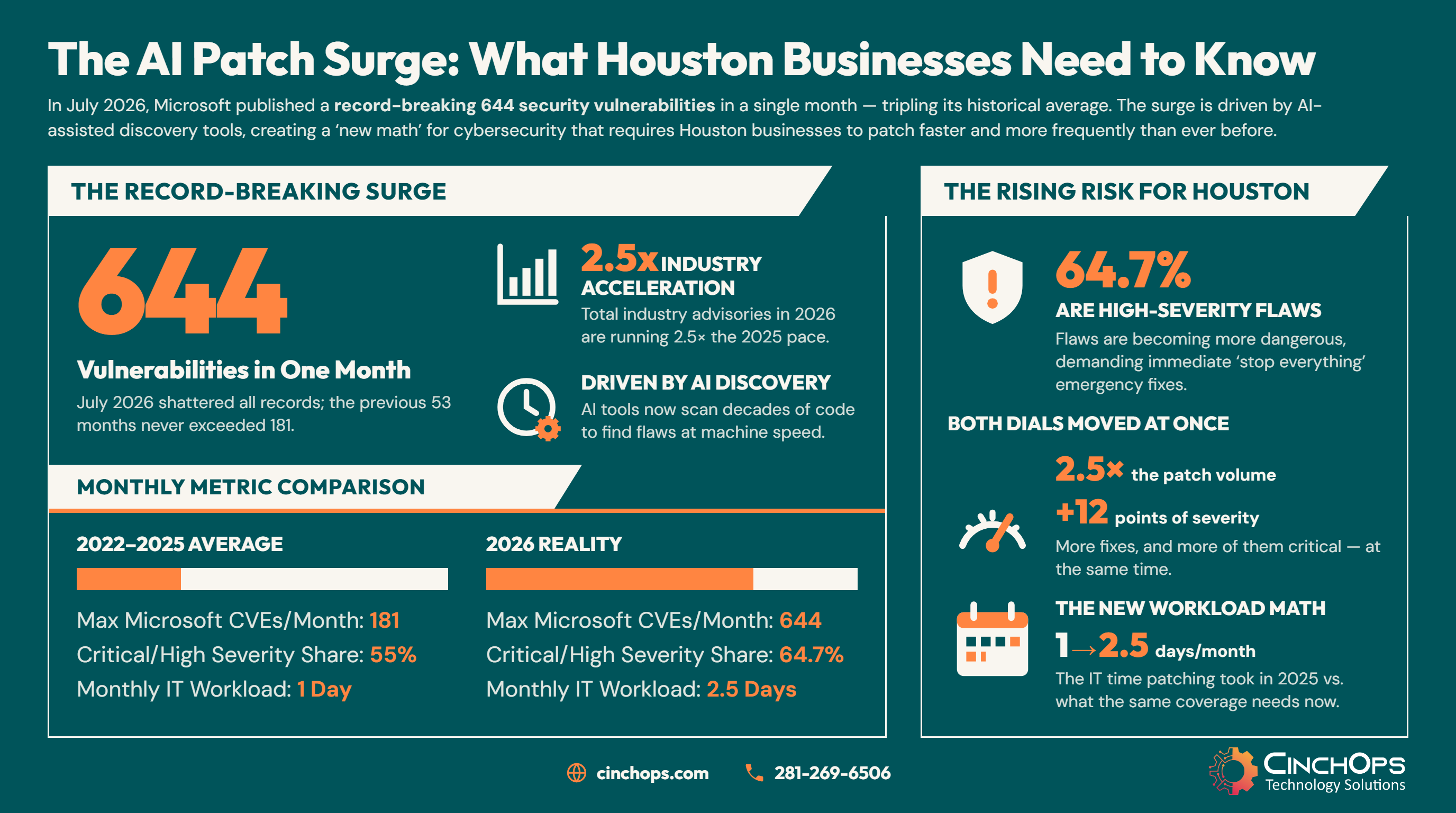
Microsoft vulnerabilities hit a number in July 2026 that nobody in IT has seen before: 644 CVEs in a single month, against a range of 38 to 181 in every other month since January 2022.
If you work in IT, the surge itself is not news - anyone watching Patch Tuesday has felt the volume climb since AI discovery tools and Project Glasswing went live. So we went back into our own data to answer the question the headlines skip: is this just more patches, or worse ones? It is both.
The share of critical and high-severity flaws jumped in 2026 after holding flat for 4 straight years, and the same AI tooling is shrinking the other side of the clock - the time from published patch to working exploit keeps getting shorter. More patches, worse patches, faster exploitation. The patch window your business planned around in 2024 does not exist anymore, and every business running Windows, Microsoft 365, or Edge inherits that math.
We are IT people and unapologetic data geeks, but this post is not written for engineers. It is written for the business owner who has to budget, staff, and plan around what comes next. CinchOps provides managed patch management specifically for small and mid-sized businesses in Houston, with a flat monthly rate per user and an under-15-minute help desk response. We also track this data ourselves: the charts in this post come from the CinchOps vendor patch-trend dataset, 45,431 advisories across 24 vendors from January 2022 through July 2026, cross-checked against Microsoft, CISA, and press reporting before publication.
Microsoft's July 2026 Patch Volume Broke Every Prior Record
Fifty-three unremarkable months, then two records back to back. This is what a regime change looks like on a chart.
The CinchOps patch-trend dataset shows Microsoft published 644 Microsoft-assigned CVEs in July 2026 and 220 in June - after 53 straight months that never exceeded 181.

Look at the shape of that chart, because the shape is the story. For four and a half years, Microsoft's patch volume behaved like a metronome: heavier months, lighter months, always inside the same band. Patch Tuesday was so predictable that IT teams built their whole month around it. Then June 2026 landed at 220 - which would have been the all-time record by itself - and July tripled it.
A note on counting, because the press numbers vary. Outlets reported July's Patch Tuesday at 569 to 622 CVEs depending on whether Edge and same-week additions were included. Our 644 covers the full calendar month of Microsoft-assigned CVEs. Pick any of those denominators and the conclusion is identical: July 2026 is the largest Microsoft patch month ever recorded, and it was not close.
AI Is Finding Software Flaws Faster Than Humans Ever Could
Three separate AI programs went operational between late 2024 and mid-2026 - and the patch surge tracks all of them.
AI-assisted vulnerability discovery means using large language models and machine-driven analysis to find exploitable bugs in code at machine speed, and in 2026 it moved from research demo to production practice across the software industry.
The timeline is short and steep. Google's Project Zero reported the first real-world vulnerability found by its Big Sleep AI agent in November 2024 - a bug in SQLite that fuzzing had missed. By April 7, 2026, Anthropic's Project Glasswing was giving 200-plus organizations access to a security-focused frontier AI model for exactly this work, and Anthropic reports the model found thousands of high-severity flaws, including bugs that sat undetected in code for 16 to 27 years. Microsoft built its own: Windows chief Pavan Davuluri said on July 9, 2026 that Microsoft's in-house MDASH scanner drove its surge in discovered and fixed flaws.
Notice what that means. The biggest software companies now have the capability to build their own AI-enabled bug finders in-house - Microsoft's spike is just the first one big enough to see from orbit. Expect more spikes like it from other vendors as the capability spreads, including from companies that stay quiet about their tooling. This is not one vendor borrowing one tool. It is the entire industry independently arriving at the same capability at the same time. That is why the surge shows up everywhere at once.

Why does AI change discovery so much? Two reasons that matter to how you defend.
- Scale without fatigue. A model can read an entire codebase - including the 20-year-old corners no engineer has looked at since they were written - and it does not get bored or skip the tedious paths. Those 16-to-27-year-old bugs were sitting in code the whole time; humans never had the hours to find them.
- The same capability cuts both ways. The tools that let Microsoft find 644 flaws also compress the time attackers need to turn a published patch into a working exploit. Discovery got faster on offense and defense at the same time, which squeezes the safe window in the middle - the window where your business does its patching.
One honest caveat, because we would rather under-claim than get quoted wrong: nobody outside these companies can prove which AI tool found which bug. What the data supports is the pattern - volume and severity surged industry-wide precisely when AI discovery tooling went operational, and Microsoft says on the record that its AI is why.
The Flaws Are Not Just More Numerous - They Are More Severe
Four flat years, then a 12-point jump in the share of critical and high-severity flaws. That changes what patching costs you.
Among CVEs with vendor-assigned severity scores, the critical-plus-high share held between 53 and 57 percent every year from 2022 through 2025 - then jumped to 64.7 percent in 2026.

This is the finding that should worry you more than the raw count. If AI were just surfacing a pile of trivial, low-impact bugs, the 2026 surge would be paperwork. The opposite is happening: the severity mix is climbing for the first time in five years. That fits what the AI labs claim their tools are good at - reaching deep, old, structurally interesting flaws that fuzzers and human review missed - and those flaws tend to be the dangerous kind.
There is a second-order cost most Houston business owners have not priced in yet: cyber insurance. Renewal questionnaires ask directly about patch cadence and time-to-remediate for critical vulnerabilities. Answers that were honest in 2024 - "we patch quarterly" - now describe falling behind at 2.5 times the old rate. Carriers notice, and the businesses that cannot demonstrate a working patch process will feel it in premiums or coverage exclusions before they ever feel it in a breach.
The Patch Gap Is Now the Biggest Risk
When fixes arrive 2.5 times faster, the time between "patch released" and "patch installed" becomes the attack surface.
The patch gap is the window between a vendor publishing a fix and a business actually installing it, and attackers work that window because the flaw becomes public documentation the moment the patch ships.
Here is the uncomfortable math. Publishing a patch is also publishing a treasure map: attackers reverse-engineer fixes to build exploits, and AI tooling is making that reverse-engineering faster too. Meanwhile, the average small business patches on a human schedule - when the IT person has a free evening, when the office is quiet, when someone remembers. That schedule was survivable at 100 Microsoft CVEs a month. At 644, the queue never empties, and the oldest unpatched item on your network is always your most likely breach point.
The timing is rough for the Gulf Coast specifically. This surge is landing exactly as Houston enters peak hurricane season, when IT calendars fill up with storm prep, generator tests, and change freezes.
Construction firms with job-site equipment and energy companies with OT systems get even fewer safe maintenance windows than office businesses do. A 2.5 times patch tempo colliding with a season of frozen calendars is how Katy and Sugar Land businesses end up 6 months exposed without ever deciding to be.
In 35+ years of doing IT, I have never seen release notes stack up this fast - and the businesses falling behind are not lazy. They are staffed for the old tempo. If patching your systems took your team roughly one working day a month in 2025, the same coverage now needs two and a half. Nobody budgeted for that, and pretending the old routine still covers you is the most expensive form of denial in IT right now. What actually works at this tempo:
- Inventory first. You cannot patch endpoints, servers, and network gear you are not tracking. Every unmanaged device is a permanent resident of the patch gap.
- Automate the routine 80 percent. Workstation, browser, and Office updates should deploy on a tested schedule without consuming human hours. Save the people for the judgment calls.
- Prioritize by exploitation, not just severity score. The CISA KEV catalog tells you what attackers are actually using right now - those items jump the queue, whatever their age.
- Plan windows around the Gulf Coast calendar. Hurricane season change freezes are real; the patch queue does not pause for them. Pre-schedule catch-up windows or the freeze becomes a six-month gap.
- Verify, don't assume. A patch job that reports "success" on 90 percent of machines quietly leaves the other 10 percent as your new attack surface. Reporting closes the loop.
Patching used to be a Sunday-night chore. Now vendors are shipping two and a half times the fixes, AI is finding the flaws, and the companies that treat updates as optional are the ones the 2 a.m. calls come from. The exotic zero-day is not your biggest risk - the patch sitting uninstalled for 90 days is.
Is Anyone Actually Watching Your Patch Queue?
CinchOps runs monitored, automated patch management as part of managed IT support for Houston businesses - inventory, testing, deployment, and verification, tracked against what attackers are exploiting right now.
See how CinchOps closes the patch gap →How CinchOps Can Help Houston Businesses Keep Up With the Patch Surge
CinchOps is a managed IT services provider based in Katy, Texas, serving small and mid-sized businesses across the Houston metro area. CinchOps specializes in cybersecurity, network security, managed IT support, VoIP, and SD-WAN for businesses with 10 to 200 employees.
- Through managed IT support, CinchOps handles patch inventory, testing, and deployment on a flat monthly rate per user - no contracts, no hidden fees, no cancellation penalties.
- Our cybersecurity services prioritize fixes against the CISA KEV catalog, so exploited-in-the-wild flaws jump the queue instead of waiting their turn.
- Business continuity and disaster recovery keeps geo-redundant backups outside the Gulf Coast flood zone, so a bad patch or a bad storm is a restore, not a rebuild.
- We support businesses across Houston, Katy, and Sugar Land, including construction, energy and utilities, and CPA firms.
The vendors are not going to slow down - the AI tools finding these flaws only get better from here, and we will keep publishing this data monthly as the trend develops. If your patching still depends on someone remembering to run updates between real jobs, this is the year that stops working. Get ahead of it while it is still a planning decision and talk to CinchOps.
Frequently Asked Questions
What is patch management and why does it matter?
Patch management is the process of tracking, testing, and applying the security updates vendors release for your software and hardware. It matters because attackers weaponize known flaws while the fix sits uninstalled. With vendors now shipping roughly 2.5 times the 2025 patch volume, unmanaged patching leaves gaps attackers find first.
How many vulnerabilities did Microsoft patch in July 2026?
Microsoft published 644 Microsoft-assigned CVEs dated July 2026, measured across the full calendar month in MSRC data by the CinchOps patch-trend dataset. Press counts of 569 to 622 cover only the Patch Tuesday release itself. Either way, it is the largest month on record - the prior 53 months never exceeded 181.
What does patch management cost in Houston?
Managed patch management in Houston is typically bundled into managed IT support at a flat monthly rate per user, so cost tracks your headcount instead of surprise invoices. CinchOps includes patch inventory, deployment, and an under-15-minute help desk response in that flat rate, with no contracts, hidden fees, or cancellation penalties.
Discover More
Resource
Sources
- CinchOps Vendor Patch-Trend Dataset - 45,431 advisories across 24 vendors, Jan 2022 to Jul 2026, built from CVE.org, Microsoft MSRC, and CISA KEV data (independently verified July 2026; charts in this post are from this dataset)
- Microsoft Security Response Center - Security Update Guide
- Microsoft - Securing Our Future: July 2026 SFI Progress Report
- Malwarebytes - July 2026 Patch Tuesday Fixes 622 Microsoft CVEs
- Anthropic - Project Glasswing: Securing Critical Software for the AI Era
- Google Project Zero - From Naptime to Big Sleep (first real-world AI-found vulnerability, Nov 2024)
- CISA - Known Exploited Vulnerabilities Catalog


