


Sugar Land Cybersecurity Is the Surprise of the Index
Reading the Houston Security Index for Sugar Land – 54.5% of Sugar Land Businesses Failed the Scan
The lowest security scores of any major Houston business hub, and the reason has nothing to do with budgets. Here is why, and what it takes to fix it.
Sugar Land cybersecurity should be a metro leader on paper. It is one of the most established business communities in the Houston area. In the data, it lands near the bottom, and that gap is the most interesting finding in the whole index.
The first release of the CinchOps Houston Area Security Index scanned 2,420 small and mid-sized businesses across twelve Houston-area cities (the index has since grown to 4,393), using an external attack-surface assessment platform, grading each one from the public internet the way an attacker would. The Woodlands and Katy led at a 1.67 GPA. Houston set the baseline at 1.60. Sugar Land came in at 1.33, with more than half of its businesses failing. Doing well as a business clearly did not translate into a locked front door.
Where does Sugar Land rank in the Houston Security Index?
Every meaningful city, sorted by grade.
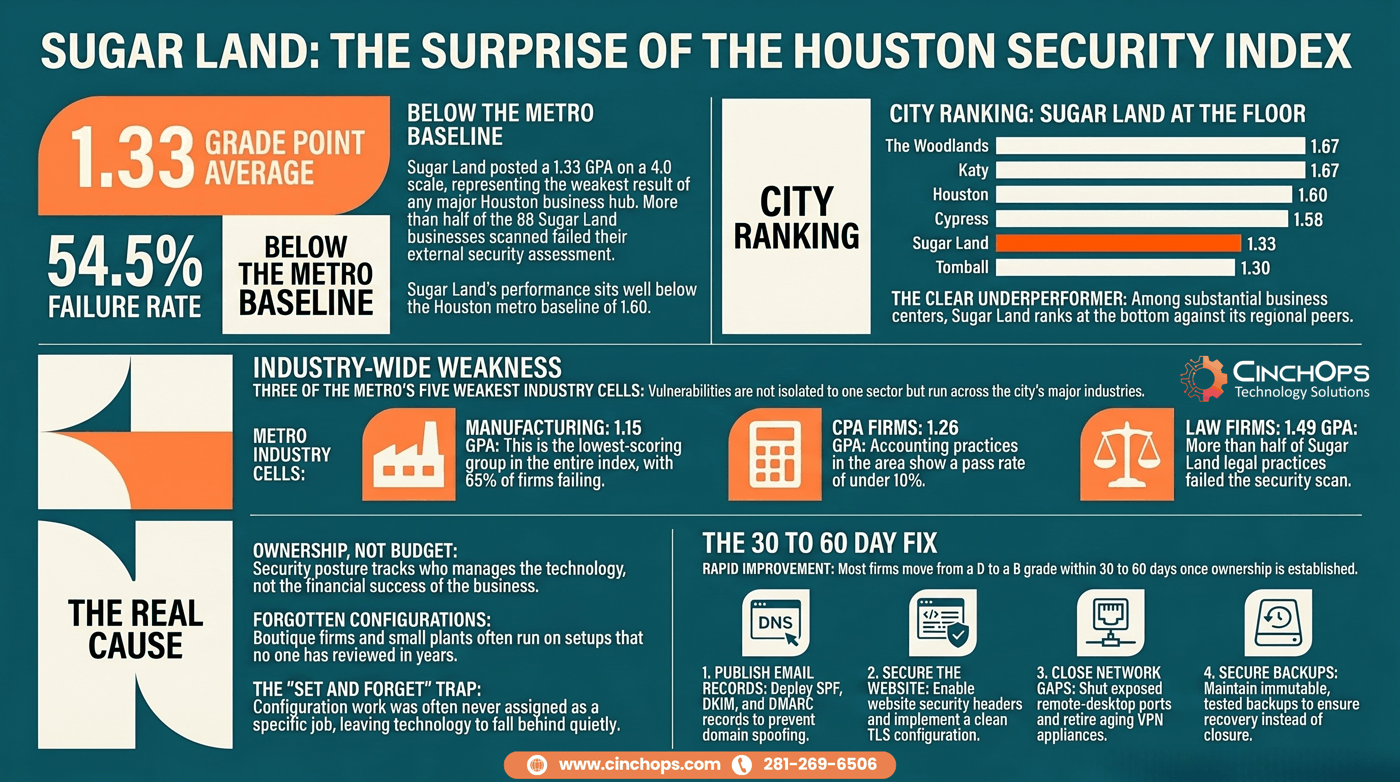
Sugar Land scores a 1.33 GPA with a 54.5% fail rate, the lowest of any major Houston business hub in the index and a full third of a grade point behind The Woodlands and Katy.
The table below ranks every city with at least ten scanned businesses. Sugar Land's 88 businesses put it on solid statistical ground, unlike the smaller outlying towns, which makes its low placement hard to wave away as a fluke. More than half of Sugar Land businesses failed outright. That is the highest fail rate of any city of its size in the metro.
| Region | Businesses | Grade (GPA) | Pass rate | Fail rate |
|---|---|---|---|---|
| The Woodlands | 135 | 1.67 | 31.1% | 42.2% |
| Katy | 70 | 1.67 | 25.7% | 41.4% |
| Houston | 2,054 | 1.60 | 26.6% | 45.7% |
| Cypress | 26 | 1.58 | 15.4% | 38.5% |
| Sugar Land | 88 | 1.33 | 21.6% | 54.5% |
| Tomball | 20 | 1.30 | 10.0% | 50.0% |
Tomball sits a hair lower, but on a sample of twenty businesses against Sugar Land's 88. Among the metro's substantial business centers, Sugar Land is the clear underperformer, and it is the one where that result is the most surprising.
Why does Sugar Land underperform?
Low scores, and the real reason behind them.
Sugar Land underperforms because security posture tracks who manages the technology, not how the business is doing. The city has many boutique firms and small plants with little or no dedicated IT staff, often running on a setup nobody has reviewed in years.
Financial health does not show up in DNS records. A well-run eight-person law firm or a specialty manufacturer can have an excellent year and still have an email domain with no SPF record and a website with no security headers, because that configuration work was never anyone's job. The technology was set up once, it works, and it has quietly fallen behind ever since. We see the same pattern across lean firms everywhere, and Sugar Land has a lot of them.
- Boutique firms with no IT staff. Small practices often hand IT to an office manager or the person who set up the network a decade ago.
- Small manufacturers with thin support. Specialty plants run lean and put dollars into production, leaving security configuration undone.
- Set-and-forget technology. A network that has worked for years feels safe, which is exactly when the unpatched, unconfigured gaps pile up.
- A false sense of safety. A business that is running well assumes its security is running well too, so nobody requests the outside check that would show otherwise.
Which Sugar Land businesses are weakest?
The city shows up three times in the metro's bottom five.
Sugar Land holds three of the five weakest region-and-industry cells in the entire index: its manufacturers, its CPA firms, and its law firms all rank near the metro floor.
This is what makes Sugar Land's number more than a single bad average. The weakness runs across industries, not one stray sector. Sugar Land manufacturers are the worst-performing group in the whole dataset. Sugar Land CPA firms have the lowest pass rate of any cell. Even Sugar Land law firms, in an industry that leads the metro overall, fail at over half. The common thread is local: smaller firms in this market that have not brought in real IT oversight.
| Sugar Land industry | Businesses | Grade (GPA) | Pass rate | Fail rate |
|---|---|---|---|---|
| Manufacturing | 20 | 1.15 | 25.0% | 65.0% |
| CPA | 31 | 1.26 | 9.7% | 51.6% |
| Legal | 37 | 1.49 | 29.7% | 51.4% |
A Sugar Land manufacturer at a 1.15 GPA is the toughest spot in the metro to sit in without a plan. A CPA firm with a 9.7% pass rate is not far behind. Both are fixable, and neither is rare in this market.
Run a business in Sugar Land?
We will scan your firm from the outside and show you exactly which categories are failing, in plain language, with no obligation.
Talk to CinchOpsWhat does it take to fix a Sugar Land security score?
The same four fixes that move any business in the index.
A Sugar Land business moves from a failing grade to a passing one through four fixes: DNS records, website security settings, network exposure cleanup, and tested backups. Most firms make the jump in 30 to 60 days.
None of this is exotic, and none of it requires replacing the IT you already have. For a market scoring this low, that is the encouraging part. The budget was never the obstacle. The missing piece was ownership, someone whose job is to do the configuration work and keep it current.
- Publish DNS records. SPF, DKIM, and DMARC stop attackers from spoofing your domain to defraud clients and staff. A few hours of work, no hardware.
- Fix the website settings. Security headers and a clean TLS configuration move the application security score, usually within one billing cycle.
- Close the network exposure. Shut public remote-desktop ports, patch firewall firmware, and retire VPN appliances older than five years.
- Back it up properly. Immutable, off-site, tested backups, so a ransomware hit is a recovery rather than a closure, which matters most for firms facing filing deadlines.
Sugar Land was the result that made me sit up. These are solid, well-run businesses, and they are scoring at the bottom. It is the clearest proof I have seen that security is not something you can buy your way to. It is something someone has to own, and in most of these firms nobody did.
A well-run business with an open front door is still an open door
CinchOps gives Sugar Land firms the IT ownership their score has been missing: DNS and website fixes, network cleanup, and tested recovery. Start with IT support in Sugar Land.
Explore CinchOps in Sugar Land →How CinchOps Can Help Sugar Land Businesses
CinchOps is a managed IT services provider based in Katy, Texas, serving small and mid-sized businesses across the Houston metro area. CinchOps specializes in cybersecurity, network security, managed IT support, VoIP, and SD-WAN for businesses with 10 to 200 employees.
- With IT support in Sugar Land, we become the owner your technology has been missing, running the configuration and monitoring work that revenue alone never provides.
- Through cybersecurity services, we publish SPF, DKIM, and DMARC, fix website security headers and TLS, and close exposed remote access, moving the failing categories first.
- With business continuity and disaster recovery, we keep immutable, tested backups so a breach is a recovery, not a closure during a deadline.
- We work with Sugar Land's strongest sectors, including CPA firms, law firms, and manufacturing, and across the metro in Houston and Katy.
Sugar Land's score is a wake-up call, not a verdict. A market this established has everything it needs to lead the metro on security, and the only thing standing in the way is that nobody has owned the work. CinchOps does exactly that for Sugar Land firms, turning a near-bottom grade into a passing one in a couple of months. If you want to know where your business actually stands, talk to CinchOps and we will show you what an attacker sees.
Frequently Asked Questions
How does Sugar Land rank for cybersecurity in the Houston metro?
Sugar Land scores a 1.33 GPA with 54.5% of businesses failing, the weakest result of any major Houston business hub in the first release of the CinchOps Houston Area Security Index. It sits well below the 1.60 metro baseline and a full third of a grade point behind leaders The Woodlands and Katy.
Why does Sugar Land have weak cybersecurity scores?
Security posture tracks who manages the technology, not how well a business is doing. Sugar Land has many boutique firms and small plants with little dedicated IT staff, often running on a setup nobody has reviewed in years. A healthy, well-run business can still have no email records and no website security headers.
Which Sugar Land businesses score worst?
Sugar Land holds three of the five weakest cells in the entire index. Its manufacturers are last overall at a 1.15 GPA with 65% failing, its CPA firms have the lowest pass rate at 9.7%, and even its law firms fail at 51.4%. The weakness runs across industries.
How long does it take to fix a Sugar Land security score?
Most Sugar Land businesses move from a D to a B within 30 to 60 days. The fixes are DNS records, website security settings, closing exposed network services, and tested backups. None require replacing existing IT, so the limiting factor is ownership, not budget.
Does CinchOps provide IT support in Sugar Land?
Yes. CinchOps provides managed IT support and cybersecurity for small and mid-sized businesses in Sugar Land and across the Houston metro. We run the configuration and monitoring work that this market has been missing, focusing first on the failing categories an external scan exposes.
Discover More
Resource
Sources
- CinchOps — Houston Area Security Index (region and region-by-industry grades; Sugar Land GPA, pass and fail rates, weakest cells)

