

8.3 Billion Phishing Emails: What Q1 2026 Means for Cybersecurity in Houston
The Microsoft Q1 Report Every Houston Owner Should Read – Three Months. 8.3 Billion Phishing Emails. One Wake-Up Call.
Microsoft tracked a record quarter of email threats. Here's what changed and what Houston SMBs need to do about it.
Microsoft Threat Intelligence published its Q1 2026 email threat report on April 30, 2026, and the numbers should put every Houston business on alert. The report counted approximately 8.3 billion email-based phishing threats between January and March, with QR code phishing growing 146% over the quarter and CAPTCHA-gated attacks more than doubling in March alone. For cybersecurity in Houston, this picture matters because the same kits hitting Fortune 500 inboxes are landing in the inboxes of CPA firms in Sugar Land, law offices in Katy, and oil and gas operators along the Energy Corridor.
Email remained the dominant initial access vector, and the threat actors behind these campaigns kept evolving faster than most SMB defenses. Around 78% of email threats were link-based by quarter's end, suggesting attackers prefer hosted credential phishing infrastructure over locally-rendered payloads. Translation: the bad email reaches the inbox first, then waits for one click to do everything else.
QR code phishing volume grew from 7.6 million attacks in January to 18.7 million in March. PDF attachments now deliver 70% of these attacks, and email-body QR codes (no attachment at all) surged 336% in March. If your security stack still treats QR codes as a low-priority signal, it is already behind.
QR code phishing (sometimes called "quishing") works because it bypasses the part of the email security stack that scans text and URLs. The malicious link lives inside an image, and the user scans it with a phone that is usually outside the company's managed defenses. By the time the credential prompt appears, the attack has moved to an unmanaged device.
Microsoft reported QR code attacks rose from 7.6 million in January to 18.7 million in March, a 146% jump in just three months. The delivery mix shifted too:
- PDF Attachments. Grew from 65% of QR code attacks in January to 70% in March. PDFs feel safe to most users and slip past basic attachment filters.
- DOC and DOCX Files. Volume kept climbing each month even as the share dropped from 31% to 24%.
- Email-Body QR Codes. The big surprise. Up 336% in March with no attachment at all, just an inline image. Still only 5% of total volume, but the growth rate is the warning sign.
For Houston firms in regulated industries, this matters more than it does for the average business. Healthcare practices around the Texas Medical Center, accounting firms preparing for tax season filings, and wealth management offices in The Galleria all handle data where a single credential compromise creates a regulatory event, not just an IT problem.
"Phishing tests that only catch link clicks miss the majority of business email compromise. The damage in a BEC chain happens in conversation across four or five emails, not in a single click. Houston SMBs need training that mirrors how the attack actually unfolds, not the version that lives in a vendor brochure."
CAPTCHA-gated phishing is exactly what it sounds like. A user clicks a link, lands on a page that looks like a Cloudflare or Google security check, and clicks the box to prove they are human. The CAPTCHA is fake. Its job is to delay automated scanners that flag malicious destinations and to make the page feel legitimate before the credential prompt loads.
After declining in January (-45%) and February (-8%), the technique exploded in March to 11.9 million attacks, a 125% month-over-month increase and the highest single-month volume Microsoft has tracked. What is more telling is the rotation in delivery payloads:
- PDF Files. Quadrupled in March (+356%), beating their previous annual high by 37%.
- DOC and DOCX Files. Up 373% in March to claim 15% of payloads, after months of being a rounding error.
- HTML Attachments. Doubled in March, but ended the quarter as only the second-most common method.
- SVG Files. Spiked 49% in February, then fell 57% in March. Attackers are testing what evades filters.
The same report also noted that Tycoon2FA, a phishing-as-a-service platform Microsoft and Europol partially disrupted in early March, no longer dominates this space. Its share of CAPTCHA-gated infrastructure fell from over 75% at the end of 2025 to 41% in March. That sounds like good news. It is not. It means the technique is spreading across more kits and more actors, not concentrating in one. The disruption hurt one operator. The playbook proliferated.
Traditional malware delivery kept its long-term decline, accounting for only 5% to 6% of payloads by end of Q1. Credential phishing took the rest, and the shift in file types is worth a close look:
| Payload Type | January 2026 Share | March 2026 Trend | What It Means |
|---|---|---|---|
| HTML Attachments | 37% | +175% rebound | Volatile and campaign-driven |
| PDF Files | 19% | +50% growth | Now 29% share, annual high |
| SVG Files | Mid-range | -32% drop | Tested as evasion, then declined |
| ZIP / GZIP | Low share | +79% surge | Used to bypass Mark of the Web |
| DOC and DOCX | Steady | Growing share | 12% of total by end of quarter |
One campaign on March 17, 2026 sent 1.5 million malicious HTML messages to more than 179,000 organizations in 43 countries in a single day. The senders impersonated routine billing and document workflows. ACH alerts. Invoice statements. E-signature requests. The kind of subject lines that pass without a second glance in a busy back office.
If your team relies on perimeter filtering and a quarterly phishing test, that is not enough anymore. Houston businesses need layered cybersecurity protection that covers email, endpoint, identity, and user training as a single system.
Not Sure Where Your Email Defenses Stand?
CinchOps offers a free security assessment for Houston-area businesses that maps your current exposure across email, identity, and endpoint.
Request Your AssessmentBusiness email compromise (BEC) is a text-based attack that impersonates a trusted person to convince the recipient to wire money, send documents, or change a payroll detail. Microsoft counted approximately 10.7 million BEC attacks in Q1 2026, with March alone bringing in over 4 million. The composition tells you exactly how these attackers operate:
- Generic Outreach Messages. 82% to 84% of all initial contact. Things like "Are you at your desk?" or "Quick question, are you available?" The first email never asks for anything financial.
- Explicit Financial Requests. Only 9% to 10% of initial messages. The attacker waits for engagement first, then drops the ask.
- Payroll Update Requests. Up 15% in February to an eight-month high. Tax season timing was no accident.
- Gift Card Requests. Fell 37% in February, then jumped 108% in March. Still under 3% of overall volume, but the variance suggests attackers keep testing what works.
A phishing test that focuses only on attachment opens and credential entry will miss most BEC attempts entirely. The first email is conversational and harmless on its face. The damage happens in the third or fourth email, after a relationship has been established. Construction firms, CPA practices, law firms, and wealth management offices in the Houston area have all lost six-figure sums to this exact pattern over the past two years. The wire goes out before anyone realizes the email chain was hijacked.
None of this requires enterprise-grade tooling. It requires the right configuration of tools most Houston SMBs already own, paired with consistent user training and a documented response process. The five highest-leverage actions:
- Move To Phishing-Resistant MFA. SMS codes and push approvals fall to adversary-in-the-middle attacks. FIDO2 keys and passkeys do not. Microsoft's report shows the AiTM kits are still the most effective credential-theft technique on the market.
- Block QR Code Renderings in Email PDFs. Modern email security platforms can extract and scan QR codes inside attachments. If yours cannot, that is a tooling gap worth addressing this quarter.
- Train Users on the "Are You at My Desk" Opener. Most BEC attempts start with a question, not an ask. Your team needs to recognize the pattern. Simulated phishing alone will not catch this; conversational simulations do.
- Turn On Safe Links and Safe Attachments. Microsoft Defender for Office 365 ships these features. Many Houston SMBs we audit have them turned off or scoped to the wrong groups.
- Document Your Wire Transfer Verification Process. A 60-second callback to a known phone number before any wire over $10,000 stops most BEC losses cold. Write the policy, train the finance team, and audit it twice a year.
Quick Self-Check: How Exposed Is Your Business?
- Does every employee use phishing-resistant MFA on email and finance systems?
- Can your email security stack scan QR codes inside PDF attachments?
- Has your finance team practiced a wire transfer verification callback in the last 90 days?
- Do you run phishing simulations that include CAPTCHA-gated landing pages?
- Is there a documented incident response playbook for a compromised mailbox?
How CinchOps Can Help Houston Businesses Defend Against Email Based Attacks
CinchOps is a managed IT services provider based in Katy, Texas, serving small and mid-sized businesses with 10 to 200 employees across the Houston metro area. CinchOps specializes in cybersecurity, network security, managed IT support, VoIP, and SD-WAN for businesses across law, accounting, construction, oil and gas, wealth management, manufacturing, and engineering.
The Q1 2026 trends are not a forecast. They are a record of attacks that already hit Houston-area inboxes during the same months your finance team was closing books and your sales team was pursuing pipeline. CinchOps positions Houston businesses to defend against these specific techniques through layered controls and ongoing monitoring.
- Email Security Hardening. Microsoft Defender for Office 365 and Microsoft 365 hardening with Safe Links, Safe Attachments, Zero-hour Auto Purge, and anti-phishing policies tuned for your industry.
- Phishing-Resistant Authentication. FIDO2 key rollouts, Microsoft Authenticator deployment with number matching, and conditional access policies that block legacy authentication paths.
- User Awareness Training. Quarterly phishing simulations that include QR code, CAPTCHA-gated, and conversational BEC scenarios. Real attack patterns, not generic templates.
- Incident Response Readiness. Documented playbooks for compromised mailbox events, wire transfer fraud, and AiTM session theft. Plus tabletop exercises with your leadership team.
- 24/7 SOC Monitoring. Endpoint detection, identity protection, and email anomaly alerting feeding a security operations center that triages incidents around the clock.
If your current IT provider has not briefed you on QR code phishing growth, CAPTCHA-gating, or the shift to PDF payloads, that is a signal worth acting on. CinchOps cybersecurity services, managed IT support, and business continuity planning are available across the Houston, Katy, and Sugar Land service areas.
Frequently Asked Questions
What is QR code phishing and why is it growing so fast?
QR code phishing embeds a malicious URL inside an image, usually delivered as a PDF attachment. The user scans it with a phone, which is often outside corporate security controls, and lands on a fake sign-in page. Microsoft reported QR code attacks grew 146% in Q1 2026 because they bypass text-based email scanners and shift the attack to unmanaged mobile devices.
What is a CAPTCHA-gated phishing attack?
A CAPTCHA-gated phishing attack uses a fake "security check" page between the malicious link and the credential trap. The CAPTCHA appears legitimate but its real purpose is to delay automated scanners and make the page look credible. After clicking through, the user lands on a fake sign-in page that harvests credentials.
How does business email compromise (BEC) typically start?
BEC attacks usually start with a generic conversational message like "Are you at your desk?" or "Quick question." Microsoft reported that 82% to 84% of initial BEC contact emails in Q1 2026 contained no financial ask at all. The attacker establishes rapport first, then makes the fraudulent request in a later email when the target is less suspicious.
Why are Houston SMBs being targeted by these attacks?
Houston SMBs are not specifically targeted by name. Phishing-as-a-service platforms blast millions of emails worldwide, and any business inbox is a potential entry point. The 8.3 billion phishing emails Microsoft counted in Q1 2026 hit Houston law firms, CPA practices, construction companies, and energy services firms at the same rate as businesses anywhere else.
What is the most effective single defense against these threats?
Phishing-resistant multifactor authentication (MFA), specifically FIDO2 security keys or passkeys, is the highest-leverage single control. Microsoft's report shows adversary-in-the-middle phishing kits are designed to defeat SMS codes and push notifications. Passkeys and hardware keys block this attack class entirely because the credential never leaves the device.
Discover More
Related reading from the CinchOps blog on phishing trends and email security.
Resources
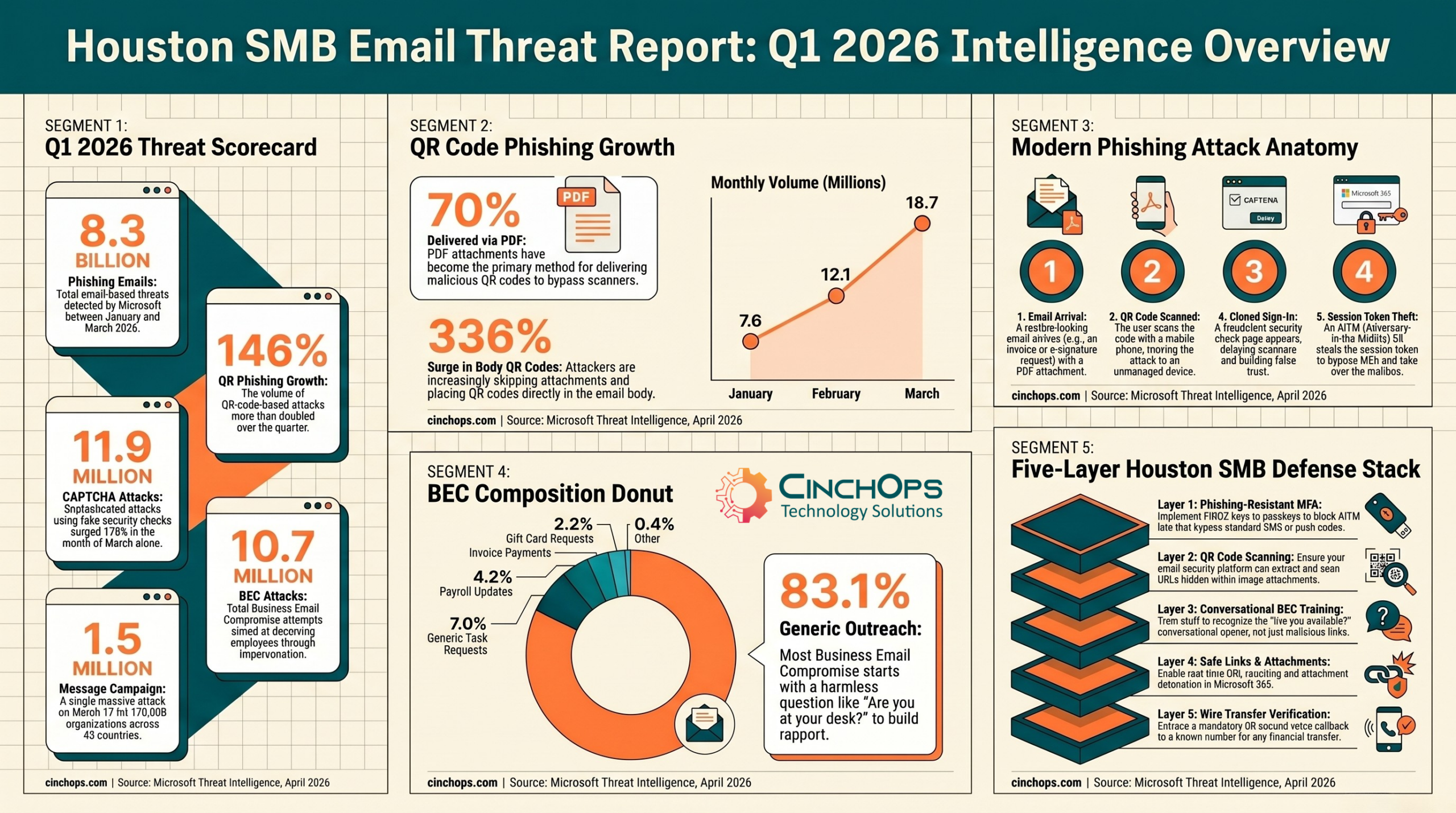
The Q1 2026 Houston SMB Email Threat Report summarized in a single visual. Click to open the full-size version.
Sources
- Microsoft Threat Intelligence, Email Threat Trends and Insights for Q1 2026, April 30, 2026
- Microsoft Security Blog, Inside Tycoon2FA: How a Leading AiTM Phishing Kit Operated at Scale, March 4, 2026
- Microsoft On the Issues, How a Global Coalition Disrupted Tycoon, March 4, 2026
- Microsoft Security Blog, AI-Enabled Device Code Phishing Campaign, April 2026


