


Best IT Support for Houston Law Firms: 7 Standards Your Firm Should Demand (2026)
What A Managing Partner Should Ask An IT Provider In Writing – A 14-Point Scorecard For Choosing Law Firm IT Support In Houston
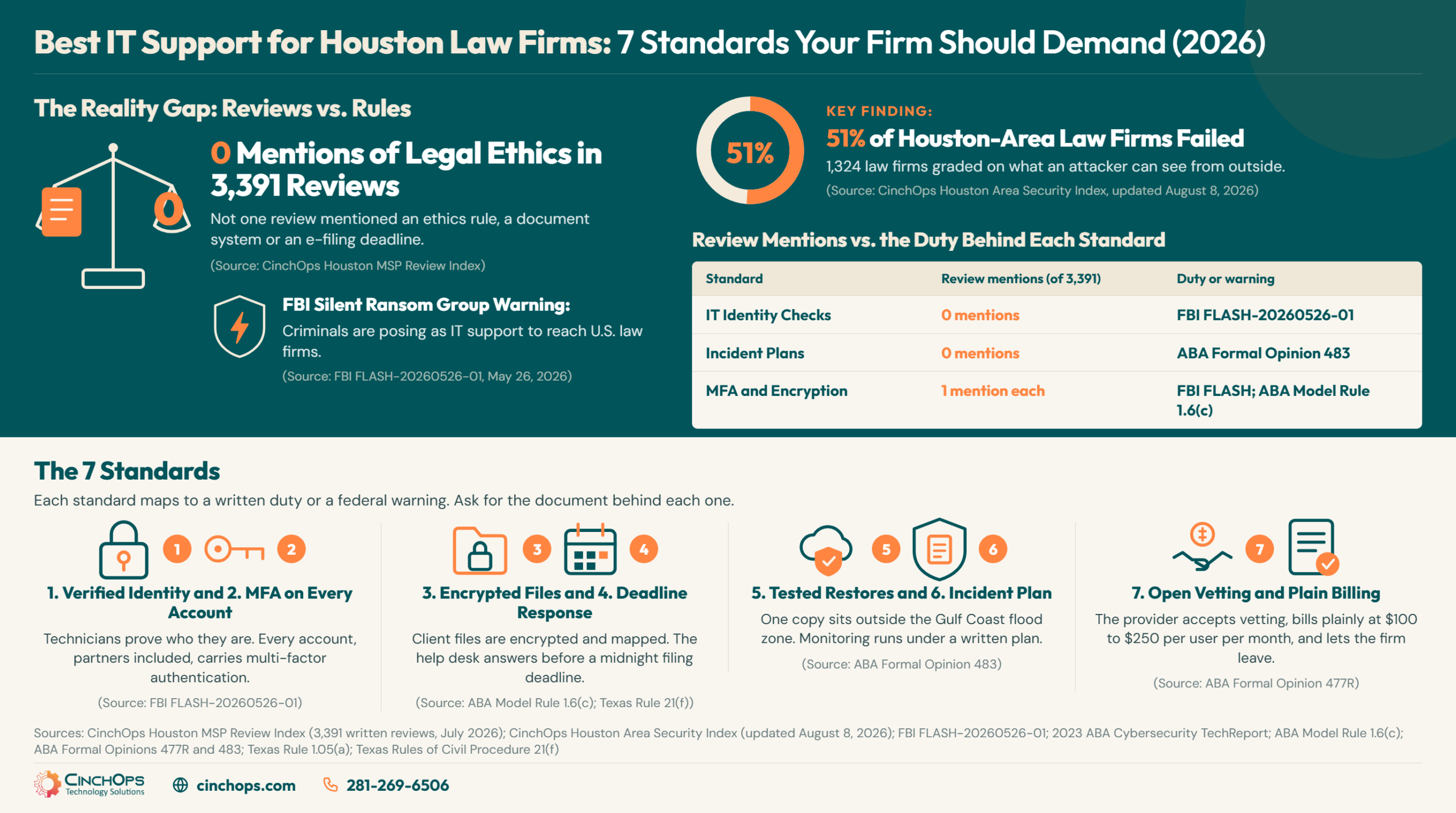
7 standards for law firm IT support in Houston, each mapped to an ethics rule, an FBI warning or 3,391 Google reviews.
The best IT support for Houston law firms proves its technicians' identity before they touch a computer, enforces multi-factor authentication on every account, encrypts client files and knows where they live, answers before a filing deadline passes, restores from backup on a tested schedule, monitors for intrusions under a written incident plan, and opens its own security to the firm's review.
If you are the managing partner or firm administrator comparing IT support for Houston law firms, you have probably started with Google reviews. CinchOps searched all 3,391 written reviews in the July 2026 snapshot behind the Houston MSP Review Index, which covers 140 Houston-area IT providers, for the vocabulary of legal work. Eighteen reviews came from a law practice. All 18 are five stars, 10 of them praise speed, and not one mentions a bar rule, a document management system, e-filing or a court deadline.
That silence matters more for a law firm than for most businesses, because a lawyer's duties around technology are written down. ABA Model Rule 1.6(c) requires reasonable efforts to prevent unauthorized access to client information. Comment 8 to Texas Disciplinary Rule 1.01 tells every Texas lawyer to stay competent in "the benefits and risks associated with relevant technology." The FBI has warned twice, in May 2025 and again in May 2026, that one extortion group is targeting US law firms by posing as their IT support. None of that shows up in a star rating.
So this list ranks standards, not companies. No provider is named. CinchOps does not appear anywhere in the ranking, and the only place CinchOps measures itself is a labeled box at the end, after the list is finished.
How We Ranked the 7 Standards for Houston Law Firm IT Support
The sample, the search, the sources and the ordering rule, stated so you can check them.
The 7 standards were chosen by searching 3,391 written Google reviews of 140 Houston-area IT providers for the language of legal practice, then testing each candidate standard against the ABA Model Rules, 2 ABA formal ethics opinions, the Texas Disciplinary Rules, the Texas Rules of Civil Procedure and 2 FBI notifications. A standard made the list only if a named duty or warning stands behind it and a well-run provider of any size could meet it.
The review sample is the July 13, 2026 snapshot behind the Houston MSP Review Index: 4,289 public Google reviews across 140 providers, of which 3,391 carry written text. On September 17, 2026 CinchOps searched those 3,391 texts for law firm, law office, attorney, lawyer, legal, paralegal, litigation, counsel, court, e-filing, case management, docket, Clio, PracticePanther, MyCase, NetDocuments, iManage, Worldox, e-discovery, privilege, state bar, IOLTA and trust account. The search returned 27 raw matches and every one was read by hand. Eighteen came from someone at a law practice, spread across 12 providers and dated 2017 through 2025. The other 9 were false positives: "privilege" used as a courtesy 3 times, a repair shop's "trial" fit of a hard drive, a help desk that handled "my case," a threat of small claims court from an accountant, a contract dispute described as "legal," and a copier dealer's "document management."
Here is what those 18 reviews talk about. Ten praise speed or responsiveness. Two mention security or confidentiality. One credits a provider's continuity planning. None names a legal application, and across the full 3,391 reviews the words attorney and lawyer appear 0 times, Clio, NetDocuments, iManage and Worldox appear 0 times, e-filing and e-discovery appear 0 times, encryption appears once and multi-factor authentication appears once. The market-wide praise and complaint shares used below (responsiveness in 22.4% of 3,705 positive reviews, billing surprises in 18.0% of 122 negative reviews) are the published Review Index figures and were not recomputed.
The ordering rule is simple. Standards are ranked by how directly a named professional duty or federal warning attaches to them, and ties are broken toward the standard the public record says least about, because that is where a firm has to do its own testing. The standard with a current FBI warning aimed at law firms by name comes first. Billing and contract terms come last: they carry the strongest review evidence and the lightest professional duty, since the ethics opinions treat a technology vendor as someone the lawyer must vet, not someone the rules regulate.
One finding from the search stands by itself. Public reviews of Houston IT providers almost never describe the work a law firm is professionally accountable for: across 3,391 written reviews, 18 came from a law practice, more than half of those praise speed, and none mentions a rule of professional conduct, a document management system, e-filing or a filing deadline. A Google profile can tell a managing partner that a provider is quick and pleasant. It cannot say whether that provider has ever produced an MFA report or a restore test for a firm that holds privileged files.
The 7 Standards the Best IT Support for Houston Law Firms Meets
Each standard opens with the evidence behind it and closes with the question that tests it.
The best IT support for Houston law firms meets 7 standards: technicians prove who they are, every account carries multi-factor authentication, client files are encrypted and mapped, the help desk answers before a deadline passes, restores are tested with a copy outside the flood zone, monitoring runs under a written incident plan, and the provider accepts the vendor vetting that ABA Formal Opinion 477R describes.
The matrix below sets each standard against the duty or warning it maps to, the document a firm should be shown, and how often the subject appears in 3,391 written Houston IT reviews. Read across a row and you have the whole argument for that standard: why it applies to a law firm, what proof looks like, and how little a star rating says about it.
1. Technicians prove who they are before they touch a computer
The FBI warned on May 26, 2026, in FLASH-20260526-01, that the Silent Ransom Group has consistently targeted US-based law firms since Spring 2023 by posing as the firm's own IT support, and identity verification by an IT provider is mentioned in 0 of 3,391 written Houston IT reviews. The scheme is plain. Someone calls or emails a paralegal claiming to be from IT and asks for a remote session. If that fails, the FBI says the group sends a person to the office who claims they need to image the machine or create a backup, then plugs in a storage device and copies client files. No ransomware runs. The firm learns about it from an extortion email.
This standard ranks first because the warning names law firms and because the attack uses the IT provider's own role as the disguise. The FBI's recommendations read like a checklist for a provider: develop and communicate policies on when and how IT support will authenticate itself to employees, verify the credentials of everyone entering company spaces, and where possible disable external drive installation on computers holding confidential data. The bulletin also says recent campaigns leave few artifacts and that traditional antivirus is unlikely to flag them, because the tools used are the same remote access products legitimate support teams use. A provider that treats this as the firm's problem has misread its own job.
Ask: how will my staff know that a caller or a visitor is really your technician, is that procedure written down, and which remote access tools do you use so that everything else can be blocked?
2. Every account carries multi-factor authentication, partners included
The 2023 ABA Cybersecurity TechReport found that only 54% of attorneys had two-factor authentication available to them, while the FBI's 2026 law firm bulletin recommends phishing-resistant multi-factor authentication for as many services as possible, and MFA appears in 1 of 3,391 written Houston IT reviews. The ABA report's own authors called that 54% figure disappointing, given that the control is usually free. Sophos' State of Ransomware 2026 survey adds the reason it matters: 79% of ransomware attacks on the 2,158 organizations surveyed began with a compromised identity.
In a law firm, the accounts that get exempted are the ones that matter most. A senior partner who dislikes the prompt, a shared intake mailbox, a scanner's service account, the bookkeeper's remote login to the trust accounting system. A provider meeting this standard can show, on request, a list of every account without MFA and the reason each exception exists. A provider that answers "we turned it on" has described a setting. The report is the evidence.
Ask: for an MFA enforcement report on a firm like mine showing every account without it, including partners, shared mailboxes and service accounts, and ask which sign-ins use a phishing-resistant method.
3. Client files are encrypted, and the provider can say where they live
ABA Model Rule 1.6(c) requires a lawyer to make reasonable efforts to prevent unauthorized access to information relating to a client's representation, yet the 2023 ABA Cybersecurity TechReport found file encryption available to 48% of respondents and email encryption to 42%, and encryption appears in 1 of 3,391 written Houston IT reviews. Texas draws the circle wide. Texas Disciplinary Rule 1.05(a) defines confidential information as both privileged information and unprivileged client information, meaning everything the firm acquires about a client during the representation. The intake form and the billing narrative count, along with the privileged memo.
ABA Formal Opinion 477R turns the rule into practical steps. Two of its 7 considerations are to understand how client confidential information is transmitted and where it is stored, and to understand and use reasonable electronic security measures. The opinion says a fact-based analysis means strong protective measures, like encryption, are warranted in some circumstances. For a Houston law firm that means a provider should be able to draw the map: which matters sit in the document management system, whether that is iManage, NetDocuments or Worldox, what is synced to partner laptops, what leaves by email, and what is encrypted at each stop. Those 3 platform names appear 0 times in 3,391 Houston IT reviews, so no profile will tell you whether a provider has ever worked with one.
Ask: for a device-by-device encryption status report, a one-page map of where client files are stored and synced, and how the provider would send a settlement agreement to opposing counsel if the client asked for extra protection.
4. The help desk answers before the filing deadline passes
Responsiveness is the most common reason Houston businesses praise an IT provider, appearing in 22.4% of 3,705 positive reviews in the CinchOps Houston MSP Review Index, and 10 of the 18 law-practice reviews in the dataset praise speed, which makes it the one standard a law firm can partly judge from a Google profile. The reason law firms care is structural. Texas Rule of Civil Procedure 21(f)(1) requires attorneys to file electronically in courts where e-filing is mandated, and Rule 21(f)(5) treats a document as timely if it is e-filed at any time before midnight on the deadline. The workday for a litigation team ends at 11:59 p.m., and the help desk hours need to reflect that.
One of the 18 law-practice reviews was written by a paralegal, and its point is practical: roadblocks have to be cleared quickly and accurately. Slow or no response is also a complaint theme, at 8.2% of 122 negative reviews. The test for a law firm goes past the average response time and asks what happens at 9:40 p.m. on a filing day when the PDF will not upload, the VPN has dropped, or the attorney's token has locked. A provider with business-hours coverage and a voicemail box has answered the question.
Ask: for the first-response time in writing, who answers after 6 p.m. and on weekends, what that coverage costs, and whether the after-hours technician can reach my firm's systems or only take a message.
5. Restores are tested, and one copy sits outside the Gulf Coast flood zone
ABA Formal Opinion 483 says that after a breach a competent lawyer must make all reasonable efforts to restore computer operations to be able again to service the needs of the lawyer's clients, while backups appear in 46 of 3,391 written Houston IT reviews, about 1.4%, and only 1 of the 18 law-practice reviews credits a provider's continuity planning. The FBI's Silent Ransom Group bulletin lists maintaining regular backups among its recommendations for law firms. A backup that has never been restored is a belief. The evidence a law firm should ask for has three parts: the date of the last test, what was restored, and how long it took.
Houston adds a location test. A copy kept in the same building, or in the same flood-prone part of Harris County, fails in the event most likely to close the office. The National Hurricane Center puts the peak of the Atlantic season at September 10, with most activity between mid-August and mid-October. Storm or power-outage recoveries appear in 5 of the 3,391 reviews, including an office described as in distress after Hurricane Harvey. A provider meeting this standard keeps at least one copy far enough away that the storm cannot take the office and the backup together, and can name the city where it sits.
Ask: when was the last restore test for a client my size, what was restored and how long did it take, where does the second copy physically sit, and how long would my document system be down if the server room flooded tonight?
6. Monitoring runs under a written incident plan that includes telling clients
The 2023 ABA Cybersecurity TechReport found that only 34% of law firms had an incident response plan, falling to 19% at firms of 2 to 9 attorneys, even though ABA Formal Opinion 483 concludes that lawyers must employ reasonable efforts to monitor their technology for a breach and have a duty to notify clients when material client information is involved. The same survey reported that 29% of respondents' firms had experienced a security breach at some point and another 19% did not know whether theirs had. The ABA's authors caution that a security breach in that question includes a lost phone and is not the same as a data breach. The 19% is the more telling number. A firm that cannot say is a firm nobody is monitoring.
Opinion 483 describes what a plan does: identify and evaluate the intrusion, assess its scope, determine whether data was accessed, quarantine the threat, prevent exfiltration and restore the network, with named team members and a way to reach them at any hour. The IT provider owns most of those verbs. The lawyer owns the notification decision, which means the plan has to get facts to a partner fast enough to make it. Texas adds a financial reason to write the plan down: under Texas SB 2610, in effect since September 1, 2025, a business with fewer than 250 employees that maintained a conforming cybersecurity program is protected from exemplary damages in a breach lawsuit, with CIS Controls Implementation Group 1 as the benchmark for firms of 20 to 99 employees.
The outside view belongs here too. In the 2026 CinchOps Houston Area Security Index, which grades what an attacker can see from the open internet, 51.0% of 1,324 Houston-area law firms failed and the legal cohort averaged a 1.47 GPA, third of 4 industries. Sugar Land law firms were the third-weakest cell in the index at a 1.27 GPA with 61.0% failing. Incident response plans appear in 0 of 3,391 written reviews.
Ask: what do you monitor and who looks at the alerts at 2 a.m., may I read a redacted incident response plan you maintain for another professional firm, and at what point in that plan does a partner get the facts needed to decide on client notification?
7. The provider accepts vetting, bills plainly and lets the firm leave
ABA Formal Opinion 477R lists the factors a lawyer should weigh when selecting a technology vendor, including reference checks and credentials, the vendor's security policies and protocols, its hiring practices and the use of confidentiality agreements, and the Houston MSP Review Index shows billing surprises are the top complaint theme at 18.0% of 122 negative reviews, with contract lock-in next at 12.3%. Opinion 483 frames the same point as supervision: lawyers must make reasonable efforts to monitor external vendors providing services relating to data. Your IT provider holds administrator rights to every matter in the firm. Under the ethics opinions it is the most consequential vendor you will ever vet.
A provider meeting this standard hands over its own security policy, signs a confidentiality agreement without negotiation theater, explains how it screens and offboards its technicians, and supplies references from other professional firms. It also bills in a way a firm administrator can read. One negative review in the dataset describes an 8-hour outage during a provider's botched firewall change, followed by a dispute over termination fees the reviewer says were never disclosed. That pairing, a service failure and a contract that makes leaving expensive, is the pattern to price in before signing. Read the termination clause first, then the pricing page.
Ask: for your written security policy, your confidentiality agreement, how technicians are background-checked and how their access is removed when they leave, 2 references from law or accounting firms, and the exact cost of ending the contract in month 7.
"Every business needs its IT to work. A law firm needs its IT to hold up under an ethics rule, a midnight filing deadline and an FBI warning aimed at firms by name. That is a different job, and you should hire for it on purpose."
A Houston Law Firm's Deadlines Do Not Move Just Because the Power Went Out
What the Texas rules and the Hurricane Beryl order say about outages, and what they leave to the firm.
Houston law firms file electronically under a rule that treats midnight as the deadline and offers relief for a technical failure only by asking the court, and the Supreme Court of Texas' emergency order after Hurricane Beryl reached only justice courts in 5 counties, and only until July 26, 2024. A firm's own continuity plan, not the court calendar, is what protects a filing during a Gulf Coast storm.
Start with the rule. Texas Rule of Civil Procedure 21(f)(6) says that if a document is untimely due to a technical failure or a system outage, the filing party may seek appropriate relief from the court, and that a missed deadline imposed by the rules must be given a reasonable extension. Read that the way a litigator would. Relief is something you request, with an explanation, after the fact. A firm whose internet was down because its only circuit and its only firewall sat in a flooded first-floor closet is asking a judge to excuse a preventable failure. Most judges will be reasonable. No partner wants to find out which ones are not.
Then look at what happened the last time a hurricane hit Houston. Hurricane Beryl struck Texas on Monday, July 8, 2024. On July 12, the Supreme Court of Texas issued Misc. Docket No. 24-9042, which recognized that court proceedings were affected by closures and by "difficulties with access, electricity, internet, travel, and communication by lawyers, parties, and others." The order let justice courts in Fort Bend, Galveston, Harris, Matagorda and Montgomery counties treat the disaster as good cause for extending time periods in civil cases until July 26, 2024. That is the whole order. It covered justice courts. It did not address district courts, county courts at law, federal deadlines, statutes of limitations running in other states, or a closing scheduled for that Thursday.
The practical reading for IT support is that a Houston law firm should plan to work through a storm week from somewhere else. That means the document system is reachable from a partner's home in Katy or a hotel in Austin without the office being online, e-filing credentials and MFA tokens are not locked inside the building, phones fail over to mobiles, and at least 2 people know how to run the firm from laptops. It also means the provider has rehearsed it. The season peaks on September 10 according to the National Hurricane Center, which is late enough in the year that most firms have stopped thinking about it and early enough that fall trial settings are already on the calendar.
This is where standards 4 and 5 meet. A fast help desk is only useful during a regional outage if the provider's own operations survive it, so ask where their technicians and their tools sit when Harris County loses power. A tested restore is only useful if the copy being restored is outside the water. Settle both questions in the spring, while the answers can still change what you buy.
How to Choose Law Firm IT Support in Houston, Texas
A 14-point card, one week of document requests and one after-hours phone call.
To choose law firm IT support in Houston, Texas, score each provider 0, 1 or 2 on the 7 standards for a 14-point card, where 2 means you were shown the document, 1 means you were given a credible verbal answer and 0 means neither. Request the documents in writing, give every provider the same week to respond, and test the after-hours line yourself before you sign.
Begin with what is public, because it costs nothing. Standards 4 and 7 can be partly scored from a Google profile: look for reviews that describe speed in specifics, and read the critical reviews for billing and contract complaints. Then look up how law firms in your city graded on the Houston Area Security Index, so you walk into the meeting knowing that roughly half of Houston-area firms fail an outside scan and that your own firm may be one of them. A provider worth hiring will offer to scan your domain before you ask.
Next, send one email to every provider on the shortlist asking for 5 documents, redacted from another professional-services client: the technician verification procedure, an MFA exception report, a device encryption report, the record of the last restore test and an incident response plan. These are standards 1, 2, 3, 5 and 6. None of them takes a well-run provider more than a few days to produce, because each is a report their tools already generate or a policy they already follow. The speed and completeness of the reply is itself a score. A provider that sends a brochure in response to a request for a restore record has told you how an incident would go.
Then make the call. Pick an evening, dial the support number at 8 p.m. and see who answers, how they verify who you are and whether they could have helped. It is a fair test of standards 1 and 4 together, and it takes 5 minutes. Finish with the vendor file that Opinion 477R describes: the security policy, the confidentiality agreement, 2 references from law or accounting firms, and the termination clause. A provider scoring 11 or more of 14 deserves a second meeting. Below 7, the documents were not there, and they will not appear after the contract is signed.
Two CinchOps guides go deeper on parts of this. The cybersecurity checklist for law firms in Sugar Land covers the controls themselves, and managed IT for a 30-person law firm in West Houston walks through scope and staffing for a mid-sized practice. For the market-wide version of this scorecard, see what the top managed IT providers in Houston have in common.
Managed IT for a Houston Law Firm Runs $100 to $250 per User per Month in 2026
What the rate should include, and the 3 things that move it for a legal practice.
Managed IT for a Houston law firm is commonly priced as a flat monthly rate per user, and CinchOps' published 2026 range is $100 to $250 per user per month depending on how much security, backup and after-hours coverage is included. For a 20-person firm that is roughly $2,000 to $5,000 a month. A rate near the bottom of the range that leaves out after-hours support can cost a litigation practice more than a higher rate that includes it.
Three things move the number for a legal practice. The first is whether the controls in standards 2, 3, 5 and 6 sit inside the base rate or are sold back as add-ons. MFA enforcement, device encryption, backup with restore testing and monitoring are the parts a law firm's duties depend on, and a low per-user price that lists each one as a separate line usually costs more by December. The second is after-hours coverage. A litigation practice that files at 11 p.m. needs a help desk that works at 11 p.m., and a quote that is silent on evenings and weekends has priced a different service. The third is term and exit. A cheaper monthly rate tied to a 3-year contract with a termination fee is a more expensive agreement, and it removes the only real pressure a firm has if standard 4 slips.
The best value managed IT service in the Houston area for a law firm is the one that passes the most of the 7 standards at a price that does not change when you ask for the documents. CinchOps publishes its own model in three tiers: Launch at $100 to $125, Mission at $125 to $175 and Explorer at $175 to $225 or more per user per month, with no long-term contract, no hidden fees and no cancellation penalty. Compare every quote you receive on the same 3 questions before you compare the totals.
Take the 7 Standards Into Your Next IT Meeting
Every question above works on any provider, before any contract. To see how a Houston provider answers them for a legal practice, start with how CinchOps approaches managed IT for law firms and cybersecurity.
See CinchOps IT for law firms →How CinchOps Helps a Houston Law Firm Hold IT Support to These Standards
CinchOps is a managed IT services provider based in Katy, Texas, serving small and mid-sized businesses across the Houston metro area. CinchOps specializes in cybersecurity, network security, managed IT support, VoIP, and SD-WAN for businesses with 10 to 200 employees.
For legal practices, CinchOps provides managed IT support and cybersecurity specifically for law firms in Houston, with a help desk that answers in under 15 minutes and backups kept outside the Gulf Coast flood zone.
- Through IT services for law firms and CPA firms, CinchOps supports professional practices that hold confidential client files.
- Help desk, patching, monitoring and security run under one flat per-user rate, delivered as managed IT support and cybersecurity services.
- Backups are geo-redundant outside the Gulf Coast flood zone and restore-tested on a schedule rather than assumed, under business continuity and disaster recovery.
- CinchOps serves law firms through local teams for IT support in Houston, Sugar Land, The Woodlands and Katy.
How CinchOps measures against these criteria - judge for yourself:
- Standard 1 - Technician identity. Every client is assigned a named engineer who knows the firm's network, so staff know whose voice to expect. No number to quote beyond that. Ask us for the written verification procedure and try to talk your way past it.
- Standard 2 - MFA everywhere. No approved figure to publish here. Ask for a redacted MFA exception report from another professional firm and count the exceptions.
- Standard 3 - Encryption and the data map. Ask for a sample device encryption report and ask which of iManage, NetDocuments and Worldox we have supported. If the answer for your platform is none, weigh that.
- Standard 4 - Answering before the deadline. The CinchOps help desk answers in under 15 minutes. Our Google profile lists Monday to Friday, 8 to 6, so ask exactly how evening and weekend filing emergencies are handled and get it in writing.
- Standard 5 - Tested restores. Backups are geo-redundant outside the Gulf Coast flood zone and restore-tested on a schedule. Ask for the date of the last test.
- Standard 6 - Monitoring and the plan. CinchOps publishes the Houston Area Security Index cited under standard 6. Ask us to scan your firm's domain and to show a redacted incident response plan.
- Standard 7 - Vetting, billing and exit. A flat monthly rate of $100 to $250 per user, Zero-Zero-Zero terms (no long-term contracts, no hidden fees, no cancellation penalties) and a 30-day satisfaction guarantee. CinchOps is about 2 years old, led by a founder with 35+ years in IT, so ask for our longest-standing client and call them.
CinchOps holds a 5.0 rating across 22 Google reviews as of September 8, 2026, a small number you should weigh accordingly. Read our Google profile and the market figures in the Houston MSP Review Index, read the critical reviews on every provider you consider, then hold all of them, CinchOps included, to the same 7 standards.
A law firm's IT support gets graded on the night a filing will not upload and the week the office has no power, so run these tests in a quiet month while you can still act on the answers. Send the 5-document request to every provider you are considering this week. If you want CinchOps on that list, bring the hard questions and talk to CinchOps.
Frequently Asked Questions
Who are the top managed IT providers for Houston law firms?
No independent, audited ranking of managed IT providers for Houston law firms exists, and most published lists are written by a provider that ranks itself first. Score candidates on the 7 standards in this guide instead: technician identity checks, MFA, encryption, after-hours response, tested restores, a written incident plan and openness to vendor vetting.
What is the best IT support for Houston law firms?
The best IT support for Houston law firms is the provider that can show, in writing, how its technicians prove their identity, an MFA report with no unexplained exceptions, encryption on every device, a dated restore test and an incident response plan. Across 3,391 written Houston IT reviews, only 18 came from a law practice and none mentions these.
What does managed IT cost for a law firm in Houston?
Managed IT for a Houston law firm is commonly billed as a flat monthly rate per user. CinchOps publishes a 2026 range of $100 to $250 per user per month, with no long-term contracts, no hidden fees and no cancellation penalties. Confirm whether after-hours support, encryption, backup testing and monitoring are included before comparing quotes.
Do Texas ethics rules require a law firm to have cybersecurity?
Texas rules do not list specific controls, but they set the duty. Comment 8 to Texas Disciplinary Rule 1.01, amended in February 2019, says lawyers should stay competent in the benefits and risks of relevant technology, and Rule 1.05 protects privileged and unprivileged client information alike. ABA Opinions 477R and 483 describe what reasonable efforts look like.
What is the FBI warning about fake IT support at law firms?
FBI FLASH-20260526-01, dated May 26, 2026, warns that the Silent Ransom Group has targeted US law firms since Spring 2023 by posing as IT support over the phone, by email and in person, then copying client data for extortion. The FBI recommends written policies for how real IT staff identify themselves, plus phishing-resistant MFA.
What happens if a Houston law firm misses an e-filing deadline because of an outage?
Texas Rule of Civil Procedure 21(f)(6) lets the filing party seek relief from the court when a document is untimely due to a technical failure or system outage. Relief must be requested and explained. After Hurricane Beryl, the Supreme Court of Texas' emergency order covered only justice courts in 5 counties, through July 26, 2024.
Discover More
Resource
Sources
- CinchOps Houston MSP Review Index (2026) - 140 Houston-area IT providers, 4,289 public Google reviews, July 13, 2026 snapshot; legal-vocabulary search over the 3,391 written reviews run September 17, 2026
- CinchOps Houston Area Security Index 2026 - 3,690 Houston-area businesses including 1,324 law firms, published June 15, 2026, updated August 8, 2026
- FBI FLASH-20260526-01, "Silent Ransom Group Impersonating IT Personnel through Social Engineering" (May 26, 2026)
- FBI Private Industry Notification 20250523-001, "Silent Ransom Group Targeting Law Firms" (May 23, 2025)
- American Bar Association, Model Rule of Professional Conduct 1.6(c), Confidentiality of Information
- ABA Formal Opinion 477R, "Securing Communication of Protected Client Information" (revised May 22, 2017)
- ABA Formal Opinion 483, "Lawyers' Obligations After an Electronic Data Breach or Cyberattack" (October 17, 2018)
- American Bar Association, 2023 Cybersecurity TechReport (ABA Legal Technology Survey)
- Texas Disciplinary Rules of Professional Conduct (effective March 7, 2025), Rule 1.01 comment 8 and Rule 1.05(a)
- Texas Rules of Civil Procedure, Rule 21(f), Electronic Filing
- Supreme Court of Texas, Misc. Docket No. 24-9042, Emergency Order Authorizing Modification of Time Periods in Certain Justice Courts Affected by Disaster (July 12, 2024)
- Sophos, State of Ransomware 2026 press release (July 2026)
- Texas SB 2610 (89th Legislature), cybersecurity safe harbor for businesses with fewer than 250 employees, effective September 1, 2025
- NOAA National Hurricane Center, Tropical Cyclone Climatology (season peak September 10)

