


Top IT Providers for Houston CPA Firms: 8 Things the Good Ones Do (2026)
How Houston Accounting Firms Can Test An IT Provider Before Signing – MFA, Encryption, Restores And A Flat Bill For Houston CPA Firms
8 things good IT providers for Houston accounting firms do, tested against 3,391 Google reviews, the FTC Safeguards Rule and the IRS calendar.
The best managed IT for Houston CPA firms keeps a tax practice running through 4 filing deadlines a year, proves multi-factor authentication, encryption and restore testing in writing, and bills a flat per-user rate that flexes when seasonal preparers join in January and leave in May.
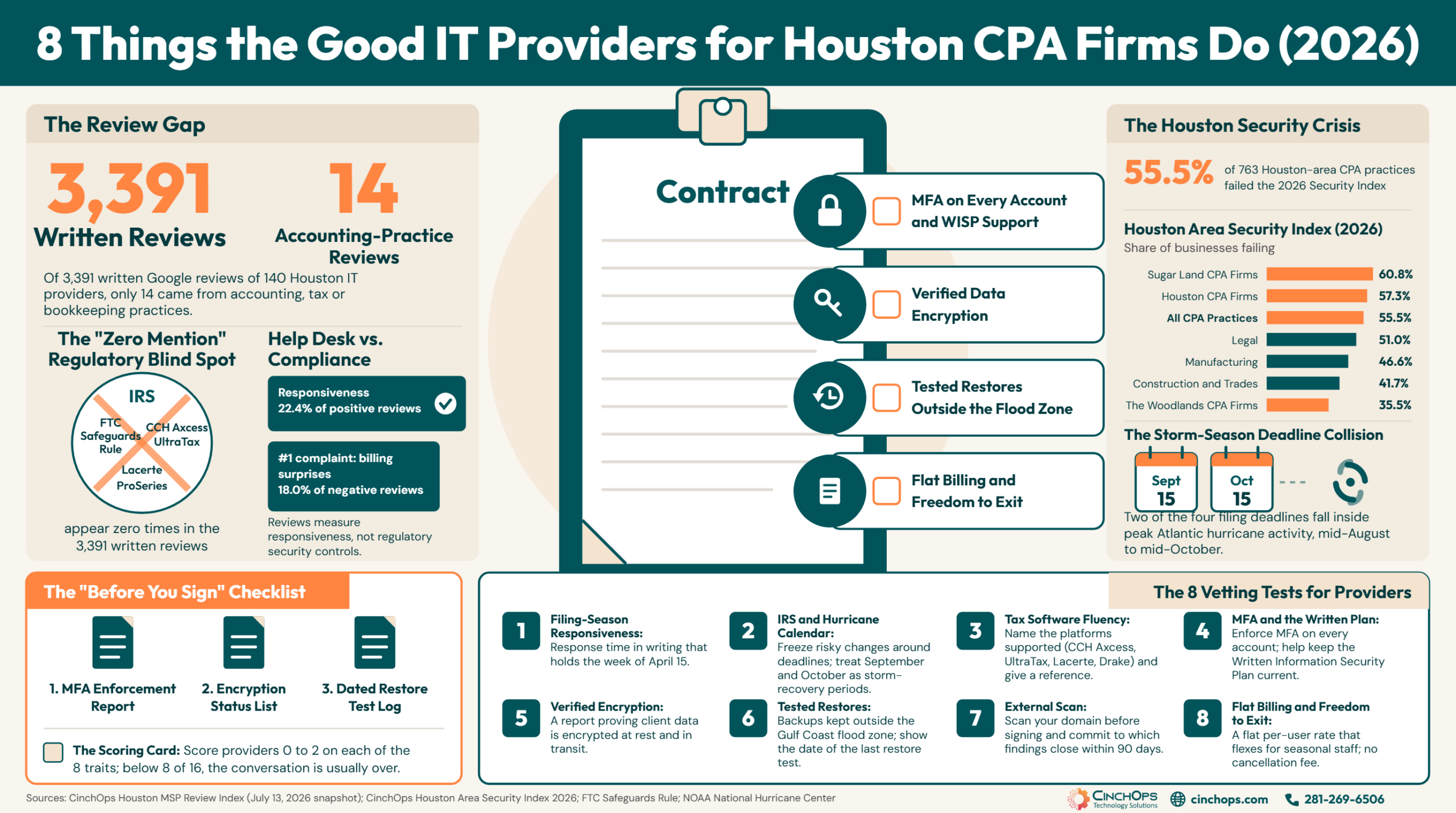
If you are a managing partner comparing top IT providers for Houston CPA firms right now, the public record is thinner than it looks. CinchOps read all 3,391 written Google reviews in the July 2026 snapshot behind the Houston MSP Review Index, which covers 140 Houston-area managed IT providers. Only 14 of those reviews came from an accounting, tax or bookkeeping practice. The FTC Safeguards Rule appears in none of them. Neither does the IRS.
So this list does not rank companies. It ranks the 8 things a good IT provider for a Houston accounting firm actually does, explains where the evidence for each one comes from, and gives you a question to ask out loud in the sales meeting. No provider is named. CinchOps is not ranked anywhere in it, and the only place CinchOps measures itself is a clearly labeled box at the end.
How This List of 8 Things Was Built
A ranked list is only as honest as its method. This one fits in five bullets.
This list was built by searching 3,391 written Google reviews of 140 Houston-area IT providers for the language of accounting work, then filling the gaps the reviews leave with the FTC Safeguards Rule, IRS guidance for tax professionals and the 2026 Houston Area Security Index. Every one of the 8 things is something a well-run provider can meet.
- Review sample: the July 13, 2026 snapshot behind the Houston MSP Review Index, 4,289 reviews across 140 providers, of which 3,391 carry written text. Every count in this post is a count over those 3,391 texts unless it says otherwise.
- Accounting vocabulary search: CPA, accounting, accountant, tax, tax season, bookkeeping, QuickBooks, CCH Axcess, UltraTax, Lacerte, Drake, ProSeries, IRS, WISP and Safeguards Rule. Every match was read by hand. Of 24 raw matches, 14 came from a real accounting, tax or bookkeeping practice, spread across 13 providers, all five stars. The rest were false positives such as a provider's own billing clerk.
- Market themes: praise and complaint shares (responsiveness 22.4% of positive reviews, billing surprises 18.0% of negative reviews) are the published Review Index figures, not recomputed here.
- What reviews cannot measure: encryption, MFA coverage, restore tests and external security posture. Those traits are evidenced from 16 CFR Part 314, IRS news release IR-2025-79 and the 763 CPA practices graded in the CinchOps Houston Area Security Index, updated August 8, 2026.
- Order: the 8 things follow the order a filing year tests a provider, from the first call to the calendar, the software, the controls a regulator asks about, recovery, the outside view and finally the bill.
One finding from that search deserves to stand alone. Public reviews of Houston IT providers almost never describe the work a CPA firm is regulated on: across 3,391 written reviews, the FTC Safeguards Rule and the IRS appear zero times, and CCH Axcess, UltraTax, Lacerte and ProSeries appear zero times. A review can tell you a provider is pleasant. It cannot tell you whether that provider has ever had to prove MFA coverage to a Qualified Individual.
What Separates a Good IT Provider for a Houston CPA Firm From a Failing One?
The same 8 things, from both ends, with how much the public record can tell you about each.
A good IT provider for a Houston CPA firm answers fast in April, plans around the 15th of March, April, September and October, knows the tax software by name, enforces MFA and encryption, tests restores, closes externally visible security gaps and bills a flat rate you can leave. A failing one does the opposite, and the reviews rarely reveal which is which.
The table below compares each of the 8 things by what a good provider does, what a failing provider does, and how many of the 3,391 written Houston IT reviews mention the subject at all. The last column is the point: the lower the number, the more the test has to happen in the meeting.
| Thing the good ones do | What a good provider does for a Houston CPA firm | What a failing provider does | Mentions in 3,391 Houston IT reviews |
|---|---|---|---|
| 1. Answer fast, in April too | States a response time in writing and keeps it during filing season | Fast in July, voicemail the week of April 15 | Responsive / response time: 320 |
| 2. Plan around the IRS calendar | Freezes risky changes around filing deadlines and plans storm recovery for September and October | Pushes a server update on April 13 | "Tax season": 1 |
| 3. Know the tax software | Names the platforms it has supported and calls the vendor for you | "We support all software" | CCH Axcess, UltraTax, Lacerte, ProSeries: 0 |
| 4. MFA on every account, plus the WISP | Shows an MFA report with zero exceptions and helps maintain the written plan | MFA on staff, exempted for partners | MFA: 1. WISP: 1 |
| 5. Encrypt client data and prove it | Reports encryption status for every laptop, server and backup copy | Assumes the laptops came encrypted | Encryption: 1 |
| 6. Test restores, keep a copy away from the flood | Gives a date, a file and a duration for the last restore test | "The backups run every night" | Backup: 46 |
| 7. Close the gaps a scan can see | Scans the firm's domain before signing and shows the 90-day fix list | Never looks at the firm from outside | Not a review subject; see the Security Index |
| 8. Bill flat and let you leave | One per-user rate that flexes with seasonal staff, short or no term | Line items and a cancellation fee | Billing is the #1 complaint theme at 18.0% of negative reviews |
Only row 1 has enough review evidence to judge a provider from its Google profile. Rows 2 through 7 are the traits that decide whether an accounting firm gets through a bad February, and they are exactly the rows the public record is silent on.
The 8 Things the Best Managed IT for Houston CPA Firms Does
Each one opens with the number behind it and closes with the question that tests it.
The best managed IT for Houston CPA firms does 8 things: it answers fast in filing season, plans around the IRS calendar, knows the tax software, enforces MFA and supports the written security plan, encrypts client data, tests restores, closes the gaps an outside scan can see, and bills a flat rate you can walk away from.
1. They answer fast, and keep answering in April
Responsiveness is the most common reason Houston businesses praise an IT provider, appearing in 22.4% of 3,705 positive reviews in the CinchOps Houston MSP Review Index, and it is the one trait a CPA firm can test before signing anything. The complaint side agrees: slow or no response drives 8.2% of negative reviews. For an accounting practice the stakes are uneven. A 3-hour wait in July costs an afternoon. The same wait on April 14 costs a return.
The single review in the whole dataset that mentions tax season makes the point better than any statistic. The provider tried to fix the problem remotely, could not, and came to the office because the firm was on a deadline. That is the behavior to buy.
Ask: for the first-response time in writing, then ask whether that number is different between February 1 and April 15, and who picks up when the named engineer is on vacation that week.
2. They plan around the IRS calendar and hurricane season
A Houston CPA firm's IT year peaks on the 15th of March, April, September and October, and the September and October extension deadlines fall inside the stretch the National Hurricane Center says holds most Atlantic hurricane activity, mid-August to mid-October, with the peak on September 10. A good provider freezes risky changes around all 4 dates and treats the last 2 as storm-recovery deadlines, not ordinary Tuesdays.
The calendar also moves. When Hurricane Beryl hit in July 2024, IRS news release IR-2024-191 postponed filing and payment deadlines falling between July 5, 2024 and February 3, 2025 to February 3, 2025 for 67 Texas counties, including Harris, Fort Bend, Montgomery and Waller. A provider supporting accounting firms in Houston has to follow those postponements, because the busy season shifts with them. Tax season appears in exactly 1 of 3,391 Houston IT reviews, so no profile will tell you whether a provider plans this way.
Ask: to see the provider's change-freeze calendar for next year, what happens to a Windows update scheduled for April 13, and how the storm plan changes if a hurricane closes the office the week before October 15.
3. They know the tax software by name
CCH Axcess, UltraTax, Lacerte and ProSeries appear 0 times in 3,391 written Houston IT provider reviews, Drake appears once and QuickBooks twice, so a CPA firm cannot learn from reviews whether a provider has ever supported its tax platform. Knowing the platform matters for practical reasons: where the data lives, which ports and updates the application needs, how the license server behaves, and who calls the vendor when a batch will not post.
A provider that has done this work can describe what broke last season on a named platform and what the fix was. A provider that has not will say it supports all software, which is true of every provider and useless to you.
Ask: which tax and accounting platforms the provider has supported for another firm in the last 12 months, for a reference running the same platform you run, and whether the provider or your office manager opens the ticket with the software vendor.
4. They put MFA on every account and help keep the written security plan current
The FTC Safeguards Rule names tax preparation firms as covered financial institutions and requires multi-factor authentication for any individual accessing any information system, yet MFA appears in 1 of 3,391 Houston IT reviews and the Safeguards Rule in none. The IRS is just as direct: its July 29, 2025 release IR-2025-79 says tax professionals are legally required to have a written, accessible information security plan and should review, test and update it regularly.
A good provider also knows which parts of the rule your firm's size actually triggers. Under 16 CFR 314.6, a firm holding customer information on fewer than 5,000 consumers is exempt from 4 provisions: the written risk assessment, continuous monitoring or scheduled penetration testing, the written incident response plan and the annual report to the board. MFA and encryption are not on that exempt list, which is why a small Katy or Cypress practice still needs both. Our FTC Safeguards Rule guide for 10 to 50 employee CPA firms walks through the full list.
Ask: for an MFA enforcement report listing every account without MFA, including partners, shared mailboxes and service accounts, and whether the provider has helped a firm your size update its written information security plan in the last year.
5. They encrypt client data and can prove it
16 CFR 314.4(c)(3) requires encryption of all customer information held or transmitted by a covered firm, both in transit over external networks and at rest, while encryption appears in just 1 of 3,391 written Houston IT reviews. For an accounting practice that covers the partner's laptop, the file server holding scanned W-2s, the client portal, email carrying returns and every backup copy.
The failing version is an assumption: the laptop supports encryption, so everyone believes it is on, and nobody checks the old desktop in the back office that still maps the tax share. A good provider can produce a device-by-device status in minutes because the management tool already knows.
Ask: for an encryption status report covering every laptop, desktop, server and backup destination, and what happens to client data on a device that gets lost at the airport in March.
6. They test restores and keep a copy away from the Gulf Coast flood zone
Backups appear in 46 of 3,391 written Houston IT reviews, about 1.4%, and almost always as praise after something already broke, which is late for a CPA firm holding years of client returns. One review in the snapshot describes an accounting database and 6 months of its backups found corrupt at the same time. The backup had run every night. Nobody had restored from it.
Houston adds a second test. A backup stored in the same building, or the same flood-prone part of town, fails in exactly the event most likely to close a Houston office. The good providers restore-test on a schedule and keep at least one copy far enough away that a hurricane does not take the office and the backup together.
Ask: for the date of the last restore test, what was restored, how long it took, and the city where the second copy of your data physically sits.
7. They close the gaps an outside scan can see
CPA practices finished last of 4 industries in the 2026 CinchOps Houston Area Security Index, with 55.5% of 763 scanned firms failing and a 1.32 average GPA, and Sugar Land CPA firms were the weakest cell in the entire index at a 1.10 GPA with 60.8% failing. The index grades what an attacker sees from outside: DNS health, exposed employee data, weak configurations and known vulnerabilities.
The spread is the useful part. The 572 CPA practices graded in Houston itself averaged 1.30 with 57.3% failing, while the 32 in The Woodlands averaged 1.81 with 35.5% failing, the strongest professional-services cell in the index. Same profession, same regulations, very different results, which says the grade reflects what a firm and its provider actually did rather than anything built into the work.
Ask: the provider to run an external scan of your firm's domain before you sign, show you the findings in plain language, and commit to which of them will be closed in the first 90 days. You can look up how CPA firms in your city scored on the Houston Area Security Index first.
8. They bill a flat rate and let you leave
Billing surprises and hidden fees are the #1 complaint theme in Houston IT provider reviews at 18.0% of 122 negative reviews, and contract lock-in follows at 12.3%, so the pricing model predicts the relationship better than the price does. Accounting firms add a wrinkle most businesses do not have: seasonal preparers who join in January and leave in May.
A per-user rate that flexes with that headcount keeps the invoice readable. A per-device model, or a contract that bills the January peak all year, turns the seasonal hire into a 12-month cost. And a 3-year term with a cancellation fee means a provider that fails trait 1 in April still gets paid through the next 2 filing seasons.
Ask: for a sample invoice for a firm your size, how seasonal staff are added and removed from the bill, and to read the termination clause before the pricing page.
Want to see how your firm looks from outside?
A free security assessment grades your Houston CPA firm on the same external signals as the Security Index, before your next filing season.
Talk to CinchOps"We read 3,391 reviews of Houston IT providers looking for proof that any of them understood an accounting firm, and the IRS never came up once. So stop reading reviews to pick your CPA firm's IT provider. Ask for the MFA report, the encryption list and the last restore date, and make them show you their plan for the 15th of March, April, September and October."
How to Choose Accounting Firm IT Support in Houston, Texas
A 16-point card, 4 steps and one afternoon of evidence.
To choose accounting firm IT support in Houston, Texas, score each provider 0, 1 or 2 on the 8 things for a 16-point card, look up your city's CPA grade on the Security Index, ask for the MFA, encryption and restore evidence in writing, and call a reference running your tax platform. Providers that cannot produce the evidence in a week rarely produce it later.
- Step 1 - Score what is public. Trait 1 and trait 8 can be scored from a Google profile: do reviews describe speed, and do critical reviews mention billing or contracts? Then look up how CPA firms in your city graded on the Security Index, so you know what a provider is walking into.
- Step 2 - Ask for the evidence, not the promise. Traits 4, 5 and 6 each end in a document: an MFA exception list, an encryption status report and a dated restore test. A provider supporting CPA firms in Houston should be able to show a redacted example of each from another client within a week.
- Step 3 - Test the calendar and the software. Ask for next year's change-freeze calendar and the storm plan for the week before October 15, then call a reference running the same tax platform you run. Traits 2 and 3 are where general-purpose providers most often come apart.
- Step 4 - Price the exit before the entry. Read the termination clause, ask how seasonal staff are billed, and agree to a trial period that starts well before January rather than during it.
A provider scoring 12 or more of 16 is worth a second meeting. Below 8, the conversation is usually over. For the question-by-question version of this process, including what weak answers sound like, see how to choose an IT provider that understands CPA firms. For the full service stack a firm should have in place, see the IT services checklist for CPA firms.
What Does Managed IT Cost for a Houston CPA Firm in 2026?
Value is how many of the 8 things a provider passes at a price that does not move.
Managed IT for a Houston CPA firm is commonly priced as a flat monthly rate per user, and in 2026 CinchOps' published range runs from $100 to $250 per user per month depending on how much security, backup and after-hours coverage is bundled in. For accounting firms, what the rate includes matters more than the rate.
The best value managed IT service in the Houston area for an accounting practice is the one that passes the most of the 8 things without selling them back as add-ons. Three things move the number:
- Whether the Safeguards Rule controls are in the base rate. MFA enforcement, device encryption, endpoint protection and backup with restore testing are traits 4 through 6. A lower rate that prices each one separately usually costs more per year.
- How seasonal staff are billed. Per-user billing that adds a preparer in January and removes them in May keeps the bill tied to the real headcount. Ask to see it in the contract.
- Term and exit. A cheaper monthly number tied to a long term and a cancellation fee is not a cheaper price. Price the exit, then compare.
CinchOps publishes its own model as three tiers: Launch at $100 to $125, Mission at $125 to $175 and Explorer at $175 to $225 or more per user per month, with no long-term contract, no hidden fees and no cancellation penalty. The accounting-specific breakdown, including what moves a firm up or down the range, is in the 2026 managed IT pricing guide for CPA firms.
Take the 8 Things Into Your Next Provider Meeting
Every test above works on any provider, before any contract. If you want to see how a Houston provider answers them for an accounting practice, start with how CinchOps approaches managed IT for CPA firms and cybersecurity.
See CinchOps IT for CPA firms →How Can CinchOps Help a Houston CPA Firm Compare IT Providers?
CinchOps is a managed IT services provider based in Katy, Texas, serving small and mid-sized businesses across the Houston metro area. CinchOps specializes in cybersecurity, network security, managed IT support, VoIP, and SD-WAN for businesses with 10 to 200 employees.
For accounting practices, CinchOps provides managed IT and cybersecurity specifically for CPA firms in Houston with a help desk that answers in under 15 minutes and backups kept outside the Gulf Coast flood zone.
- Through IT services for CPA firms and wealth management firms, CinchOps supports the regulated side of financial work.
- Through managed IT support and cybersecurity services, help desk, patching, monitoring and security run under one flat per-user rate.
- Through business continuity and disaster recovery, backups are geo-redundant outside the Gulf Coast flood zone and restore-tested on a schedule rather than assumed.
- CinchOps serves accounting firms through local teams for IT support in Houston, Sugar Land, The Woodlands and Katy.
How CinchOps measures against these criteria - judge for yourself:
- Trait 1 - Answering fast. The CinchOps help desk answers in under 15 minutes. Ask whether that holds the week of April 15, and hold us to the answer.
- Trait 2 - The IRS calendar. CinchOps is about 2 years old, so we have fewer filing seasons behind us than older providers. Ask for our change-freeze calendar and storm plan in writing and judge the detail.
- Trait 3 - Tax software. Ask which of CCH Axcess, UltraTax, Lacerte, Drake, ProSeries and QuickBooks we have supported, and ask for a reference on the one you run.
- Trait 4 - MFA and the written plan. No number to quote here. Ask us for a redacted MFA exception report and to walk through the Safeguards Rule provisions your firm's size triggers.
- Trait 5 - Encryption. Ask for a sample device encryption status report before you sign.
- Trait 6 - Restores. Backups are geo-redundant outside the Gulf Coast flood zone and restore-tested on a schedule. Ask for the date of the last test.
- Trait 7 - The outside view. CinchOps publishes the Houston Area Security Index behind trait 7. Ask us to scan your own domain and show the findings.
- Trait 8 - Billing and exit. A flat monthly rate of $100 to $250 per user, Zero-Zero-Zero terms (no long-term contracts, no hidden fees, no cancellation penalties) and a 30-day satisfaction guarantee.
CinchOps holds a 5.0 rating across 22 Google reviews as of September 8, 2026, a small number you should weigh accordingly. Read our Google profile and the market figures in the Houston MSP Review Index, read the critical reviews on every provider you consider, then hold all of them, CinchOps included, to the same 8 tests.
A CPA firm's IT provider gets judged in April and in hurricane season, not in the sales meeting, so run the tests while you still have time to act on the answers. Ask any provider for the MFA report, the encryption list and the last restore date this month. If you want CinchOps to be one of the providers you test, bring the hard questions and talk to CinchOps.
Frequently Asked Questions
Who are the top IT providers for Houston CPA firms?
No independent, audited ranking of IT providers for Houston CPA firms exists, and most published lists are written by a provider that ranks itself first. Score candidates on the 8 things in this guide instead: filing-season response, the IRS calendar, tax software, MFA, encryption, restore tests, external security posture and flat billing.
What is the best managed IT for Houston CPA firms?
The best managed IT for Houston CPA firms is the provider that can prove, in writing, MFA on every account, encryption on every device, a dated restore test and a filing-season plan. Reviews rarely show this: across 3,391 written Houston IT reviews, the FTC Safeguards Rule and the IRS appear zero times.
What does managed IT cost for a CPA firm in Houston?
Managed IT for a Houston CPA firm is commonly billed as a flat monthly rate per user, and CinchOps publishes a range of $100 to $250 per user per month in 2026, with no long-term contracts, no hidden fees and no cancellation penalties. Confirm how seasonal preparers are billed before comparing quotes.
Does the FTC Safeguards Rule apply to a small Houston CPA firm?
Yes. The FTC lists tax preparation firms among the financial institutions the Safeguards Rule covers, and the IRS says tax professionals are legally required to have a written information security plan. Firm size changes which provisions apply, but MFA, encryption and a designated Qualified Individual apply to small practices too.
Does a CPA firm with fewer than 5,000 clients need a written risk assessment?
Under 16 CFR 314.6, a firm maintaining customer information on fewer than 5,000 consumers is exempt from the written risk assessment, continuous monitoring or scheduled penetration testing, the written incident response plan and the annual board report. It still must meet the other requirements, including MFA and encryption of customer information.
Should a CPA firm's IT provider know CCH Axcess, UltraTax or Lacerte?
Yes, or at least show it has supported the platform your firm runs. Those platforms appear zero times across 3,391 written Houston IT reviews, so the only way to confirm experience is to ask which accounting firms the provider supported in the last 12 months and call a reference running the same software.
What happens to tax deadlines when a hurricane hits Houston?
The IRS can postpone them. After Hurricane Beryl, release IR-2024-191 moved filing and payment deadlines falling between July 5, 2024 and February 3, 2025 to February 3, 2025 for 67 Texas counties, including Harris and Fort Bend. An IT provider for a Houston accounting firm should plan recovery around the shifted calendar.
Discover More
Sources
- CinchOps Houston MSP Review Index (2026) - 140 Houston-area IT providers, 4,289 public Google reviews, July 13, 2026 snapshot; accounting-vocabulary search over the 3,391 written reviews run September 16, 2026
- CinchOps Houston Area Security Index 2026 - 3,690 Houston-area businesses, published June 15, 2026, updated August 8, 2026
- Federal Trade Commission, "FTC Safeguards Rule: What Your Business Needs to Know" (updated December 2024)
- 16 CFR 314.4, Elements of an information security program (encryption, MFA, testing, incident response, annual report)
- 16 CFR 314.6, Exceptions for institutions with customer information on fewer than 5,000 consumers
- IRS, IR-2025-79, "IRS, Security Summit remind tax pros they must have a Written Information Security Plan to protect client data" (July 29, 2025)
- IRS, IR-2024-191, "IRS provides relief to Hurricane Beryl victims in Texas; various deadlines postponed to Feb. 3, 2025" (July 22, 2024)
- IRS Publication 509 (2026), Tax Calendars
- NOAA National Hurricane Center, Tropical Cyclone Climatology (season peak September 10)

