


TSA Security Directive Pipeline-2021-02G: 2026 Guide for Houston
Pipeline Security Addenda: What Houston Contractors Should Ask – What SD Pipeline-2021-02G Requires From Pipeline Operators
Six public versions, a renewal every year, and a 2024 clause that makes contractors working for Houston pipeline operators share the liability.
TSA Security Directive Pipeline-2021-02 is the federal cybersecurity order that TSA-designated critical natural gas and hazardous liquid pipelines and LNG facilities must follow. TSA reissues it every year with a new letter at the end, and the current edition is SD Pipeline-2021-02G, which took effect May 3, 2026 and runs through May 2, 2027.
If you own a Houston or Katy engineering, controls, inspection or field-services firm, you probably met this directive as a line in an operator's vendor security addendum. Some addenda cite 02C. Some cite 02F. Plenty just say "the TSA pipeline directive" and leave you to work out the rest. The technical controls have barely moved since 2022, so the letter matters less than you'd expect there. It matters a lot for one clause added in July 2024, which is the reason this guide exists.
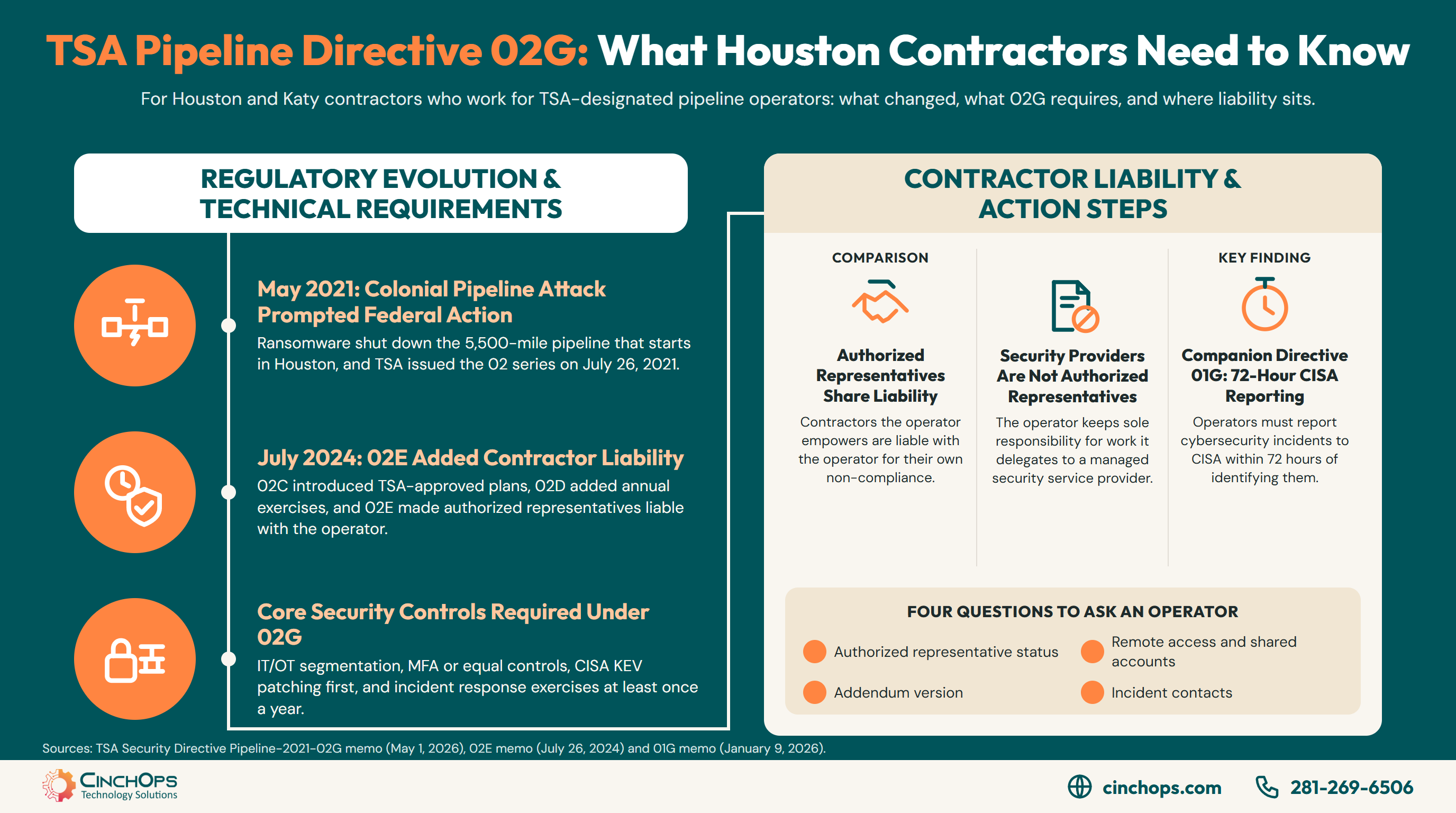
The series has a Houston origin story. The Colonial Pipeline system, more than 5,500 miles long, starts in Houston, and the ransomware attack that shut it down on May 7, 2021 is what pushed TSA to act. The companion SD Pipeline-2021-01 series took effect May 28, 2021. TSA first issued the 02 series on July 26, 2021, and it has been renewed every year since.
The directive also runs on a fixed clock. The directive itself is renewed every 12 months. An operator resubmits its Cybersecurity Assessment Plan within 12 months of the last approval, files the annual assessment report on the same 12-month clock, and exercises its incident response plan at least once a year. The architecture design review comes due every 24 months, and 100 percent of the approved plan must be assessed over any 36-month period.
CinchOps provides managed IT and cybersecurity specifically for energy-services contractors in Houston and Katy, with 24/7 threat monitoring and a flat rate of $100 to $250 per user per month. Below, CinchOps lays out each version side by side, then what the current text asks of operators and the people they hire.
What Changed in Each Version of TSA SD Pipeline-2021-02?
The 02 series has moved from prescriptive rules to operator-written plans, then settled into yearly renewals with one contractor-facing change in between.
The TSA SD Pipeline-2021-02 series changed substantively three times. Version 02C (July 2022) replaced fixed rules with a TSA-approved Cybersecurity Implementation Plan, 02D (July 2023) added yearly testing and auditing, and 02E (July 2024) made authorized representatives, including contractors, liable. Versions 02F and 02G were renewals with no substantive revisions.
The table below compares every public version of SD Pipeline-2021-02 by TSA's listing or issue date, what TSA changed, and what that change means for a Houston contractor reading an operator's paperwork.
| Version | TSA date | What TSA changed | What it means for a contractor |
|---|---|---|---|
| SD Pipeline-2021-02 (original) | Issued July 26, 2021 | First mandatory cybersecurity mitigation measures for critical pipelines, two months after the Colonial attack | Not posted on TSA's public directive page; old master service agreements may still reference it |
| SD Pipeline-2021-02B | Listed June 9, 2022 | The prescriptive version operators kept following until TSA approved their implementation plan | An addendum citing 02B is out of date by four years |
| SD Pipeline-2021-02C | Listed July 21, 2022; effective July 27, 2022 | Switched to a performance-based model; each operator wrote a Cybersecurity Implementation Plan, due to TSA by October 25, 2022 | Controls now come from each operator's own approved plan, so two operators can ask you for different things |
| SD Pipeline-2021-02D | Listed July 26, 2023; effective July 27, 2023 | Annual incident response exercises testing at least two objectives; at least 30 percent of the plan assessed each year | Operator security questions start arriving on a yearly cycle |
| SD Pipeline-2021-02E | Listed July 26, 2024 | Defined "authorized representative" (agents, contractors, subcontractors) and made it liable for its own non-compliance; excluded managed security service providers; changed 30 percent to one-third | The clause that reaches you, if the operator has empowered your firm to perform directive work |
| SD Pipeline-2021-02F | Listed May 3, 2025 | Renewal; TSA's memo says no substantive revisions | Same obligations as 02E |
| SD Pipeline-2021-02G | Memo May 1, 2026; in force May 3, 2026 to May 2, 2027 | Renewal; changes limited to dates, the series letter and formatting | The current version; it expires unless TSA renews it again |
The practical reading is simple. If your addendum cites 02E, 02F or 02G, the requirements are the same text. If it cites 02B or the original, the operator copied an old template, and the gap is worth one polite email asking which version and which plan sections apply to your work.
Three substantive changes in five years is a slow pace for a federal cybersecurity rule, and that is good news for a small firm. The controls you put in place to satisfy an operator in 2024 still satisfy the same operator under SD Pipeline-2021-02G in 2026, as long as they still work when someone checks.
Got a Pipeline Security Addendum on Your Desk?
CinchOps will read it with you, match each clause to the TSA directive text, and tell you what your firm can already prove.
Talk to CinchOpsWhat Does SD Pipeline-2021-02G Actually Require?
SD Pipeline-2021-02G requires covered operators to run three documents: an implementation plan, an incident response plan and an assessment plan.
SD Pipeline-2021-02G requires each covered operator to implement a TSA-approved Cybersecurity Implementation Plan covering network segmentation, access control, continuous monitoring and patching for its Critical Cyber Systems, plus an incident response plan exercised at least yearly and an assessment plan that audits one-third of the approved plan every year.
A Critical Cyber System means any IT or OT system or data that, if compromised, could cause operational disruption, and the 02G definition includes business services. TSA writes the outcomes and the operator writes the method, which is why the directive reads short and the operator's plan reads long. TSA says every currently identified critical operator already has an approved plan in place.
Three requirements in the 02G text tend to land on a contractor's side of the fence, because they govern how outside people get into the operator's systems:
- Access control (Section III.C) covers local and remote access, requires multi-factor authentication or controls that provide equivalent risk reduction, and limits shared accounts to those critical for operations. When a shared account is used, anyone who no longer needs access must not know its password.
- Monitoring (Section III.D) requires capabilities to stop malicious email, block known bad IP addresses and web domains, and prevent unauthorized code, including macro scripts, from running.
- Patching (Section III.E) covers operating systems, applications, drivers and firmware, and puts the CISA Known Exploited Vulnerabilities Catalog at the top of the queue.
The companion SD Pipeline-2021-01G (in force January 16, 2026 through January 15, 2027) adds the reporting side: a Cybersecurity Coordinator reachable 24 hours a day, at least one coordinator who is a U.S. citizen, and incident reports to CISA no later than 72 hours after the operator identifies a cybersecurity incident. If your staff notice something odd on an operator's network, the operator's 72-hour clock may already be running, so tell them the same day.
Does TSA SD Pipeline-2021-02 Apply to Contractors or Only to Pipeline Operators?
TSA SD Pipeline-2021-02 binds pipeline operators, but since 02E it also names the contractors who do directive work for them.
TSA SD Pipeline-2021-02 is addressed to TSA-designated pipeline operators, but since 02E an authorized representative, meaning a non-employee the operator empowers to perform directive or plan measures, can be held liable alongside the operator for its own non-compliance. The term includes agents, contractors and subcontractors and excludes managed security service providers.
The exact 02G wording is short: "Both Owner/Operators and Authorized Representatives are liable for non-compliance on the part of the Authorized Representative." Whether your firm is an authorized representative depends on what the operator has empowered you to do. A controls integrator configuring a SCADA firewall rule the plan depends on sits much closer to that line than a surveyor who never logs in.
The split runs the other way for security vendors. If an operator hands monitoring or another plan measure to a managed security service provider, the 02G text says the operator "retains sole responsibility" for compliance. So the provider watching the operator's network is outside the authorized-representative definition, while the field firm whose engineers log in to change a setting may be inside it.
This matters more in Katy each year. The Katy Hub sits at the start of two proposed lines to the Gillis area in Louisiana: Enbridge's Katy to Gillis expansion, up to 2 Bcf/d by early 2031, and Boardwalk's 155-mile Texas Gateway, targeting November 1, 2029. Both projects are still subject to approvals. Every new line means more engineering, inspection and controls firms in west Houston answering to operators that run under this directive. Here is what to ask an operator before work starts:
- Does your Cybersecurity Implementation Plan treat our firm as an authorized representative, and for which sections?
- Which version letter does our addendum rely on, and will you update it to SD Pipeline-2021-02G?
- How will our staff authenticate for remote access, and do any shared accounts apply to us?
- Who do we call, and how fast, if we see a possible cybersecurity incident on your systems?
Read the vendor addendum for two words: authorized representative. If they describe your firm, the operator's TSA plan has your name in it, and your MFA, patching and logs need to hold up when someone checks.
Get Your Firm Ready Before the Operator Asks
CinchOps sets up MFA on remote access, retires shared logins, keeps patching current against the CISA KEV catalog and watches your systems with 24/7 threat monitoring, so a Houston contractor can answer an operator's TSA questions with records. See CinchOps cybersecurity services.
See IT for oil and gas contractorsHow CinchOps Can Help Houston Contractors Working Under the TSA Pipeline Directive
CinchOps is a managed IT services provider based in Katy, Texas, serving small and mid-sized businesses across the Houston metro area. CinchOps specializes in cybersecurity, network security, managed IT support, VoIP, and SD-WAN for businesses with 10 to 200 employees.
Section IV of SD Pipeline-2021-02G lists the records TSA may inspect at an operator: a hardware and software asset inventory including SCADA systems, firewall rules, network and architecture diagrams, log files, and a packet capture of network traffic for up to 24 hours. A contractor isn't required to keep that set. Keeping a small version of it is the fastest way to answer an operator's questions about your firm.
- Through managed IT support, CinchOps keeps the device and account list current, answers help desk requests in under 15 minutes, and patches laptops and field tablets on a schedule you can show an operator.
- Through cybersecurity services, CinchOps turns on MFA for remote access, removes shared logins and runs 24/7 threat monitoring with logs you keep.
- Through business continuity and disaster recovery, CinchOps keeps immutable, offsite backup copies stored apart from the systems they protect, which is the same idea Section III.F of the directive asks of operators.
- For oil and gas, energy services and utilities and engineering firms, CinchOps segments office IT from OT and SCADA connections at the boundary.
- CinchOps supports contractors in Houston, Katy, Cypress and The Woodlands.
The TSA pipeline directive will keep changing letters every year, and TSA has said it intends to replace the directives with a permanent rule. Your obligations follow the operator's approved plan and your contract, so build your records around those two documents and you won't care which letter comes next. If an operator's addendum has you unsure where you stand, talk to CinchOps.
Frequently Asked Questions
What is the current version of TSA Security Directive Pipeline-2021-02?
The current version is SD Pipeline-2021-02G. TSA issued it with a memo dated May 1, 2026, and it is in force from May 3, 2026 through May 2, 2027. It replaced SD Pipeline-2021-02F, and TSA's memo says the renewal made no substantive revisions, only date, letter and formatting changes.
Can my company be liable if we only work for a pipeline operator?
Possibly. Since SD Pipeline-2021-02E in July 2024, the directive says both operators and authorized representatives are liable for non-compliance by the authorized representative. The term includes agents, contractors and subcontractors the operator empowers to perform directive or plan measures. Ask the operator in writing whether your firm fits, and have counsel review the contract.
What is the difference between SD Pipeline-2021-01 and SD Pipeline-2021-02?
SD Pipeline-2021-01 covers reporting and coordination: a 24/7 Cybersecurity Coordinator, incident reports to CISA within 72 hours, and a vulnerability assessment. SD Pipeline-2021-02 covers the controls themselves: a TSA-approved implementation plan for segmentation, access control, monitoring and patching, plus incident response and assessment plans. The current versions are 01G and 02G.
Will the TSA pipeline directives become a permanent regulation?
TSA has proposed it. The "Enhancing Surface Cyber Risk Management" proposed rule was published November 7, 2024, and comments closed February 5, 2025. The Fall 2025 Unified Agenda lists the final rule date as to be determined, and no final rule had appeared in the Federal Register as of October 17, 2026.
What does getting ready for an operator's TSA pipeline questions cost in Houston?
For most small contractors, the work is MFA, retiring shared logins, patching, monitoring and keeping records, which fits inside a managed IT and security plan. CinchOps charges a flat $100 to $250 per user per month in Houston, so a 20-person firm would pay $2,000 to $5,000 a month depending on the plan tier.
Discover More
Resource
Sources
- TSA, Security Directive Pipeline-2021-02G and transmittal memo (May 1, 2026)
- TSA, Security Directive Pipeline-2021-02E and memo with section-by-section revision summary (July 26, 2024)
- TSA, Security Directive Pipeline-2021-01G and transmittal memo (January 9, 2026)
- TSA, Security Directives and Emergency Amendments listing
- Bracewell, "TSA Revises Cybersecurity Directive for Critical Pipeline and LNG Facilities" (July 29, 2022)
- Dragos, "TSA Security Directive Pipeline-2021-02D Reinforces Requirement for Tabletop Exercises and Rigor in Plan Auditing"
- Federal Register, "Enhancing Surface Cyber Risk Management" proposed rule (November 7, 2024)
- Reginfo.gov, Unified Agenda entry for RIN 1652-AA74 (Fall 2025)
- Wikipedia, Colonial Pipeline
- Oil & Gas Journal, Texas Eastern Katy to Gillis Expansion Project open season (October 13, 2026)
- Pipeline & Gas Journal, Boardwalk Texas Gateway pipeline (October 30, 2025)


