Project Glasswing: How AI Cybersecurity Is Finding Bugs That Humans Missed for Decades
Big Tech United on Cybersecurity and Small Business Should Pay Attention – When AI Hunts Bugs, Decades of Hidden Flaws Surface Fast
Anthropic's unreleased Claude Mythos model discovered thousands of zero-day vulnerabilities across every major operating system and browser - and Houston businesses should pay attention.
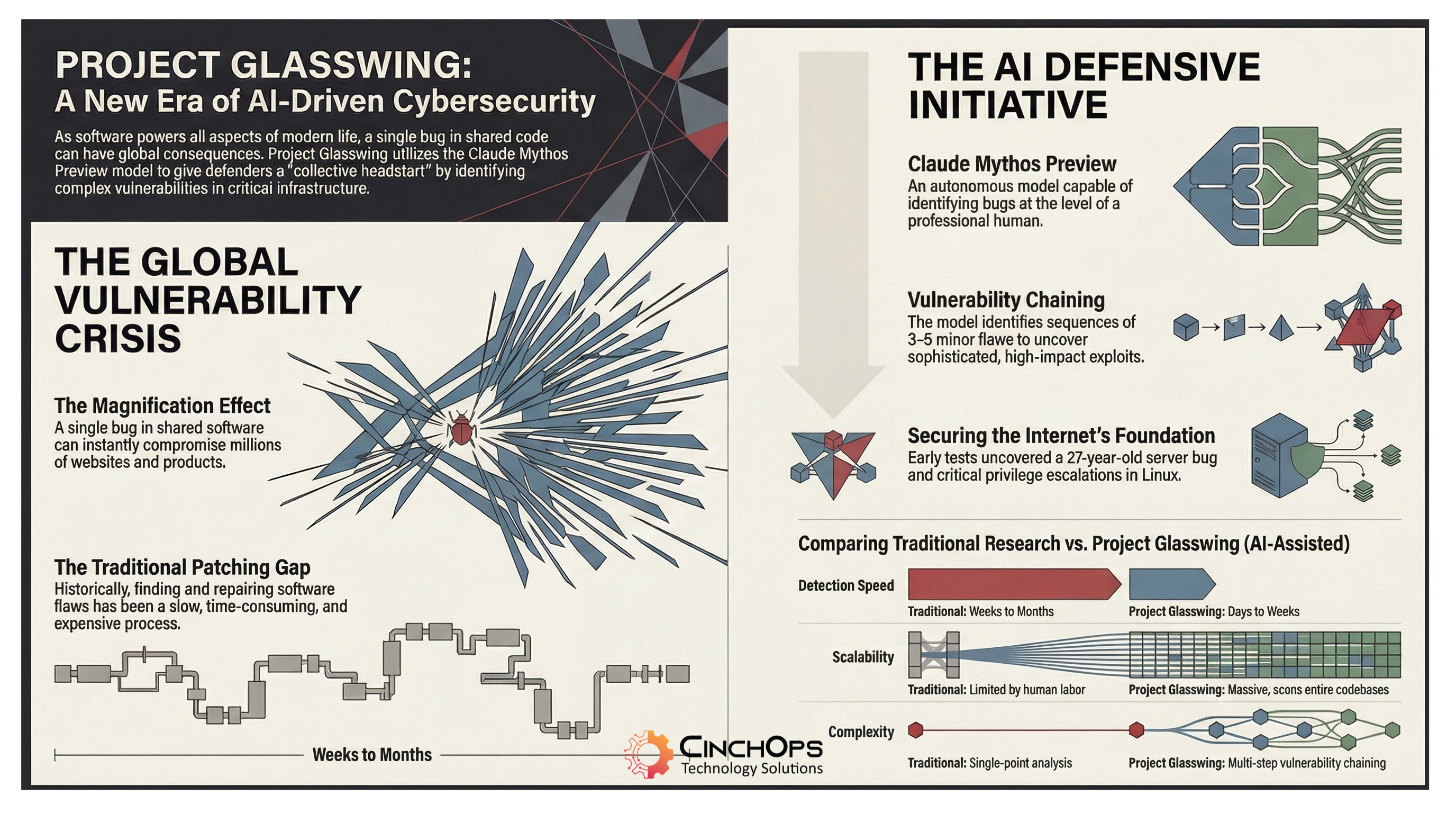
After much speculation following last week's code leak, Anthropic just became more transparent concerning Claude Mythos. The company behind Claude announced Project Glasswing, a $100 million initiative that pairs its most advanced AI model with the biggest names in tech to hunt down software vulnerabilities that have been hiding in plain sight for years. We're talking bugs that have gone undetected for over two decades.
This isn't just a press release. The model at the center of this, Claude Mythos Preview, has already found thousands of zero-day vulnerabilities across every major operating system and web browser. And Anthropic considers it too dangerous to release publicly. That alone should tell you something about where cybersecurity is headed.
CinchOps is a managed IT services provider based in Katy, Texas, serving small and mid-sized businesses across the Houston metro area. CinchOps specializes in cybersecurity, business continuity, managed IT support, VoIP, and SD-WAN for businesses with 20 to 200 employees.
On April 7, 2026, Anthropic announced Project Glasswing, a cybersecurity initiative that brings together Amazon, Apple, Broadcom, Cisco, CrowdStrike, Google, JPMorganChase, the Linux Foundation, Microsoft, NVIDIA, and Palo Alto Networks. That's not a coalition you see every day.
At the center of it sits Claude Mythos Preview, a general-purpose frontier AI model that Anthropic says is its most capable ever. The company isn't releasing it to the public. Instead, the 12 launch partners and roughly 40 additional organizations that maintain critical software infrastructure will get access to use it for defensive security work.
| |
Here's what we know about the initiative:
- $100 million in usage credits allocated for Mythos Preview across the participating organizations
- $4 million in direct donations to open-source security organizations
- Thousands of zero-day vulnerabilities already identified across every major operating system and every major web browser
- Bugs dating back 27 years discovered in foundational open-source software like OpenBSD and Linux
- 90-day public reporting commitment from Anthropic on what they've learned
Newton Cheng, Anthropic's Frontier Red Team Cyber Lead, put it bluntly: "We do not plan to make Claude Mythos Preview generally available due to its cybersecurity capabilities." The concern is straightforward. If the model can find and chain together 3 to 5 vulnerabilities into working exploits the way a professional human security researcher would, that capability in the wrong hands is a national security problem.
Software vulnerabilities aren't new. What's new is the speed at which AI can find them. Historically, detecting and patching these flaws has been slow, manual, and expensive. One researcher working with Claude Mythos Preview noted they found more bugs in a few weeks than in their entire prior career.
That acceleration works both ways. The same Large Language Models that generate code at the level of top developers can also identify bugs and craft exploits with comparable effectiveness. Anthropic disclosed in November 2025 that a Chinese state-sponsored group achieved 80 to 90 percent autonomous tactical execution using Claude across approximately 30 targets. That's not a theoretical risk. It already happened.
"If your IT provider isn't talking to you about how AI is changing the threat equation, that's a red flag. The tools attackers have access to today are a generation ahead of what most small businesses are defending against."
The key point for Katy and Houston area businesses: the vulnerabilities Mythos found exist in software your company is almost certainly running. OpenBSD, Linux kernels, major web browsers - this is foundational infrastructure. A 27-year-old bug in OpenBSD means that flaw has been present in systems since before some of your employees were born.
| Houston Industry | Primary AI Cyber Risk | Why It Matters |
|---|---|---|
| Oil & Gas | OT/ICS systems running legacy code | Decades-old vulnerabilities in industrial control software now discoverable by AI at scale |
| Law Firms | AI-powered phishing and credential theft | Client privilege data becomes a higher-value target as extraction methods improve |
| Construction | Remote site access and unpatched endpoints | Field devices and project management systems often run months behind on patches |
| CPA Firms | Financial data exposure via browser exploits | Browser zero-days now discovered in bulk - every client portal session is a risk surface |
| Manufacturing | Supply chain software vulnerabilities | Shared software libraries across production systems amplify single-bug impact |
Is Your Business Prepared for AI-Driven Threats?
Get a free security assessment to understand where your Houston area business stands.
Schedule Your Free AssessmentThe logic behind Project Glasswing is simple. AI models capable of finding and exploiting software vulnerabilities are coming whether we like it or not. Anthropic's position is that defenders need a head start. By restricting Mythos to trusted partners and critical infrastructure maintainers first, they're buying time.
Here's the operational model:
- Gated access through Amazon Bedrock with enterprise-grade security controls including customer-managed encryption, VPC isolation, and detailed logging
- Partners scan their own codebases and open-source dependencies using Mythos Preview's autonomous vulnerability detection
- Discovered vulnerabilities are reported directly to maintainers who apply and deploy patches, securing users worldwide
- Findings are shared across the coalition so the broader tech industry benefits from what each partner learns
- Anthropic commits to public reporting within 90 days on results and lessons learned
AWS noted that in their internal testing, Mythos Preview proved more productive than previous models at surfacing security findings, requiring less manual guidance from engineers to deliver actionable results. They're already applying it to critical AWS codebases that undergo continuous AI-powered security reviews.
What makes Mythos different from previous AI security tools isn't just speed. The model can chain multiple vulnerabilities together, linking 3 to 5 flaws in sequence to create working exploits. That's how professional human security researchers operate, but Mythos does it autonomously over extended periods. It mimics the long-range task pursuit that previously required specialized teams working for weeks.
Project Glasswing isn't theoretical. Anthropic and its partners have already been scanning open-source code that forms the backbone of internet infrastructure. The results are significant.
- OpenBSD - 27-year-old bug: A vulnerability that could crash any server by sending minimal data. This flaw existed since 1999 and was never detected by human reviewers or conventional automated tools. Reported, patched, and deployed.
- Linux kernel - privilege escalation: Vulnerabilities allowing unprivileged users to gain full administrator access using simple binaries. Multiple flaws identified, reported to maintainers, and fixed.
- Major web browsers: Zero-day vulnerabilities identified across every major browser platform. The specific details remain coordinated with vendors, but the scope is broad.
- Every major operating system: Thousands of high-severity zero-day vulnerabilities identified across Windows, macOS, Linux, and others - many previously unknown to their developers.
All disclosed bugs were reported to maintainers, who applied and deployed patches. That's the entire point. Find it, fix it, ship it - before someone with less charitable intentions finds the same flaw.
Logan Graham, who leads Anthropic's frontier development team, framed it this way: "If we are crossing the Rubicon where you can functionally automate those capabilities and make them very cheap as well, then we're in an entirely new world." The Houston business community, particularly companies in energy and financial services, should take that statement seriously.
Project Glasswing is an enterprise and infrastructure play. Small and mid-sized businesses in Sugar Land, Cypress, and across the Houston metro won't get direct access to Claude Mythos Preview. But the implications hit every business running software.
Here's the practical takeaway:
- Patch Cycles Matter More Than Ever. If AI can find a 27-year-old bug in OpenBSD, it can find the unpatched flaw in your firewall firmware. The window between discovery and exploitation is shrinking from months to days.
- Legacy Systems Are A Growing Liability. Software that hasn't been updated in years likely contains vulnerabilities that AI tools will surface. If you're running Windows 10 past its October 2025 end-of-support date, you're running on borrowed time.
- Your Browser Is An Attack Surface. Zero-days found in every major browser means every employee session is a potential entry point. Browser management and endpoint protection aren't optional.
- AI-Powered Attacks Are Already Happening. The Anthropic disclosure about Chinese state-sponsored groups achieving near-autonomous attack execution isn't a prediction. That was 2025. The tools available to threat actors in 2026 are better.

Source: red.anthropic.com
The Katy Area Chamber of Commerce and the Greater Houston Partnership have both highlighted cybersecurity as a top concern for local businesses. This announcement underscores why. Organizations like the engineering firms and manufacturers along the Energy Corridor are running exactly the kind of mixed IT/OT environments where decades-old vulnerabilities hide.
AI Cybersecurity Readiness Self-Assessment
- Are all operating systems and browsers across your organization patched within 30 days of updates?
- Do you have visibility into every piece of software running on your network, including open-source components?
- Is multi-factor authentication enabled on all employee accounts and administrative systems?
- Does your IT provider proactively monitor for newly disclosed vulnerabilities rather than waiting for scheduled updates?
- Do you have an incident response plan that accounts for AI-accelerated attack timelines?
Project Glasswing is a wake-up call for every business that relies on software - which is every business. The vulnerabilities being found by AI aren't exotic edge cases. They're in the operating systems, browsers, and infrastructure software your team uses every single day. CinchOps helps Houston area businesses with 20 to 200 employees stay protected as the threat model accelerates.
- Proactive Patch Management that prioritizes critical and zero-day vulnerabilities rather than waiting for scheduled cycles - learn more about our managed IT services
- Continuous Network Monitoring and endpoint protection that catches exploitation attempts in real time through our cybersecurity services
- Legacy System Assessment And Migration Planning to eliminate the aging software where decades-old bugs hide - supported by our CTO/CIO services
- Browser And Endpoint Security Management including controlled update deployment across your organization via managed IT support
- Security Awareness Training that prepares your team for AI-powered phishing and social engineering attacks - part of our cybersecurity program
- Incident Response Planning built for the compressed timelines that AI-driven threats demand through our business continuity and disaster recovery services
The companies building AI defenses at scale are doing their part. Your part is making sure the fundamentals are covered - because the next vulnerability an AI finds in your software might not be reported to a defender first.
Frequently Asked Questions
What is Project Glasswing and why does it matter for businesses?
Project Glasswing is Anthropic's $100 million AI cybersecurity initiative using Claude Mythos Preview to find zero-day vulnerabilities in critical software. Partners including Amazon, Apple, Microsoft, and Google are scanning and patching flaws in operating systems, browsers, and open-source code.
What is a zero-day vulnerability and why should Houston businesses care?
A zero-day vulnerability is a software flaw unknown to its developer with no existing patch. Project Glasswing found thousands across every major operating system and browser. The same AI capabilities will soon be available to attackers targeting small and mid-sized companies.
How does AI cybersecurity change the threat model for small businesses?
AI tools like Claude Mythos Preview can chain multiple vulnerabilities autonomously, compressing what took human researchers weeks into hours. The gap between discovery and exploitation is shrinking fast, making proactive patch management and continuous monitoring essential.
Can small businesses access Project Glasswing or Claude Mythos Preview?
Claude Mythos Preview is restricted to 12 launch partners and roughly 40 additional organizations maintaining critical infrastructure. Small businesses benefit as partners patch vulnerabilities in widely used software, but still need strong managed IT support and cybersecurity practices.
What should a Houston business do right now to prepare for AI-driven cyber threats?
Houston businesses should prioritize aggressive patch management, enable multi-factor authentication, replace legacy systems, deploy endpoint protection, and partner with a managed IT services provider like CinchOps that proactively monitors for newly disclosed vulnerabilities.
Discover More
Sources
- Project Glasswing: Securing critical software for the AI era - Anthropic
- Claude Mythos Preview - Anthropic Red Team
- Building AI defenses at scale: Before the threats emerge - AWS Security Blog
- Anthropic says its most powerful AI cyber model is too dangerous to release publicly - VentureBeat
- Anthropic debuts preview of powerful new AI model Mythos in new cybersecurity initiative - TechCrunch
- Tech giants launch AI-powered 'Project Glasswing' to identify critical software vulnerabilities - CyberScoop
- Anthropic launches cybersecurity partnership with Nvidia, Microsoft, other tech giants - Yahoo Finance
Resource