CinchOps managed IT services and cybersecurity Houston Texas
  • Services
    • Managed IT Services
      • IT Help Desk
      • 24/7 Emergency Support
      • Co-Managed IT
      • Remote IT Support
      • Onsite IT Support
      • Proactive Monitoring
      • Patch Management
      • Network Monitoring
      • Mobile Device Management
      • IT Procurement
      • IT Documentation
      • Server Management
      • Mac Support
      • Employee Onboarding & Offboarding
    • Cybersecurity
      • Endpoint Security
      • Network Security
      • Managed Firewall
      • Email Security
      • Phishing Protection
      • Security Awareness Training
      • Dark Web Monitoring
      • Penetration Testing
      • Multi-Factor Authentication
      • Zero Trust
      • Vulnerability Scanning
      • SIEM Services
      • Managed SOC
      • Virtual CISO (vCISO)
      • Password Management
      • Managed Detection & Response
    • Business Continuity & Disaster Recovery (BCDR)
      • Backup & Disaster Recovery
      • Microsoft 365 Backup
      • Cloud Disaster Recovery
      • Backup & DR Audit
      • Backup as a Service
      • Tabletop Exercises
    • Cloud Services
      • Microsoft 365
      • Microsoft Azure
      • Cloud Migration
      • SharePoint
      • Virtual Desktop
      • Azure Managed Services
      • Cloud Monitoring & Management
      • Microsoft Entra ID
      • Microsoft Teams
      • Microsoft Exchange
      • OneDrive for Business
      • Amazon Web Services (AWS)
    • AI Services
      • AI Policy & Governance
      • AI Security & Risk
      • AI Readiness Assessment
      • AI Strategy
      • AI Assistant Platforms
      • AI Training & Adoption
      • AI Workflow Automation
      • AI Development
      • Agentic AI
      • Business Intelligence
      • Business Process Automation
      • Data Analytics
    • Compliance
      • SOC 2
      • HIPAA
      • CMMC
      • NIST CSF
      • PCI DSS
      • FTC Safeguards
      • CIS Controls
      • Cyber Insurance
      • Compliance Audit
    • Network, Voice & Strategy
      • Software Defined Wide Area Networks (SD-WAN)
      • Voice Over IP (VoIP)
      • Virtual CTO & CIO Services
      • Teams Phones & Conferencing
      • Network Assessment
      • IT Consulting
      • IT Cost Assessment
      • Digital Transformation Strategy
      • Legacy System Assessment
  • Industries
    • By Company Size
      • Small & Midsize Businesses
      • Enterprise
    • Architecture
    • Banking & Credit Unions
    • Construction
    • CPA Firms
    • Energy Services & Utilities
    • Engineering
    • Healthcare
    • Law Firms
    • Manufacturing
    • Non-Profit
    • Oil & Gas Services
    • Real Estate & Property Management
    • Transportation & Logistics
    • Wealth Management
  • Local to You
    • Brookshire
    • Cypress
    • Fulshear
    • Houston
    • Katy
    • Missouri City
    • Richmond
    • Rosenberg
    • Sealy
    • Sugar Land
    • The Woodlands
    • Tomball
  • Resources
    • IT Scorecards
    • IT Outage Calculator
    • Blog
    • News & Updates
    • Videos
    • FAQs
    • CinchOps CyberJeopardy
  • Research
    • Houston Area Security Index
    • Houston Area Patch Index
    • Houston MSP Review Index
    • Houston Growth Index
    • Texas Breach Notice Index
    • Houston Vulnerability Index
    • Cybersecurity by the Numbers
  • About Us
    • Our Story
    • Your Story
    • My Story
  • Reviews
  • Contact
I Need IT Support Now
Conference table whose surface is a glowing city network map with small towers marked by orange warning rings, surrounded by empty chairs
Shane Stevens
Shane Stevens October 5th, 2026

How To Run A Cybersecurity Tabletop Exercise At A Houston Business

Tabletop Exercise Scenarios For Small And Mid-Sized Businesses – Ransomware, Supply Chain And Email Compromise: Three Tabletop Scenarios

How-To Guide
A Tabletop Exercise Turns Your Incident Response Plan Into Muscle Memory

How Houston businesses pressure-test their incident response plan in a conference room, before an attacker tests it for them.

TL;DR
A cybersecurity tabletop exercise walks your team through a simulated attack to find the holes in your incident response plan before a real breach does. Here is how Houston businesses run one: the recovery metrics to set, who to put in the room, the five phases, the scenarios worth testing, and what a good exercise should produce.
📐 Recovery Metrics 👥 Who Is in the Room 🧭 The Five Phases 🎯 Scenarios Worth Running ✅ What It Produces 🚀 How CinchOps Helps

A tabletop exercise is a guided, discussion-based drill where your team works through a simulated cyber incident to see whether your incident response plan actually holds up under pressure. An untested plan is a guess. For a Houston business, the gap between a rough week and a full shutdown usually comes down to whether the people in the room have argued through a hard call before it counted.

IBM's 2026 Cost of a Data Breach Report put the global average breach at $4.99M, a 12% increase over the prior year and a record high. IBM attributes the rise to higher detection, escalation and lost business costs. Detection and escalation are the two steps a tabletop exercise rehearses. Firefighters do not wait for a real fire to run drills. Your response team should not wait for a real breach.

IBM 2026 BREACH COSTWhat a Data Breach Costs Now$4.99MGlobal average costof a data breach12%Increase overthe prior yearRecord highThe highest averageIBM has reportedSource: IBM Cost of a Data Breach Report 2026CinchOps · cinchops.com
The short version: a tabletop exercise surfaces the gaps in your cybersecurity response while they are still cheap to fix, on paper, and not during a live ransomware negotiation.

Set Your Four Recovery Metrics First

Before you simulate anything, agree on the numbers that define an acceptable recovery.

Recovery metrics are the targets that decide how much data loss and downtime your business can survive. Four of them drive nearly every decision in an incident: RPO, RTO, WRT, and MTD.

Most teams discover during an exercise that they have never actually agreed on these numbers. That disagreement is the point. It is far better to have the argument about acceptable data loss in a planning room than at 2 a.m. while systems are down.

MetricThe question it answersPlain-English example
RPO - Recovery Point ObjectiveHow much data can we afford to lose?Back up every 24 hours and you can lose up to a full day of work.
RTO - Recovery Time ObjectiveHow fast must we be back online?Core systems restored within 4 hours before revenue takes real damage.
WRT - Work Recovery TimeHow long to verify everything works?2 hours of testing and validation before staff resume normal work.
MTD - Maximum Tolerable DowntimeWhat is our absolute limit?RTO plus WRT: the total disruption the business can absorb before serious harm.
RECOVERY METRICSHow the Four Recovery Metrics Fit TogetherRPO: data you can loseRTO: time to restoreWRT: time to verifyLast goodbackupIncidentstartsSystemsrestoredNormal workresumesLooks backward: data lossMTD: the most downtime the business can absorb (RTO + WRT)CinchOps · cinchops.com

Set these first, and every later decision in the exercise has a yardstick. Skip them, and the discussion drifts into opinion.

Get the Right People in the Room

A cyber incident is a business crisis, not just a technical one, so the room needs more than IT.

A tabletop exercise needs decision-makers who can commit the business, not just the staff who run the tools.

Technical teams drive the response, but the hardest calls in a real incident are not technical. Executive leadership decides whether to pay a ransom or halt operations. Legal counsel owns regulatory reporting and disclosure timelines. Communications keeps stakeholders informed without adding risk. Finance weighs both the immediate response cost and the longer business impact. Practicing together is how these people learn each other's constraints before a crisis forces the lesson.

Core decision-makers:

  • Executive leadership
  • IT and security teams
  • Legal counsel
  • Communications and PR
  • Finance representatives

Supporting participants: department heads, HR, key vendors and partners, technical subject-matter experts, and a documentation specialist.

Three exercise roles keep the session honest and worth the time: a facilitator who guides discussion and introduces new twists, an observer who documents decisions and process gaps, and a timekeeper who protects the schedule so every phase gets real discussion.

IN THE ROOMWho Decides What During the ExerciseCORE DECISION-MAKERSEXERCISE ROLESExecutive leadershipPay the ransom or halt operationsIT and securityDrive the technical responseLegal counselRegulatory reporting and disclosureCommunicationsKeep stakeholders informedFinanceResponse cost and business impactFacilitatorGuides discussion andintroduces the twistsObserverDocuments decisionsand process gapsTimekeeperProtects the schedulefor every phaseCinchOps · cinchops.com

Run the Exercise in Five Phases

The scenario changes from one exercise to the next; the structure stays the same.

Every effective tabletop exercise moves through five phases: brief, respond, escalate, respond again, and debrief.

  • 1. Initial briefing - review the objectives, set ground rules, and introduce the opening scenario so everyone starts from the same picture.
  • 2. Response phase - the team works the initial incident, documents the decisions and actions it takes, and names the resources it needs.
  • 3. Scenario evolution - the facilitator introduces a complication that breaks an assumption, and the team adapts the plan in real time.
  • 4. Second response - the team handles the escalation, coordinates across departments, and captures the revised approach.
  • 5. Debrief - review the key decisions, identify the gaps, and write down the lessons and specific fixes while they are fresh.
TABLETOP EXERCISE FLOW The Five-Phase Tabletop Exercise 1 Briefing Objectives, rules, and the opening scenario 2 Respond Work the incident and document actions 3 Escalate A twist breaks an assumption; the team adapts 4 Respond 2 Handle the escalation across departments 5 Debrief Capture gaps, lessons, and specific fixes CinchOps · cinchops.com

Never Run One Before?

CinchOps designs and facilitates the whole exercise, so your team can focus on the decisions instead of the logistics.

Talk to CinchOps

Pick Scenarios That Match Real Houston Risk

The best scenarios are the ones your business would actually face.

A scenario earns its place when it maps to a threat your business is genuinely exposed to, and the strongest ones stack a second problem on top of the first.

Three scenarios cover most of what small and mid-sized businesses need to rehearse:

  • Ransomware plus extortion - ransomware hits the finance department, then the attacker threatens to leak stolen customer data even after you restore from backups.
  • Supply-chain compromise - a critical vendor reports a breach, and your own monitoring starts showing signs of internal compromise.
  • Business email compromise - an executive's email account is taken over, and fraudulent wire transfers surface across multiple regions.

Here is the Houston-specific twist we build into most exercises: run a ransomware scenario during hurricane season, with a regional power or connectivity loss happening at the same time. Attackers time campaigns to disruption, and a plan that quietly assumes clean power and a full staff falls apart fast when neither is true. Gulf Coast businesses that skip this end up testing it live in August.

SCENARIO PICKERThree Scenarios, Each With a Second ProblemRansomware plus extortionOPENINGRansomware hits thefinance departmentTWISTThe attacker threatens to leakstolen customer data afteryou restore from backupsSupply-chain compromiseOPENINGA critical vendorreports a breachTWISTYour own monitoring startsshowing signs of internalcompromiseBusiness email compromiseOPENINGAn executive's emailaccount is taken overTWISTFraudulent wire transferssurface across multipleregionsHouston twist: run the ransomware scenario during hurricane season,with a regional power or connectivity loss at the same time.CinchOps · cinchops.com

In one exercise we facilitated, a team decided not to pay after restoring from backups, and then the "attacker" revealed they had taken snapshots of the cloud environment and threatened to release them. The room went quiet. That single twist rewrote the team's entire data-handling and disclosure playbook. Real incidents rarely arrive one problem at a time.

In 35+ years I have never seen an incident response plan survive first contact with a real attack. The teams that recover fast are not the ones with the thickest binder. They are the ones who already argued through a bad day in a conference room, before it counted.
Shane Stevens, CEO, CinchOps - LinkedIn

Know What a Good Exercise Produces

If the session ends with "that went well," it failed.

A tabletop exercise that ends with applause failed; a good one ends with a written, prioritized list of things to fix.

The value is not in completing the scenario. It is in the specific, documented improvements that come out of it, plus the proof of readiness you can hand to an auditor, a regulator, or a cyber-insurance underwriter. A well-run exercise should deliver:

  • Validated incident response procedures, and the gaps where they broke
  • Clear roles and decision authority under pressure
  • Better coordination between technical and business teams
  • Documented lessons learned with named owners
  • A prioritized list of specific improvement actions
  • Audit-ready evidence that your organization tests its response
EXERCISE OUTPUTSWhat a Good Tabletop Exercise Leaves BehindValidated response procedures,and the gaps where they brokeClear roles and decisionauthority under pressureBetter coordination betweentechnical and business teamsDocumented lessons learnedwith named ownersA prioritized list of specificimprovement actionsAudit-ready evidence that theorganization tests its responseCinchOps · cinchops.com

Turn Your Plan Into Practiced Response

CinchOps designs and runs custom tabletop exercises for Houston businesses, then folds the findings back into your business continuity and disaster recovery plan so the fixes actually stick.

Explore CinchOps cybersecurity services →

How CinchOps Can Help Houston Businesses Test Their Response

CinchOps is a managed IT services provider based in Katy, Texas, serving small and mid-sized businesses across the Houston metro area. CinchOps specializes in cybersecurity, network security, managed IT support, VoIP, and SD-WAN for businesses with 10 to 200 employees.

  • Through cybersecurity services, we design custom scenarios, facilitate the session, and document every decision in real time.
  • With business continuity and disaster recovery planning, we turn exercise findings into tested RPO and RTO targets.
  • Backed by managed IT support and Houston IT support, we help you close the gaps the exercise surfaces.
FROM EXERCISE TO FIXHow the Findings Get Closed Out1Design and facilitateCustom scenario, guided session,every decision documentedCybersecurity services2Set recovery targetsFindings become testedRPO and RTO targetsBusiness continuity and DR3Close the gapsFix what the exercisesurfacedManaged IT supportCinchOps · cinchops.com

Most businesses do not fail an incident because they lacked a plan. They fail because the plan had never been tested, and the first time anyone read it closely was during the breach. If your incident response plan has sat untouched since the day it was written, that is the gap worth closing this quarter. Talk to CinchOps about running your first tabletop exercise.

100% Free

Know Your Business Security Score

Get a FREE comprehensive security assessment for your Houston area business. Understand vulnerabilities across your network, applications, DNS, and more.

Get Your Free Assessment

Frequently Asked Questions

What is a cybersecurity tabletop exercise?

A cybersecurity tabletop exercise is a discussion-based drill where a business walks its team through a simulated cyber incident to test the incident response plan. Participants talk through the decisions they would make, exposing gaps in procedures, roles, and coordination before a real breach forces the issue.

How often should a business run a tabletop exercise?

Most small and mid-sized businesses should run a tabletop exercise at least once a year, and again after any major change: a new system, a merger, a new compliance requirement, or a real incident. Annual testing keeps the plan current and the team's response sharp rather than theoretical.

Who should participate in a tabletop exercise?

Include decision-makers, not just IT. Executive leadership, IT and security, legal counsel, communications, and finance all make critical calls during a real incident. Adding department heads, HR, and key vendors as supporting participants means the whole business practices coordinating before a crisis, not during one.

What is the difference between RTO and RPO?

RPO, or Recovery Point Objective, measures how much data you can afford to lose, set by how often you back up. RTO, or Recovery Time Objective, measures how quickly you must restore operations. RPO looks backward at data loss; RTO looks forward at downtime.

How long does a tabletop exercise take?

It scales to the organization. A small business with limited IT can cover core response and communication in a focused half-day. A larger enterprise with multiple business units, sites, or regulatory jurisdictions may need a full day to work through complex, evolving scenarios and capture the lessons properly.

Discover More

Houston Business Disaster Recovery Guide
7 Essential Business Continuity Strategies for Houston SMBs
The True Cost of IT Downtime: Why Prevention Matters
Houston Cybersecurity by the Numbers
Does a Small Business Really Need an Incident Response Plan? (2026 Guide)
IBM Cost of a Data Breach Report 2026: The AI Tipping Point

Resource

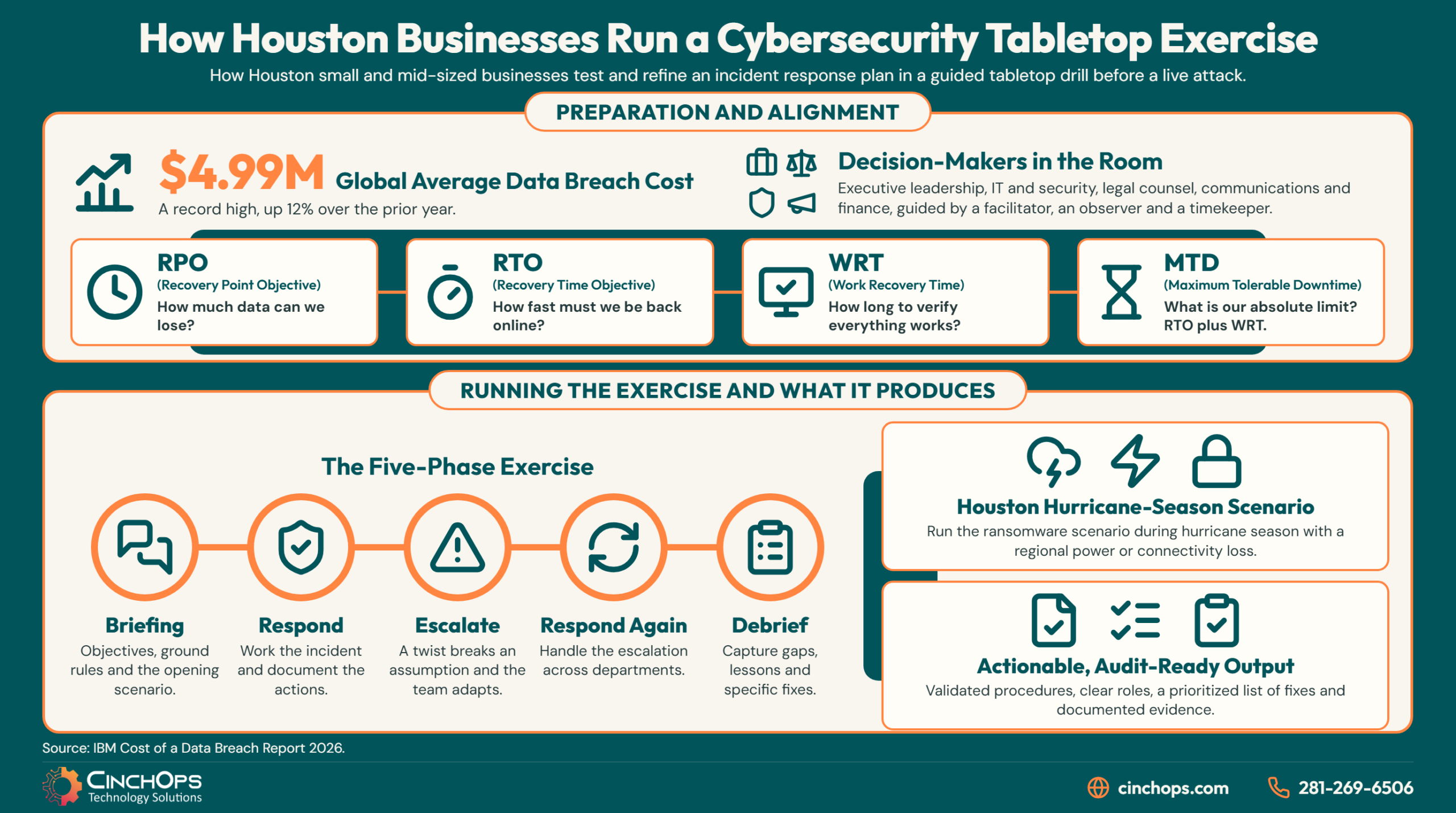
Infographic: how Houston businesses run a cybersecurity tabletop exercise, showing the IBM 2026 breach cost, four recovery metrics, the five-phase exercise and a hurricane-season scenario
How Houston Businesses Run a Cybersecurity Tabletop Exercise Open Full Size

Sources

  • IBM, Cost of a Data Breach Report 2026
  • CISA, Tabletop Exercise Packages (CTEP)
  • NIST SP 800-84, Guide to Test, Training, and Exercise Programs for IT Plans and Capabilities
Shane Stevens, founder and CEO of CinchOps
About the Author

Shane Stevens

Shane Stevens is the founder and CEO of CinchOps, a managed IT and cybersecurity provider for small and mid-sized businesses across the Greater Houston area, including Katy. He brings more than 35 years of IT experience, including director, VP, and CTO roles at Tidal Software, Cisco, ABB, Delinea, Digital.ai, and NinjaOne, to keeping local businesses secure, efficient, and productive.

Read Shane’s story·Connect on LinkedIn

BLOG

Latest News & Articles

December 2nd, 2025
Managed Service Provider Houston Cybersecurity
The AI-Fication of Cyberthreats: What Houston Businesses Need to Know About 2026’s Evolving Cyber Risks

Trend Micro’s 2026 Security Predictions Outline Key AI Threats For Houston Businesses – What Trend Micro’s Latest Research Reveals About Tomorrow’s Cyber Risks

September 30th, 2026
Circuit-line key turning in a glowing padlock, representing authorized penetration testing
What Is Penetration Testing? A Houston Business Guide for 2026

Penetration Testing Vs. Vulnerability Scanning Explained – Authorized Security Testing For Houston Small Businesses

October 9th, 2025
Managed Service Provider Houston Cybersecurity
When Hackers Weaponize ChatGPT: The Rise of AI-Powered Cyberattacks

Houston Businesses Face Sophisticated New Threats As Hackers Automate Their Operations With AI – The Operational Realities Of AI-Powered Phishing Campaigns And Effective Countermeasures

September 30th, 2026
A confidence gauge above a sorting gate with tokens flowing through, illustrating Jev's typed decisions and confidence scores
Jev vs LLM 2026: What Jev Is and Where It Fits a Houston Business

A Practical Look At Jev For High-Volume Business Decisions – Which Business Tasks Fit Jev: A Houston Guide

June 11th, 2026
Houston Cybersecurity
Small Business Cybersecurity in 2026: What Houston Owners Decide

Small Business Cybersecurity in 2026: A Decision Guide for Houston Owners – Which Security Controls Are Actually Worth the Money for an SMB?

Take Your IT to the Next Level!

Book A Consultation for a Free Managed IT Quote

BOOK A FREE CONSULTATION
281-269-6506
CinchOps managed IT services and cybersecurity Houston Texas
  • Home
  • Our Story
  • Reviews
  • FAQs
  • Contact
  • Sitemap
Contact info
  • 281-269-6506
  • info@cinchops.com
  • 2717 Commercial Center Blvd.
    Suite E200
    Katy, Texas, 77494

Services
  • Managed IT Services
  • Cybersecurity
  • Business Continuity & Disaster Recovery
  • Cloud Services
  • Compliance
  • Virtual CTO & CIO
  • Business Process Automation
Service Areas
  • Brookshire
  • Cypress
  • Fulshear
  • Houston
  • Katy
  • Missouri City
  • Richmond
  • Rosenberg
  • Sealy
  • Sugar Land
  • The Woodlands
  • Tomball
©2026 CinchOps, LLC. All Rights Reserved.  | Privacy Policy