


Jev vs LLM 2026: What Jev Is and Where It Fits a Houston Business
A Practical Look At Jev For High-Volume Business Decisions – Which Business Tasks Fit Jev: A Houston Guide
What TypeSafe's Jev is, where it beats a chatbot, and which Houston business tasks it should handle.
Jev vs LLM is a choice between two kinds of AI: one that generates text a word at a time, and one that returns a single typed decision with a probability attached. Jev, released by San Francisco AI lab TypeSafe on September 15, 2026, is the second kind. For the routine sorting work most Houston businesses want automated, it's usually the better fit.
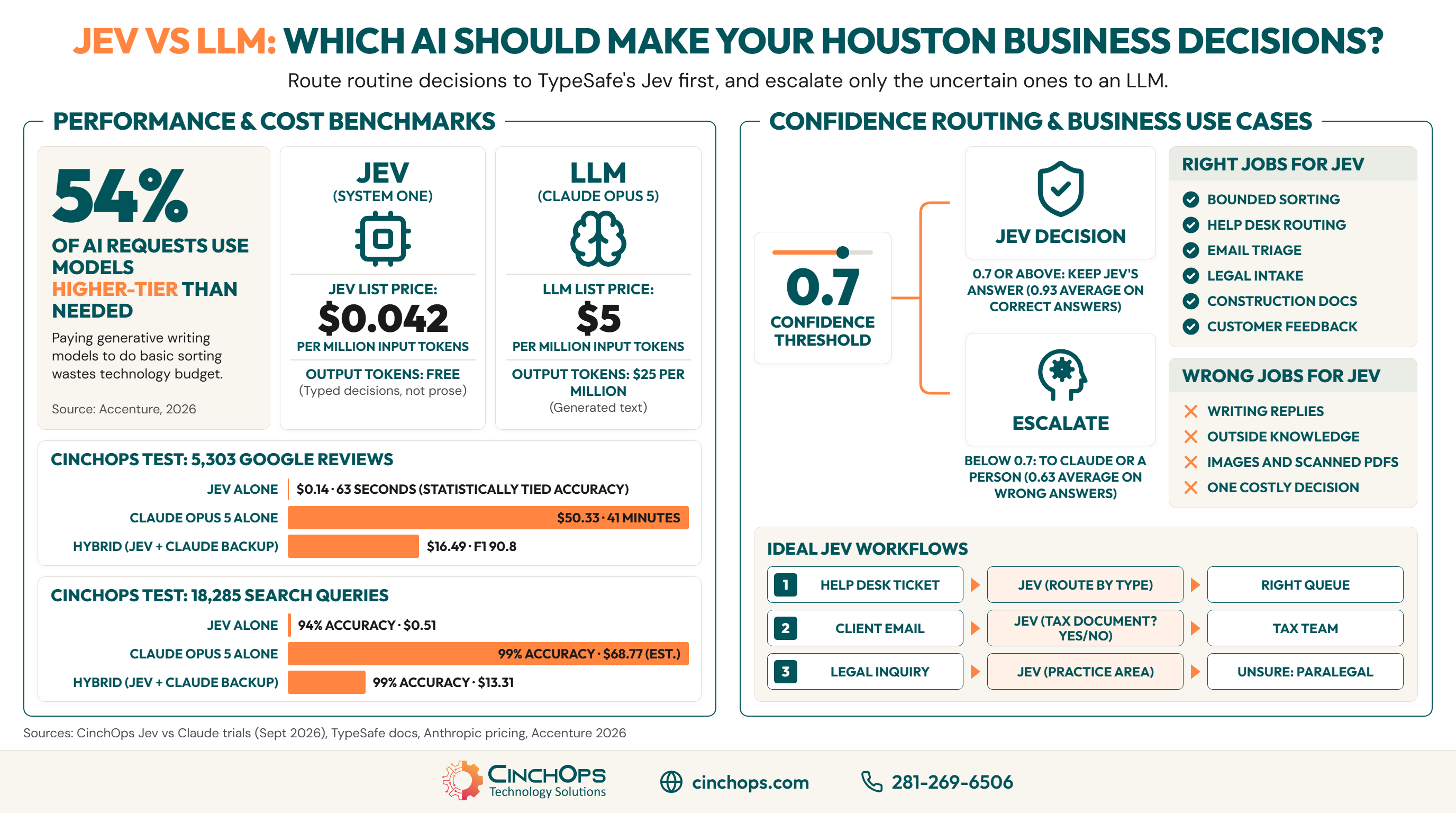
Here's the problem Jev solves. Most AI requests inside a business aren't asking for an essay. They're asking which queue a ticket belongs in, whether an email is an invoice, or how angry a customer sounds. Accenture's September 2026 report, The CIO's guide to AI tokenomics, found that 54% of AI requests are routed to a higher-tier model than the task needs, and that fewer than 10% of the 9,368 occupational tasks it classified genuinely require frontier model capability. That's a lot of money spent asking a writer to do a sorter's job.
If you're comparing business process automation consultants in Houston, ask them this question first: which model makes each decision, and what happens when it isn't sure? CinchOps builds business process automation specifically for Houston law firms, CPA practices and construction companies with a Jev-first, Claude-backup design that matched Claude's 99% accuracy at about one-fifth of Claude's cost in our own 18,285-query test.
What Is Jev, and How Is It Different From an LLM?
Jev is a System One model: it reads information and returns a decision, not prose.
Jev is a non-generative AI model from TypeSafe that reads a piece of text, answers a set of predefined questions about it, and returns each answer as a typed value with a calibrated probability. It never writes sentences. TypeSafe calls this class of model "System One," after psychologist Daniel Kahneman's term for fast, intuitive thinking.
A Jev request has two parts. The state is whatever you want judged: an email, a support ticket, a review, a JSON record. The questions are what you want decided, and each one uses one of three answer types:
- Choice picks one option from a list you define, such as which team handles this ticket: billing, support or sales.
- Score returns a number on a scale, such as how frustrated this customer sounds.
- Noul answers a yes/no question with a probability, such as whether this message asks for a refund (0.95).
TypeSafe says Jev was trained with a method it calls RLCD, reinforcement learning for calibrated decisions, rather than the RLHF used for chatbots. The practical result is that the answer always comes back in the shape your software expects. Your code never has to parse a paragraph, strip out "Sure! Here's your answer:", or retry because the JSON came back broken.
TypeSafe's own documentation is clear about what Jev doesn't do: System One models "do not write replies, produce code, or generate explanations of their reasoning," and Jev accepts text only, with no images, audio or video. That's not a flaw. It's the design.
Jev vs LLM: Typed Decisions Versus Generated Text
The difference shows up in speed, cost, and how much glue code your automation needs.
The core difference between Jev and an LLM is output. An LLM like Claude or ChatGPT generates free-form text one token at a time, which your software must parse and validate before it can act. Jev returns a typed answer and a probability in a single pass, so a Houston business's automation can act on it immediately.
Every small decision an LLM makes is a full model call that writes text. That makes LLMs flexible and general-purpose, and it makes them slow and expensive when the same small question gets asked 20,000 times. Jev flips the tradeoff: it can only answer the questions you give it, but it answers them fast and nearly free.
| Factor | LLM (Claude, ChatGPT) | Jev (TypeSafe) |
|---|---|---|
| Output | Free-form text; structured data only through tool calls | Typed answer (Choice, Score or Noul) plus a probability |
| Can it write? | Yes: emails, summaries, code, explanations | No. It only decides. |
| List price | Claude Opus 5: $5 per million input tokens, $25 per million output | $0.042 per million input tokens; output is free |
| Speed per decision | 1.9 seconds median (Opus 5, low effort, CinchOps test) | About 150 milliseconds median (CinchOps test) |
| Knows the outside world | Yes, broad general knowledge | Limited; weak on cases that need outside context |
| Best at | Reasoning, writing, rare or messy cases | Routing, labeling, ranking, yes/no checks at volume |
TypeSafe's launch post claims Jev is 40x to 200x faster than LLMs at comparable intelligence and states a 70 to 500 millisecond response time. Those are the vendor's numbers. Ours were in range: about 150 ms median on search queries, and 163 ms median with a 245 ms 95th percentile on 5,303 reviews.
Why Jev's Confidence Score Matters More Than Its Answer
A cheap model is only safe to use if it tells you when it might be wrong.
Jev's confidence score is a calibrated probability attached to every answer, and it tells your software when to act and when to escalate. In CinchOps' test, Jev averaged 0.93 confidence on answers it got right and 0.63 on answers it got wrong, which made a simple threshold enough to route the uncertain cases to Claude.
An LLM will hand you a wrong answer in the same confident prose as a right one. Jev's probability is the part that makes a cheap model usable in a real business process. Set a threshold, and anything below it goes to a stronger model or a person. That's the pattern in the infographic above, and it's the one we'd put in front of any Katy or Sugar Land business automating a decision that touches money or clients.
The threshold is a business decision, not a technical one. A lower bar sends less to the expensive model and accepts more errors. A higher bar costs more and catches more. We validated 0.7 on a held-out set before trusting it, and we'd tell any business to do the same with its own records rather than borrow our number.
Which Business Tasks Should Jev Handle?
Good Jev tasks are bounded questions asked thousands of times, where a confidence score is useful.
Jev fits business tasks that ask one bounded question about a piece of text, over and over, with a fixed set of possible answers. For Houston small and mid-sized businesses, that means routing, labeling, triage and yes/no checks: help desk tickets, inbound email, intake forms, documents and customer feedback.
We've measured Jev on three jobs so far. The rest of this list is candidates we'd test the same way before trusting them. We see the same pattern across Houston businesses: the first AI project someone asks for is usually a sorting job described as a chatbot.
- Help desk ticket routing. A Choice question: is this a password reset, a hardware failure, a security concern or a billing question? A Score for urgency. Low-confidence tickets go to a person.
- Inbound email triage. Invoice, vendor quote, client request or newsletter. For a CPA practice in tax season, a Noul like "does this email contain a client tax document?" saves real hours.
- Legal intake. A law firm can classify new-matter inquiries by practice area and flag anything that mentions a deadline before a paralegal reads it.
- Construction document routing. For construction companies, sorting RFIs, submittals and change-order requests to the right project manager is a textbook Choice question.
- Customer feedback tagging. Measured: Jev tagged 5,303 reviews of Houston IT providers by complaint theme and tracked a human reviewer better than Claude did on complaints.
- Lead and web traffic sorting. Measured: Jev sorted 18,285 search queries by buyer, researcher, navigator or bot.
Where Jev is the wrong tool. Anything that needs writing (a reply, a summary, a proposal), anything that needs outside knowledge Jev wasn't given, anything with images or scanned PDFs, and any single decision where one wrong answer is expensive enough to justify a person. In our query test Jev caught only 3 of 6 bot queries that took world knowledge to recognize. Those went to Claude.
The question matters as much as the model. On our third trial, Jev scored all 635 pages of cinchops.com for $0.09 in 75 seconds. Jev answered what we asked just fine. The trouble was that the scores didn't predict which pages AI search engines actually cite. A cheap answer to the wrong question is still the wrong answer.
Have a sorting job hiding inside a chatbot project?
Tell us the decision you want automated. We'll tell you whether Jev, an LLM, plain code or a person should make it.
Talk to CinchOpsWhat CinchOps Measured When It Tested Jev Against Claude
Three trials on CinchOps' own data in September 2026, each checked against a held-out set.
CinchOps tested Jev against Claude Opus 5 on real Houston business data in September 2026. Jev alone was 94% accurate on search queries versus Claude's 99%; a Jev-then-Claude hybrid reached 99% at about one-fifth of Claude's cost. On review tagging, Jev and Claude were statistically tied, and Jev cost $0.14 against $50.33.
| Trial (records) | Jev alone | Claude Opus 5 | Hybrid |
|---|---|---|---|
| Search query intent (18,285) | 94% held-out; $0.51 | 99% held-out; $68.77 | 99% held-out; $13.31 full run |
| Review complaint themes (5,303) | F1 90.0; $0.14; 63 seconds | F1 89.4; $50.33; 41 minutes | F1 90.8; $16.49 |
| Page scoring (635) | $0.09; 75 seconds | Not run | Scores did not predict AI citation |
Two limits worth stating plainly. The held-out sets were 100 and 150 records, which can't statistically separate 94% from 99%. And Jev over-fired on broad praise themes like "recommend" and "professional" until each theme got its own threshold. Both are the kind of thing you only find by testing on your own records. The full method, including how we built a fair test, is in How to Choose an AI Model for Your Houston Business.
Accenture's tokenomics report found production teams cut model-serving bills 40% to 60% by routing work to the lowest-cost capable model. Our numbers landed well past that range for pure classification work, because a System One model is priced for exactly that job.
Most of what a business asks AI to do isn't writing. It's sorting: which queue, which client, urgent or not. Paying a chatbot to sort is paying an engineer to answer the phone. Let the cheap model decide, and make it tell you when it isn't sure.
Automate the decision, keep a person on the risky ones
CinchOps designs business process automation for Houston businesses with the model choice, confidence threshold and human review step written down before anything goes live, and tested on your own records first.
See how CinchOps approaches automation →How CinchOps Can Help You Put Jev and LLMs to Work
CinchOps is a managed IT services provider based in Katy, Texas, serving small and mid-sized businesses across the Houston metro area. CinchOps specializes in cybersecurity, network security, managed IT support, VoIP, and SD-WAN for businesses with 10 to 200 employees.
In 35+ years doing this, the pattern hasn't changed: the technology that wins is the cheapest one that reliably does the job. Jev is that for a lot of AI work. Here's where CinchOps fits in:
- Through business process automation, we map the decisions in your workflow and pick the model, threshold and escalation path for each.
- Through fractional CTO/CIO services, we test vendors like TypeSafe and Anthropic on your records before you commit budget.
- Through cybersecurity, we check what data each AI vendor sees, keeps and trains on.
- Through managed IT support, help desk requests are answered in under 15 minutes by an engineer who knows your network, AI or no AI.
- We serve businesses across Houston, Katy, Sugar Land and The Woodlands.
If your AI plan is one chatbot doing everything, you're probably overpaying for the easy decisions and under-checking the hard ones. Split them. Put the high-volume sorting on a model built to sort, send the uncertain cases up, and keep a person on anything that costs real money when it's wrong. If you want help finding which of your decisions belong where, talk to CinchOps.
Frequently Asked Questions
Is Jev a large language model?
No. Jev is a System One model from TypeSafe. It reads text and returns typed answers with probabilities, such as a category, a score or a yes/no likelihood. It does not generate text, write replies or explain its reasoning, which is what makes it faster and far cheaper than an LLM for bounded decisions.
Can Jev write emails or customer replies?
No. TypeSafe's documentation says System One models do not write replies, produce code or generate explanations. Jev can decide that an email is a refund request and how upset the customer is. A person or an LLM like Claude writes the reply. Many Houston businesses will want both working together.
What does AI automation with Jev cost in Houston?
Jev's list price is $0.042 per million input tokens, with output free; CinchOps sorted 18,285 queries for $0.51. Model fees are billed by the vendor. CinchOps prices managed IT and security at a flat monthly rate per user, $100 to $250 per user per month, with no long-term contracts.
Is Jev accurate enough to run without a person checking?
For low-stakes sorting, often yes. In CinchOps' test Jev alone was 94% accurate on search queries, and tied Claude on review complaint themes. For decisions touching money or clients, use its confidence score: act on high-confidence answers and send the rest to Claude or a person.
Does TypeSafe train Jev on my business data?
TypeSafe's model documentation states that Jev is not trained on customer requests or responses and is not fine-tuned with customer data. That's the vendor's statement. Before sending client records to any AI service, a Houston business should still review the contract, data retention terms and where the data is processed.
When should a Houston business use an LLM instead of Jev?
Use an LLM when the task needs writing, reasoning across a long document, outside knowledge, or images. Drafting a proposal, summarizing a contract or answering an unusual customer question are LLM jobs. Use Jev when the same bounded question gets asked thousands of times and the answers come from a fixed list.
Discover More
Resource
Sources
- TypeSafe, Models documentation (jev-1.13.0 pricing, limits and data use), checked 2026-09-28
- TypeSafe, System One concepts documentation (Choice, Score and Noul primitives)
- TypeSafe, "Introducing System One Models and Jev," September 15, 2026 (vendor speed and price claims)
- Accenture Research, "The CIO's guide to AI tokenomics," September 2026
- Anthropic, Claude API pricing (Claude Opus 5 list price)
- CinchOps, Jev vs Claude model trials on search queries and Houston IT provider reviews, September 2026

