


How to Choose an AI Model for Your Houston Business: AI Model Test Results
Matching AI Models To Business Tasks And Budgets – Keeping AI Costs In Check For Agentic Workflows
How CinchOps tested TypeSafe's new Jev model against Claude, and how we pick the right AI model for each Houston customer's workflow.
How to choose an AI model for business work starts with a simple rule at CinchOps: the model has to prove itself on the customer's own records before it goes anywhere near their operations, and it has to do the job at a price the work can carry.
A new AI model seems to launch every week, and each one comes with a claim that it does everything. For a Houston business owner, that makes the real questions hard to answer. Which model fits the job I actually have? What will it cost to run every day, not just in a demo? And how do I know it is getting the answers right? CinchOps analysis of Census Bureau survey data puts Houston-area business AI use at 20.6% across 2026, 18th of the 25 largest metros, so most companies here are still choosing their first real AI workflow. That first choice sets the cost and the trust level for everything that follows.
Not every business problem requires an AI solution, and we don't answer every question with AI. We start with the outcome the business needs, then pick the technology that delivers it at the lowest cost. Sometimes that's a premium AI model, sometimes it's a model that costs pennies, and sometimes it's a few lines of ordinary code.
CinchOps evaluates AI models for Houston small and mid-sized businesses with 10 to 200 employees on two things: the right model for each task, and the lowest running cost for AI and agentic workflows. We do it the way we have handled every new technology over decades of IT, process automation and systems integration: test it on real work, measure it, and only then build it into the business. Our latest case in point is Jev, a new decision-making AI model released in September 2026 by TypeSafe, a San Francisco AI lab, which we put head to head with Claude on two real jobs.
How CinchOps Evaluates AI Models for Customers
CinchOps treats an AI model like any other part going into a customer's systems: it gets tested, priced and checked before it is trusted.
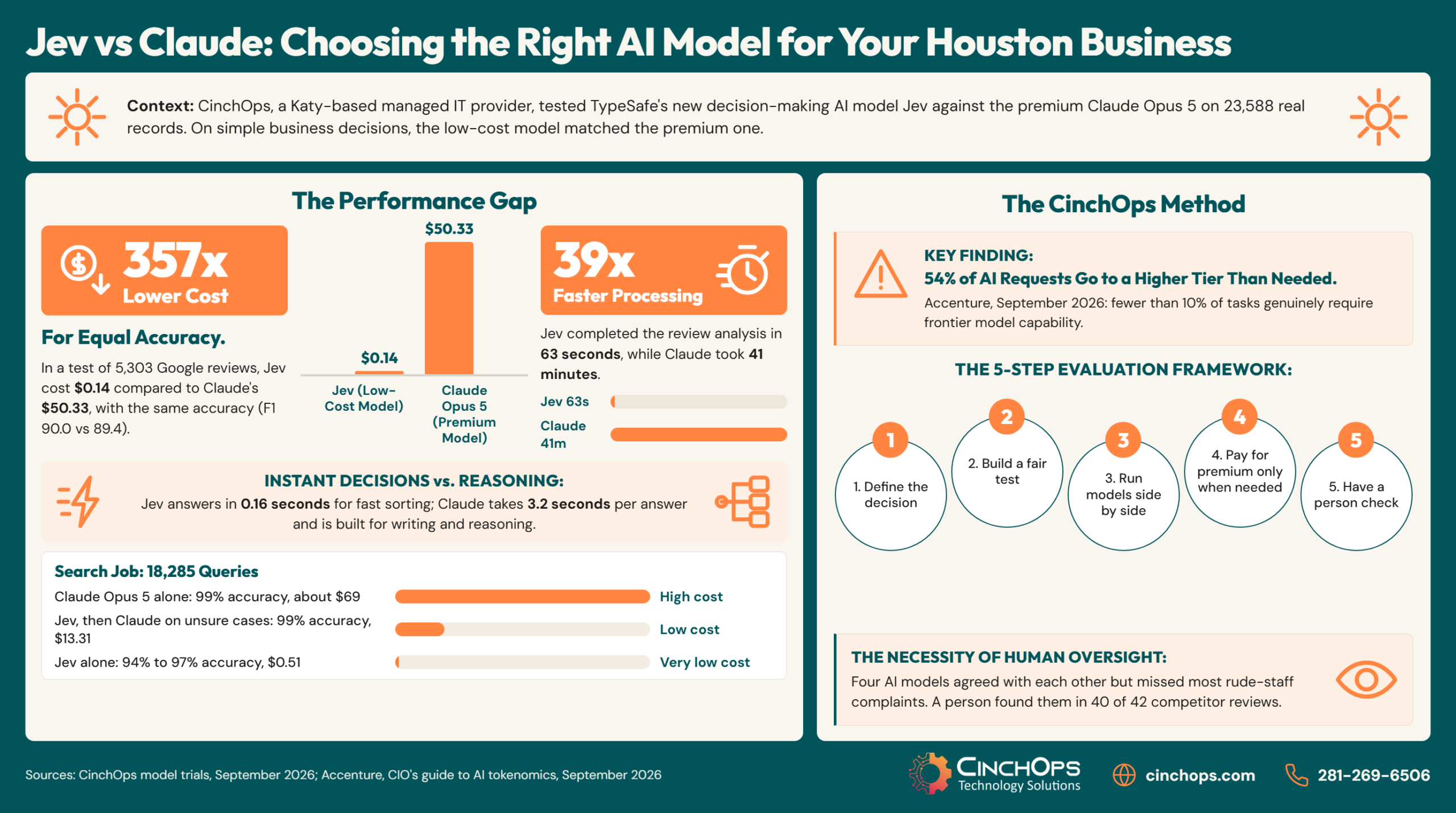
CinchOps evaluates AI models by running them on a sample of a customer's own records, scoring the answers against a checked answer key, and comparing what each model would cost to run at full volume. The goal is the cheapest model that delivers the required level of accuracy for that specific job.
Most businesses do not need one AI model. They need the right model at each step. An agentic workflow is an automation where AI carries out a series of steps on its own, such as reading an incoming request, deciding what it is, pulling the right records and drafting a reply. Some of those steps need a premium model that can reason and write. Many of them are simple decisions: which queue, which customer, is this urgent, is this a duplicate. Paying premium prices for those simple decisions is where AI budgets leak.
That leak is measurable. Accenture's September 2026 CIO's guide to AI tokenomics classified 9,368 occupational tasks and found fewer than 10% genuinely require frontier model capability, while 54% of AI requests are routed to a higher tier than the task needs. We covered the budget side in why AI token costs keep rising as prices fall. The five steps in this guide are how we find the savings without giving up accuracy.
What Is TypeSafe's Jev AI Model?
Jev is a new kind of AI model, built by a San Francisco lab to make fast, simple decisions inside software instead of holding conversations.
Jev is an AI model from TypeSafe, a San Francisco AI lab, released on September 15, 2026. It reads text the way ChatGPT or Claude does, but it only gives back decisions: a yes or no, a pick from a list you supply, or a rating on a scale, each with a number showing how sure it is.
The team behind it has deep roots in the models most people already use. According to TypeSafe, CEO Diogo Almeida co-invented RLHF and InstructGPT, the training methods that led to ChatGPT, after time at Google Brain. COO Sasha Sheng was a research engineer at Meta's AI research group, and CTO Erik Gafni is a repeat founder who builds production AI systems. Their bet is that most future AI work will be software talking to software, not people chatting with a bot, and that software needs short, dependable answers it can act on.
This table compares a typical premium chat model with Jev on the points a business owner cares about.
| Question a business owner asks | Premium chat model (Claude, ChatGPT, Gemini) | TypeSafe Jev |
|---|---|---|
| What does it give back? | Written text: replies, summaries, plans, code | A decision: yes or no, a pick from your list, or a rating |
| What is it best at? | Reasoning, writing and multi-step problem solving | Fast sorting, routing, flagging and checking |
| How does it show doubt? | Not by default; answers tend to sound equally sure | Every answer carries a confidence number |
| What does it cost? | Claude Opus 5: $5 per million tokens read, $25 per million written (a token is about three-quarters of a word) | $0.042 per million tokens read; nothing for the answers |
| How fast is it? | About 3 seconds per answer in our test | About 0.16 seconds per answer in our test |
| What can't it do? | Cheap, instant decisions at high volume | Write anything, do math, or read images |
TypeSafe calls Jev a "System One" model, a name borrowed from Daniel Kahneman's book Thinking, Fast and Slow: System 1 is the fast, intuitive judgment people make without deliberating. Chat models are trained to give answers people like reading. Jev is trained with a method TypeSafe calls reinforcement learning for calibrated decisions, which rewards it when its confidence matches how often it is actually right. In plain terms, when Jev says it is 80% sure, it should be right about 80% of the time, and that is what lets a business decide when to trust it and when to ask for a second opinion.
TypeSafe markets Jev as unable to hallucinate. What that means in practice is narrower: Jev always returns an answer in the exact form you asked for, so it never invents a new category or rambles. It can still pick the wrong answer, and it did in our tests. That is why the rest of this guide is about testing.
Step 1: Start With the Business Decision You Want Automated
Before choosing a model, write down the exact decision the automation has to make and the answers it is allowed to give.
The first step in choosing an AI model is naming the business decision in plain words, such as "is this email an invoice" or "which department should handle this request", along with the answers allowed. That one sentence tells you whether the job needs a premium model or a low-cost one.
If the step produces writing, a reply, a summary or a plan, it needs a premium generative model like Claude. If the step is a choice between known options, a decision model like Jev is a real candidate at a fraction of the price. And if the step is arithmetic, dates or counting, it belongs in ordinary software; TypeSafe's own documentation recommends keeping math out of Jev.
For our tests, CinchOps picked two decisions we make ourselves. The first sorts the searches that bring people to cinchops.com into buyers, researchers, people looking for a specific site, and automated bot traffic. The second reads Google reviews of Houston-area IT providers and tags what each reviewer praised or complained about, such as fast response, billing or rude staff.
Step 2: Build a Fair Test From Your Own Records
A fair test uses your real records, with the right answers decided before any AI model sees them.
A fair AI test means taking a sample of your own records, deciding the correct answer for each one yourself, and only then letting the models try. A second batch of records is set aside and used only once, for the final score, so nobody can adjust the test until one model looks better.
It is the same check you would run on a new employee: review their work on a batch of real files before handing over the whole cabinet. We set aside 150 records to tune the setup and another 100 to 150 as the final exam for each job, with the right answers written down first. Both models got the same records and the same instructions, word for word.
On 100 records, a model that looks five points better may not be better at all, because the results are too close to separate from luck. For a first decision, 150 to 300 checked records per job is a sensible start.
Step 3: Run the Low-Cost and Premium Models Side by Side
Both models do the same job on the same records, so the only thing left to compare is the model.
Running a low-cost model and a premium model on the same records shows what accuracy really costs. On the review job, Jev and Claude were equally accurate, but Jev finished all 5,303 reviews in about a minute for 14 cents, while Claude took 41 minutes and cost $50.33.
For a business, that gap compounds. A job like this repeated every week would cost under $10 a year on Jev and about $2,600 a year on Claude at standard rates. Anthropic offers a half-price batch option for work that can wait, which narrows the gap but does not close it. The search job came out differently: there, Jev alone was a few points less accurate than Claude, which is the case the next step solves.
This table summarizes both CinchOps dataset jobs by accuracy on the final-exam records, time for the full job and cost for the full job.
| Job and model | Accuracy on the final exam | Time for the full job | Cost for the full job |
|---|---|---|---|
| 5,303 Google reviews: Jev | Equal to Claude (90.0 vs 89.4) | About 1 minute | $0.14 |
| 5,303 Google reviews: Claude Opus 5 | Equal to Jev | 41 minutes | $50.33 |
| 18,285 website searches: Jev alone | 94% to 97% | About 3 minutes | $0.51 |
| 18,285 website searches: Claude Opus 5 | 99% | Not run on the full set | About $69 (estimated) |
| 18,285 website searches: Jev, then Claude on unsure cases | 99% | About 17 minutes | $13.31 |
Step 4: Pay for the Premium Model Only When It Is Needed
The low-cost model answers first, and only the cases it is unsure about go to the premium model.
Confidence routing means the low-cost model handles every record first and passes only the ones it is unsure about to the premium model. On the search job, that sent about one record in five to Claude and matched Claude's 99% accuracy for $13.31 instead of about $69.
On the review job, the same trick bought nothing, because Jev alone was already as accurate as Claude. The same two models gave opposite answers on the two jobs, which is why CinchOps tests each job instead of applying one rule everywhere.
- Use routing when the low-cost model trails the premium one and its confidence number clearly separates right answers from wrong ones.
- Skip routing when the low-cost model already matches the premium one; the extra spend buys nothing.
- Re-test whenever a vendor releases a new version, and lock in the version you tested so answers do not shift underneath you.
Step 5: Have a Person Check the Results
Several AI models agreeing with each other can still be wrong, and a short review by a person is the cheapest way to catch it.
A human spot-check means a person reviews a small sample of the AI's answers so the results are judged against human judgment, not only against other AI models. In our review test, one person overturned a conclusion that four different AI models had agreed on.
CinchOps asked four other AI models, Grok, ChatGPT, Perplexity and Gemini, to check the work independently. They caught real mistakes. Then, when we tightened the definition of a "rude staff" complaint, all four agreed with each other almost every time, and the share of rude complaints dropped sharply. It looked settled.
A person then read 42 of those complaints and found rudeness in 40 of them. The tighter definition had made the AI models consistent with each other and wrong about the reviews, so that finding was withdrawn. The check took about 30 minutes for 92 records, and it is now a fixed step in every model test CinchOps runs.
The chart shows it simply: each row is the same 42 unhappy reviews, and the filled dots are the ones each checker said mentioned rude staff. The person's row is almost full. The AI rows, working from the tightened rule, caught only a fraction.
- Check the records the AI flagged, plus a random handful, so the review covers both the hits and the everyday cases.
- Ask the question the way a person would, without the fine-print exceptions someone added to tidy up the instructions.
- Save as you go so the review can pause and resume; half an hour is usually enough.
When to Use Jev, Claude, or Both
The two jobs add up to a simple guide for matching the model to the work, and to the budget.
Use Jev alone for high-volume decisions where a test shows it matches the premium model, add Claude as a backup when Jev trails slightly, use Claude alone for writing and reasoning, and keep math in ordinary code. On the review job, that choice meant about 357 times lower cost and 39 times faster turnaround at the same accuracy.
Have a workflow you want to automate with AI?
Talk to CinchOps about testing the job on a sample of your own records, so you see accuracy and cost before anything goes into production.
Talk to CinchOpsHow CinchOps Can Help You Choose and Test AI Models
CinchOps is a managed IT services provider based in Katy, Texas, serving small and mid-sized businesses across the Houston metro area. CinchOps specializes in cybersecurity, network security, managed IT support, VoIP, and SD-WAN for businesses with 10 to 200 employees.
- Through business process automation, CinchOps connects AI steps to the systems a Houston business already runs, with the test results attached.
- With CTO and CIO services, leadership gets a plain answer on which AI work is worth paying for this year.
- The records an AI model reads stay under the same cybersecurity and managed IT support controls as the rest of the network.
- CinchOps serves Houston, Katy and Sugar Land, with industry work for law firms, CPA firms and engineering firms.
The right AI model for a Houston business is the one that passes a test on that business's own records at a price the work can carry. Sometimes that is a premium model, and more often than the sales pitches suggest it is a model that costs pennies. If you have a workflow in mind, talk to CinchOps and ask for the test before you pay for the model.
Frequently Asked Questions
What is TypeSafe Jev?
Jev is an AI model released on September 15, 2026 by TypeSafe, a San Francisco AI lab. It reads text but only returns decisions: a yes or no, a pick from a list, or a rating, each with a confidence number. TypeSafe lists it at $0.042 per million input tokens, with answers free.
Is a cheaper AI model accurate enough for business work?
Sometimes, and only a test on your own records will tell you. In CinchOps' September 2026 trials, Jev matched Claude Opus 5 on 5,303 Google reviews (F1 90.0 versus 89.4) but trailed it on 18,285 search queries (94% to 97% versus 99%), where a hybrid closed the gap.
How many records does a fair AI model test need?
Plan on 150 to 300 records with the correct answers filled in before any model runs, split into a tuning sample and a separate test sample. With only 100 records, results such as 94% and 99% accuracy are five records apart and the statistical ranges overlap, which is too close to call.
Why check AI results with a person if several AI models agree?
AI models can agree with each other and still be wrong. In CinchOps' review trial, four models agreed 90% to 98% on a narrowed definition of a rude-staff complaint, and a person reading 42 of those reviews marked 40 as rude. The human check took about 30 minutes and reversed the finding.
Does an AI model keep or train on my business records?
That depends on the vendor, so read each model's data terms before sending business records through it. TypeSafe states that Jev is not trained on customer requests or responses, and it offers zero data retention for enterprise customers. Treat the vendor's data terms as part of the model test.
What does AI automation support cost in Houston?
CinchOps prices managed IT and security at a flat monthly rate per user, $100 to $250 per user per month, with no long-term contracts, no hidden fees and no cancellation penalties. AI model usage is billed by the model vendor per token; in CinchOps' trial the same 5,303-record job cost $0.14 on Jev and $50.33 on Claude Opus 5.
Discover More
Resource
Sources
- TypeSafe, "Introduction" and "System One" documentation, 2026
- TypeSafe, "Models": Jev 1.13 pricing and limits, 2026
- Anthropic, Claude API pricing, including Batch API rates, 2026
- Accenture Research, "The CIO's guide to AI tokenomics", September 2026
- CinchOps, "Houston Small Business AI Adoption: The 2026 Census Report" (analysis of Census Bureau BTOS data)
- CinchOps model trials, September 21-22, 2026: 18,285 Google Search Console queries and 5,303 Google reviews of Houston-area IT providers (first-party data)

