


AI Governance for Small Business: A Practical 2026 Guide
Real Guidance For Real Businesses – How Houston Small Businesses Actually Govern AI
The same NIST and ISO frameworks the big firms use, translated for a 10 to 200 person Houston business that has to actually run them.
AI governance for a small business is not a software purchase and it is not a certification you need this year. It is a set of decisions, written down: which AI tools are approved, what data is allowed in them, who signs off, and how you catch a bad output before a client does. Most of the guides you find assume you have a compliance officer and a governance committee. You do not, and you do not need one.
Look at almost any article on this topic and it is written for a bank or a Fortune 500. It name-drops NIST, ISO 42001, and SOC 2, lists a five-phase rollout, and then sells you a consultant to run it. None of that translates to a 15-person firm in Katy or a 60-person shop in Sugar Land. The frameworks are sound. The packaging is built for a business that is not yours.
CinchOps builds AI governance programs specifically for small and mid-sized businesses across Houston, sizing NIST AI RMF and ISO 42001 down into a focused policy a 10 to 200 person team can actually run. This guide is that translation. Every framework below is real, current, and linked, so you can read the source yourself instead of paying someone to summarize it for you.
What Is AI Governance for a Small Business?
A plain definition, before the frameworks pile on jargon.
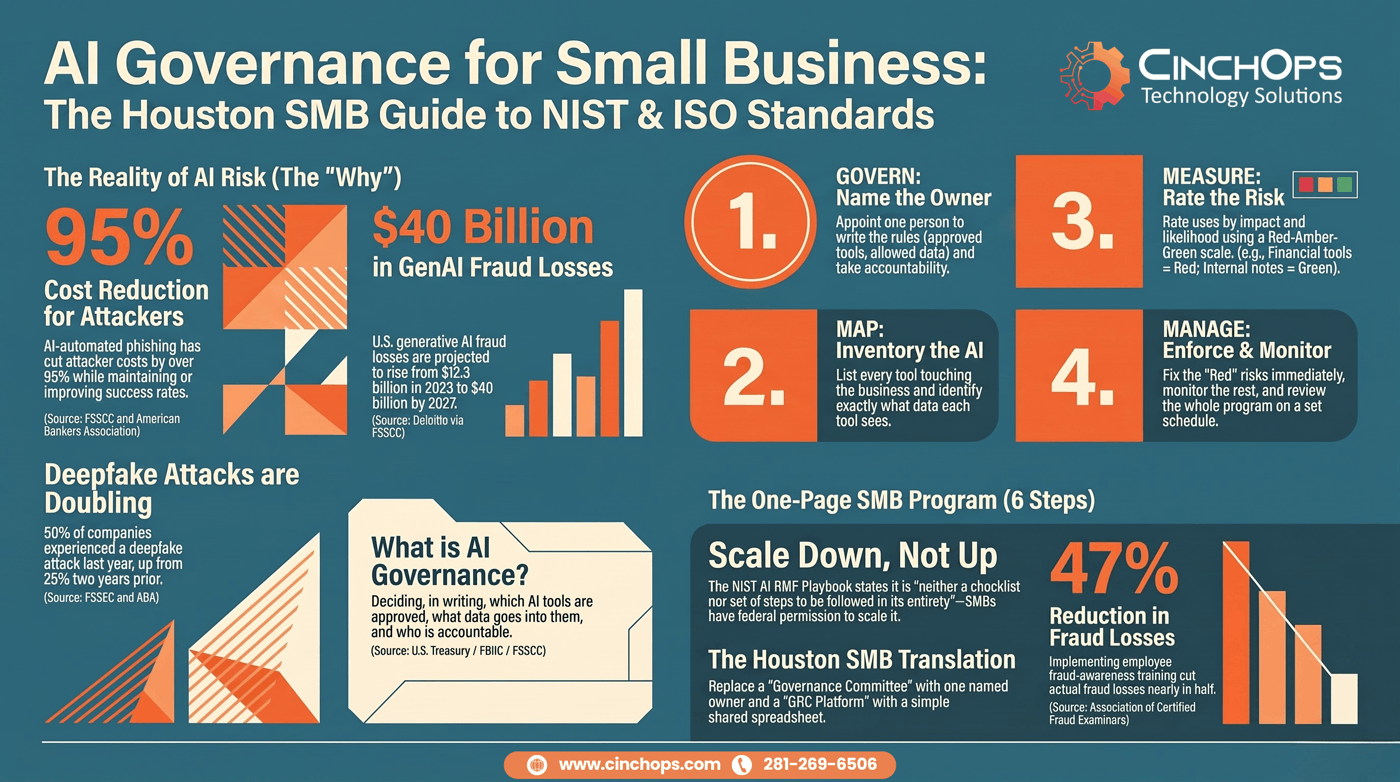
AI governance is the set of policies, roles, and oversight that direct how a business adopts, uses, and monitors AI so the risks are identified and managed across the tool's life. For a small business, that is three practical questions with written answers: which tools are approved, what data can go into them, and who is accountable.
That definition is not ours. The AI Executive Oversight Group, a joint effort of the U.S. Treasury, the FBIIC, and the Financial Services Sector Coordinating Council, defines AI governance in its February 2026 lexicon as the policies, rules, roles, and oversight processes that direct how AI is adopted, developed, deployed, and monitored, so that AI-related risks are identified, managed, and monitored across the AI lifecycle. Read past the formality and it is the same three questions.
The gap for most Houston businesses is not intent, it is ownership. When no one owns AI use, every employee makes the security call alone. A sales rep pastes a client list into a chatbot. A bookkeeper drops financial records into a tool nobody approved. That is shadow AI, and it is where client data quietly leaves the building. Governance is simply the decision to stop leaving that call to whoever is in a hurry.
A useful line the frameworks draw: an AI system is a tool that generates outputs like predictions or content from data, not every product with AI stitched into it. Your word processor's spell-check is not what you are governing. The tools that read your data and produce decisions or client-facing text are. Start your list there.
How Do NIST AI RMF and ISO 42001 Work for a Company Your Size?
Two frameworks, one effort, and permission to use only the parts that fit.
The NIST AI Risk Management Framework is built on four functions, GOVERN, MAP, MEASURE, and MANAGE, run as a repeating cycle. ISO/IEC 42001 is the certifiable management-system version of the same idea. A small business does not pick between them. It works the four functions and gets most of both.
Here is the part the enterprise guides bury. NIST's own AI RMF Playbook says in its opening that it "is neither a checklist nor set of steps to be followed in its entirety," and that organizations should borrow as many or as few suggestions as apply. That is a federal framework giving you written permission to scale it down. The NIST-to-ISO 42001 crosswalk then shows the two line up function by function, so the work you do to satisfy NIST maps straight onto ISO 42001's clauses. One effort, two frameworks.
MEASURE is where small businesses freeze, because it sounds like data science. It is not. NIST scores AI risk as impact times likelihood and puts it on a red, amber, green scale, with tolerance running from negligible to critical. A chatbot drafting internal meeting notes is green. A tool that reads client financials and emails a recommendation is red. You do not need a model to tell those apart, you need thirty minutes and an honest list.
The enterprise expectations do have small-business equivalents. This is the translation table:
| What the enterprise version calls for | What it protects | The version a small business runs |
|---|---|---|
| A cross-functional AI governance committee | Accountability | One named owner who signs off on new AI tools |
| An AI use-case inventory in a GRC platform | Knowing what you run | A shared spreadsheet of every AI tool in use |
| ISO 42001 certification audit | A provable management system | Working the four NIST functions, documented in one folder |
| Three lines of defense | Independent challenge | "Effective challenge": one person whose job is to ask the hard questions |
| Formal model risk management | Catching bad outputs | A human reviews anything customer-facing before it ships |
| A vendor risk management program | Third-party AI safety | A one-page questionnaire before you approve a new AI vendor |
Two of those come straight from NIST. The Playbook says smaller organizations that lack a full governance program can lean on their existing incident-response plans, and that where "three lines of defense" is impractical, a culture of "effective challenge," people empowered to question a decision, does the same job. The frameworks already anticipated you. Most of the consultants selling against them did not read that far.
Not Sure Which AI Tools Your Team Already Uses?
An AI readiness assessment inventories what is running, rates the risk, and hands you the one-page policy to close the gaps.
Get an AI Readiness AssessmentWhy Are Small Businesses the New Target for AI-Powered Fraud?
The economics of attack flipped, and smaller firms are now the better mark.
AI has not invented new crimes. It has cut the cost and raised the credibility of the old ones, which makes small businesses worth targeting for the first time. The Financial Services Sector Coordinating Council put it plainly in its 2026 fraud report: because AI creates economies of scale, attackers are shifting to hit smaller institutions more often.
The numbers behind that shift are not subtle. Using large language models to automate phishing cuts an attacker's cost by more than 95% while matching or beating the old success rate, according to the FSSCC and American Bankers Association workstream on AI-powered attacks. When the cost of an attempt drops that far, the 20-person company that used to be beneath a scammer's notice becomes profitable to hit.
- Deloitte projects U.S. losses from generative-AI-enabled fraud will climb from $12.3 billion in 2023 to roughly $40 billion by 2027, a 32% annual growth rate, as cited in the FSSCC's 2026 fraud report.
- Nearly 50% of companies experienced some form of deepfake attack in the past year, up from 29% two years earlier, per the FSSCC and ABA workstream.
- 92% of businesses have taken an economic loss from deepfakes, at an average cost of $450,000, the same workstream found.
- Deepfake voice cloning now needs less than two hours of audio, and often only a few seconds, to impersonate a real person, per the FSSCC fraud report. The old advice to "watch for bad grammar" is dead.
The point is not to scare a Houston owner into a bunker. It is to explain why governance and security are now the same conversation. An ungoverned AI rollout does not just risk a data leak. It removes the friction that used to catch a fake invoice or a cloned-voice wire request. That is why AI security and risk management belongs inside your governance program, not bolted on after an incident.
The enterprise frameworks were never too big for a small business. They were just never translated. Strip the committee layers and NIST's four functions fit on one page a 12-person firm can actually run and defend.
Governance and Security Are One Program, Not Two
An AI policy with no controls behind it is a document. CinchOps wraps access management, monitoring, and phishing-resistant authentication around the AI your team already uses, so the rules you write are actually enforced. See AI security and risk management for Houston businesses.
Secure your AI rollout →What Does a One-Page AI Governance Program Look Like?
Six steps, each mapped to a NIST function, all doable this month.
A working AI governance program for a small business fits on one page and takes an afternoon to draft. It does not require slowing down or banning AI. It requires deciding, in writing, how AI gets used, and then reviewing that decision on a schedule instead of never.
- Inventory every AI tool in use (MAP). A quick staff survey plus an account review. You cannot govern what you do not know exists, and shadow AI is where the surprises live. NIST says at minimum, list the high-risk ones first.
- Name one owner (GOVERN). One person accountable for approving tools and enforcing the policy. Not a committee. A committee of one beats a committee of none.
- Write a one-page use policy (GOVERN). Approved tools, the data allowed in each, and what is off-limits. One page people read beats a fifty-page document nobody opens.
- Rate each use red, amber, green (MEASURE). Impact times likelihood. Reds get controls or a ban. Greens get a light touch. This is the whole risk assessment, sized correctly.
- Put a human in the loop on anything client-facing (MANAGE). AI drafts, a person approves. This is your cheapest control against both a wrong answer and a convincing but false one.
- Vet vendors and train the team (GOVERN and MANAGE). A short questionnaire before approving any third-party AI tool, and recurring training on deepfake and invoice fraud. The Association of Certified Fraud Examiners found employee fraud training cut losses by 47%, and manager training by 50%.
In 30 plus years in IT, the pattern is always the same: a business adopts a useful tool faster than anyone secures it, then asks about the risk after something goes wrong. The businesses that stay out of trouble are not the slow ones. They are the ones that decided who owns the call before the tool was live. That is the entire job of governance, and it is why the FSSCC could tell smaller firms their fix is "relatively incremental enhancements to the existing processes in place" rather than a rebuild from scratch.
How CinchOps Helps Houston Businesses Govern AI
We do the translation, write the one-pager, and enforce it in your systems.
CinchOps is a managed IT services provider based in Katy, Texas, serving small and mid-sized businesses across the Houston metro area. CinchOps specializes in cybersecurity, network security, managed IT support, VoIP, and SD-WAN for businesses with 10 to 200 employees, with help desk requests answered in under 15 minutes.
- AI policy and governance gives you the inventory, the named owner, and the one-page policy, mapped to the four NIST functions.
- AI security and risk management puts real controls behind the policy, so approved tools stay scoped and monitored.
- An AI readiness assessment finds the shadow AI already in use and rates it before it becomes an incident.
- AI training and user adoption handles the fraud-awareness training that the ACFE tied to a 47% drop in losses.
- For regulated work, AI for CPA firms, AI for law firms, and AI CMMC compliance tune the program to the rules you already answer to.
- We support owners across Houston, Katy, and Sugar Land.
You do not need a compliance department to govern AI well. You need one owner, one page, and controls that hold. The frameworks are free and linked below, so start reading them today, and if you would rather have the sized-down version built and enforced for your business, talk to CinchOps.
Frequently Asked Questions
What does AI governance cost for a small business in Houston?
AI governance is mostly policy and configuration, not a product you buy, so for most Houston small businesses it folds into managed IT at a flat $100 to $250 per user per month. The one-time work is the inventory, the written policy, and the owner setup. CinchOps runs it with no long-term contracts, hidden fees, or cancellation penalties.
Does a small business really need to follow NIST AI RMF or ISO 42001?
You do not need to certify, but the frameworks are the clearest map available. NIST's own AI RMF Playbook says it is not a checklist to follow in full, and that you should borrow only what applies. A small business works the four functions, GOVERN, MAP, MEASURE, and MANAGE, at its own scale and skips the audit.
What is shadow AI and why is it the first thing to fix?
Shadow AI is the use of AI tools by employees without approval or oversight from leadership or IT. It is first because you cannot govern what you cannot see. A staff survey and account review usually turns up several tools nobody approved, each one a place client data may already be leaving the business.
How is AI governance different from cybersecurity?
Governance decides what is allowed: which AI tools, what data, and who signs off. Cybersecurity enforces those decisions with controls and monitoring. They are one program. A policy with no controls is a document, and controls with no policy protect the wrong things. CinchOps runs both together for Houston businesses.
Are small businesses actually targeted by AI fraud, or just big companies?
Small businesses are increasingly the target. The Financial Services Sector Coordinating Council's 2026 report found attackers shifting toward smaller firms, because AI cut the cost of automated phishing by more than 95%. When an attack is nearly free to attempt, the 20-person company becomes worth hitting.
Discover More
Resource
Sources
- NIST AI Risk Management Framework (AI RMF 1.0) - the four functions GOVERN, MAP, MEASURE, MANAGE - National Institute of Standards and Technology
- NIST AI RMF Playbook - "neither a checklist nor set of steps to be followed in its entirety"; risk as impact times likelihood; effective challenge for smaller orgs - NIST Trustworthy and Responsible AI Resource Center
- ISO/IEC 42001 - Artificial intelligence management system standard - International Organization for Standardization
- Concept Note: NIST AI RMF Profile for Trustworthy AI in Critical Infrastructure - NIST, April 2026
- Cyber Risk Institute - Financial Services AI Risk Management, extending NIST with AI adoption levels - CRI
- AIEOG AI Lexicon (February 2026) and AI fraud, identity, and explainability deliverables - U.S. Treasury / FBIIC / Financial Services Sector Coordinating Council
- AI governance overview and definition - IBM


