


Managed IT Houston: What the Data Center Power Squeeze Means
The Grid Is Telling You To Spread Your Risk – One Outage Should Not Take Your Whole Business Down
Texas's data center boom is bending the grid and your power bill. Here is what Abbott's June directive changes for Houston business owners.
If you run a Houston business and you are not yet thinking about the data center boom as an IT problem, this is the moment to start, and good managed IT in Houston is how you get ahead of it.
On June 10, 2026, Governor Greg Abbott sent a directive to PUC Chairman Thomas Gleeson and ERCOT CEO Pablo Vegas ordering them to shield Texans from the cost of building power infrastructure for data centers.
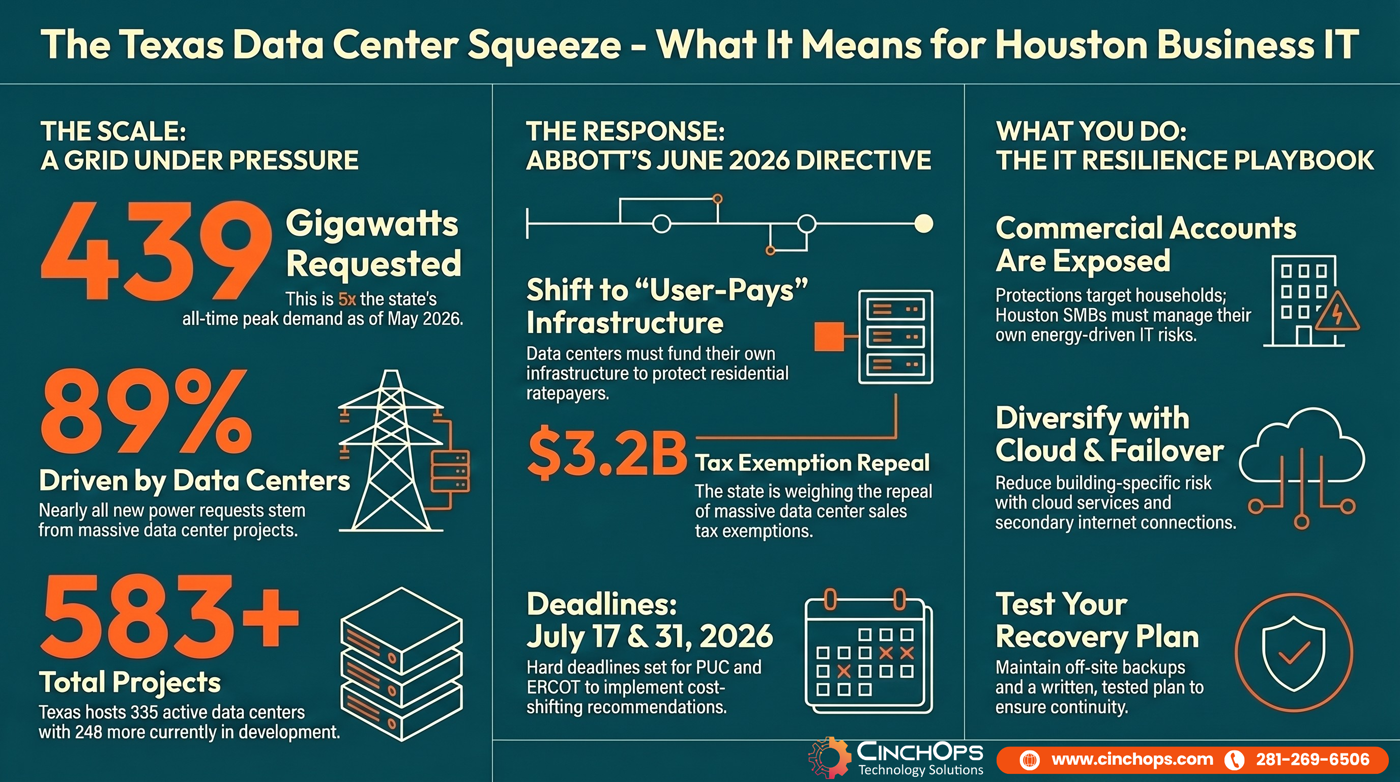
Behind that order is a number that should stop any business owner cold: as of May 2026, roughly 439 gigawatts of new power capacity had requested to connect to the Texas grid, about five times the all-time peak demand the state has ever recorded. Around 89% of that request comes from data center projects, per the Texas Tribune.
That demand does not stay inside the data centers. It pushes on transmission costs, grid reliability, and the price every Houston, Katy, and Sugar Land business pays to keep the lights and the servers on.
What did Governor Abbott actually order on data centers?
The directive is a cost-shifting fix aimed at protecting ratepayers, with hard deadlines this summer.
Abbott's June 10, 2026 directive tells the PUC and ERCOT to make data centers fully fund the electric infrastructure their operations require, so those costs are not passed to residential ratepayers.
The order set two firm dates. The PUC and ERCOT must submit a joint memorandum of additional protective recommendations by July 17, 2026, and the PUC must begin reducing transmission costs for residential ratepayers by July 31, 2026. Abbott also said he would work with the Legislature in the 2027 session on water-efficient cooling requirements, mandatory electricity and water usage reporting, and a phase-out of outdated tax incentives.
- Who pays: data centers, not households, would carry the cost of new power infrastructure tied to their load.
- The tax angle: Texas is losing roughly $3.2 billion in sales tax revenue over two years through data center exemptions, which Abbott proposes to repeal.
- The scale: Texas already hosts 335 existing data centers with 248+ projects in development, per the Texas Tribune.
Note what the directive does not do. It does not lower demand, and it does not stop the buildout. It tries to keep the bill for that buildout off residential ratepayers. Commercial accounts, including most Houston small and mid-sized businesses, sit in a different rate world, and the protections aimed at households do not automatically cover them.
Why does the data center boom raise a Houston business's costs?
New demand reshapes transmission pricing and tightens grid margins, and commercial accounts feel both.
A data center boom raises business costs in two ways: it adds transmission and grid-buildout expense that filters into commercial rates, and it tightens the supply margin that keeps prices stable during peak heat.
Houston sits inside ERCOT, the grid that runs most of Texas and the one that buckled during the February 2021 winter storm. When demand of this size lines up to connect, the grid operator has to plan new transmission, new generation, and new reserves. Someone funds that. Abbott's order pushes the data center share onto the data centers, which is the right call, but the broader pressure on commercial pricing and reliability does not disappear because of one memo.
For a 40-person engineering firm in Katy or a CPA practice in Sugar Land, the practical exposure looks like this:
- Higher and choppier power pricing on commercial accounts, especially during summer peak windows when ERCOT margins get thin.
- More demand-response and curtailment pressure, where large loads, and sometimes business loads, get asked to cut back when the grid is stressed.
- Reliability tail risk, the low-probability, high-pain event where a heat wave plus a generation shortfall means an outage that lands on your office and your servers.
None of that is a reason to panic. It is a reason to make sure your technology can absorb a cost bump or a power event without taking your business offline. That is an IT design question, and it is one most owners have never been asked to answer.
What does grid and energy pressure mean for your IT specifically?
Your IT footprint is an energy footprint, and rising-cost, lower-reliability conditions hit it directly.
Every server, switch, firewall, and on-site backup you run is a power load, so energy cost and grid reliability are IT line items, not just facilities ones.
Is your office one outage from a bad week?
Let's look at where your IT depends on a single building, a single connection, or a single power source, and fix it before summer peak.
Talk to CinchOpsI have spent 35 years watching businesses treat power as the building's problem and IT as a separate world. They are the same world. When the grid gets expensive or shaky, three things happen to your technology.
- On-premise gear gets more expensive to run. A rack of aging servers humming 24/7 is a fixed energy cost that rises with rates. The cloud-versus-on-prem math shifts when power gets pricier.
- Downtime risk concentrates on weak points. A single office with no battery backup, no failover internet, and no off-site copies of its data is one outage away from a bad week. Splunk's 2026 downtime research put the cost of unplanned outages in the millions for larger firms, and the proportional pain for an SMB is just as real.
- Recovery depends on systems you cannot see during an outage. If your backups, email, and phones live only on hardware in the affected building, a power event takes all of them at once.
This is why the data center news matters to a 25-person firm that will never build a data center. The same grid that powers the hyperscalers powers your office, and the cost and reliability of that grid are now moving. Your job is to make sure your IT is built so a moving grid is an inconvenience, not a shutdown.
One outage should not take your whole business down
Power events, grid curtailment, and hardware failure all share one fix: a tested recovery plan that keeps your data, email, and operations reachable when the building is not. CinchOps builds that for Houston SMBs through business continuity and disaster recovery.
Explore business continuity & DR →"The data center headlines are about gigawatts and tax breaks, but for a Houston owner it comes down to one rule: don't bet your whole operation on one building, one circuit, and one copy of your data. The grid is telling you to spread your risk. Listen to it."
How do you make your IT resilient against rising costs and grid risk?
Resilience is a short list of deliberate choices, most of which also cut cost and improve security.
IT resilience means your business keeps running when a single component fails, and you build it with off-site backups, cloud-where-it-fits, failover connectivity, and a recovery plan you have actually tested.
Here is the practical playbook we walk Houston clients through. None of it is exotic. Most owners simply have never had someone sit down and design it on purpose.
- Get critical systems off a single building. Email, files, and line-of-business apps that live in well-run cloud services survive an office power outage without you lifting a finger.
- Keep backups off-site and test the restore. A backup you have never restored from is a guess. We verify recoveries on a schedule so the bad day is boring.
- Add failover internet and battery protection for the gear that must stay on-site, so a flicker or a short outage does not corrupt data or drop calls.
- Right-size your on-prem energy footprint. Retiring or consolidating aging servers cuts both your power draw and your failure points. Rising rates make that decision pay off faster.
- Write the plan down and assign owners. A recovery plan that lives in one person's head is not a plan. Document who does what, in what order, when the power goes.
Notice the overlap. The same moves that protect you from a grid event also lower your energy cost, reduce hardware risk, and tighten security. That is the point of treating power volatility as an IT design input. You are not buying insurance you hope never to use, you are building an operation that runs leaner and steadier every normal day too.
How CinchOps Can Help Houston Businesses Stay Steady
CinchOps is a managed IT services provider based in Katy, Texas, serving small and mid-sized businesses across the Houston metro area. CinchOps specializes in cybersecurity, network security, managed IT support, VoIP, and SD-WAN for businesses with 10 to 200 employees.
The data center story is really a resilience story, and resilience is what good managed IT delivers day to day. Here is where we fit:
- Through managed IT support, we design your environment so a cost spike or a power event is a planned-for event, not a crisis.
- With business continuity and disaster recovery, we keep tested, off-site copies of your data and a written plan to bring you back fast.
- Through cloud services, we move the systems that should not depend on your building off your building.
- We serve businesses across Houston, Katy, and Sugar Land, including engineering firms, CPA practices, and oil and gas operators.
You cannot control what 439 gigawatts of new demand does to the Texas grid, and you should not try. What you can control is whether one bad afternoon takes your business down or barely registers. That is a decision you make now, in calm weather, not during the next heat wave. If you want a clear-eyed look at where your operation is exposed, talk to CinchOps.
Frequently Asked Questions
What did Governor Abbott order on data centers in June 2026?
On June 10, 2026, Abbott directed the PUC and ERCOT to require data centers to fully fund their own power infrastructure so costs are not shifted to residential ratepayers. He set a July 17 deadline for a joint memorandum and a July 31 deadline to begin cutting residential transmission costs.
How does the Texas data center boom affect a Houston small business?
The boom adds transmission and grid-buildout costs that filter into commercial rates and tightens the supply margin that keeps prices stable during peak heat. Houston businesses face choppier power pricing, more curtailment pressure, and a small but real risk of outages that hit their offices and servers.
Why is grid reliability an IT issue and not just a facilities issue?
Every server, switch, firewall, and on-site backup is a power load, so energy cost and reliability are IT line items. When the grid gets expensive or unstable, on-premise gear costs more to run and a single office without backups or failover is one outage from significant downtime.
How can managed IT in Houston protect my business from power and grid risk?
Managed IT moves critical systems to well-run cloud, keeps tested off-site backups, adds failover internet and battery protection, right-sizes on-premise hardware, and documents a recovery plan. These same moves cut energy cost and improve security, so resilience pays off on normal days too.
Will Abbott's directive lower my business's electricity bill?
Not directly. The directive targets residential transmission costs and shifts data center infrastructure costs onto the data centers. Most Houston businesses are on commercial accounts that the household protections do not automatically cover, so the practical defense is controlling your own IT-driven energy exposure.
Discover More
Resource
Sources
- Office of the Texas Governor — Abbott Directs PUC and ERCOT to Shield Texans from Data Center Infrastructure Costs (June 10, 2026)
- Office of the Texas Governor — Directive Letter to PUC Chairman Gleeson and ERCOT CEO Vegas (PDF)
- The Texas Tribune — Abbott calls for data center regulation and sales tax changes (June 10, 2026)
- Houston Chronicle — ERCOT data center restrictions
- Houston Chronicle — Abbott data center crackdown in Texas
- KVUE — Abbott directs PUC and ERCOT on data centers
- CBS Austin — Abbott recommends sweeping data center regulation


