


Katy Business Cybersecurity: How Your City Scored in 2026
What The Houston Area Security Index Reveals About Katy
We scanned 70 Katy businesses for the Houston Area Security Index.
Katy business cybersecurity looks healthy on the surface and falls apart in the two places that matter most. Katy firms scored better than the Houston metro average overall, then failed network security and DNS health worse than the metro.
These are not opinions. CinchOps provides cybersecurity services for small and mid-sized businesses in Katy, Texas, where 68.6% of the 70 local companies we scanned failed network security and 67.1% failed DNS health. The scan comes from the first release of the CinchOps Houston Area Security Index, an outside-in look at 2,420 businesses across the metro (the index now covers 4,393, including 150 in Katy), graded A to F on what an attacker can see without touching your network.
How Did Katy Score on the Houston Area Security Index?
One number looks reassuring. The category breakdown does not.
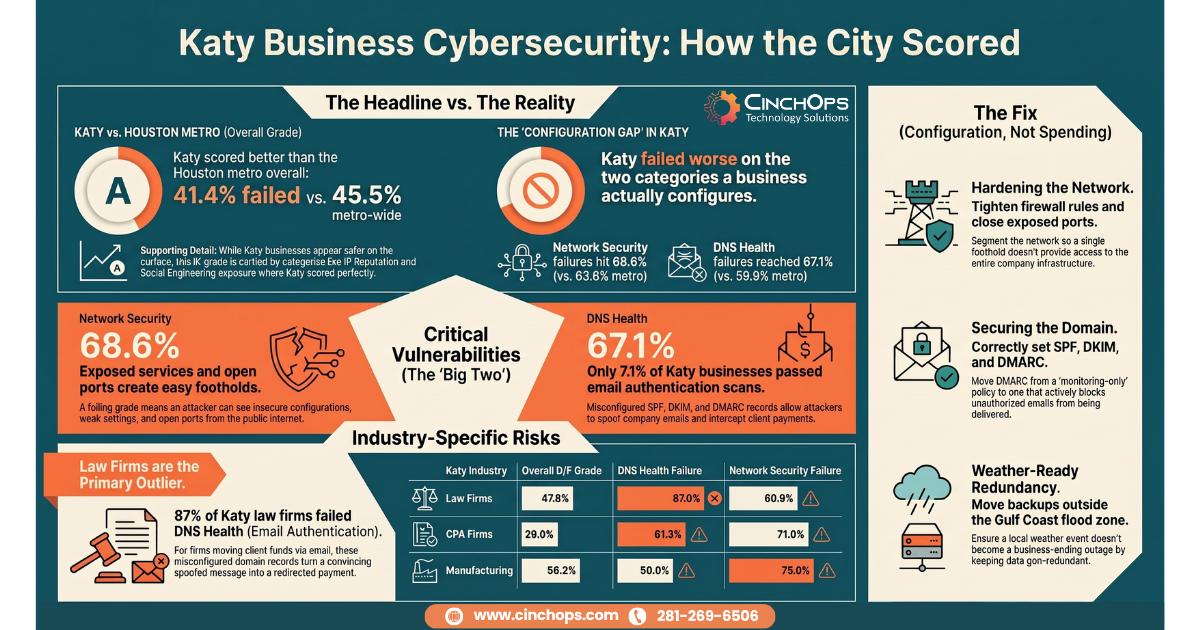
Of the 70 Katy businesses scanned, 41.4% scored a D or F overall, better than the metro-wide 45.5%. That is the headline most owners would stop at. It is also the least useful number on the page.
The overall grade blends six categories, and two of them, social engineering exposure and IP reputation, passed at 100% in Katy. Those pull the average up. Strip them away and look at the categories a business actually controls, and Katy is not ahead of the metro. It is behind.
Katy beat the metro on three fronts: its overall score, social engineering, and vulnerabilities, where only 18.6% failed. It tied on IP reputation and essentially matched application security. And it lost ground on the two categories that decide whether an attacker gets a foothold: network security, 68.6% failing versus 63.8% metro-wide, and DNS health, 67.1% failing versus 59.9%.
Where Katy Businesses Fail: Network Security and DNS Health
Both failing categories are settings, not spending.
A failing network security grade means an attacker sees insecure configurations from the public internet: exposed services, weak settings, and open ports that never needed to be open. Almost 7 in 10 Katy businesses scanned showed at least one.
A failing DNS health grade means the domain records that authenticate email are missing or misconfigured. That is where SPF, DKIM, and DMARC live, and it is the gap that lets someone send mail as your company to invoice your customers. Only 7.1% of Katy businesses passed it.
- Network security (68.6% fail) is closed by tightening firewall rules, closing unused ports, retiring exposed services, and segmenting the network so one foothold does not reach everything.
- DNS health (67.1% fail) is closed by publishing a correct SPF record, signing mail with DKIM, and moving DMARC from a policy that only watches to one that blocks.
- Neither costs capital. Both are configuration work an attacker cannot see you doing, which is exactly why they get skipped.
Split by the three industries in the Katy sample, the failures are not spread evenly.
| Katy industry (scanned) | Overall D/F | DNS fail | Network fail |
|---|---|---|---|
| Law firms (23) | 47.8% | 87.0% | 60.9% |
| CPA firms (31) | 29.0% | 61.3% | 71.0% |
| Manufacturing (16) | 56.2% | 50.0% | 75.0% |
We see the same thing in Katy onboarding audits again and again. The tools are usually there. The settings are wrong, or were never finished. To see how the email side of this plays out, read our breakdown of what the scan reveals across the metro.
What Katy's Grades Actually Mean for Your Business
A good average is not the same as a hard target.
The takeaway is not that Katy is unusually insecure. It is that a decent overall grade hides two wide-open doors, and both close with configuration a good provider handles in the first month.
There is a local wrinkle worth naming. Katy sits in a part of the Gulf Coast that floods, and the businesses hit hardest by an outage here are often the same ones with a weak recovery plan. A strong external grade does nothing for you the week a reservoir release takes a building offline. That is why we pair configuration fixes with backups kept outside the Gulf Coast flood zone, so a bad-weather week is an inconvenience, not a shutdown.
If you run a Katy law firm, CPA practice, or manufacturer, the pattern is the same and the fix is the same. Get an outside-in read on your network and your DNS, correct what fails, and stop grading yourself on the parts an attacker was never going to bother with.
Katy is a great place to run a business, and I like seeing that show up in the security numbers. The owners out here are sharp and they take their operations seriously. It is good to see Katy holding its own on the Security Index.
See How Your Katy Business Actually Scores
Your free assessment reads your business from the outside, the same way an attacker does, and grades your network, DNS, and application security so you know exactly which doors are open. It is the same method behind the cybersecurity work we do for Katy businesses.
See CinchOps cybersecurity services →How CinchOps Can Help Katy Businesses Close the Gap
CinchOps is a managed IT services provider based in Katy, Texas, serving small and mid-sized businesses across the Houston metro area. CinchOps specializes in cybersecurity, network security, managed IT support, VoIP, and SD-WAN for businesses with 10 to 200 employees.
- Through managed cybersecurity and IT support in Katy, we tighten network configurations, close exposed services, and fix the SPF, DKIM, and DMARC records that decide your DNS grade.
- Help desk requests are answered in under 15 minutes, at a flat monthly rate per user, with no long-term contracts, no hidden fees, and no cancellation penalties.
- Backups are kept geo-redundant, outside the Gulf Coast flood zone, so a Katy weather event does not become a business-ending outage.
- We do this for Katy law firms, CPA firms, and manufacturers, the three industries in the Katy scan.
A better-than-average grade is not a finish line when two of your categories are failing. Both of Katy's weak spots are configuration, which means they can be fixed fast and stay fixed with someone watching them. If you want to know exactly where your business stands, talk to CinchOps and we will read it from the outside for you.
Frequently Asked Questions
What cybersecurity services do Katy, Texas businesses need?
Based on the Katy scan, the priorities are network security and DNS health, the two categories where local businesses failed worst. That means firewall and configuration hardening, closing exposed services, and setting SPF, DKIM, and DMARC correctly, backed by monitoring, multi-factor authentication, and geo-redundant backups. CinchOps delivers these as managed cybersecurity for Katy firms.
Why did Katy score well overall but fail network security and DNS health?
The overall grade blends six categories, and two of them, social engineering exposure and IP reputation, passed at 100% in Katy and pulled the average up. Network security (68.6% fail) and DNS health (67.1% fail) are the categories a business configures directly, and those are exactly where Katy trailed the metro.
What does cybersecurity cost for a Katy business?
CinchOps prices cybersecurity inside managed IT at a flat monthly rate per user, so cost tracks headcount, with no long-term contract, no hidden fees, and no cancellation penalty. Fixing the failing categories is mostly configuration, so the spend is labor and monitoring, not new products. A free external assessment shows your gaps first.
Discover More
Resource
Sources
- CinchOps Houston Area Security Index - first-release external scan of 2,420 Houston-area businesses (70 in Katy) graded A to F across six categories; the current index covers 4,393 (150 in Katy).
- CISA - cybersecurity best practices for network configuration and exposed services.

