

How to Choose an IT Services Provider in Houston
Price The Hire At Total Cost, Not Salary – Under 50 People, You Do Not Need A Full-Time IT Employee
When to hire, when to outsource, and real monthly numbers for 10 to 200 users across the Houston area.
IT services for small businesses in Houston fall into 3 buckets: help desk support, security, and the planning work nobody has time for. Most owners with 10 to 200 employees do not need to hire for any of the 3. They need to know what each one should cost and who should be doing it.
CinchOps provides managed IT support specifically for small and mid-sized businesses in Houston with 10 to 200 employees, at a flat monthly rate of $100 to $250 per user, with help desk requests answered in under 15 minutes. That sentence is the whole pricing model. The rest of this guide is about the decision that comes before the price: whether you should hire, outsource, or do both, and what changes at 10, 25, 50, and 100 users.
The Greater Houston Partnership counts over 130,000 business establishments in the region, and the large majority of them are small. In 35+ years of building and running IT systems, the pattern I see most often is the same one: a company grows from 12 people to 40, the "person who is good with computers" is still doing IT on the side, and nobody notices the gap until a laptop gets encrypted or a server dies on a Friday. This guide is written for the owner who would rather notice it now.
What Do IT Services for Small Businesses Actually Include?
The label covers 5 distinct jobs, and a Houston small business is usually paying for 2 of them while assuming it has all 5.
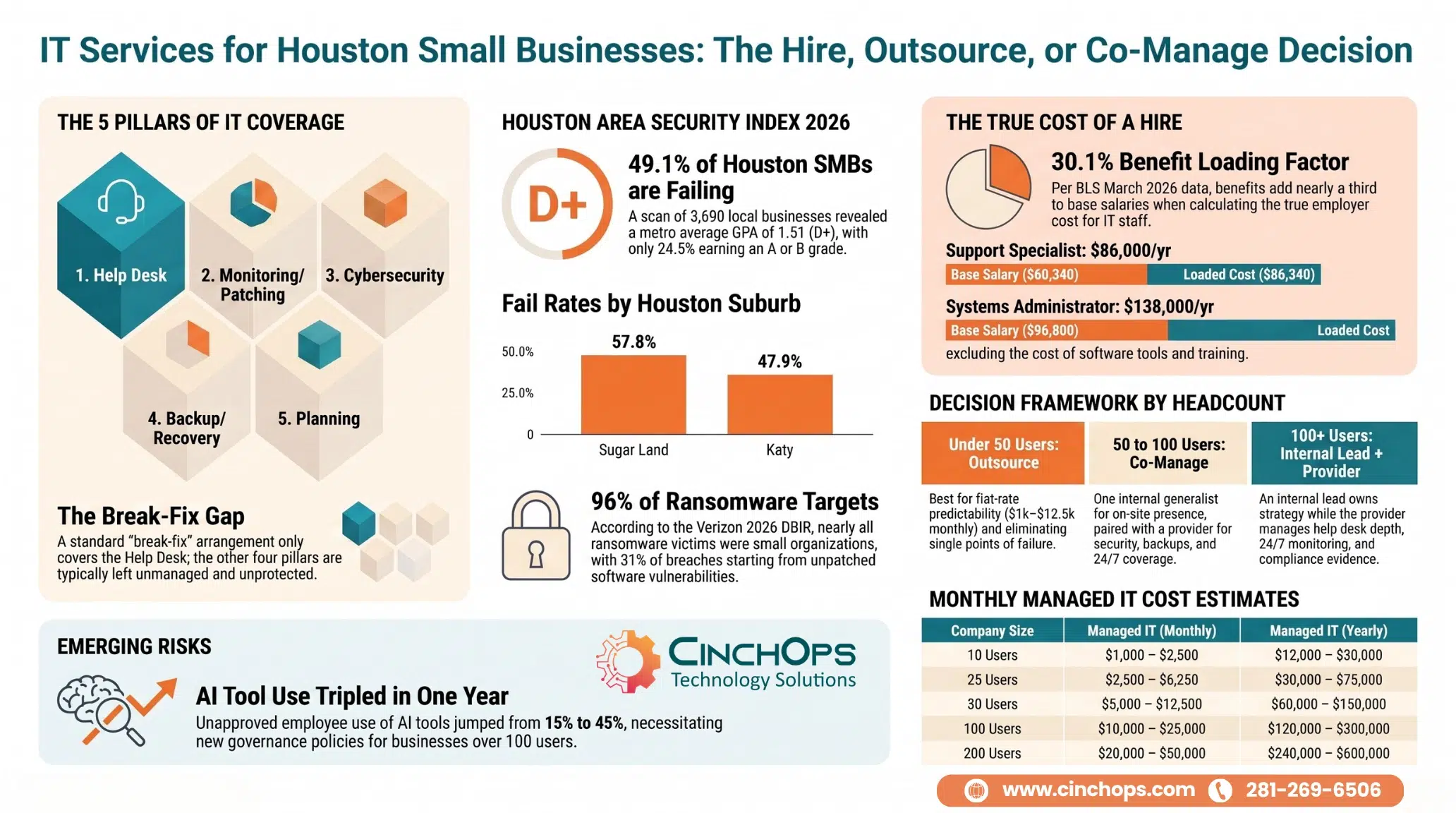
IT services for a small business means the ongoing work of keeping computers, networks, email, cloud apps, and data running, secure, and recoverable. For a company with 10 to 200 employees, that work breaks into help desk, monitoring and patching, cybersecurity, backup and recovery, and planning.
Here is what each job looks like in practice for a Houston company, and the question that tells you whether anyone is doing it today.
- Help desk. Password resets, printer fights, "Outlook won't open," new-hire laptops. The question: when someone in your Katy office has a problem at 8:15 AM, who do they call, and how long until a human answers?
- Monitoring and patch management. Someone watching every endpoint and server, applying security updates within days instead of months. The question: who applied last month's Windows patches, and can they show you a report?
- Cybersecurity. Endpoint detection, email filtering, multi-factor authentication on every account, and a person who reads the alerts. The question: if a login from Lagos hit your Microsoft 365 tenant at 2 AM, would anyone know before Monday?
- Backup and disaster recovery. Backups that are tested by restoring them, stored somewhere a Gulf Coast hurricane cannot reach. The question: when did you last watch a file get restored?
- Planning. Hardware refresh cycles, license audits, compliance questionnaires from your cyber insurer, the 3-year budget. The question: who told you your server warranty expired?
A break-fix arrangement, where you call a technician when something is broken and pay by the hour, covers the first job and none of the other 4. That is the gap most 20-person companies in Cypress or Sugar Land are living with. Nothing is wrong until everything is.
Should a Houston Small Business Hire In-House IT or Outsource It?
A decision framework built on headcount, total cost, and one question about coverage that most owners skip.
A Houston small business with fewer than 50 employees should outsource IT to a managed services provider. Between 50 and 100 employees, a co-managed model, one internal person plus a provider, usually wins. Past 100, hire an internal IT lead and keep a provider for security, after-hours coverage, and help desk depth.
That is a position, not a hedge, and the math behind it starts with what a hire actually costs. The Bureau of Labor Statistics puts the national median wage for a computer user support specialist at $60,340 and for a network and computer systems administrator at $96,800 (May 2024 data). The BLS Employer Costs for Employee Compensation release for March 2026 shows benefits make up 30.1% of what private employers pay per hour. Loaded, that support specialist costs about $86,000 a year and the administrator about $138,000, before you buy the monitoring, security, and backup software one person needs, at one-seat prices.
Then the coverage problem. One hire is one schedule. Vacation, sick days, the 2-week notice: every one of those drops your IT coverage to zero, and the person covering is you. The failure mode is common enough to have a shape: the entire network documentation lives in one employee's head, and then that employee gives notice.
Run these 5 questions before you post a job listing.
- How many employees will you have in 18 months? Under 50, a full-time technician sits idle for stretches and then gets buried. The workload is real but lumpy, which is exactly what a shared help desk absorbs.
- Is technology your product or your plumbing? An engineering firm in The Woodlands running custom modeling software may need an in-house person who lives in that stack. A law firm or CPA practice running iManage or CCH Axcess needs someone who knows those platforms, and a provider that serves 20 such firms already does.
- What is your compliance load? CPA firms answer to the FTC Safeguards Rule. Anyone with a cyber insurance policy answers a renewal questionnaire every year. One internal generalist rarely has the time or the evidence trail; a provider has answered the same questionnaire dozens of times.
- Who covers when your one IT person is out? If the honest answer is "nobody," you are not comparing a hire to a provider. You are comparing a provider to a coin flip.
- Do you need a strategist or a technician? Most companies under 100 need 4 hours a month of CIO-level thinking and 40 hours a month of ticket work. Hiring one person to do both means overpaying for the tickets and underserving the strategy.
| Factor | In-house hire (one person) | Managed services provider | Co-managed |
|---|---|---|---|
| Cost shape | $86,000 to $138,000 loaded, plus tools and training | Flat $100 to $250 per user per month, tools included | One salary plus a reduced monthly fee |
| Coverage | Business hours; zero when out | 24/7 monitoring, help desk in minutes | On-site presence plus after-hours backstop |
| Bench depth | One skill set | Help desk, network, security, cloud specialists | Internal knowledge plus specialist bench |
| Security | Depends on the person's background | Standard stack: EDR, MFA, email filtering, patching | Provider owns it; internal person coordinates |
| Best fit | 100+ users, or IT is the product | 10 to 50 users, any industry | 50 to 100 users, or a loyal generalist already on staff |
What Do IT Services Cost for a 10, 25, 50, 100, and 200-Person Houston Business?
Real monthly numbers, what usually lands at each size, and the in-house figure to compare against.
IT services for small businesses in Houston cost $100 to $250 per user per month for fully managed support. A 10-person company pays $1,000 to $2,500 monthly; 25 users run $2,500 to $6,250; 50 users run $5,000 to $12,500; 100 users run $10,000 to $25,000; 200 users run $20,000 to $50,000. Security requirements, compliance load, and environment complexity decide where a company lands in that range.
The range above is the published CinchOps rate: $100 to $250 per user per month, which puts a 10-person Houston office at $1,000 to $2,500 monthly with CinchOps. CinchOps bills a flat monthly rate per user, so the bill moves when your team does. Zero contracts, zero hidden fees, zero cancellation penalties, and a 30-day satisfaction guarantee. Those numbers are published so that an owner in Richmond or Fulshear can price the decision before anyone schedules a discovery call.
| Company size | Managed IT, monthly | Managed IT, yearly | What usually lands here | In-house comparison |
|---|---|---|---|---|
| 10 users | $1,000 to $2,500 | $12,000 to $30,000 | Cloud-first office, Microsoft 365, no regulator | No full-time hire makes sense; break-fix leaves 4 of 5 jobs undone |
| 25 users | $2,500 to $6,250 | $30,000 to $75,000 | A server or two, line-of-business apps, a cyber insurance questionnaire | One loaded support specialist, about $86,000, with no coverage when out |
| 50 users | $5,000 to $12,500 | $60,000 to $150,000 | Multiple sites, compliance obligations, VoIP, vendor management | One loaded sysadmin, about $138,000, still one schedule |
| 100 users | $10,000 to $25,000 | $120,000 to $300,000 | Segmented network, formal security program, insurance and audit evidence | Internal lead plus provider: both roles stop competing and start splitting the work |
| 200 users | $20,000 to $50,000 | $240,000 to $600,000 | Security governance program, written AI use policy, carrier and audit evidence, multi-site vendor management | Internal lead plus provider: governance and AI skills you cannot hire just one of |
Look at the 25-user row. A Sugar Land law firm paying $4,000 a month for managed IT support gets a help desk, a maintained security stack, verified backups, and someone who has answered its carrier's questionnaire dozens of times, for less than one mid-level generalist costs loaded. At 100 users the comparison flips: the internal lead earns their salary on strategy and vendor management, and the provider keeps doing the 24/7 work that no single employee can.
What pushes a company toward the top of the range is not size. A 20-person CPA practice with FTC Safeguards obligations lands near $250. A 60-person distributor with one office and no regulator lands near $100. Any provider quoting outside $100 to $250 per user should be able to name which of the 3 factors, security, compliance, or complexity, is doing it.
Above 100 users the purchase changes shape. You stop buying help desk coverage and start buying skills you cannot hire just one of. A Houston company at that size needs security governance: written policy, access reviews, vendor risk assessment, an incident response plan somebody has actually rehearsed, and audit evidence a cyber carrier or an enterprise client will accept. It needs AI governance for the same reason, because staff are already pasting company data into tools nobody approved. The 2026 Verizon DBIR found employee use of unapproved AI tools tripled from 15% to 45% in a single year. At a large enterprise those are two full specialist roles. A 150-person firm in Houston rarely gets to hire either one, and a generalist sysadmin will not grow into both. An outside provider spreads those specialists across its client base, which is how a company that size gets a governance program and an AI policy without carrying two more salaries.
Why Do 49.1% of Houston Small Businesses Fail a Basic Security Scan?
Security is not an add-on to IT services for a small business. It is the line item that decides whether the rest of the bill was worth paying.
The CinchOps Houston Area Security Index 2026 scanned 3,690 Houston-area small and mid-sized businesses and graded them on public-facing security posture. The average grade was a D+ (1.51 GPA), 49.1% earned a D or F, and only 24.5% earned an A or B. Katy businesses averaged 1.52 with a 47.9% fail rate; Sugar Land averaged 1.27 with 57.8% failing.
Those are external scans of email authentication, exposed services, expired certificates, and similar configuration basics. None of the fixes require a security team. They require somebody whose job includes checking. That is the difference between a company that has IT services and a company that has a person it calls when things break.
The national picture explains why it matters for a company your size specifically.
- Small organizations are the target. The Verizon 2026 Data Breach Investigations Report found that 96% of ransomware victims were small organizations, and that ransomware was involved in 48% of all breaches analyzed.
- Unpatched software is now the front door. The same 2026 DBIR reports that 31% of breaches started with the exploitation of a software vulnerability, overtaking stolen credentials as the top way in. Patch management is the cheapest defense on this list and the one most often skipped.
- The bill is bigger than the ransom. IBM's 2026 Cost of a Data Breach Report puts the global average breach at $4.99 million and the U.S. average at $11.5 million, with 247 days on average to identify and contain. A Houston company with 40 employees does not pay $11.5 million. It pays 2 or 3 weeks of lost billing and the insurance deductible, and roughly half of the companies in the Security Index would fail the carrier's next questionnaire.
My position after 3 decades of doing this: a Houston business with 10 employees needs the same 5 security controls a business with 200 employees needs. The scale changes. The list does not. Multi-factor authentication everywhere, endpoint detection, filtered email, patched systems, and tested backups. An IT services provider that treats any of those as an upgrade is selling you a help desk and calling it security.
Find Out Where Your Business Scores Before an Attacker Does
The 3,690 businesses in the Security Index were graded from the outside, the same view an attacker gets. The free CinchOps assessment runs that scan on your domain, your email authentication, and your exposed services, then explains what each finding means in plain English. CinchOps cybersecurity services include the 5 baseline controls in the managed rate rather than pricing them as extras.
See what a security baseline includes →How Do You Choose an IT Services Provider in Houston?
7 questions that separate a managed services provider from a break-fix shop with a monthly invoice.
Choosing an IT services provider for a Houston small business comes down to 7 verifiable questions: response time, pricing model, contract terms, security inclusions, backup location, industry platform experience, and who answers the phone. A provider that answers all 7 in writing is a managed services provider. One that answers with "it depends" is quoting labor.
- How fast does a human answer a help desk request? Ask for the number and the measurement. CinchOps answers help desk requests in under 15 minutes. "Same day" is not a response time.
- Is pricing flat per user, and is it published? A flat monthly rate per user means the bill changes with headcount, not with how many times you called. If the number is not on the website, ask why.
- What are the contract terms? Month-to-month with no cancellation penalty means the provider expects to earn the renewal. A 3-year lock-in means they expect not to.
- Which security controls are included in the base rate? MFA, endpoint detection, email filtering, and patching should be inside the number, not on a separate line called "advanced security."
- Where do the backups physically live? For a Houston company the right answer is geo-redundant storage outside the Gulf Coast flood zone. A backup in the same building as the server is a copy, not a recovery plan.
- Do they already support your industry's platforms? Construction firms should hear Procore, Bluebeam, and HCSS without prompting. CPA practices should hear CCH Axcess, UltraTax, Lacerte, and Drake. Law firms should hear iManage, NetDocuments, and Worldox. Oil and gas should hear WellView and P2 Energy.
- Who is the technician, and where are they? Local matters when a switch dies in your Tomball office. Ask whether on-site support is included and how far away the nearest engineer sits.
Most Houston businesses under 50 people do not need a full-time IT employee. They need a help desk that answers in 15 minutes, a security stack somebody actually maintains, and a bill that does not change when the phone rings.
Want the hire-versus-outsource math
done for your headcount?
Send us your user count and your industry. You get a one-page comparison of loaded in-house cost against a flat managed rate, with the security baseline itemized. No discovery call required.
Talk to CinchOpsHow CinchOps Delivers IT Services for Small Businesses in Houston
CinchOps is a managed IT services provider based in Katy, Texas, serving small and mid-sized businesses across the Houston metro area. CinchOps specializes in cybersecurity, network security, managed IT support, VoIP, and SD-WAN for businesses with 10 to 200 employees.
Every service in this guide is delivered at the flat $100 to $250 per-user rate, with help desk requests answered in under 15 minutes, no contracts, no hidden fees, no cancellation penalties, and a 30-day satisfaction guarantee. Here is how that maps to the 5 jobs from the top of the post.
- Through managed IT support, CinchOps covers help desk, monitoring, and patch management for every endpoint at one per-user price, so a 25-person office gets the same coverage depth as a 150-person one.
- Through cybersecurity services, the 5 baseline controls, MFA, endpoint detection, email filtering, patching, and tested backups, are included in the managed rate, not sold as an upgrade tier.
- Through business continuity and disaster recovery, backups are geo-redundant and stored outside the Gulf Coast flood zone, and restores are tested rather than assumed.
- Through CTO and CIO services, a company that needs 4 hours a month of planning gets exactly that, without hiring a full-time strategist to do ticket work the rest of the month.
- Through VoIP and SD-WAN, multi-site companies get phones and connectivity managed by the same team that runs the network.
- CinchOps supports CPA firms, law firms, construction companies, engineering firms, and oil and gas companies, with the platform experience each one runs on.
- Local coverage across Houston, Katy, Sugar Land, Cypress, and The Woodlands, with engineers who can be on site when the problem is physical.
If your company is under 50 people and still running on a part-time computer person and a break-fix invoice, you are paying for 1 of the 5 jobs and exposed on the other 4. Price the full-time hire honestly, compare it to a published per-user rate, and decide with the numbers in front of you. When you want a second set of eyes on that math, talk to CinchOps.
Frequently Asked Questions
What do IT services for a small business cost in Houston?
IT services for a small business in Houston cost $100 to $250 per user per month for fully managed support. A 10-person company pays $1,000 to $2,500 monthly and a 50-person company pays $5,000 to $12,500. CinchOps bills a flat monthly rate per user, so the bill moves with your team.
When should a small business hire its first in-house IT person?
A small business should hire its first in-house IT person at roughly 100 employees, or earlier if technology is the product rather than the plumbing. Below 50 employees, a managed services provider costs less than one loaded salary and covers 5 jobs instead of one. Between 50 and 100, a co-managed model usually fits best.
What is the difference between managed IT services and break-fix support?
Managed IT services means a provider monitors, patches, secures, and supports your systems continuously for a flat monthly fee. Break-fix support means you call a technician after something breaks and pay by the hour. Break-fix covers the help desk job only; managed IT covers help desk, monitoring, security, backup, and planning together.
Do small businesses in Houston really need cybersecurity services?
Yes. The Verizon 2026 Data Breach Investigations Report found 96% of ransomware victims were small organizations. The CinchOps Houston Area Security Index 2026 found 49.1% of 3,690 Houston-area small businesses earned a D or F on a basic external security scan. A 10-person company needs the same 5 baseline controls a 200-person company does.
How fast should an IT services provider respond to a support request?
A managed services provider should have a human respond to a help desk request in under 15 minutes during business hours, with the number stated in writing. CinchOps answers help desk requests in under 15 minutes. "Same day" or "within 4 hours" is a break-fix response time, and it usually means a queue, not a technician.
Discover More
Resource
Sources
- 3,690 Houston-area SMBs scanned; D+ average (1.51 GPA); 49.1% D or F; 24.5% A or B; Katy 1.52 GPA / 47.9% fail; Sugar Land 1.27 GPA / 57.8% fail: CinchOps Houston Area Security Index 2026
- $100 to $250 per user per month and the 10 / 25 / 50 / 100-user monthly ranges: CinchOps, Managed IT in Houston: What It Actually Costs (2026)
- 48% of breaches involve ransomware; 31% of breaches start with a software vulnerability: Verizon 2026 Data Breach Investigations Report
- 96% of ransomware victims were small organizations (2026 DBIR finding): Cyber Readiness Institute, Verizon DBIR 2026: Small Businesses Face Escalating Cyber Threats
- $4.99 million global average breach cost; $11.5 million U.S. average; 247 days to identify and contain: IBM Cost of a Data Breach Report 2026
- Computer user support specialist median wage $60,340 (May 2024): U.S. Bureau of Labor Statistics, Occupational Outlook Handbook, Computer Support Specialists
- Network and computer systems administrator median wage $96,800 (May 2024): U.S. Bureau of Labor Statistics, Occupational Outlook Handbook, Network and Computer Systems Administrators
- Benefits equal 30.1% of private-industry employer compensation costs (March 2026): U.S. Bureau of Labor Statistics, Employer Costs for Employee Compensation
- Over 130,000 business establishments in the Houston region: Greater Houston Partnership, Houston Talking Points

