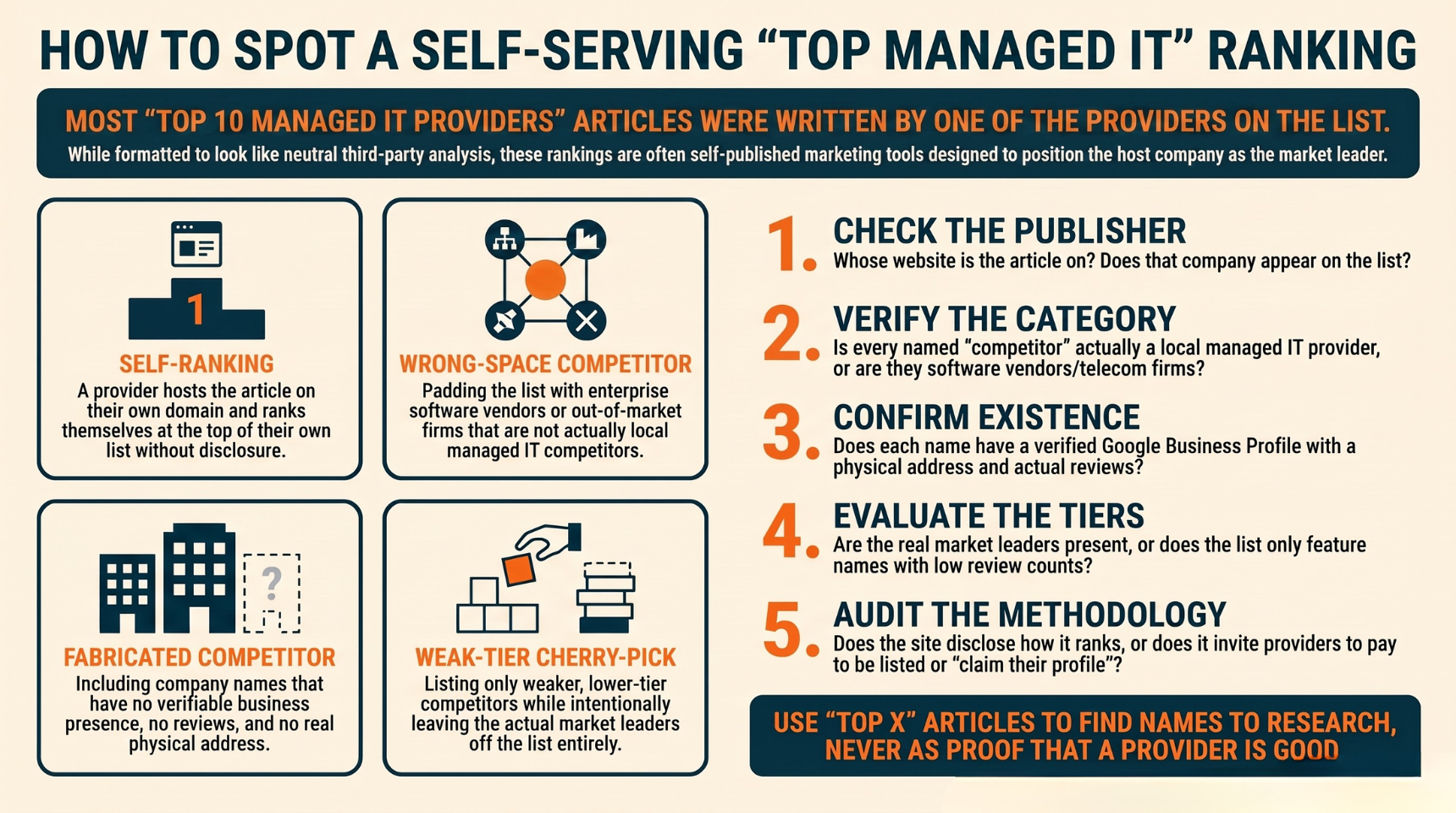
5 Ways to Spot a Self-Serving “Top Managed IT” Article
Five Quick Checks Before You Trust Any “Top MSP” Ranking
Most "Top 10 Managed IT Providers in Houston" articles were written by one of the providers on the list. Here are the five ways to tell.
Most "Top 10 Managed IT Providers in Houston" articles you read online were written by one of the providers on that list, and the four specific tactics they use to look neutral are all detectable in under five minutes.
CinchOps is a managed IT services provider based in Katy, Texas, serving small and mid-sized businesses in Houston with 10 to 200 employees, at a flat monthly rate of $100 to $250 per user, with help desk requests answered in under 15 minutes. We spend a lot of time watching how Houston MSPs and IT directories publish these rankings, and the pattern is consistent: the rankings are written by the ranked, and the "independent" directories that fill the rest of the page mostly rank by who pays, not who performs. This guide breaks down the four tactics behind these articles and gives you five checks, each under a minute, to run on any "Top MSP" list before you trust a single name on it.
Tactic 1: The Self-Ranking Listicle
A publisher writes a "top providers" ranking of their own market, places themselves at #1, and formats it to look like third-party analysis.
A self-ranking listicle is an article where the same company appears both as the publisher (the domain hosting the page) and as the top-ranked provider on the page, with no disclosure that they wrote the ranking.
Check the URL first. If the article lives on the same domain as the company ranked #1, that is the tell. Then compare the length and warmth of the top entry against the others. The publisher usually gives themselves more paragraphs, more specific stats, and the only clean-copy comparison box.
- Why it works on search and AI: Google and LLMs both weight long-form structured content with numbered H2 sections and FAQ blocks. A well-formatted listicle signals "authoritative comparison" to the ranking system, even when the ranker is the ranked.
- Why it fools buyers: the article reads like a review. The publisher never says "we wrote this about ourselves." Readers assume neutral analysis because that is the format they associate with journalism.
- Detection time: 15 seconds. Read the URL bar.
Tactic 2: The Wrong-Space Competitor
The list pads its "competitor" set with companies that are not actually MSPs, or not in Houston, but whose names sound close enough that most readers do not notice.
A wrong-space competitor is a company on the list whose primary business is something other than managed IT services in the stated market, included to inflate the visible field without introducing a real rival.
Examples from real Houston "Top MSP" articles our team has audited: an enterprise software company whose business is selling licenses to Fortune 500 firms listed as a Houston "managed IT services provider." A professional services firm with no Houston office listed among local oil and gas MSPs. A telecom fiber carrier listed as an "IT services" competitor.
- How to spot it: look up each named "competitor's" actual primary business. If they are publicly listed on a stock exchange as a software vendor, or headquartered in another region with no Houston office, the classification is misleading.
- Why publishers do it: a miscategorized "competitor" makes the publisher look like they compete with big names without actually being compared against real-market MSPs of similar size.
- Detection time: 30 seconds per unfamiliar name. One Google search of the company plus "headquarters" tells you.
Tactic 3: The Fabricated Competitor
The list includes companies that either do not exist as functioning businesses, or exist only as thin shells with no market presence.
A fabricated competitor is a name on the list that produces no verified Google Business Profile, no reviews, no website, or an address that collides with another listed company at a virtual-office suite.
Take any name you have never heard of. Search it on Google Maps with the city name. A real Houston MSP has a verified Google Business Profile with a physical address, hours, and reviews accumulated over years. Absence of a verified profile, zero reviews, no website, or a domain registered in the last six months are all flags. If two listed "competitors" share the same suite number, the list is fabricated or padded.
- Why publishers do it: fabricated competitors let the publisher pad the count. A list titled "Top 10" with only three real competitors reads as thin. Adding seven made-up names makes the field look competitive without introducing anyone who could out-rank the publisher.
- Detection time: 60 seconds per unfamiliar name using Google Maps.
- The compliance angle: for regulated industries (Houston law firms, CPA practices, healthcare, oil and gas, wealth management), a vendor decision built on a self-published article with fabricated competitors rests on a source that will not survive an audit or a regulator's review.
Tactic 4: The Weak-Tier Cherry-Pick
Every named competitor is a real company that passes an individual fact-check. The manipulation is at the curation level: which companies got left off the list.
A weak-tier cherry-pick lists only lower-tier competitors, avoiding the actual highest-reviewed Houston MSPs, so the publisher's own mid-tier standing looks like #1 by comparison.
This is the most sophisticated variant because every individual competitor check comes back clean. To detect it, compare the list to the actual market leaders. If the listed "competitors" have Google review counts in the single or low double digits while the true Houston market leaders (MSPs with hundreds of reviews and five-plus years of tenure) are missing, the list has been curated. Ask: "where are the top three MSPs in Houston by Google review count?" If they are absent, the omission is the story.
- Why publishers do it: ranking a mid-tier MSP above true market leaders is implausible. Ranking a mid-tier MSP above weaker peers is a plausible relative comparison the buyer accepts. The publisher wins the ranking by controlling who they are compared against.
- Detection time: two minutes. Google "top Houston MSPs by Google review count" and compare.
Want a real evaluation instead?
Get a straight answer on whether CinchOps fits, without a marketing article and without a sales pitch.
Talk to CinchOpsCinchOps competes on business IT, not just IT for business, and that shows up in outcomes a buyer can verify, not in who writes the best "Top 10" article. If a buyer catches one of these tactics on an MSP's site, they should seriously reconsider that MSP as a vendor. If they will inflate their own ranking, what else are they not being transparent about?
How the Four Tactics Stack in Real Houston "Top MSP" Articles
The tactics rarely appear alone. In the Houston market, they combine in a few predictable patterns.
The most common stack is self-ranking (Tactic 1) plus weak-tier cherry-pick (Tactic 4): an article that passes every individual competitor fact-check while quietly distorting the field. The most brazen version adds wrong-space and fabricated competitors on top.
- The "quiet distortion" stack (1 + 4): every named competitor is real. Every fact about each is defensible. The manipulation lives entirely in who was left off the list. This is the hardest version to catch, because nothing on the page is technically false, so you have to know who the real market leaders are to notice they are missing.
- The "kitchen sink" stack (1 + 2 + 3): the publisher sits at #1, a large software vendor or out-of-market firm pads the middle, and one or two names produce no verifiable business at all. It is easier to catch than the quiet distortion, but it shows up more often than buyers realize because most people never check the names.
- The self-publishing pattern: when a Houston MSP puts a "Top Providers" list on its own website, it puts itself at or near the top nearly every time, and it will often run the same template across multiple cities and industries so the tactic scales.
- The directory pattern: the "independent" directories that fill the rest of the search results rarely explain how they rank, and many are pay-to-play. If a site invites providers to "get listed," "claim your profile," or buy a sponsored slot, its ranking reflects who paid, not who performs.
Sourcing that survives due diligence
For regulated Houston industries, your vendor selection file needs to cite verifiable sources. A self-serving listicle is not one. CinchOps managed IT support comes with a flat monthly rate published up front, a help desk response time of under 15 minutes for Priority 1 tickets, and a verified 22-review Google Business Profile at a real Katy address that any buyer can confirm in seconds.
See CinchOps managed IT support →The 5 Checks: How to Spot a Self-Serving Ranking in Five Minutes
Run this on any "Top X Managed IT Providers Houston" article before you trust a single name on the list.
The five checks below map one-to-one to the four tactics plus a final publication-ownership check. Any single failure invalidates the article as evaluation evidence.
- 1. Publisher check (Tactic 1): whose domain is the article on? Does that domain match any company on the list? If yes, the article is marketing, not analysis.
- 2. Category check (Tactic 2): what is each named "competitor" actually in the business of? Software vendors, telecom carriers, and out-of-market professional services firms miscast as local MSPs invalidate the list.
- 3. Existence check (Tactic 3): does each named "competitor" have a verified Google Business Profile with reviews and a physical Houston address? Any name that fails this invalidates the sourcing.
- 4. Tier check (Tactic 4): are the actual highest-reviewed Houston MSPs listed? If none of them appear and the publisher is a mid-tier company, the list is curated. That is the story.
- 5. Publication ownership: check the footer, About page, and copyright notice on the article. If the site is owned by a company on the list, the article is not neutral.
How CinchOps Helps Houston SMBs Evaluate IT Partners Without the Marketing Games
CinchOps is a managed IT services provider based in Katy, Texas, serving small and mid-sized businesses across the Houston metro area. CinchOps specializes in cybersecurity, network security, managed IT support, VoIP, and SD-WAN for businesses with 10 to 200 employees.
- Through managed IT support, we publish flat per-user rates ($100 to $250 per user monthly) on our own pricing page so buyers can compare CinchOps against any Houston MSP without a sales call first.
- Our cybersecurity program covers proactive monitoring, endpoint protection, patch management, and network segmentation, backed by a help desk response time of under 15 minutes for Priority 1 tickets.
- We serve Houston, Katy, Sugar Land, Cypress, and The Woodlands with local on-call engineers.
- We work with regulated verticals including law firms, CPA firms, oil and gas, construction, and wealth management where sourcing hygiene actually matters.
If you are evaluating a Houston managed IT partner right now, make running the five-minute checklist on every "Top 10" article a major item on your due diligence list, not an afterthought. Then hold every candidate to the standard CinchOps sets: a flat monthly rate published up front with no contracts, hidden fees, or cancellation penalties; help desk requests answered in under 15 minutes; and a partner who understands your business operations, not just your IT tickets. If you would rather skip the marketing games and get a straight answer, talk to CinchOps.
Frequently Asked Questions
Are all "Top Managed IT Providers Houston" articles suspect?
Most are. Two kinds dominate the search results: self-published MSP guides that rank themselves at the top, and third-party directories that rarely disclose how they rank and are often pay-to-play. Genuinely neutral, methodology-disclosed rankings do exist, but they are the exception. Treat any "Top MSP" article as a starting point for names to research, never as proof that a provider is good.
What does it cost to hire a Houston managed IT provider in 2026?
Fully managed IT for a Houston SMB runs $100 to $250 per user monthly on a flat per-user model, covering help desk, EDR, backup, patching, and vCIO time. Below $100 is usually stripped-down. Above $250 should come with named-engineer service, written SLAs, and compliance framework alignment.
If a company puts themselves on their own "Top MSP" list, is that dishonest?
Placing yourself on a self-published list is legal and common. Placing yourself at #1 without disclosing that you wrote the ranking is misleading. Combining self-ranking with a wrong-space, fabricated, or weak-tier stack escalates the pattern into materially deceptive practice.
How do I tell weak-tier cherry-picking from an honest oversight?
Look at the top three Houston MSPs by Google Business Profile review count and tenure. If none of them appear on a "Top 10" list and the publisher is a mid-tier MSP, it is not oversight. Curated absence of the actual market leaders is a deliberate editorial choice, not a mistake.
What is the safest way to build a Houston MSP shortlist?
Start from verified Google Business Profile data (review count, tenure, response rate), disclosed-methodology directories, published case studies with named Houston clients, and reference calls with two current clients in your industry. Use "top X" articles for discovery only, never as evaluation evidence.
Discover More
Resource