


24/7 Help Desk in Houston: Does Your Business Need One?
Match Your IT Coverage To How Your Business Actually Runs
A straight answer for Houston and Katy businesses with 25 to 100 employees, minus the sales pitch.
Friday, 6:40 PM. The last person locks up your Katy office, and somewhere on the network a strain of ransomware quietly starts encrypting the file server. Nobody notices until Monday at 8 AM. That weekend gap is the real question behind whether your business needs a 24/7 help desk in Houston.
Search any list of Houston IT providers with 24/7 helpdesk coverage and you will find two very different products sold under one banner: round-the-clock monitoring that watches your systems, and a fully staffed desk that answers phones at 3 AM. Confusing them is how a 40-person firm either overpays by thousands a month or leaves a hole open all weekend.
CinchOps delivers managed IT support with 24/7 monitoring specifically for 25 to 100 employee businesses in Houston and Katy, with under-15-minute help desk response and a flat monthly rate per user. This guide lays out which side of the line your business sits on, what each option should cost, and where the sales decks stretch the truth.
What Does a 24/7 Help Desk Actually Cover?
Two different services hide behind the same phrase, and the one you pick changes the invoice by thousands a month.
A 24/7 help desk is a support operation that answers IT tickets and responds to system alerts at any hour, every day of the year, including weekends and holidays. That definition sounds simple. It hides the split that decides your budget.
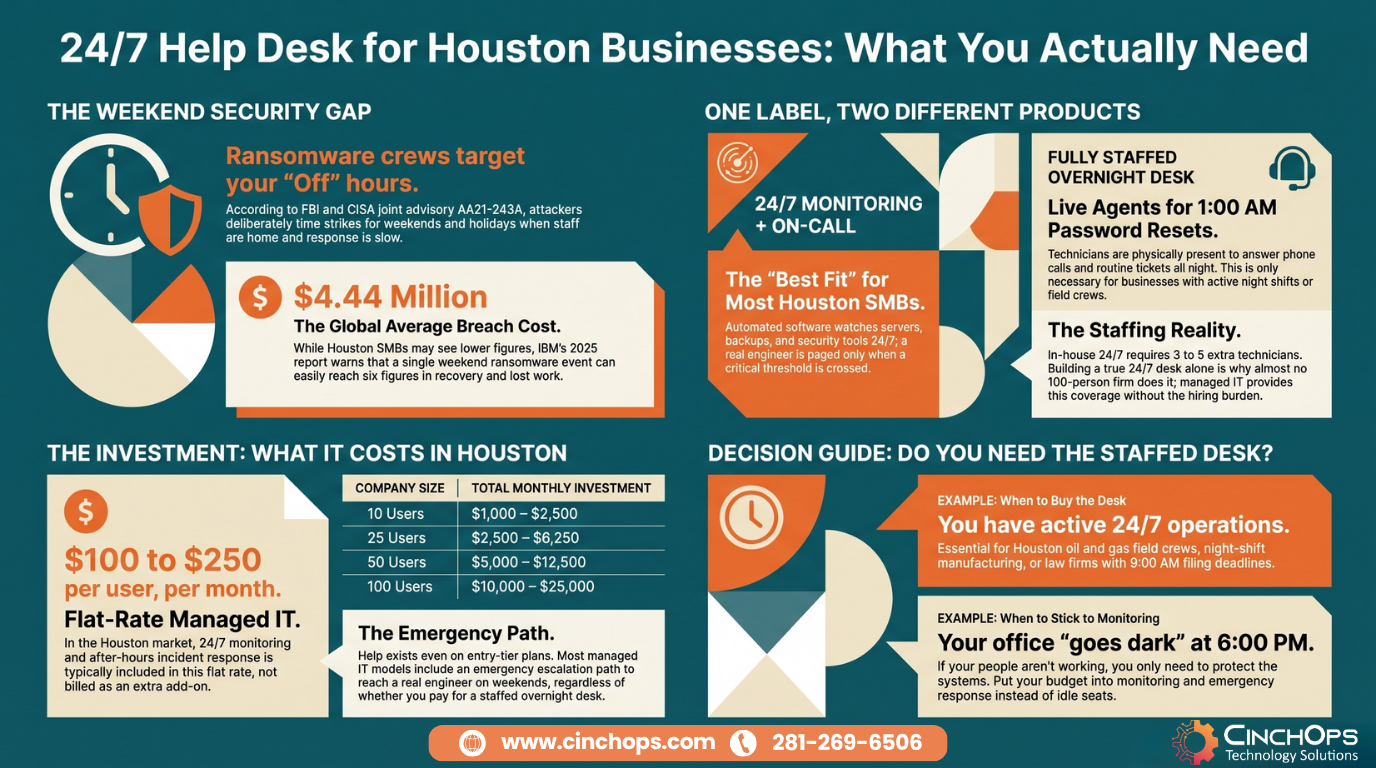
24/7 monitoring and incident response means software watches your servers, network, backups, and security tools around the clock. When something crosses a threshold, an on-call engineer gets paged and acts, whether that is a failing backup at 2 AM or a login from an unfamiliar country on a Sunday. No one sits by a phone all night; the system raises its hand and a human responds.
A fully staffed overnight help desk means live technicians answer calls and tickets through the night, so an employee working at 1 AM can reach a person for a locked account or a printer that will not cooperate. This is genuine round-the-clock staffing, and you pay for the seats whether they field 40 tickets or 4.
- Monitoring catches the events that cost the most: ransomware, outages, backup failures, and drive-space problems that surface after hours.
- A staffed desk serves people, not systems: it matters when you actually have staff working nights and weekends.
- Almost every SMB needs the first. A minority genuinely needs the second. Vendors bundle them so the line item looks like one decision instead of two.

When Does a Houston Business Genuinely Need 24/7 IT Support?
A handful of profiles where after-hours coverage stops being optional. If 2 or more describe you, budget for it.
The FBI and CISA warned in an August 2021 joint advisory that ransomware crews deliberately time attacks for weekends and holidays, when staff are home and response is slow. Attackers know your schedule. That single fact reshapes which Houston businesses need after-hours coverage.
- You run operations after hours. Field crews, night shifts, and remote sites mean systems are live when the office is dark. Houston oil and gas operators with round-the-clock field data are the clearest case.
- Downtime stops production, not just email. A manufacturer whose line halts when a server drops cannot wait until Monday for a fix.
- Deadlines ignore business hours. A law firm with a filing due at 9 AM needs its document system healthy the night before, not repaired the morning of.
- Cyber insurance or compliance requires it. More Houston policies now expect continuous monitoring and documented incident response as a condition of coverage. Read your renewal before it reads you.
- You cannot absorb a Monday-morning surprise. If a weekend outage means missed shipments, blown SLAs, or a public-facing failure, the math already favors coverage.
When Is Business-Hours IT Support Enough?
Paying for a night shift you never use is a common and avoidable waste. Some firms are fine with 8 to 5 plus monitoring.
Plenty of 25 to 100 person businesses do not need a staffed overnight help desk, and they should not buy one. If your office genuinely goes dark at 6 PM and stays dark until morning, the risk lives in your systems, not in your people, and monitoring covers the systems.
- Single-site, standard-hours operations. One office, no night shift, minimal weekend work. Your people are not filing tickets at 3 AM because nobody is working then.
- Low after-hours digital dependence. If a system being down overnight is an inconvenience rather than lost revenue, live overnight staffing is hard to justify.
- Tight budget, real risk. When money is limited, put it toward 24/7 monitoring plus an on-call engineer. That covers the ransomware-on-a-Saturday scenario at a fraction of a staffed desk.
In 35+ years running IT for businesses, the pattern I see most is a firm paying for a premium 24/7 tier because a salesperson framed it as the responsible choice, then using it twice a year. Coverage should map to how you actually operate. Nothing else.
24/7 In-House vs Outsourced vs Business-Hours: Which Model Fits?
The 4 options a Houston SMB usually chooses between, side by side.
For most 25 to 100 employee Houston businesses, the right model is outsourced 24/7 monitoring with an on-call engineer. It closes the after-hours security and outage gap without funding overnight seats that sit idle, and it costs a fraction of building the same coverage in-house.
| Option | Coverage | Best for | Weekend / holiday incidents | Relative cost | Staffing burden on you |
|---|---|---|---|---|---|
| Business hours only | 8 to 5, Mon to Fri | Single-site firms that fully close after hours | Not covered | $ | Low |
| 24/7 monitoring + on-call (best fit) | Automated 24/7, human escalation | Most 25 to 100 employee Houston SMBs | Covered | $$ | Low |
| Fully staffed 24/7 help desk (MSP) | Live agents, all hours | Firms with real after-hours ticket volume | Covered | $$$ | Low |
| 24/7 in-house team | Live agents, all hours | Large operations with budget for 3 to 5 extra hires | Covered | $$$$ | Very high |
Building a true 24/7 desk in-house means 3 to 5 additional technicians on rotation before anyone takes a vacation day. That is why almost no 100-person firm does it alone, and why the second row is where most Houston SMBs land.
Paying for a night shift you never use?
A 15-minute conversation about how your team actually works will tell you which tier fits.
Talk to CinchOpsWhat Should 24/7 IT Support Cost a 25 to 100 Employee Houston Business?
The real numbers, and why 24/7 coverage usually is not the line item you think it is.
Managed IT support in Houston runs $100 to $250 per user per month, and 24/7 monitoring with after-hours incident response is already baked into that flat rate, not billed on top. For a 25 to 100 employee business, that puts the all-in monthly cost between $2,500 and $25,000 depending on size and security requirements.
Every tier includes the same core service: unlimited help desk with under-15-minute response, 24/7 monitoring, endpoint security, backup management, proactive patching, and vendor management. What moves you up or down the range is your size, compliance load, and environment complexity, not whether the round-the-clock coverage is switched on. Here is the full breakdown from our Houston managed IT pricing guide:
| Company size | Per user / month | Total monthly investment |
|---|---|---|
| 10 users | $100 to $250 | $1,000 to $2,500 |
| 25 users | $100 to $250 | $2,500 to $6,250 |
| 50 users | $100 to $250 | $5,000 to $12,500 |
| 100 users | $100 to $250 | $10,000 to $25,000 |
Where you land in that range depends on three drivers. A simple cloud-first office with light compliance sits near the bottom; a firm carrying HIPAA obligations, a cyber-insurance mandate, or a multi-location setup sits near the top. The genuine add-on above all of it is a fully staffed overnight desk with live agents answering tickets at 3 AM, and you only pay for that if your people actually work those hours.
Even on the entry tier, you are never stranded after hours. The lower-priced plans still include an emergency escalation path, so a Saturday-night outage or a suspected breach reaches a real engineer whether or not you pay for a staffed overnight desk. The tier decides how much runs on autopilot, not whether help exists when something breaks.
Anchor the decision on the downside, not the monthly line item. IBM's 2025 Cost of a Data Breach Report put the global average breach at $4.44 million. A Houston SMB will not see that figure, but a single weekend ransomware event that locks your systems and forces a rebuild can still run into 6 figures once you count downtime, recovery, and lost work. One prevented incident pays for years of monitoring.
"My job isn't to sell you the biggest plan, it's to figure out how your business actually runs and match the coverage to it. And even on the entry tier, there's always an emergency path when something breaks after hours. Nobody gets left stranded."
Not sure which tier you actually need?
We will look at how your team works, where the real after-hours risk sits, and whether managed IT support with monitoring plus on-call covers it, or you genuinely need staffed overnight support. No pressure toward the priciest plan.
See CinchOps managed IT support →How CinchOps Handles After-Hours Support
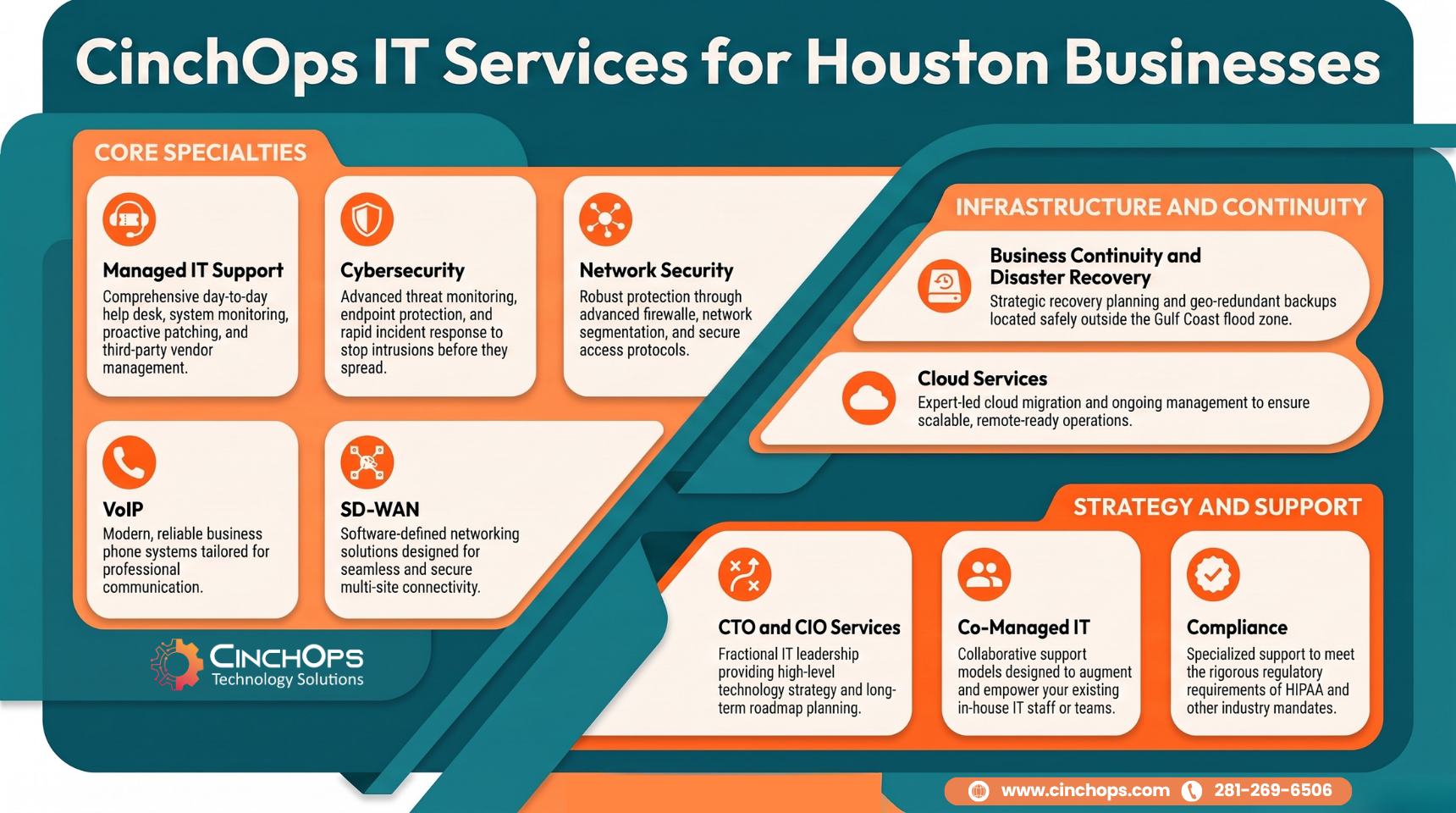
CinchOps is a managed IT services provider based in Katy, Texas, serving small and mid-sized businesses across the Houston metro area. CinchOps specializes in cybersecurity, network security, managed IT support, VoIP, and SD-WAN for businesses with 10 to 200 employees.
Our default is 24/7 monitoring and after-hours incident response for every managed client, because that is the coverage nearly everyone needs. A staffed overnight help desk is available when your operation truly runs at night, and we will tell you honestly if it does not. There are no long-term contracts, hidden fees, or cancellation penalties, so the coverage has to keep earning its spot on your invoice every month.
- Through managed IT support, every client gets round-the-clock monitoring, patching, and an on-call escalation path at a flat rate per user.
- Cybersecurity services watch for the Friday-night intrusion the FBI and CISA warned about, and respond while it is still one machine instead of forty.
- Business continuity and disaster recovery keeps geo-redundant backups outside the Gulf Coast flood zone, so the worst weekend still ends with a restore.
- We support businesses across Houston, Katy, and Sugar Land.
Your after-hours risk does not care which support tier the brochure recommended. If you run nights, buy the desk; if you do not, buy the monitoring and keep the difference. Either way, make the decision on how your business actually operates. If you want a second opinion on your current coverage, talk to CinchOps.
Frequently Asked Questions
What is a 24/7 IT help desk?
A 24/7 IT help desk is a support operation that answers technology issues and responds to system alerts at any hour, every day of the year, including weekends and holidays. In practice it combines two parts: automated monitoring that watches your systems, and a human who responds when something breaks.
Does a 25 to 100 employee Houston business really need 24/7 IT support?
Most need 24/7 monitoring with after-hours incident response, because ransomware and outages happen overnight. Far fewer need live agents answering routine tickets at 3 AM. If your team does not work nights or weekends, monitoring plus an on-call engineer covers the real risk at a fraction of the price.
What does 24/7 IT support cost in Houston?
CinchOps prices managed IT at a flat monthly rate per user, so the bill tracks headcount instead of surprise hourly invoices. 24/7 monitoring and after-hours incident response are part of the standard service, with no long-term contracts, hidden fees, or cancellation penalties. A staffed overnight desk is a separate add-on.
What is the difference between 24/7 monitoring and a staffed overnight help desk?
24/7 monitoring uses software to watch servers, backups, and security tools around the clock, paging an on-call engineer when something crosses a threshold. A staffed overnight help desk pays live technicians to answer calls all night. Monitoring protects systems; staffing serves people who actually work overnight.
Do ransomware attacks really target weekends and holidays?
Yes. The FBI and CISA issued a joint advisory in August 2021 warning that ransomware operators deliberately launch attacks on weekends and holidays, when offices are empty and response is slow. A Friday-evening infection can run unnoticed until Monday, which is exactly the gap after-hours monitoring closes.
Discover More
Sources


