


State of AI 2026: What Deloitte’s Survey Means for Houston Businesses
Redesigning One Role Around AI Before Buying More Seats – Segmenting Physical AI From The Office Network
Deloitte's January 2026 findings, turned into seven checks for Houston companies with 10 to 200 employees.
The State of AI 2026 report from Deloitte surveyed 3,235 business and IT leaders in 24 countries, and its sharpest finding is that companies are handing out AI tools much faster than they are changing how work gets done. For a Houston business owner whose team already uses ChatGPT or Copilot, that gap is the useful part.
Deloitte's AI Institute fielded the survey between August and September 2025 and published it in January 2026 as State of AI in the Enterprise: The untapped edge. Every respondent was a director or above at an organization with at least one AI system in daily use, and 1,200 of them were in the United States. These are large companies. A 40-person engineering firm in Katy or a CPA practice in Sugar Land is not in the sample, and the percentages should not be read as a benchmark for one.
The value for a smaller company sits somewhere else. Large organizations are running the experiment first and paying for the mistakes in public: licenses nobody opens, agents that act without a written limit, AI tools no one can list. CinchOps provides managed IT and cybersecurity specifically for 10-to-200-person businesses across the Houston metro at a flat $100 to $250 per user per month, and the seven checks below are how we would translate Deloitte's numbers for a company that size.
Check 1: Count Who Actually Uses the AI You Already Pay For
Access and adoption are two different numbers, and the State of AI 2026 data shows the second one lagging.
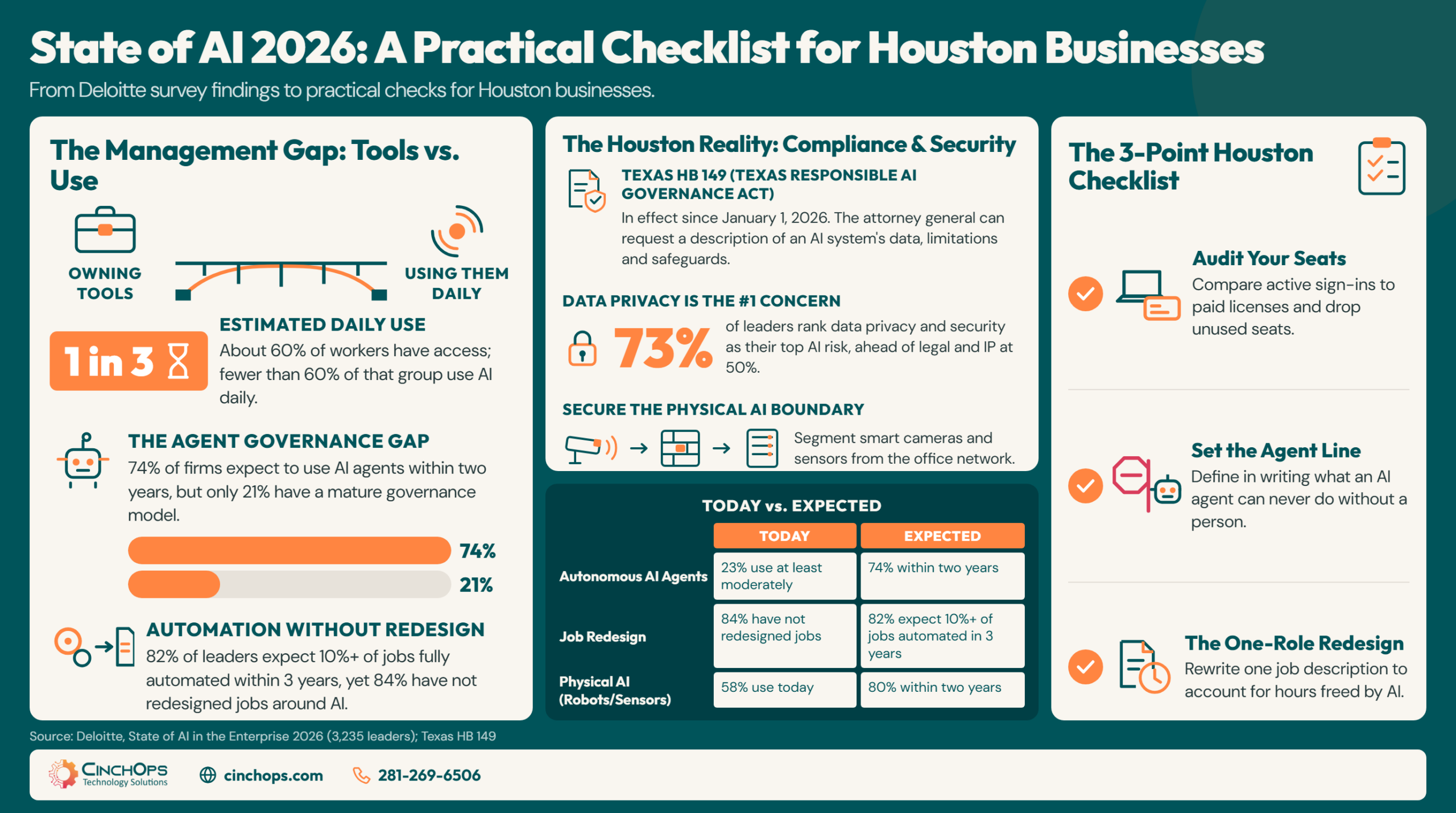
AI adoption means people using a tool in their daily work, not holding a login to it. Deloitte's State of AI 2026 survey found worker access to sanctioned AI tools up 50% in one year, from fewer than 40% of workers to around 60%, while fewer than 60% of workers with access use it daily.
Put those two figures together and the arithmetic is blunt: if about 60% of workers have access and under 60% of that group uses it every day, roughly one worker in three at these companies is a daily AI user. Deloitte notes the daily-use share is largely unchanged from the year before. More seats did not move it.
A Houston company with 40 people does not run pilots in that sense. It buys 40 Copilot or ChatGPT seats, or leaves staff to pay for their own. The check that matters is plainer than anything in the report:
- Pull the sign-in or activity report for every AI tool the company pays for and compare active users to paid seats.
- Ask the three heaviest users what they use it for, then write those tasks down; that list is the start of Check 6.
- Find the people using personal AI accounts for company work, because they are the users your admin reports cannot see.
- Drop or reassign seats nobody opened in 60 days before the next renewal.
A pattern we see in vCIO reviews with Houston businesses: the AI license count gets approved in one meeting and never compared against actual use again. The comparison takes 20 minutes. Deloitte's own advice to its enterprise readers is to close the gap between access and activation, and that starts with knowing the size of the gap.
Are AI Agents Already Running Inside Software Your Team Uses?
Agentic AI is the fastest-moving number in the State of AI 2026 report, and the governance number behind it barely moved.
An AI agent is software that can set goals, work through multi-step tasks and act through tools and APIs instead of only answering questions. Deloitte found 23% of companies use agentic AI at least moderately today, 74% expect to within two years, and 21% have a mature governance model for autonomous agents.
The difference between an assistant and an agent is the difference between a draft and a sent email. Deloitte's report puts it directly: conventional AI gives a recommendation a person acts on, while agents take actions themselves, such as making purchases, sending communications or modifying systems. A wrong answer from an assistant costs a rewrite. A wrong action from an agent costs whatever it bought, sent or changed.
For a 40-person company in Cypress or The Woodlands, the question is less "should we build an agent" and more "did one already get switched on." Agent features increasingly ship inside platforms a business already licenses, so the first job is an inventory of what can act, not a strategy deck. Walk through each platform's admin settings and write down every AI feature that can send, buy, delete, schedule or change a record.
Deloitte's description of what good governance looks like translates cleanly to a small company:
- An approval line. Decide in writing which actions an agent may take alone and which need a named person to approve.
- An audit trail. Keep the log that shows what the agent did, when, and on whose instruction.
- Monitoring. Someone reviews that log on a schedule and has the authority to turn the feature off.
- A slow start. Begin with low-risk tasks, which is what Deloitte says its most successful companies are doing.
A former telecom executive interviewed for the report put the staffing reality plainly: at first, "it is going to be more work for those people," who will be watching the agents and checking their output. Budget for that time. An agent nobody watches is an unsupervised employee with a company credit card.
Checks 4 and 5: Map Where Company Data Goes and Keep the Record Texas Can Ask For
Leaders in the State of AI 2026 survey worry about data first, and Texas law now describes the records an inquiry can request.
Data privacy and security is the AI risk companies worry about most. In Deloitte's State of AI 2026 survey, 73% named it, ahead of legal, intellectual property and regulatory compliance at 50%, governance and oversight at 46%, and model quality at 46%.
One detail from Deloitte's interviews should worry a Houston owner more than any percentage. An AI leader at a large organization discovered there was no clear inventory of the AI tools and models running in production, because teams had built and deployed them without central tracking. If a company with a dedicated AI function can lose count, a 25-person office where each person signed up for their own tools almost certainly has.
Here is the Texas point that turns Deloitte's inventory story into a local obligation worth planning for. The Texas Responsible Artificial Intelligence Governance Act (HB 149) took effect January 1, 2026. Its prohibitions are narrow and based on intent, only the attorney general can enforce it, and there is no private right of action. When the attorney general receives a complaint, though, the statute lets that office issue a civil investigative demand for a description of an AI system's purpose, its training and input data, its known limitations, and the post-deployment monitoring and user safeguards the business uses. A company that cannot list its AI tools cannot answer that request.
The statute also rewards the paperwork. A defendant may not be found liable if it discovers a violation through red-team testing or through substantial compliance with the NIST AI Risk Management Framework: Generative AI Profile or another recognized AI risk framework. None of this is legal advice, and a business with a real exposure question should talk to its attorney. The practical takeaway is simpler: the inventory and the data map are the same records whether the reason is Deloitte's risk list or Austin's statute.
- List every AI tool in use, who owns it, what it can reach and whether the company or an employee pays for it.
- Mark which tools may see client files, HR records or financial data, and block the rest from those sources.
- Keep the list in one place with a review date, and update it when a platform turns on a new AI feature.
The CinchOps AI governance guide for small businesses has a one-page version of this program, and the AI-driven threats report covers the attack side: AI-written phishing and deepfake payment requests.
Not Sure Which AI Tools Your Team Is Using?
CinchOps can pull the sign-in data, list the AI tools touching company data and show you the gaps in one review.
Talk to CinchOpsWhich Jobs Should AI Change First at a 40-Person Company?
The State of AI 2026 survey shows companies expecting automation while leaving job design untouched.
Job redesign means changing what a role is responsible for once AI handles part of it. Deloitte found 82% of companies expect at least 10% of their jobs to be fully automated within three years, yet 84% have not redesigned jobs around AI, and 53% focus their talent response on general AI education.
Education is the easy move and the report suggests it is not enough. Leaders named insufficient worker skills as the biggest barrier to fitting AI into existing workflows, but fewer than half of companies are making significant changes to their talent strategies. Deloitte's example is a loan officer who now works beside an AI recommendation and has to decide when to override it and how to explain the decision to a customer. The job changed. The job description did not.
At 40 people, redesign does not mean an org chart project. It means picking the one role where AI already does the most work and rewriting it on purpose:
- Write down which tasks in that role the AI now drafts, and which decisions stay with the person.
- Name when the person must override or double-check the AI, the way Deloitte's loan officer has to.
- Move the freed hours to work a client would notice, and say so in the job description.
- Keep one path for a junior hire to learn the fundamentals the AI now handles.
The Deloitte numbers say big companies bought AI faster than they learned to manage it. A 40-person Houston firm does not have to repeat that. Count who uses it, write down what it can touch, and decide what it is never allowed to do alone. That is a week of work, and it is the week most companies skipped.
Physical AI Is Reaching Houston Plant Floors Next to the Corporate Network
Cameras, sensors and robots running AI are spreading, and in Houston they often share a building with the office network.
Physical AI is AI that perceives the real world and drives machines or control systems, such as robots, smart cameras and autonomous forklifts. Deloitte found 58% of companies use it at least in a limited way today and 80% expect to within two years; in the Americas the figures are 56% and 77%.
The types leaders expect to matter most are intelligent security systems and smart monitoring at 21%, collaborative robots at 20% and digital twins at 19%. Deloitte's report says these systems must be secure, interoperable and resilient against cyberthreats, because unlike software AI they interact with people and equipment, and a compromised one can create a safety problem. Cost was the barrier named most often.
This is where the report lands hardest on the Houston area. The region's manufacturers, fabrication shops, chemical plants and oil and gas service companies already run operational technology: PLCs, sensors and SCADA systems. Energy, resources and industrials was one of the six industries in Deloitte's sample. When a smart camera or a monitoring sensor with AI built in gets added to a plant floor, it is one more networked device, and on a flat network it can talk to the same switches as the accounting server.
- Before a camera, robot or sensor is installed, ask the vendor what it connects to, which cloud service it reports to and how the vendor reaches it remotely.
- Put it on the OT side of the boundary, not on the office Wi-Fi because that was the easiest port.
- Count the full cost, which Deloitte notes includes facility changes, integration, maintenance and downtime, not only the device.
Put Your AI Inventory and Network Boundary on Paper
CinchOps reviews which AI tools can reach company data, which features can act on their own, and whether plant-floor devices are segmented from the office. See how CinchOps cybersecurity handles it for Houston businesses.
See the cybersecurity service >How CinchOps Helps Houston Businesses Act on the State of AI 2026
CinchOps is a managed IT services provider based in Katy, Texas, serving small and mid-sized businesses across the Houston metro area. CinchOps specializes in cybersecurity, network security, managed IT support, VoIP, and SD-WAN for businesses with 10 to 200 employees.
The seven checks in this post map onto work CinchOps already does for Houston clients. None of it requires an AI project with its own budget line.
- Through managed IT support, CinchOps compares AI license counts to real sign-in activity and tracks which platforms have switched on AI features, with help desk requests answered in under 15 minutes.
- With cybersecurity services, CinchOps maps which AI tools can reach client, HR and financial data and sets the approval line for anything that can send, pay or delete.
- The vCIO and CTO/CIO service keeps the written AI inventory, the review date and the one-role redesign plan on the agenda.
- For manufacturing, energy and utilities and engineering clients, CinchOps segments plant-floor and field devices from the corporate network.
- CinchOps serves Houston, Katy, Sugar Land, Cypress and The Woodlands at a flat monthly rate per user, with Zero-Zero-Zero terms: no long-term contracts, no hidden fees, no cancellation penalties.
The State of AI 2026 report reads like a warning written by the companies that went first: they bought the tools, skipped the records and are now building governance after the fact. A Houston business with 10 to 200 people gets to do it in the right order, and it costs a list, a limit and a network boundary rather than another round of licenses. If you want someone to run the seven checks with you, talk to CinchOps.
Frequently Asked Questions
What is the State of AI 2026 report?
State of AI in the Enterprise: The untapped edge is Deloitte AI Institute's annual survey, published January 2026. Deloitte surveyed 3,235 director-level to C-suite leaders in 24 countries between August and September 2025, plus 15 executive interviews. Every respondent's organization had at least one AI system in daily use.
Does the Deloitte State of AI 2026 data apply to a small business in Houston?
The direction applies, the percentages do not. Deloitte surveyed leaders at large organizations, so its figures are not a benchmark for a 40-person Houston company. The patterns transfer well: AI seats outpacing daily use, agents arriving before written limits, and no central list of which AI tools touch company data.
What is agentic AI and why does it need governance?
Agentic AI is software that can plan multi-step tasks and act through tools, such as sending messages, buying or changing records. Deloitte found 23% of companies use it at least moderately and 74% expect to within two years, while 21% have a mature governance model. Agents need a written approval line and an audit log.
Does Texas have an AI law that applies to my business?
Texas HB 149, the Texas Responsible Artificial Intelligence Governance Act, took effect January 1, 2026. Its prohibitions are narrow and intent-based, only the attorney general enforces it, and there is a 60-day cure period. An investigation can request a description of an AI system's data, limitations and safeguards. Ask your attorney about specifics.
What does AI governance support cost for a Houston business?
CinchOps prices managed IT and cybersecurity at a flat $100 to $250 per user per month, with no long-term contracts, no hidden fees and no cancellation penalties. AI licenses are billed separately by the vendor; Microsoft 365 Copilot Business lists at $21 per user per month for businesses up to 300 users.
Discover More
Resource
Sources
- Deloitte AI Institute, State of AI in the Enterprise: The untapped edge (January 2026) - survey of 3,235 leaders, August to September 2025
- Texas Legislature, HB 149 (89th Regular Session), Texas Responsible Artificial Intelligence Governance Act, enrolled text
- Microsoft Partner Center announcements, December 2025: Microsoft 365 Copilot Business SKUs


