


What Is Penetration Testing? A Houston Business Guide for 2026
Penetration Testing Vs. Vulnerability Scanning Explained – Authorized Security Testing For Houston Small Businesses
What a pen test is, how it differs from a scan, and when Houston businesses are required to run one.
Penetration testing is security testing in which authorized testers copy the methods of real attackers to find out whether your defenses can be bypassed. For a Houston business, the question usually shows up in writing first: a cyber insurance renewal, a client's vendor questionnaire, or an auditor asking the date of your last pen test.
We see this every renewal season with Houston businesses. The owner forwards the questionnaire, points at the line that asks for a penetration test, and asks whether the monthly scan counts. Usually it doesn't. A scan and a pen test answer different questions, and the people reading your answer know the difference.
CinchOps coordinates authorized penetration testing for Houston small and mid-sized businesses with 10 to 200 employees, scoped to the systems attackers actually go after first: Microsoft 365, remote access and the internet-facing edge, with a retest of every finding after it is fixed.
Is a Penetration Test the Same as a Vulnerability Scan?
Three kinds of testing get lumped together under "security testing." They cost different amounts and prove different things.
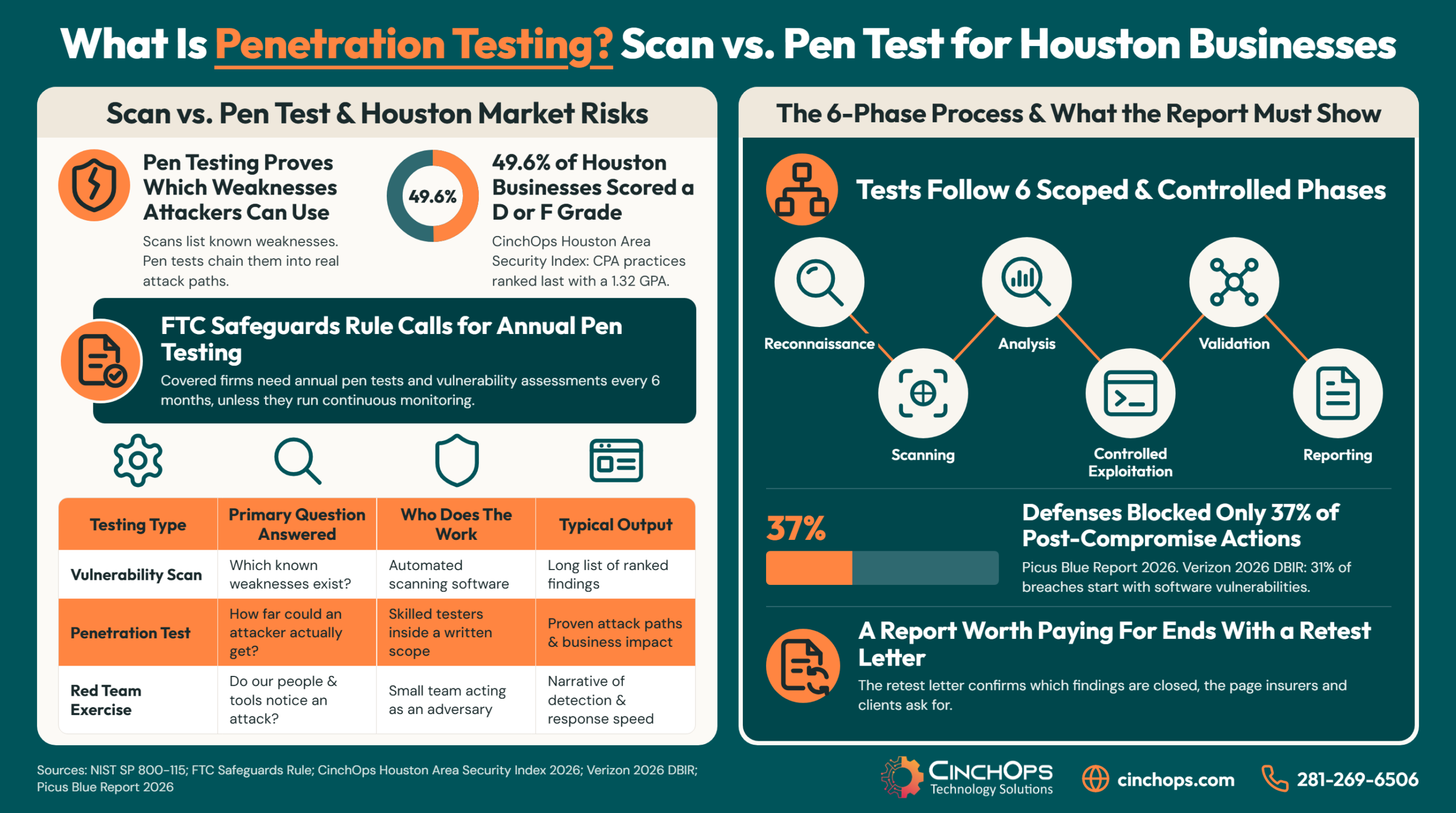
A penetration test is not the same as a vulnerability scan. A vulnerability scan is an automated check for known weaknesses. A penetration test is a human-led, scoped attempt to exploit those weaknesses and show the business impact. A red team exercise tests whether your staff and tools detect a realistic attack.
The table below compares vulnerability scans, penetration tests and red team exercises on the five things a Houston business owner actually has to decide: what each one answers, who does the work, how often it runs, what you get at the end, and what usually triggers it.
| Decision point | Vulnerability scan | Penetration test | Red team exercise |
|---|---|---|---|
| Question it answers | Which known weaknesses exist on our systems? | Can an attacker actually use those weaknesses, and how far could they get? | Would our people and tools notice a real attack in progress? |
| Who does the work | Automated scanning software, reviewed by IT | Skilled testers working inside a written scope | A small team acting like a specific adversary, often unannounced to staff |
| Typical frequency | Monthly, and after big changes | Annually, and after major changes | Occasionally, once a security program is mature |
| What you get | A long list of findings ranked by severity score | Proven attack paths, evidence, business impact and fixes | A narrative of what was detected, what was missed and how fast the response was |
| Usual trigger | Routine hygiene, compliance scan requirements | Insurance renewals, client questionnaires, the FTC Safeguards Rule | Board or leadership asking whether detection works |
The practical difference shows up in the findings. A scan might report an outdated VPN appliance and a user with a weak password as two separate medium-severity items. A pen tester uses the password to log in to the VPN, reaches a file server, and reports one critical path: an outsider could reach client files. Same two weaknesses, very different urgency.
That is also why a pen test is the stronger answer on an insurance or vendor questionnaire. The reader wants proof that someone tried to break in and that you fixed what they found.
What Happens During a Penetration Test?
Every legitimate pen test follows the same arc: agree on the rules, attack carefully, prove the result, then fix and retest.
A penetration test runs in six phases: reconnaissance, scanning, vulnerability analysis, controlled exploitation, validation and reporting. Before any of it starts, the business signs a written scope and rules of engagement that list which systems are in bounds, when testing happens and what the testers must never touch.
Reconnaissance and scanning look a lot like what an attacker does from the outside: reading public DNS records, finding exposed login pages, and fingerprinting the VPN and email platform. Analysis sorts the findings by what they could lead to, not just by severity score. Controlled exploitation is the part that separates a pen test from a scan: the tester actually tries the weakest links, stops at proof, and avoids anything that could disrupt production.
Validation answers the business question. Could the tester read the accounting share? Reset a mailbox password? Move from a front-desk PC to the server? Each "yes" comes with screenshots, logs or output as evidence. Reporting turns that into a ranked list of fixes, and the retest confirms each fix actually closed the path.
One Houston-specific caution: businesses along the Gulf Coast energy corridor often run operational technology such as SCADA controllers and plant-floor systems on or near the office network. Active exploitation against OT can trip real equipment. Scope OT out of a standard pen test, or test it only with passive methods agreed in writing with the people who run the plant.
Most owners who tell me they had a pen test actually had a scan with a nicer cover page. Ask the tester one question: which findings did you chain together to reach something that matters? If the answer is a spreadsheet of CVEs, you paid for a scan.
Which Houston Businesses Are Required to Run a Penetration Test?
For some Houston firms a pen test is a federal requirement. For most, the requirement arrives through an insurer or a client.
Houston tax preparers, CPA practices and other firms covered by the FTC Safeguards Rule must run annual penetration testing plus vulnerability assessments at least every 6 months, unless they run continuous monitoring. Most other Houston small businesses face the requirement through cyber insurance renewals and client security questionnaires.
The FTC Safeguards Rule, 16 CFR 314.4(d)(2), says that without continuous monitoring a covered business needs annual penetration testing based on its risk assessment, plus vulnerability assessments every 6 months and after material changes to operations. The FTC's own guide names tax preparation firms among the 13 example financial institutions the rule covers. Houston has a dense concentration of CPA and tax practices, so this lands on a lot of 10 to 50 person firms. The rule does exempt businesses holding information on fewer than 5,000 consumers from this testing section, so count before you assume.
The outside view is usually where the trouble starts. The CinchOps Houston Area Security Index graded the external attack surface of 4,393 Houston-area businesses, and 49.6% scored a D or F. CPA practices finished last of the 5 industries measured, at a 1.32 GPA with 55.5% failing. Those are the same public-facing signals a pen tester's reconnaissance phase collects on day one.
The matrix below is CinchOps guidance for matching the test to whatever triggered the question. Only the FTC Safeguards row reflects a legal requirement; the rest reflect what insurers, clients and auditors typically accept.
The broader breach data points the same way. The Verizon 2026 Data Breach Investigations Report found that 31% of breaches start with software vulnerabilities, ahead of stolen passwords. Picus Labs' Blue Report 2026 found that in autonomous penetration testing, defenses blocked only 37% of post-compromise attacker actions, and fewer than 1 in 7 simulated attacks produced an alert. That second number is the argument for testing inside the network as well as the edge.
One caution on the Safeguards Rule: whether your monitoring counts as "continuous monitoring" under the rule is a compliance judgment. Ask your compliance advisor before you drop the annual pen test on that basis. The CinchOps guide to FTC Safeguards Rule requirements for Houston CPA firms walks through the rest of the rule.
Start With What Attackers See From Outside
Before you scope a pen test, it helps to know how your business looks from the internet. CinchOps runs vulnerability scanning for Houston businesses so the pen test budget goes to proving attack paths instead of rediscovering known problems.
See how CinchOps scopes a penetration testWhat Should a Penetration Test Report Actually Prove?
The report is what you hand to your insurer, auditor or client, so it has to stand on its own.
A penetration test report should prove four things: what the testers found, how they proved it, how much it matters to the business, and exactly how to fix it. A report that only lists scanner output with severity scores is a vulnerability scan, whatever the cover page says.
A report worth paying for has an executive summary a business owner can read in 5 minutes, then technical findings the IT team can act on. Look for these pieces before you accept it:
- Scope and dates. Which systems were tested, from where, and when. Insurers and auditors check this first.
- Attack paths, not just findings. How individual weaknesses combined to reach something valuable, such as client files, email or payroll.
- Evidence for every exploited finding. Screenshots, command output or logs showing the access was real.
- Business impact in plain language. "An outsider could read tax returns" beats "CVSS 8.1."
- A fix for each finding, ranked so the most dangerous path closes first.
- A retest letter confirming which findings are closed. This is the document that actually satisfies a questionnaire.
In 35+ years doing this, the document clients and carriers ask for most is the retest letter. A pen test with no retest documents that you knew about a problem. A pen test with a retest documents that you fixed it, which is the version your insurer and your clients want to see.
A good tester also tells you what they could not do. "We tried to move from the guest Wi-Fi to the server network and could not" is a real finding. It proves your network security controls held, and it belongs in the report.
Did a Questionnaire Just Ask About Your Last Pen Test?
CinchOps can tell you what the question is really asking for, and scope a test that answers it without paying for more than you need.
Talk to CinchOpsHow CinchOps Can Help With Penetration Testing in Houston
CinchOps is a managed IT services provider based in Katy, Texas, serving small and mid-sized businesses across the Houston metro area. CinchOps specializes in cybersecurity, network security, managed IT support, VoIP, and SD-WAN for businesses with 10 to 200 employees.
CinchOps coordinates and oversees authorized penetration testing for Houston businesses, then stays on to fix what the test finds. Ongoing managed IT and security work is priced at a flat monthly rate per user, with 24/7 threat monitoring watching between tests.
- Through cybersecurity services, CinchOps scopes the test around Microsoft 365, remote access and the internet-facing edge, then manages remediation and the retest.
- With vulnerability scanning, known weaknesses get cleared before the pen test, so testers spend their time on real attack paths.
- Through managed IT support, fixes such as patching, MFA and firewall changes get made by the same engineer who knows the network.
- For CPA firms under the FTC Safeguards Rule, CinchOps lines the testing cadence up with the annual pen test and 6-month assessment schedule.
- For law firms and wealth management firms, the report is written to answer client and carrier questionnaires directly.
- For oil and gas and manufacturing operations, OT systems are scoped carefully or tested passively so production keeps running.
- CinchOps serves businesses across Houston, Katy, Sugar Land, Cypress and The Woodlands.
If a questionnaire just asked for your last pen test date, the worst answer is a scan report dressed up as one. Get a test scoped to the systems an attacker would go after, fix what it proves, and keep the retest letter on file. When you're ready to scope it, talk to CinchOps.
Frequently Asked Questions
What is penetration testing?
Penetration testing is authorized security testing in which testers copy the methods of real attackers to find ways around the security of your applications, systems or network. NIST SP 800-115 defines it that way. A pen test goes past listing weaknesses: it proves which ones can be exploited and what an attacker could reach.
Do cyber insurance requirements for Houston businesses include a penetration test?
Many cyber insurance renewal questionnaires for Houston businesses ask whether you run penetration testing and when the last test happened. Requirements vary by carrier. A vulnerability scan answers a different question, so check the exact wording. A current pen test report plus a retest letter is the strongest answer an IT support provider can hand your broker.
How often should a Houston small business run a penetration test?
Most Houston small businesses should run an external penetration test once a year and after major changes, such as a new office, a Microsoft 365 migration or new remote access. Firms under the FTC Safeguards Rule need annual penetration testing and vulnerability assessments every 6 months unless they run continuous monitoring.
Will a penetration test take down our systems?
A properly scoped penetration test should not take down your systems. Testers stop at proof of access instead of causing damage, and any technique that could affect production is agreed in writing and scheduled in advance. Operational technology, such as SCADA and plant-floor controllers, is usually scoped out or tested only with passive methods.
What does penetration testing cost in Houston?
Penetration testing cost in Houston depends on scope: external only, internal added, web applications, Microsoft 365 configuration or phishing. CinchOps scopes and quotes each test before work begins. Ongoing managed IT and security, including fixing what the test finds, is billed at a flat monthly rate of $100 to $250 per user.
Discover More
Resource
Sources
- NIST Computer Security Resource Center - Penetration Testing definition (NIST SP 800-115)
- 16 CFR 314.4 - FTC Safeguards Rule, elements of an information security program (Cornell LII)
- 16 CFR 314.6 - Exceptions for institutions with fewer than 5,000 consumers (Cornell LII)
- Federal Trade Commission - FTC Safeguards Rule: What Your Business Needs to Know
- Verizon - 2026 Data Breach Investigations Report
- Picus Labs - The Blue Report 2026
- CinchOps - Houston Area Security Index 2026


