


What Happens to IT Support After Your MSP Is Bought Out
What To Expect After Your IT Provider Changes Hands – A 90-Day Watchlist For The Newly Acquired MSP
A decision guide for Houston businesses whose IT provider just changed hands.
Houston businesses keep learning their IT provider was acquired the same way: the email signatures change, an invoice shows up with an unfamiliar logo, or the engineer they have called for 5 years stops answering. If you searched some version of "my MSP was acquired, what happens now," this post is the answer, and it exists because the pattern is measurable: reviews of IT providers sour after ownership changes.
In CinchOps' analysis of 4,289 public Google reviews across 140 Houston-metro managed IT service providers, 5.7% of themed negative reviews describe service decline after a merger or acquisition. That is a distinct complaint category on its own, separate from the slow-response and billing complaints that often follow the same event. For context on who we are while you read: CinchOps is a managed IT services provider in Katy, Texas that supports small and mid-sized Houston businesses with under-15-minute help desk response and no long-term contracts. We are neither an acquirer nor a target, which is exactly why we can write about this plainly.
MSP Consolidation Is a Business Model, Not a Scandal
Why IT providers sell, and why it is happening at scale right now.
An MSP acquisition is usually one of three stories: a private equity platform rolling up regional providers for scale, a larger MSP buying a client list and technician bench, or a founder who is ready to retire selling the company they built because there is no second generation to run it.
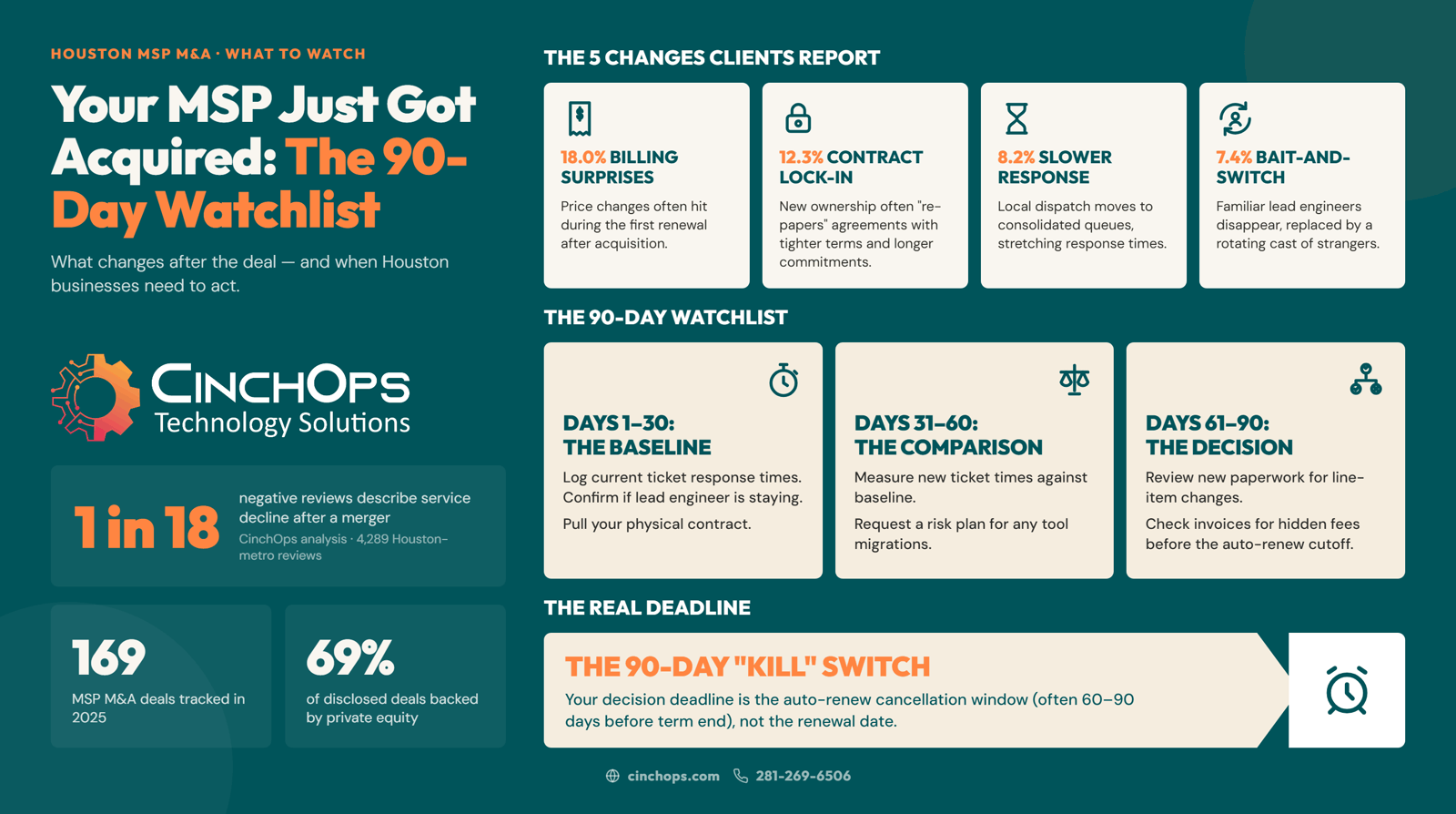
None of those stories involves a villain. Omdia, the technology analyst arm of Informa, tracked 169 publicly announced MSP merger and acquisition deals in 2025, with private equity involved in 69% of disclosed transactions. The buyers are professional, the sellers usually earned the exit, and the deal math often depends on efficiencies: shared help desks, standardized tool stacks, centralized management.
The 5 Changes Clients Actually Report
What the post-acquisition complaints in our Houston review dataset describe, mapped against the market's complaint themes.
Post-acquisition complaints in the CinchOps review analysis describe 5 recurring changes: response times stretch, the familiar engineer disappears, the tool stack gets migrated, the contract gets re-papered, and the price changes at renewal. Each one also exists as its own complaint category in the wider Houston data, which is what makes the pattern credible.
- Response slows. Slow or no response is already 8.2% of all negative Houston MSP reviews. After an acquisition, tickets that used to reach a local dispatcher enter a consolidated queue, and the reviews describe the difference in hours, not minutes.
- The engineer you trusted leaves. Acquisitions trigger technician turnover, and clients feel it as a rotating cast of strangers who need your network explained from scratch. The market-wide version of this complaint, sales-and-service bait-and-switch, runs 7.4% of negatives.
- The tool stack migrates. New ownership usually means a forced move to the acquirer's remote monitoring, ticketing, and security platforms. Done well, you barely notice. Done on a deadline, agents break, backups lapse, and your team learns a new portal mid-quarter.
- The contract gets re-papered. New master service agreements arrive for signature, often with tighter terms. Contract lock-in is 12.3% of all Houston MSP complaints, and re-papering is the moment lock-in gets written in.
- The price changes at renewal. Acquirers pay for growth, and renewal is when the growth math reaches your invoice. Billing surprises are the number 1 complaint theme in the Houston data at 18.0%, so watch renewals doubly hard after a sale.
The 90-Day Watchlist Starts the Day of the Announcement
Concrete tells to monitor after your IT provider changes hands, in the order they usually appear.
The 90-day watchlist is a simple discipline: from the day an MSP acquisition is announced, a Houston business should track ticket response times, account manager continuity, tooling migration notices, and renewal paperwork, because those 4 signals predict whether service will hold better than any reassurance email.
Two of these signals deserve emphasis. First, the day-1 baseline: memory is a terrible measuring stick, and 60 days in, nobody can honestly say whether 4-hour responses used to be 1 hour. Write the numbers down while the old service level is still running. Second, the auto-renew window: many Houston MSP agreements renew automatically unless cancelled 60 or 90 days before term end, so your real decision deadline is the cancellation cutoff, not renewal day.
There is also a Gulf Coast reason to run the watchlist on a calendar, not a vibe. Hurricane season is a live operational test: when a storm takes power out in Katy or Cypress, you find out in one afternoon whether escalation decisions are still made locally or now wait on a corporate bridge call 2 time zones away. Do not let the first test of the new ownership be a named storm.
Your Contract Decides More Than the Press Release Does
The 3 clauses that determine what an acquisition can and cannot change for you. This is contract literacy, not legal advice.
When an MSP is acquired, the client's rights come from 3 places in the existing agreement: the term and auto-renewal clause, the assignment clause that says whether the contract transfers to a buyer, and the exit provisions that set notice periods and offboarding obligations.
Contract lock-in is 12.3% of negative Houston MSP reviews, and acquisition is when loose terms get expensive. Three things to find in your agreement this week, ideally with your attorney if you are a larger shop or a regulated one like a CPA practice or law firm:
- Term and auto-renewal. Know your end date and the cancellation notice window. A 3-year term with a 90-day notice requirement is a very different acquisition than a month-to-month agreement.
- Assignment clause. Most agreements let the provider assign the contract to an acquirer without your consent. Some require notice. A few give you a termination right on change of control, which is the single most valuable sentence you can find right now.
- Exit provisions. What does offboarding cost, how fast must they hand over credentials and documentation, and who owns your configurations and backups? The answers matter more under new ownership than they did the day you signed.
If you are asked to sign new paperwork after the deal, that is a negotiation, not a formality. You generally cannot be forced onto worse terms mid-contract just because ownership changed, and the moment they need your signature is your moment of maximum bargaining power.
When Should a Houston Business Switch Managed IT Providers?
The fair test, because some acquisitions genuinely improve service.
A Houston business should switch managed IT providers when measured service declines against a written baseline: response times that stay worse for 60+ days, the loss of named engineers without replacement, a forced tool migration that breaks working systems, or renewal terms materially worse than the current agreement. Announcement alone is not a reason to leave.
One class of problem skips the 90-day patience entirely: egregious errors, misconfigurations, and security issues. If the new team disables MFA to close tickets faster, lets backups fail for weeks unnoticed, or leaves a firewall port open to the internet, that is not drift to monitor. That is an immediate exit conversation, whatever the calendar says.
Reasons to stay are just as real. If the acquirer brings a staffed 24/7 security operations center, a deeper project bench, and your day-to-day contacts stay put, you may end up better off than before the deal. We have watched Houston businesses bolt from a newly acquired provider into a worse contract out of pure nerves, which solves nothing.
The tell we see most often in the reviews is not one dramatic failure. It is drift: each month slightly slower, each renewal slightly tighter, familiar names disappearing one by one. Drift never triggers an obvious "leave now" moment, which is why the baseline matters. If it has not recovered by day 90, start vetting replacements while your notice window is still open.
Switching Without Downtime Is a Process, Not a Leap
If the data says go, this is how businesses leave cleanly.
Switching MSPs without downtime means overlapping providers for a short transition: the new provider documents and takes over monitoring while the old one still holds support duty, credentials and backups transfer on a checklist, and the cutover happens after verification, not before.
Three acquisition-specific rules sit on top of the standard cutover. Time your exit to the notice window you found in the contract section. Get your documentation exported early, because the person who knows where everything lives may not work there next quarter. And vet the replacement with the same review data that flagged the problem: our analysis of how to choose an IT company in Houston ranks the 7 green flags and 7 red flags from 4,289 real client reviews, and post-acquisition decline is red flag 6 on that list.
"I don't fault any owner for selling the company they built. But the week the deal closes, decisions about your service move to people you have never met. Skip the reassurance email, write down your response times, and check them again in 90 days. The numbers will tell you the truth."
Getting the Acquisition Letter Treatment Right Now?
If your provider just changed hands and response times are already slipping, a second opinion costs nothing. CinchOps runs side-by-side assessments for Houston businesses through managed IT services with no contract required to talk.
See what stable IT support looks like →How CinchOps Can Help After Your IT Provider Is Acquired
CinchOps is a managed IT services provider based in Katy, Texas, serving small and mid-sized businesses across the Houston metro area. CinchOps specializes in cybersecurity, network security, managed IT support, VoIP, and SD-WAN for businesses with 10 to 200 employees.
CinchOps is independently owned, has never been acquired, and does not migrate clients onto a new tool stack to satisfy an acquirer. Operating on a Zero-Zero-Zero model - no long-term contracts, no hidden fees, no cancellation penalties - means clients stay because the service holds, and leaving is never a clause-hunting exercise.
- Through managed IT support, businesses get under-15-minute help desk response with a named engineer who knows their network.
- Through cybersecurity services, the security stack gets rebuilt on merit, not on whichever platform a buyer standardized on.
- Businesses across Houston, Katy, and Sugar Land get local escalation decisions, which matters most in hurricane season.
- Regulated firms like CPA practices, law firms, and construction companies get transitions planned around their compliance and project calendars.
If your MSP was just acquired, do not decide anything this week. Baseline your service, read your contract, and watch the 90 days. And if the numbers slip and you want a provider whose ownership question has a 1-sentence answer, talk to CinchOps.
Frequently Asked Questions
Can my MSP change my contract after an acquisition?
Not unilaterally. An acquirer inherits your existing agreement as written, usually through an assignment clause, and cannot impose worse terms mid-contract without your signature. Changes typically arrive as new paperwork at renewal or as a re-papered master agreement. Treat any new signature request as a negotiation, and review it before signing. This is general information, not legal advice.
How do I know who owns my MSP?
Ask directly: who owns the company, has ownership changed in the past 3 years, and is current management staying? A locally owned provider answers in 1 sentence. Hesitation, holding-company names, or "we are part of a family of brands" all warrant follow-up. It is one of the vetting questions in our guide to choosing an IT company in Houston, built from 4,289 real reviews.
What does switching to a new MSP cost in Houston?
The switch itself is mostly time: expect a 30 to 60 day overlap for documentation and cutover, plus any early-termination fee in your old contract. Ongoing Houston managed IT pricing typically runs a flat monthly rate per user; CinchOps publishes flat $100 to $250 per user pricing with no onboarding contracts, no hidden fees, and no cancellation penalties.
Discover More
Resource
Sources
- CinchOps original research: analysis of 4,289 public Google Business reviews (3,705 positive and 122 negative reviews themed by category) across 140 Houston-metro managed IT service providers, exported via Outscraper, July 2026 snapshot. Percentages are shares of themed reviews. Full methodology in How to Choose an IT Company in Houston.
- Omdia (Informa), "MSP M&A 2025: Deals Focus on Cybersecurity, AI," April 2026 - 169 publicly announced MSP M&A transactions tracked in 2025; private equity involved in 69% of disclosed deals.


