


2026 Thales Data Threat Report: What It Means for Houston SMBs
Data Security Before AI Adoption For Houston Businesses – Texas SB 2610 And The Audit Gap In The 2026 Thales Data Threat Report
Five enterprise findings translated for Houston firms with 10 to 200 employees, before anyone switches on AI.
The 2026 Thales Data Threat Report calls AI "the new insider threat," and the number behind that line is plain: only a third of the organizations surveyed know where all of their data is stored. If you run a Houston business with 30 or 80 employees and someone just asked to switch on Copilot or connect ChatGPT to the shared drive, that finding describes your office too.
One detail the headlines skip. The survey screened out every organization under $100 million in annual revenue, and its smallest revenue band ran from $100 million to $249.9 million. Not one respondent looks like a CPA practice in Sugar Land or an engineering firm in Katy. So the percentages can't be pasted onto a small business. They need translating, and that's what this post does, finding by finding.
CinchOps runs data security and AI readiness specifically for Houston businesses with 10 to 200 employees, at a flat monthly rate of $100 to $250 per user, and the work starts with a map of where the data lives before any AI tool gets a login.
What Does the 2026 Thales Data Threat Report Mean for a Business Under $100 Million?
Five enterprise findings, restated at the scale of a 10 to 200 person company.
The 2026 Thales Data Threat Report is a survey of 3,120 security and IT managers in 20 countries, run by S&P Global Market Intelligence 451 Research for Thales. For a smaller Houston business its value is directional: the same failure patterns show up at small scale, usually with fewer people watching for them.
The table below compares five Thales findings with how each one tends to appear inside a small or mid-sized Houston company, and the first move that addresses it.
| Thales 2026 finding | Enterprise figure | How it shows up at 10 to 200 employees | First move |
|---|---|---|---|
| Data location is unknown | Only a third know where all their data is stored; 39% can classify all of it | Files spread across an old server, OneDrive, a personal Dropbox and a former employee's mailbox | A one-page data map: what you hold, where it sits, who can open it |
| AI agents arrive fast | 34% already run embedded AI agents; 73% expect to within 12 months (451 Research) | Copilot, ChatGPT or a CRM's built-in assistant switched on under the owner's account | Trim file-share permissions before enabling any assistant |
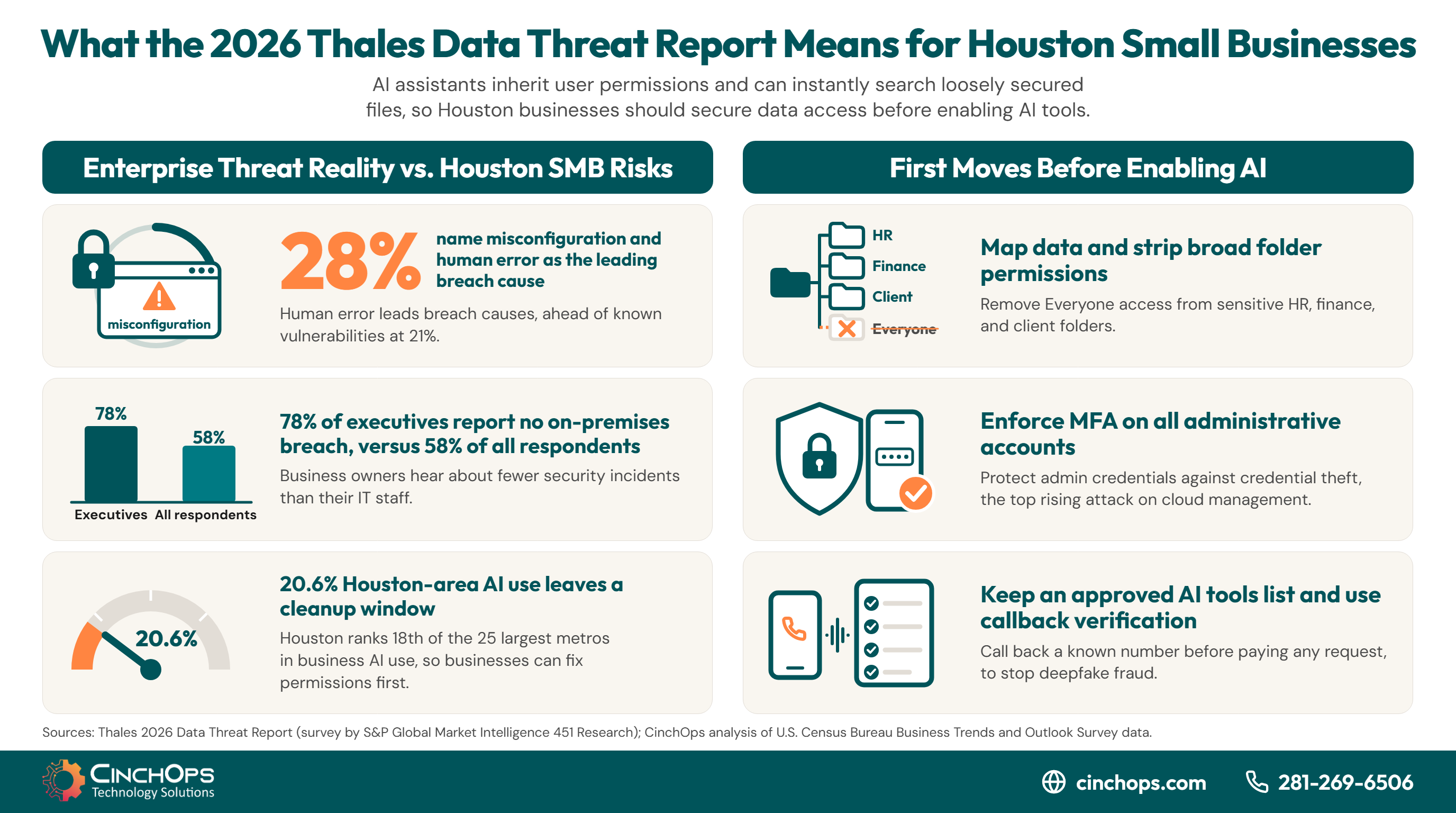
| Human error leads breach causes | 28% of breached organizations name misconfiguration or human error first | A folder shared as "anyone with the link," an admin login without MFA | MFA on every admin account and a scheduled review of sharing links |
| Credentials are the cloud target | 67% of those seeing more cloud management attacks cite credential theft | A Microsoft 365 global admin password reused on a personal site | Separate admin accounts and phishing-resistant MFA |
| Sensitive data sits unencrypted | 47% of sensitive cloud data is encrypted, on average | Laptops without BitLocker and client files sent as plain attachments | Device encryption plus encrypted email for client records |
The table leaves out two of the report's longest chapters, quantum computing and data sovereignty. Those chapters matter to a multinational deciding which country its servers live in.
One more calibration. Thales and 451 Research describe the study as observational, and the report makes no causal claims. When the numbers below say that one group reports more breaches than another, read it as a pattern worth checking in your own company, not as proof of cause.
How Does AI Become an Insider Threat at a Small Business?
Why an AI assistant with good intentions can still expose payroll, client files and HR records.
AI as an insider threat means an AI assistant or agent reaching company data through legitimate access, the way an employee would, rather than by breaking in. The 2026 Thales Data Threat Report's point is that an agent can read whatever its user can read, so loose file permissions become searchable the moment the tool is switched on.
For years, an over-permissioned file share was a slow risk. Nobody browsed 40,000 folders looking for the salary spreadsheet. An assistant connected to that share does exactly that kind of searching on request, in seconds, for anyone who asks the right question. The data didn't move. What changed is how easy it became to find.
- "What did we pay the operations manager last year?" pulled from an HR folder shared too broadly.
- "Summarize our open litigation" surfacing privileged notes at a law firm, to a receptionist.
- "Find client Social Security numbers" returning scanned tax documents from a CPA practice's archive.
Houston has a timing advantage here. CinchOps' analysis of U.S. Census Bureau Business Trends and Outlook Survey data put Houston-area business AI use at 20.6% averaged across 2026, 18th of the 25 largest metros, with 24.9% expecting to use AI in the next six months. Most Houston businesses haven't switched these tools on yet, which means most can still clean up permissions first instead of after an assistant has already indexed the mess.
Why Do Business Owners Report Fewer Breaches Than Their IT Staff?
The most useful finding for an owner is the one about owners.
In the 2026 Thales Data Threat Report, 78% of CEOs, presidents and managing directors said their organization had never had an on-premises breach, compared with 58% of all respondents. The gap suggests owners hear about fewer incidents than the people who clean them up, and security budgets follow what owners believe happened.
The cloud numbers show the same direction, smaller: 62% of executives reported no cloud breach history against 54% survey-wide. Thales flags these discrepancies as having "material impacts on how security budgets are prioritized." At a 50-person company the effect is sharper, because there is often one IT person, or one outside provider, deciding which incidents are worth mentioning.
The audit split in the chart is the other half of the story. Among organizations that failed a compliance audit in the last 12 months, only 6% reported no breach history. Among those that passed every audit, 30% did. An audit forces someone to write down what happened, and written records are how incidents reach the owner's desk.
Thales also found a mismatch in what worries security teams. 63% rank nation-state attackers among their top three concerns, yet misconfiguration and human error lead the causes of actual breaches at 28%, ahead of known-vulnerability exploits at 21% and zero-days at 14%. For a Houston small business, that ordering is good news. The most common cause is also the cheapest to fix.
Houston is late to AI, and I'd treat that as an opening. The companies that switched assistants on first are now cleaning up after tools that indexed every loose file share they had. A business that fixes permissions first can turn AI loose on proposals, estimates and client service with confidence, and pull ahead while the early movers are still doing cleanup.
What Does AI Security for a Small Business in Houston, Texas Actually Cover?
Access, sign-in, approved tools and verification, with very little new software.
AI security for a small business in Houston, Texas covers four things: who can reach which data, how admin accounts sign in, which AI tools staff are allowed to use, and how staff verify requests that could be deepfakes. Most of it is access control and training, and very little of it requires buying another product.
That last point runs against the enterprise pattern in the report. Thales counted an average of seven data protection and monitoring tools per organization. When asked why they resist consolidating, 83% said alternative tools lacked compatibility or capability, while only 39% said they were highly confident they understood the tools they already had. A 60-person company copying that habit ends up paying for overlapping licenses nobody has configured, when the first job is configuring the tools it already owns.
- Permissions before prompts. Remove "Everyone" and "anyone with the link" access from HR, finance and client folders before any assistant is connected.
- Admin accounts apart from daily accounts. Thales found credential theft the top rising attack on cloud management infrastructure. A global admin who also reads email is the easiest target in the tenant.
- An approved-tools list. Name which AI tools staff may use with client data and which they may not. Free consumer chatbots belong on the second list.
- Callback rules for money and data requests. 59% of Thales respondents have seen deepfake attacks, and 97% report some harm from AI-generated false information. A voice that sounds like the owner asking for a wire gets a callback to a known number, every time.
- Certificate renewal on autopilot. The CA/Browser Forum will cut the maximum TLS certificate lifetime to 47 days by 2029. Websites, VPN portals and firewalls renewed by hand will break more often.
The callback rule matters more in Houston than in most markets. Oil and gas service companies, construction firms and commercial real estate outfits here move large vendor payments on short notice, which is exactly the pattern a cloned voice exploits. The control costs nothing but discipline.
Switching on Copilot or an AI agent this quarter?
CinchOps reviews file-share permissions, admin sign-in and sharing links before the tool goes live, so the assistant only finds what each person should see. See how CinchOps handles agentic AI for Houston businesses.
Book an AI data-access reviewHow CinchOps Can Help Houston Businesses Get Data Ready for AI
CinchOps is a managed IT services provider based in Katy, Texas, serving small and mid-sized businesses across the Houston metro area. CinchOps specializes in cybersecurity, network security, managed IT support, VoIP, and SD-WAN for businesses with 10 to 200 employees.
- Through cybersecurity services, CinchOps maps where sensitive data lives, trims file-share permissions and enforces MFA on every admin account.
- With agentic AI for Houston businesses, AI tools are introduced after access is cleaned up, with an approved-tools list staff can follow.
- Through managed IT support, help desk requests are answered in under 15 minutes, so a suspicious call or email gets checked before anyone acts on it.
- With vCIO and CTO services, owners get incidents reported in writing, which closes the blind spot the Thales data describes.
- CinchOps serves Houston, Katy and Sugar Land, with industry work for CPA firms, law firms and engineering firms.
The Thales report was written for companies a hundred times your size, and its most useful lesson still fits on one page: know where your data is before you hand a machine the keys to it. Most Houston businesses haven't switched AI on yet, so the cleanup can come first. If you want that page drawn up for your company, talk to CinchOps.
Frequently Asked Questions
Is the 2026 Thales Data Threat Report relevant to a small business?
Partly. The survey excluded businesses under $100 million in revenue, so its percentages describe much larger businesses. The failure patterns carry down, though: unknown data locations, human error as the top breach cause, credential theft in the cloud and AI tools reaching loosely permissioned files all show up in Houston businesses with 10 to 200 employees.
What does "AI is the new insider threat" mean?
It means an AI assistant or agent can expose data through access it was legitimately given, the way an employee could. The tool reads whatever its user can read, so a file share with broad "Everyone" permissions becomes searchable in seconds. The fix is tightening permissions before the tool is connected, not after it has indexed everything.
What should we do before turning on Copilot or another AI assistant?
Map where sensitive data lives, remove broad access from HR, finance and client folders, and revoke old "anyone with the link" shares. Put MFA on every admin account and keep admin accounts separate from daily email accounts. Then publish a short list of approved AI tools so staff know which ones may touch client data.
How would I know if my business has already had a breach?
Ask your IT staff or provider for a written incident log covering the last 12 months. Thales found 78% of CEOs report no on-premises breach, compared with 58% of all respondents, so owners often hear less than their technicians. A documented log also supports the Texas SB 2610 safe harbor for businesses under 250 employees.
What does AI data security cost for a business in Houston?
CinchOps prices managed IT and security at a flat monthly rate of $100 to $250 per user, depending on the plan, with no long-term contracts, hidden fees or cancellation penalties. Permission cleanup, MFA enforcement and approved-tool policies for AI fall inside that per-user model rather than arriving as a separate AI security product.
Discover More
Resource
Sources
- Thales, 2026 Data Threat Report: "Data security in the agentic age: AI is the new insider threat" (survey by S&P Global Market Intelligence 451 Research, February 2026)
- CinchOps, Houston Small Business AI Adoption: The 2026 Census Report (analysis of U.S. Census Bureau Business Trends and Outlook Survey data)
- U.S. Census Bureau, Business Trends and Outlook Survey (BTOS) data
- Texas Legislature, SB 2610 (89R), enrolled text
