


Houston Business Guide: How to Prioritize Security Patches
Introducing The Houston Area Patch Index – How To Prioritize Security Patches In 2026
Introducing the Houston Area Patch Index, built on 38,446 vendor advisories going back to 2022.
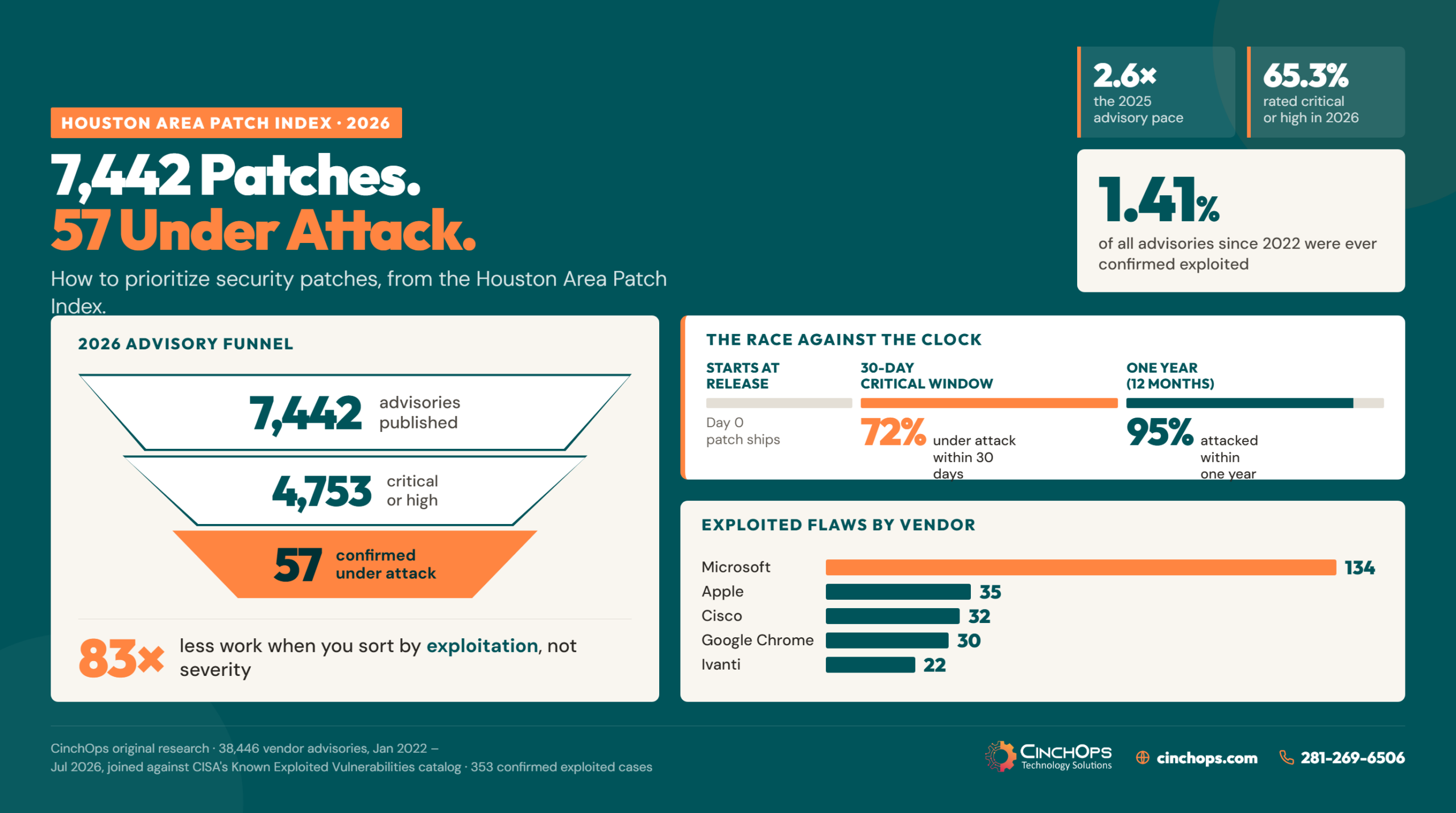
If you want to know how to prioritize security patches, the honest answer is that severity is the wrong queue. Of the 7,442 vendor advisories published in 2026, 4,753 are rated critical or high, but only 57 are confirmed to be under attack.
That is the headline finding from the Houston Area Patch Index, a piece of original CinchOps research published on 2 August 2026. It tracks 38,446 published security advisories across the vendors in a normal business technology stack, going back to January 2022, and pairs each one against CISA's Known Exploited Vulnerabilities catalog to see which flaws attackers actually picked up. CinchOps provides managed IT and patch management for small and mid-sized businesses across the Houston metro, at a flat monthly rate per user with help desk response under 15 minutes.
How Much Patching Work Are Vendors Actually Creating?
Volume roughly doubled and severity climbed in the same year, which is the unusual part.
Advisory volume in 2026 is running about 2.6 times the 2025 pace on an annualized basis, and it is not one vendor having a bad year. The rise shows up across every tracked vendor group.
- More work, arriving faster. 7,442 advisories were published in the first seven months of 2026 alone, against 38,446 across the full period since January 2022.
- And a higher share of it urgent. Critical plus high reached 65.3% of scored advisories, up from 54.9% the year before, after four years of holding roughly flat.
- Concentrated growth at the top. Google Chrome advisories rose 773% between 2025 and 2026, Oracle 394%, Broadcom and VMware 156%.
- The timing lines up with AI-assisted discovery. Two vulnerability-finding programs went public weeks apart in spring 2026: Project Glasswing on 7 April, an Anthropic-led industry program, and Microsoft's in-house MDASH scanner in May.
On that last point the index is deliberately careful, and so is this post. Microsoft has publicly credited MDASH, its own tool, for its record patch volume - Windows chief Pavan Davuluri said so in July. Nobody has demonstrated that either program caused the industry-wide surge. The index marks when they arrived because the surge and their arrival coincide, and stops there. Correlation is worth showing. Causation would need evidence nobody has published.
Why Severity Is the Wrong Queue to Prioritize
Severity tells you what could go wrong. Exploitation tells you what is going wrong.
Patching by severity means chasing 4,753 fixes this year. Patching by confirmed exploitation means starting with 57. That is roughly 83 times less work for the fixes that carry real, observed risk.
Widen the lens and the ratio gets starker. Across the entire dataset, back to January 2022, only 1.41% of published advisories have ever been confirmed exploited in the wild. Ninety-eight and a half percent of the patching work a vendor generates is precautionary. That does not make it worthless, but it does mean that a queue sorted by severity puts nearly five thousand items a year in front of a team that can realistically act on a fraction of them.
Seven thousand advisories a year makes people feel hopeless, and hopeless is how patching quietly stops happening. The volume is high but the real risk is narrow. Fifty-seven fixes is a manageable list. The hard part is knowing which fifty-seven, this month, on the stack you actually run, and that is the part worth handing to somebody who watches it full time.
How Long Do You Actually Have After a Fix Ships?
Not years. For most exploited flaws, under a month.
Across 353 confirmed cases in the index, 72% of exploited flaws were under confirmed attack within 30 days of the fix becoming available, and 95% within a year.
It also reframes what "behind on patching" means. Being three months behind on the 7,385 advisories nobody is exploiting costs you very little. Being three weeks behind on one that is on the CISA list can cost you the business. Those two states look identical on a compliance checklist and are nothing alike in practice.
Which Fixes Are You Actually Behind On?
Not all of them, and probably not the ones you are worrying about. CinchOps ranks patching against the CISA exploited list so the urgent handful gets applied first.
Talk to CinchOpsWhich Vendors' Flaws Actually Get Attacked?
The volume leaders and the exploitation leaders are not the same list.
Microsoft accounts for 134 confirmed exploited flaws in the index, ahead of Apple at 35, Cisco at 32, Google Chrome at 30, Ivanti at 22 and Fortinet at 19.
Some of that is simply footprint. Microsoft is in nearly every business stack, so attackers get the widest return from a Microsoft flaw. But the ranking is worth holding next to the growth ranking, because they disagree. Chrome advisory volume grew 773% year over year while contributing 30 confirmed exploited flaws. Ivanti and Fortinet publish far less and land 22 and 19. Edge security appliances are small in volume and heavy in exploitation, which is exactly the profile you would expect for a device that sits on the public internet holding the keys to the internal network.
The finding most likely to be misread is the quiet one. Some vendors in the index publish no advisories at all, and that reads like a clean bill of health. It is almost always the opposite: no public disclosure programme rather than no flaws. You cannot patch what a vendor never tells you about, and a vendor that never tells you anything is a risk you are carrying without a number attached to it.
What Does This Change for a Houston Business?
Four moves, and one reason this lands harder on the Gulf Coast than elsewhere.
The exploitation-first queue matters most where patch windows are hardest to get, which describes a large share of the Houston industrial base.
A downtown professional services firm can reboot workstations on a Tuesday evening. A plant, a terminal or a midstream operator cannot. Production schedules, safety interlocks and vendor-certified configurations mean the maintenance window is scarce and negotiated weeks ahead. When you only get a handful of windows a year, deciding what goes into them is the whole game - and a queue sorted by severity will fill that window with precautionary fixes while a confirmed-exploited flaw waits for the next one. For oil and gas and manufacturing operators especially, ranking by exploitation is not a refinement. It is the only version of the job that fits in the time available.
- Shrink the window, not the workload. The goal is not patching everything faster. It is getting the exploited minority applied within days, and letting everything else follow a normal maintenance rhythm.
- Rank by exploitation, then severity. Anything on the CISA Known Exploited Vulnerabilities catalog that touches your stack jumps the queue regardless of its score, because it is being used right now.
- Know what you run before the alert lands. You cannot prioritize what you have not inventoried. When a flaw hits the exploited list, "do we run that?" has to be answerable in minutes.
- Measure the delay, not the effort. The metric that predicts a breach is the average number of days between a fix being published and installed. If nobody tracks that number, nobody is managing the risk.
That last one is where most small businesses come unstuck. Patching gets reported as activity - updates applied, machines touched, tickets closed - when the only figure that correlates with getting breached is elapsed time on the fixes that matter. In 35+ years of doing this, the businesses that got hurt were rarely the ones with no patching process. They were the ones whose process had no clock on it.
Is Anyone Watching Your Patch Clock?
72% of exploited flaws are under attack within 30 days of the fix shipping. CinchOps runs patch inventory, testing, deployment and verification through managed IT services for businesses across Houston, Katy and Sugar Land.
Explore CinchOps managed IT →How CinchOps Can Help You Patch What Gets Attacked
CinchOps is a managed IT services provider based in Katy, Texas, serving small and mid-sized businesses across the Houston metro area. CinchOps specializes in cybersecurity, network security, managed IT support, VoIP, and SD-WAN for businesses with 10 to 200 employees.
- Through managed IT support, patch inventory, testing, deployment and verification run on a schedule at a flat monthly rate per user, with no contracts, hidden fees or cancellation penalties.
- Through managed cybersecurity, fixes are ranked against the CISA exploited-vulnerabilities catalog so the flaws attackers are using jump the queue instead of waiting their turn.
- Through business continuity and disaster recovery, backups stay geo-redundant outside the Gulf Coast flood zone, so a bad patch or a bad storm is a restore rather than a rebuild.
- For oil and gas and manufacturing clients, IT and OT networks are segmented so a device that cannot be patched on your schedule is not sitting on the same network as the office.
- Across Houston, Katy, Sugar Land and Cypress, help desk response runs under 15 minutes and every engagement carries a 30-day satisfaction guarantee.
The Houston Area Patch Index exists because "are we patched?" is an unanswerable question and "are we patched on the things being exploited?" is not. The first one has 7,442 parts this year and no honest yes. The second has 57 and a straight answer. If you want to know which of those 57 touch what you actually run, talk to CinchOps.
Frequently Asked Questions
How do you prioritize security patches?
Rank by confirmed exploitation first, then severity. Of 7,442 advisories published in 2026, 4,753 were rated critical or high but only 57 are confirmed under attack. Anything on CISA's free Known Exploited Vulnerabilities catalog that touches your stack should jump the queue regardless of its severity score.
What is the Houston Area Patch Index?
It is original CinchOps research published on 2 August 2026, tracking 38,446 vendor security advisories from January 2022 through July 2026. It measures how much patching work software vendors create, how severe those flaws are, and how long it takes before attackers are confirmed to be exploiting them.
How quickly are security vulnerabilities exploited after a patch is released?
Fast. Across 353 confirmed cases in the index, 72% were under confirmed attack within 30 days of the fix becoming available, and 95% within a year. A monthly patch cycle sits inside that window for most flaws. A quarterly cycle sits outside it.
Why did patch volume rise so much in 2026?
Advisory volume is running about 2.6 times the 2025 pace across every tracked vendor, and severity rose alongside it. Two AI vulnerability-discovery programs went public in spring 2026, and Microsoft has credited its own MDASH scanner for its record volume. The index shows the timing coincides but does not claim either program caused the industry-wide surge.
What does patch management cost in Houston?
CinchOps includes patch inventory, testing, deployment and verification in managed IT at a flat monthly rate per user, so the cost tracks headcount rather than arriving as a surprise. There are no contracts, hidden fees or cancellation penalties, and every engagement carries a 30-day satisfaction guarantee.
Discover More
Resource
Sources


