


Mythos Readiness: What Echo’s 2026 Report Means for Houston Businesses
A Practical Patch Plan For Houston Businesses After Mythos – The Fix Already Exists. Attackers Are Counting On You Not Installing It
AI Now Builds the Exploit for Under $2,000.
What Echo's September 2026 Mythos Readiness Report means for Houston businesses that run software rather than write it.
Mythos readiness is how quickly your business can get from a newly published software flaw to machines that are actually patched against it. The phrase comes from Claude Mythos Preview, the AI model Anthropic announced on April 7, 2026, and it is now the title of a 61-page report the software supply chain company Echo released on September 3, 2026.
If you run a 40-person firm in Houston, you do not write software. You run it: Windows, Microsoft 365, a firewall, a VPN, two browsers, and whatever accounting, design or field-service package your industry lives in. The April headlines about Mythos read like a problem for Microsoft and Google. Echo's report, built on its own telemetry, a survey of 80+ U.S. security leaders and the data Anthropic published, argues the problem has moved to the other end of the pipe. It now sits with whoever has to install the fix.
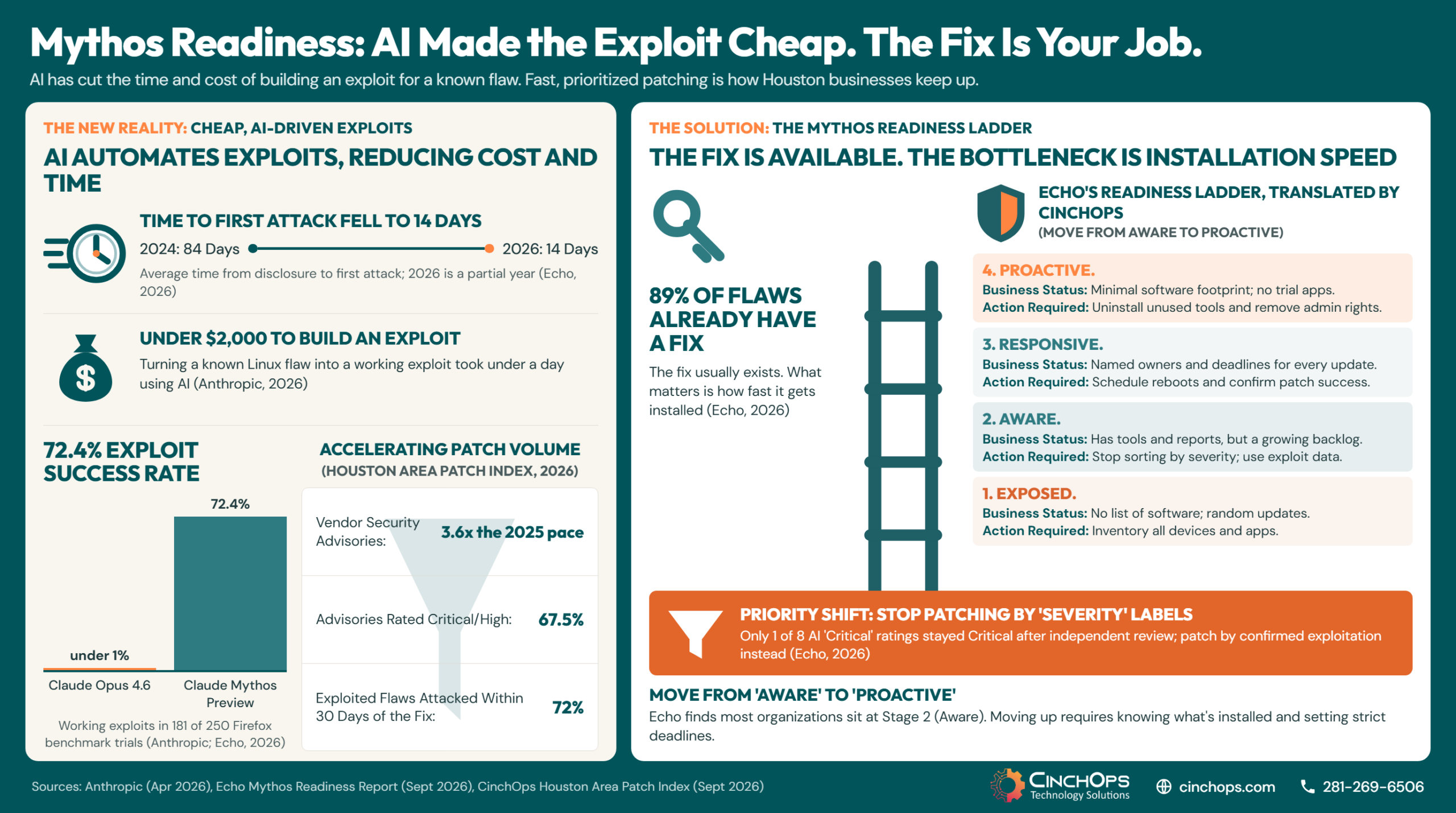
CinchOps provides managed patching and cybersecurity specifically for Houston-area businesses with 10 to 200 employees, at a flat $100 to $250 per user per month, and it sorts updates by confirmed exploitation rather than by severity score. We track the volume ourselves. The Houston Area Patch Index, updated September 16, 2026, counts 46,727 security advisories since January 2022 from the 18 vendors in a typical business technology stack. The 2026 pace is 3.6 times the 2025 pace, and 67.5% of this year's advisories are rated critical or high.
Claude Mythos Is Better at Building Exploits Than at Finding Bugs
What the model did in testing by Anthropic, the UK government and an independent security lab, and where it stalled.
Claude Mythos Preview is a frontier AI model Anthropic announced on April 7, 2026 and never released to the public. Its standout skill is turning a known flaw into a working attack. On Anthropic's Firefox benchmark it built working exploits in 181 of 250 trials, while the previous model, Claude Opus 4.6, managed 2 in several hundred attempts.
The benchmark gave each model roughly 50 known crash bugs in Firefox's JavaScript engine and 5 tries each to turn a crash into code the attacker controls. Echo's report calls the jump from under 1% to 72.4% roughly 90-fold between two consecutive model generations, and it lists the caveats Anthropic's own write-up carries: the bugs were already known, the browser's sandbox was switched off, and nobody outside Anthropic has reproduced the run yet.
The UK AI Security Institute tested Mythos Preview independently and published on April 13, 2026. It succeeded on 73% of expert-level capture-the-flag challenges, a tier no model could complete before April 2025. On a 32-step simulated corporate network attack called The Last Ones, which the Institute estimates takes a human expert about 20 hours, Mythos Preview became the first model to finish end to end, in 3 of 10 attempts, and averaged 22 of 32 steps against 16 for Claude Opus 4.6. The Institute also notes its ranges had no active defenders or defensive tooling, which makes them easier than a real, monitored network.
The most useful finding for a small business came from outside Anthropic. The security lab AISLE took the FreeBSD network file system bug Anthropic had highlighted and gave it to 8 smaller, cheaper models. All 8 found it, including one with only 3.6 billion active parameters that costs $0.11 per million tokens to run. Spotting a known bug class is now something almost any model can do. Chaining several weaknesses into a working attack is where Mythos-class models still lead, and that is the half that shortens the time between a patch being published and someone using the flaw it fixes.
Access is narrow for now. Anthropic runs Mythos Preview through Project Glasswing, launched with 12 named organizations including Microsoft, Apple, Google, Cisco, CrowdStrike and Palo Alto Networks, plus over 40 more, and backed by up to $100 million in usage credits. Those members point it at their own code, and AI-assisted discovery by programs like this one is a main reason vendor advisory counts climbed so sharply in 2026. Your business will never touch Mythos directly. You will feel it as a longer patch list arriving faster.
Finding Software Flaws Got Cheap and Fixing Them Did Not
Anthropic's own numbers, an outside audit of its disclosure ledger, and what Echo found about fixes that exist but never get installed.
The bottleneck after Mythos is the fix, not the find. Anthropic's May 22, 2026 update says Project Glasswing members found more than 10,000 high- or critical-severity vulnerabilities in the first month, and that progress on software security is now limited by how quickly anyone can verify, disclose and patch them rather than by how quickly flaws are found.
Anthropic's open-source effort shows the queue forming. Its scans produced 23,019 candidate findings. By May 22, 530 high- or critical-severity bugs had been reported to the volunteer and corporate maintainers who own that code, and 75 had been patched with public advisories. Anthropic estimates a high- or critical-severity bug found by Mythos Preview takes about 2 weeks to patch on average. The waiting happens before that point.
The vulnerability intelligence firm VulnCheck audited Anthropic's public disclosure ledger on June 9, 2026. It counted 1,596 findings that had reached maintainers, 6.9% of the candidates, 88 published advisories and 27 fixed findings. At the pace it observed, VulnCheck estimated the backlog would take about 2.4 years to clear.
Echo looked at the same problem from the receiving end. In a year-long study of 250 widely used open-source container projects, it found 89% of known vulnerabilities already had a fix available, rising above 95% for critical- and high-severity ones. Echo also reports that roughly 40% of fixable vulnerabilities stay unresolved for more than six months after the fix exists. The two pages of the report that would show how that 40% was measured are missing from the copy we reviewed, so treat it as Echo's figure rather than a settled one. The direction matches everything else in the report: the fix is written long before it is running.
Volume makes the lag worse. Echo counts 3,173 new CVEs published in June 2024 and 7,765 in June 2026, a 145% rise in two years, and notes part of that growth comes from more organizations being authorized to assign CVE numbers. Our own index shows the same curve from the business side: 13,165 vendor advisories in the first nine months of 2026, and 3,627 in the first 16 days of September alone.
Echo's survey of 80+ U.S. security leaders, fielded July 16 to 25, 2026, puts the constraint in their own words. The obstacle cited most often, by 37%, was "detecting more than we can fix." Only 11% said more detection or scanning would be their next investment. Large companies with full security teams are telling a vendor they cannot keep up with the fixes they already know about. A 25-person office in Katy with one part-time IT contact has even less room to keep up.
An AI Severity Rating Is a Draft and Not a Patch Priority
Two honest measurements of how often AI gets severity right, and why neither should set the order you patch in.
A severity rating produced by an AI model is a first draft. Anthropic reports its contractors agreed exactly with Claude's rating on 89% of 198 reviewed reports. Yet on the 27 Mythos findings that became public CVEs, Echo found 14 ratings changed after independent scoring, and only 1 of 8 Critical ratings stayed Critical.
Both numbers can be true at once because they measure different things. Anthropic's 198 reports were checked by contractors reading the same write-up the model produced. The 27 public CVEs were scored by the maintainers who own the code, against how that software is actually deployed. Echo re-derived every one of those scores from its CVSS vector and maintainer records, and 13 of the 14 changes went down.
The biggest drop shows why. Mythos rated a flaw in Temporal, a workflow server, as Critical because an attacker could control workflows across separate namespaces. Temporal's maintainers scored the same flaw, CVE-2026-5199, at 2.3 out of 10, which is Low: the attacker first needs control of a namespace on the same cluster plus a privileged internal credential. In the MinIO storage finding, the attack assumed no login was needed, while in practice it required the cluster's root credential and allowed reading rather than changing files. The model read the code correctly and misjudged the deployment.
The same caution applies to AI-written fixes. In Echo's survey, even among security leaders using AI heavily in their supply chain work, only 1 in 8 said they would trust an AI-generated fix without a human reviewing it. That instinct is correct for a business of any size. AI can draft the ticket. A person who knows your network still decides what breaks if the update goes in on a Tuesday afternoon.
In 35+ years doing this, the break-in almost never came through a flaw nobody knew about. It came through the update that sat in a queue because the reboot was inconvenient. Mythos did not change that. It made the queue more expensive to ignore.
The Time From Disclosure to Attack Is Now Measured in Weeks
How long a published flaw stays safe to ignore, and why that clock matters most for Houston's plants and field operations.
Attackers are reaching published flaws faster every year. Echo's analysis of VulnCheck and CISA exploitation data puts the average time from public disclosure to first observed exploitation at 84 days for flaws disclosed in 2024, 55 days in 2025 and 14 days so far in 2026, a partial year Echo calls provisional.
In 2018 the same measure was 1,142 days. Echo's figures use a 10%-trimmed mean and date each flaw from the earliest public disclosure by the organization that assigned its CVE, so they will not match every published estimate, and the 2026 number will move as the year fills in. The trend does not depend on the method. A flaw that used to be safe to schedule for next quarter is now a flaw attackers reach inside a month.
Houston adds a wrinkle most of the national coverage skips. The metro runs on energy services, petrochemicals and manufacturing, and plant equipment usually patches on a maintenance window measured in quarters, because a control system cannot be rebooted on a Tuesday afternoon. A 14-day exploitation average against a 90-day window is a mismatch no plant manager can close by working faster.
The UK AI Security Institute's testing points to where the time can be bought. Mythos Preview could not complete the Institute's operational technology range, called Cooling Tower, and it got stuck on the IT sections of that range before reaching the plant-control stages. In a Houston plant, the road to the control system runs through the office network: email, the VPN, the engineering workstation that talks to both sides. That office side is where fast patching is possible, and a firm boundary between the corporate network and the shop floor is what protects equipment that can only be patched quarterly. Our Houston manufacturing cybersecurity research covers how often that boundary is missing.
Most Businesses Sit on Stage Two of the Mythos Readiness Ladder
Echo's four-stage ladder was written for software teams. Here is what each stage looks like in a business that buys its software.
Echo's Mythos readiness ladder has four stages: Exposed, Aware, Responsive and Proactive. Echo says most organizations sit at Stage 2, Aware, where scanners and dashboards make confidence run ahead of actual protection. For a Houston business that buys its software rather than writing it, every stage has a plain-language equivalent you can check this week.
Echo built the ladder for companies pulling open-source code into their own products, so its questions ask where developers get their packages. CinchOps rewrote each stage for an office that runs commercial software, keeping Echo's order and its central warning. Stage 1, Exposed, is a business with no current list of what is installed, updates applied when someone remembers, and news of a flaw arriving from a headline or an outage. At Stage 2, Aware, there are security tools, a monthly patch report and a backlog sorted by severity score. A Responsive business, Stage 3, gives every update type a named owner and a deadline, puts confirmed-exploited flaws first, schedules the reboots and checks that the patch actually landed. The Proactive business at Stage 4 shrinks the list itself.
Stage 2 is the trap because it looks like Stage 3 on a dashboard. Echo's survey found 74% of security leaders were at least somewhat confident a malicious software package would not reach production. Among the ones whose developers pull straight from public repositories or only scan after the download, the share was 80%. Confidence rose where the protection was thinnest. Echo's summary is blunt: adding more detection deepens Stage 2 and does not move anyone up.
If anyone in your business writes scripts or builds small tools with an AI coding assistant, one more Stage 4 habit applies. Echo summarizes research showing about 5% of software packages suggested by the newest AI models do not exist, and a name the AI invented is a name an attacker can register and fill with malware. Echo also found hijacked versions of popular packages are publicly flagged within a median of about 8 hours, while packages built to be malicious from day one take about 9 days. Waiting a day or two before installing a brand-new package version, and checking that it exists and has a history, removes most of that risk at no cost.
Find Out Which Stage Your Business Is On
CinchOps reviews what is installed, how updates are prioritized and who owns each reboot, then shows you where your business sits on the ladder and what moves it up. Start with our cybersecurity services.
Ask for a patch readiness review →How CinchOps Helps Houston Businesses Close the Mythos Readiness Gap
CinchOps is a managed IT services provider based in Katy, Texas, serving small and mid-sized businesses across the Houston metro area. CinchOps specializes in cybersecurity, network security, managed IT support, VoIP, and SD-WAN for businesses with 10 to 200 employees.
Mythos readiness for a business that buys its software comes down to three habits: know what is installed, install confirmed-exploited fixes first on a deadline, and keep less software around to patch. That is ordinary managed IT work done on a schedule, and it is the part of AI security for small business in Houston that pays off first.
- Through managed IT support, CinchOps keeps a current record of devices and software, runs the monthly and out-of-band patch cycle, and answers help desk requests in under 15 minutes.
- With cybersecurity services, CinchOps queues updates by confirmed exploitation, removes local administrator rights and uninstalls software nobody uses.
- Leadership gets a plan from CTO and CIO services: CinchOps turns the readiness ladder into owners and dates leadership can track.
- For oil and gas, manufacturing and energy and utilities firms, CinchOps segments IT from OT and SCADA at the boundary between the shop floor and the corporate network.
- CinchOps serves Houston, Katy, Sugar Land and The Woodlands at a flat monthly rate of $100 to $250 per user.
Mythos changed the attacker's cost, and it did nothing to your reboot schedule. The businesses that come through the next year cleanly will be the ones that install known fixes on a deadline and keep less software around to patch, and that is work CinchOps does every week for Houston businesses. If you want to know which stage you are on today, talk to CinchOps.
Frequently Asked Questions
What is Mythos readiness?
Mythos readiness is how quickly an organization gets from a newly published software flaw to systems actually patched against it. The term comes from Anthropic's Claude Mythos Preview model and from Echo's September 2026 Mythos Readiness Report, which found 89% of known vulnerabilities already have a fix. For most businesses, readiness means installing fixes on a deadline.
Can attackers use Claude Mythos against my business?
Not directly today. Anthropic limits Mythos Preview to Project Glasswing members, who use it on their own code. The risk reaches you indirectly: independent testing by AISLE found 8 of 8 smaller models spotted a flaw Mythos highlighted, and Anthropic says a working Linux exploit cost under $2,000. Assume known flaws get weaponized faster.
How fast should a small business install security updates in 2026?
Install anything on CISA's Known Exploited Vulnerabilities catalog within days, not at the next monthly cycle. Echo puts the 2026 average from disclosure to first attack at 14 days for a partial year, and the Houston Area Patch Index shows 72% of exploited flaws are under confirmed attack within 30 days of the fix shipping.
Should we trust AI-generated vulnerability severity scores?
Treat them as a draft. Anthropic reports its contractors agreed exactly with Claude's severity on 89% of 198 reviewed reports, but Echo found 14 of 27 public Mythos CVEs changed rating after independent scoring, and only 1 of 8 Critical ratings held. Patch order should follow confirmed exploitation and exposure, not any label.
How do I know which readiness stage my business is at?
Ask three questions. Do you have a current list of every device and installed application? Does each type of update have a named owner and a deadline? Are confirmed-exploited flaws patched ahead of everything else? A no to the first puts you at Stage 1. A no to the others usually means Stage 2, where Echo says most organizations sit.
What does patch management cost in Houston?
CinchOps includes patch management in its flat managed IT rate of $100 to $250 per user per month, with no long-term contracts, no hidden fees and no cancellation penalties. A 25-person office would pay $2,500 to $6,250 a month for managed IT support, patching, security tools and help desk together, depending on the service tier chosen.
Discover More
Resource
Sources
- Echo, Mythos Readiness Report (released September 3, 2026) - PR Newswire announcement
- Anthropic, "Claude Mythos Preview" (April 7, 2026)
- Anthropic, Project Glasswing
- Anthropic, "Project Glasswing: An initial update" (May 22, 2026)
- VulnCheck, "Observations on Anthropic's Vulnerability Disclosure Ledger" (June 9, 2026)
- UK AI Security Institute, "Our evaluation of Claude Mythos Preview's cyber capabilities" (April 13, 2026)
- AISLE, "AI Cybersecurity After Mythos: The Jagged Frontier" (April 7, 2026)
- CinchOps, Houston Area Patch Index (updated September 16, 2026)

