


Security Validation: What the Picus Blue Report 2026 Means for Houston Businesses
What Defenses Stop Once An Attacker Is Already Inside – The Difference Between An Outside Scan And An Inside Test
The Picus Blue Report 2026 ran 338 million simulated attacks. What it means for Houston businesses that trust installed tools.
Security validation is the practice of testing whether your security tools actually stop and flag real attacker behavior, instead of assuming they work because they are installed. The Picus Blue Report 2026 shows why the difference matters: controls blocked 69% of simulated attacks overall, but only 37% of attacker actions once the attacker was already inside.
If your last quarterly IT review showed EDR on every laptop, logging switched on and a green dashboard, this report is about your business. A pattern we see in onboarding audits across Houston: the tools are installed, the licenses are current, and nobody can say when a security alert last reached a human being.
Picus Labs built the report from more than 338 million attack simulations run in real customer production environments between January and June 2026. It is vendor data from Picus customers, and it does not break results out by company size, so read it as a picture of how security tools behave in live networks rather than a Houston small business benchmark. It remains one of the few datasets that measures the distance between owning a control and owning a control that works.
CinchOps puts EDR on every managed device and runs security audits and vulnerability assessments for Houston law firms, CPA practices, manufacturers and construction companies with 10 to 200 employees, at a flat $100 to $250 per user per month. The Blue Report is the clearest argument published this year for testing those tools instead of trusting them.
Defenses Stop Two in Three Attacks at the Edge and One in Three Inside
The Blue Report 2026 measured, for the first time, what an attacker accomplishes after logging in as a real user.
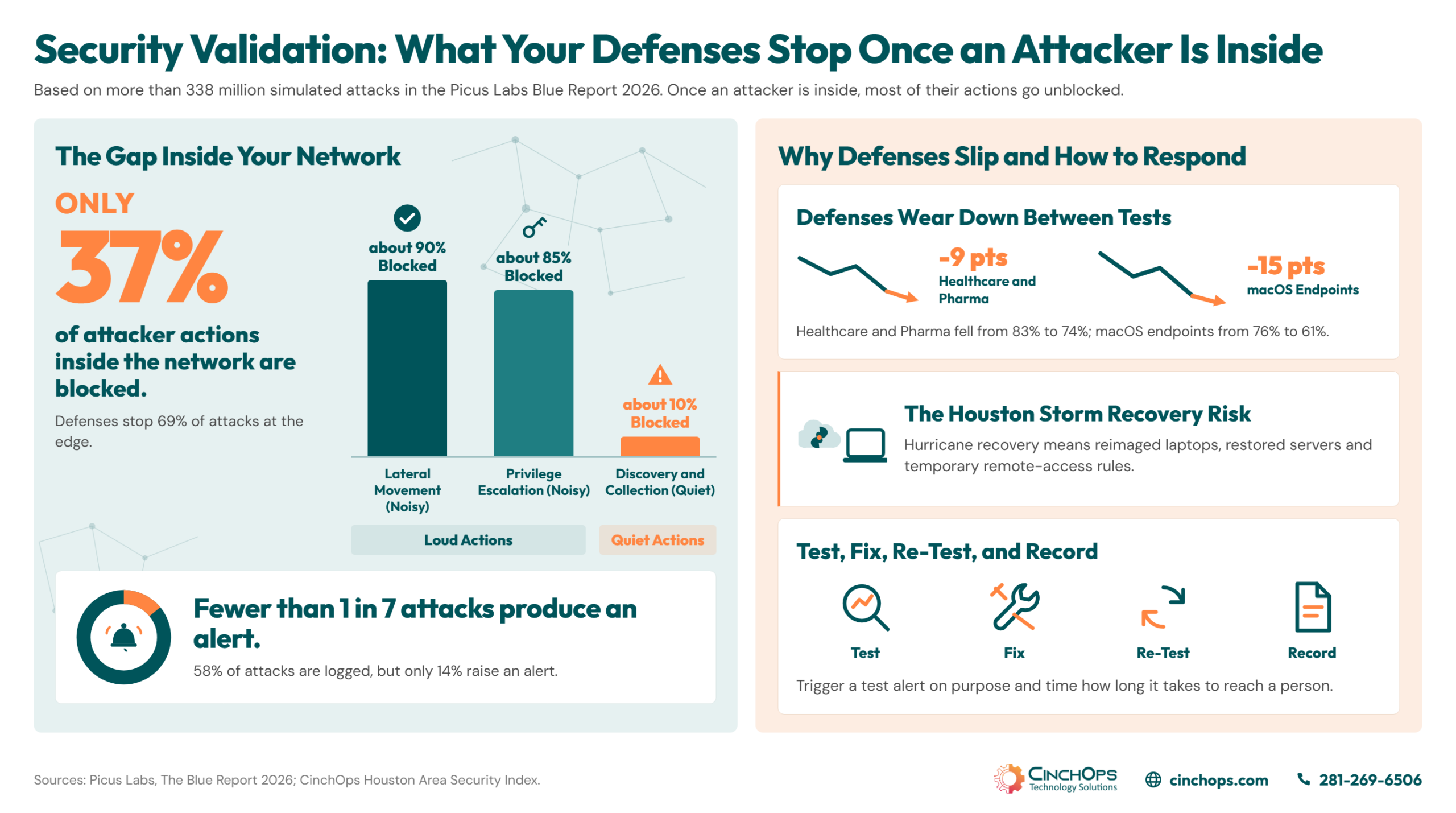
The Post-Compromise Prevention Rate in the Picus Blue Report 2026 was 37%, meaning defenses blocked roughly one attacker action in three once the attacker held a working account. The overall prevention score was 69%. The distance between those two numbers is the central finding of the report.
Picus took the 37% from its Autonomous Penetration Testing product, which runs attacker actions from inside a customer's domain the way an intruder would after stealing a password. The 69% comes from the broader simulation set across attack vectors such as email, web applications, malware downloads and endpoints, and Picus describes it as a measure of how well controls stop attacks at the boundary.
The inside number splits along one clean line. Actions that run code or jump between machines were blocked often. Lateral movement through service execution tools such as SMBExec was stopped around 90% of the time, privilege escalation through UAC bypass around 85%, and credential reuse and Active Directory abuse around 63%. Endpoint scenario prevention reached 83%, the third straight year of gains. That is EDR earning its license fee.
The quiet actions are where defenses fall apart. Discovery and collection were blocked in only about 10% of attempts. Domain enumeration with SharpHound, file share enumeration and session enumeration ran almost unopposed. Reading credentials passively from memory and the registry was blocked roughly 22% of the time. Picus reports the combined discovery and collection figure as its Stealth Prevention Rate.
For a 40-person Houston firm this lines up with how ransomware usually starts. Sophos found that 79% of ransomware attacks in its State of Ransomware 2026 began with compromised identities. An intruder with one stolen password can spend days quietly listing servers, file shares and admin accounts before doing anything noisy. The Blue Report says the noisy step gets caught more often now. The quiet days before it mostly do not.
Logging Reached 58% and Alerting Stayed at 14%
More of each attack is being recorded. Very little of that record reaches a person.
The log-to-alert gap is the difference between how many attacks leave a record and how many produce an alert someone sees. In the Picus Blue Report 2026, 58% of simulated attacks were logged and 14% generated an alert, so fewer than one in seven attacks would have prompted anyone to look.
The log score rose four points to the highest level in four editions of the report. The alert score did not move. Picus reads that as a detection engineering problem: the rules that turn log entries into alerts are not being written, tested and tuned at the pace the logging grew.
The rule-failure breakdown shows where the conversion breaks. For the first time, performance issues were the largest category of detection rule failure at 49% of issues, up from 24% a year earlier. Log collection issues fell to 41.5% and configuration issues to 9.5%. The largest individual line item was improper log source coalescing, at 15% of all issues, where events from DNS servers, proxies, Windows servers or endpoints get compressed or dropped before a rule ever sees them.
Most Houston businesses with 10 to 200 employees do not run a security operations center, and most do not need one. They do have an EDR console, Microsoft 365 alert policies and a firewall, each with alert settings someone configured once. If nobody has triggered those alerts on purpose since then, the business has no evidence its own alert rate is better than 14%.
Test your security alerts the way you test the generator before hurricane season. Nobody in Houston wants to find out it won't start while the water is rising. The Blue Report says most attacks never set off an alert, and the only way to know about yours is to trigger one on purpose.
Last Year's Strongest Defenses Slipped the Most
Security that is not re-tested wears down, and the 2026 industry numbers show how fast it happens.
Configuration drift is the gradual change in how a security tool behaves as policies, software updates and integrations pile up after installation. The Picus Blue Report 2026 found that last year's best-performing sectors regressed while last year's weakest recovered, and Picus summed it up in one line: strong performance is rented, not owned.
Healthcare and Pharmaceuticals, the top industry in 2025 at 83%, fell to 74%. Manufacturing and Engineering dropped from 81% to 72%. Banking, financial services and insurance fell from 76% to 67%, and Energy and Utilities slipped from 73% to 69%. Professional Services moved the other way, rising from 69% to 77%. North America fell from 66% to 60% and now has the lowest prevention score of any region in the report.
Ransomware tells the same story at the family level. Play ransomware was prevented 50% of the time last year and 13% this year. LockBit fell from 45% to 30%. Every one of the ten least prevented families scored 38% or lower. The least prevented vulnerabilities were everyday software: a Windows Notepad flaw (CVE-2026-20841) was blocked in 9% of exploit attempts, Chrome and 7-Zip flaws in 22%, and WinRAR in 24%.
Houston adds a drift event most of the country does not face. The Atlantic hurricane season runs from June 1 to November 30 and peaks around September 10, according to the National Hurricane Center. A storm recovery week changes security settings in bulk: laptops get reimaged, a server comes back from backup carrying last quarter's policies, and a temporary remote-access rule opened during the flooding never gets closed. The controls that passed in June are not the controls running in October unless someone tests them again.
The same logic explains why an outside scan is only half a grade. The CinchOps Houston Area Security Index graded the public-facing security of 3,690 Houston-area businesses and found 49.1% failing with a D or F. That scan sees what the internet sees: DNS, email authentication, exposed services and patch levels on public systems. It cannot see whether an intruder already inside could list your file shares or read a saved password. The Blue Report measures that inside half.
Five checks worth asking your IT provider to run this quarter, drawn from the report's own recommendations:
- A domain enumeration from a normal user account, with a note of whether anything logged it or alerted on it.
- A test alert triggered on purpose in the EDR console and in Microsoft 365, timed from trigger to the moment a person saw it.
- Mac endpoints tested against the same policy as the Windows fleet, as a separate group.
- Patch status of the everyday software the report flagged: browsers, 7-Zip, WinRAR and Windows built-in apps.
- A re-test after every major change, including a storm recovery, before anyone calls the work finished.
Test the Tools You Already Pay For
CinchOps security audits and vulnerability assessments start from what is already installed: EDR, Microsoft 365 alert policies, firewall rules and backups. The question for each one is whether it fires when it should, and the answer belongs in writing with a date next to it. See how CinchOps cybersecurity services work for Houston businesses.
Review your security controls →How CinchOps Helps Houston Businesses Test What Their Security Stops
CinchOps is a managed IT services provider based in Katy, Texas, serving small and mid-sized businesses across the Houston metro area. CinchOps specializes in cybersecurity, network security, managed IT support, VoIP, and SD-WAN for businesses with 10 to 200 employees.
The Blue Report's argument is the same rule CinchOps applies to backups: backups are geo-redundant, stored outside the Gulf Coast flood zone, and restore-tested on a schedule rather than assumed. Detection deserves the same treatment. A control counts when someone has watched it work.
- Through cybersecurity services, EDR runs on every managed device, and security audits and vulnerability assessments check what the tools catch.
- With managed IT support, help desk requests are answered in under 15 minutes, so a suspicious login gets a real answer the same morning.
- Business continuity and disaster recovery keeps backups outside the Gulf Coast flood zone and restore-tests them on a schedule.
- In virtual CTO and CIO services, the quarterly review asks what was tested, not just what was installed.
- For engineering firms, manufacturers, energy and utilities companies, law firms and CPA firms in the sectors the Blue Report tracked.
- Across Houston, Katy, Sugar Land and Cypress, at a flat monthly rate per user with no long-term contracts, no hidden fees and no cancellation penalties.
The best news in the Blue Report is that prevention came back when organizations re-tested their controls and fixed what had drifted. A Houston business can get the same recovery without buying an enterprise platform: pick the quiet actions, trigger the alerts on purpose, and put a date on the result. If you want a second set of eyes on what your tools actually catch, talk to CinchOps.
Frequently Asked Questions
What is security validation?
Security validation is testing whether your security controls actually block and alert on real attacker behavior, instead of assuming they work because they are installed. It usually means running safe, simulated attacks against your own EDR, email filtering and alert rules, then fixing what failed and testing again until the result is recorded.
My business already has EDR and logging. Does the Blue Report apply to us?
Yes, because the report measured businesses that also had those tools. Picus found 58% of simulated attacks were logged but only 14% raised an alert, and only 37% of attacker actions were blocked inside the network. Installed tools were the starting point, and the results show what happens when nobody tests them.
What did the Picus Blue Report 2026 find about ransomware?
Prevention against leading ransomware families went backward in 2026. Play ransomware was blocked in 13% of simulations, down from 50% a year earlier, and LockBit fell from 45% to 30%. Every one of the ten least prevented families scored 38% or lower, even though overall prevention rose to 69%.
What does security validation cost for a Houston business?
CinchOps includes security audits and vulnerability assessments in its managed service at a flat monthly rate of $100 to $250 per user, with no long-term contracts, no hidden fees and no cancellation penalties. Dedicated breach and attack simulation platforms are priced separately and are usually sized for larger security teams.
How often should a small business re-test its security controls?
Re-test after every major change, such as a new firewall, a Microsoft 365 policy update, a server restore or a hurricane recovery, and on a fixed schedule in between. The Blue Report 2026 found the two strongest sectors of 2025, Healthcare and Manufacturing, each fell nine points in a year.
Discover More
Resource
Sources
- Picus Labs, The Blue Report 2026: The State of Threat Exposure Management (PDF)
- Picus Security press release, "Picus Research Finds Defenses Block Only 37% of Post-Compromise Attacker Actions," August 11, 2026
- CinchOps, Houston Area Security Index 2026
- Sophos, State of Ransomware 2026 press release, July 2026
- NOAA National Hurricane Center, Tropical Cyclone Climatology


