


Texas Data Center Boom 2026: What It Means for Houston IT
Texas Beat Virginia, Then Slammed On The Brakes. – Grid Pressure, Power Costs, And Continuity Planning For Houston SMBs
Texas has twice Virginia's data center construction pipeline, and the state just hit pause. What that means for Houston.
Updated October 4, 2026 with ERCOT's Batch Zero screening results.
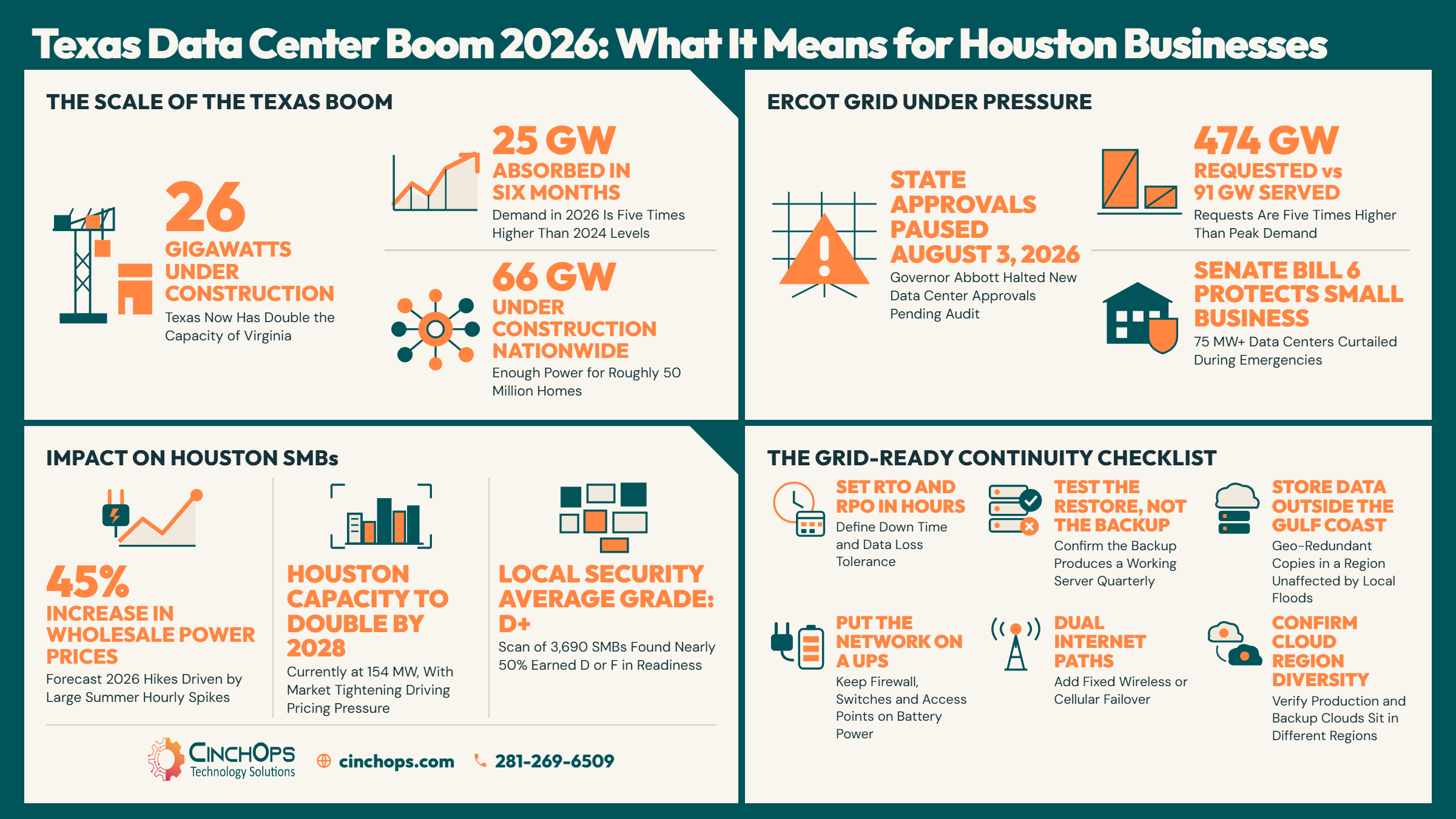
The Texas data center boom crossed a line in 2026: the state now leads the country with 26 gigawatts of data center capacity under construction, double Virginia's 13 gigawatts, according to Jones Lang LaSalle data reported by the Houston Business Journal on August 20, 2026. Houston sits inside that buildout.
Most coverage of that milestone is written for developers, utilities, and investors. Almost none of it is written for the 40-person engineering firm in Katy or the CPA practice in Sugar Land whose phones, files, and payroll all depend on the same wires. That is the gap this post fills. The buildout is not a headline for Houston businesses. It is a change in the operating conditions of their IT.
CinchOps builds business continuity and disaster recovery plans specifically for engineering, manufacturing, and energy services firms across the Houston metro, with geo-redundant backups stored outside the Gulf Coast flood zone and a help desk that answers in under 15 minutes. Grid risk is now part of that plan, not a footnote to it.
Texas Now Leads the Country in Data Center Construction
The ranking flipped on the construction pipeline, not on total market size.
Texas leads the United States with 26 gigawatts of data center capacity under construction, double Virginia's 13 gigawatts, according to Jones Lang LaSalle data reported by the Houston Business Journal on August 20, 2026. Virginia is still widely viewed as the country's largest data center market.
That distinction matters and most coverage blurs it. Texas did not become the biggest data center market. Texas became the place where the most new capacity is going up, which is a statement about the next few years rather than about today.
The national numbers explain the pace. The AI race drove 25 gigawatts of absorption in the first half of 2026, which is double the same period last year and more than five times the mark two years ago. There are currently 66 GW under construction nationwide, enough to power roughly 50 million homes.
25 GW absorbed in six months, double the same period last year and more than five times the mark two years ago. The 66 GW under construction nationwide would power roughly 50 million homes. Demand is not the open question here. Where the power comes from is.
Curt Holcomb, vice chairman with JLL's global data center solutions practice team, traces the shift to a grid problem somewhere else. Northern Virginia has always been the denser market and is still growing, but it ran into power capacity and grid limits four years ago, which pushed developers and end users toward Texas and its wind, solar, and natural gas. "The biggest reason why we have so much demand here is that we have the generation capacity to meet demand," Holcomb said.
- Texas: 26 GW under construction, the largest data center construction pipeline in the country.
- Virginia: 13 GW under construction, and still widely viewed as the largest market overall.
- United States: 66 GW under construction, enough to power about 50 million homes.
- Houston: 154 MW of capacity with 28.5 MW under construction as of the second half of 2025, and CBRE projects the market more than doubles by 2028.
Houston is a small piece of the Texas total. That is the point people miss. Houston does not need to host the gigawatts to feel them, because Houston shares an electricity market with the places that do.
Houston does not need to host the gigawatts to feel them. It shares an electricity market, a grid operator, and a transmission system with the West Texas counties that do, so the price and the capacity pressure arrive here either way.
Texas Paused New Data Center Approvals in August 2026
The boom ran into the state government three weeks before the JLL numbers landed.
Governor Greg Abbott announced a moratorium on new data center approvals on August 3, 2026, directing the Public Utility Commission of Texas and ERCOT to audit proposed projects before they connect to the grid. The audit covers on-site generation versus grid dependence, water use and cooling, tax breaks received, and facility ownership.
ERCOT responded by postponing its Batch Zero transmission planning study and seeking a good-cause exception at the PUCT's August 20 open meeting. Abbott's letter framed the reason bluntly: the roughly 474 gigawatts of interconnection requests sitting with ERCOT is more than five times the state's record peak electricity demand.
Update, September 2026: ERCOT has since run its first screen of that queue. A Batch Zero update presented to the ERCOT board on September 14-15, 2026 conditionally included 204 large-load projects totaling 66.4 GW as base load and 158 more as studied load, and excluded 373 projects totaling 302.2 GW. Houston is in the included group: the Coast region carries 10,976 MW of conditional base load for 2032, and Harris County ranks second in the state at 5,672 MW, just behind Dallas County at 5,713 MW. None of it is final. Energization of new data centers of 75 MW or more stays paused, and ERCOT's eligibility verification report is due to the PUCT by December 10, 2026.
This did not come from nowhere. Local communities have been imposing new reporting rules, pausing tax abatements, and denying some projects outright, and the Texas legislature is expected to take up more regulation in next year's session. Dozens of developers have since publicly committed to reusing water, funding infrastructure upgrades, and paying their own way.
Holcomb argues the industry can meet that bar and is already doing it. "The reality is this: The data center developers and operators and end users have to develop responsibly. That means meeting these demands. In most cases, that's already being done," he said, noting the industry moved from evaporative to closed-loop cooling nearly a decade ago and that water use on individual projects is one-tenth what it was then. He also concedes that fewer projects will get built than are currently proposed.
Here is the part a Houston business owner should take away. A pause is not a cancellation, and an audit is not a reversal. What the moratorium actually removes is certainty about timing, which is the one thing a capacity plan needs most. If you were counting on new grid capacity, a colocation build, or a utility service upgrade landing on a particular date, that date is now a guess.
What Does 474 GW in ERCOT's Queue Mean for a Houston Business?
The interconnection queue is the clearest early signal of where Texas power gets tight.
ERCOT's large-load interconnection queue is the list of big new electricity users waiting for permission to plug into the Texas grid. It now holds roughly 474 gigawatts of requests, about 90% of it data centers, which is more than five times the record peak demand the entire Texas grid has ever served.
For scale: ERCOT's all-time peak demand is 91,089 MW, set July 22, 2026. Watch the trajectory rather than the number. At the December 9, 2025 board meeting, Kristi Hobbs, ERCOT's vice president of system planning and weatherization, put the queue at 233 GW and said the agency had "outgrown the process that was established for reviewing these large loads." Eight months later it had roughly doubled again.
Almost none of that gets built, because queues always shrink, and Holcomb says as much. But the planning strain is real. ERCOT's own preliminary long-term forecast, filed April 15, 2026, projects roughly 367,790 MW of demand by 2032, and ERCOT president and CEO Pablo Vegas said plainly that the agency believes "this forecast to be higher than expected future load growth."
Take the caveat seriously. The useful reading is not the 2032 number. It is that Texas utilities, regulators, and transmission planners are working a queue they have publicly said they outgrew, and Holcomb points out the buildout still needs transmission, switch stations, and substations that are hard to deliver on schedule even when end users pay for them. That shows up downstream as longer service-upgrade timelines, and a Houston business that needs a bigger electrical service for a new suite, a shop expansion, or a rack of on-prem gear is standing in a much longer line than it was two years ago.
- Longer lead times on utility service upgrades and new capacity requests.
- Thinner reserve margins on high-demand summer afternoons across the ERCOT footprint.
- More conservative siting decisions if you are weighing an on-prem server room against cloud.
Senate Bill 6 Lets ERCOT Switch Off Data Centers Before It Switches Off You
Texas wrote the curtailment order into law in 2025, and it lands on the big loads first.
Texas Senate Bill 6, signed by Governor Greg Abbott on June 20, 2025 and effective immediately, applies to electric loads of at least 75 megawatts and requires that large loads interconnected after December 31, 2025 install equipment allowing ERCOT to directly curtail them during firm load shed events and emergencies.
SB 6 also makes large loads disclose whether they run on-site backup generation covering half or more of their demand, and it lets ERCOT direct those customers to fire up that generation or drop load with reasonable notice during an emergency. New large-load customers pay a minimum $100,000 upfront for an initial transmission screening study.
Read that from a Houston business owner's chair and it is genuinely good news. The state built a switch that sheds hyperscale campuses ahead of neighborhoods and small commercial customers. SB 6 does not make your office immune to a rolling outage, and it does not touch the ordinary causes of downtime in this market: a hurricane, a derecho, a transformer fire, a contractor's trencher. It means the newest, largest loads are first in line to be shed.
In 35+ years doing this, I have watched more Houston businesses lose a workday to one dead UPS battery than to anything ERCOT ever did. The grid story is real. It is still not the most likely reason your office goes dark this year.
Does your continuity plan assume power?
Most plans we review cover ransomware and floods, then quietly assume the lights stay on. We will show you where yours breaks.
Talk to CinchOpsWill the Data Center Boom Raise What Houston Businesses Pay for Power?
Wholesale price pressure is the part of this that reaches a 30-person office fastest.
The U.S. Energy Information Administration's Short-Term Energy Outlook forecasts wholesale power prices at ERCOT's North Hub rising roughly 45% in 2026 against 2025, driven less by a higher flat average than by large hourly spikes on summer afternoons when demand is high and renewable output is not.
EIA also expects U.S. commercial electricity sales to grow 2.2% in 2026, with the strongest increases in the West South Central region on the back of Texas data center and manufacturing growth. Data center rents move the same direction: JLL reports colocation rental rates up nearly 70% since 2020, averaging about 9% a year.
Two practical consequences for a Houston small or mid-sized business. Your retail electricity renewal quote is where this shows up first, and the summer months carry the spikes. And if you rent rack space at a Houston colocation facility, expect renewal pressure, because that market is tight: CBRE counted 154 MW of Houston capacity in the second half of 2025 with 28.5 MW under construction.
| Where you run IT | What the boom changes | What to do about it |
|---|---|---|
| On-prem server room | Higher power bills, longer waits for service upgrades | Right-size the hardware, price the cloud alternative honestly |
| Houston colocation | Tight supply, renewal pricing pressure | Start renewal talks early, get multi-year terms in writing |
| Public cloud | Regional capacity constraints, not your power bill | Confirm your primary region and your failover region are different |
| Hybrid | Both sets of pressure, plus a network dependency | Dual circuits and SD-WAN failover between them |
Best Business Continuity and Disaster Recovery Providers in Houston
Plan for Grid Risk, Not Just Storms
The data center story changes one input to a continuity plan. It does not change the plan's job.
Business continuity and disaster recovery planning means deciding, in advance and in writing, how long your Houston business can be down and how much data it can afford to lose, then engineering to those two numbers. The Texas grid is now one more input to that math alongside hurricanes, flooding, ransomware, and hardware failure.
Here is the uncomfortable part. Most Houston SMBs are not close to ready for the boring version of this, let alone the grid version. The CinchOps Houston Area Security Index 2026 scanned 3,690 Houston-area small and mid-sized businesses and found an average grade of D+ at a 1.51 GPA, with 49.1% earning a D or F and only 24.5% earning an A or B. A firm that cannot pass an external security scan is not going to ride out a regional power event gracefully.
We see this twice a month with Houston businesses: a plan that names a backup vendor, lists a phone tree, and has never once been restored end to end. Grid pressure does not create that gap. It just raises the odds you find it the hard way.
- Set an RTO and an RPO in hours, not adjectives. "As fast as possible" is not a target anyone can engineer against.
- Test the restore, not the backup. A backup job that reports success and a restore that produces a working server are different events. Test quarterly.
- Put a copy outside the Gulf Coast flood zone. A regional event that takes your office and your backup at the same time is the scenario that closes businesses.
- Put the network on a UPS, not just the servers. Firewall, switch, and access points on battery keeps a laptop-and-cloud office running through a short outage.
- Give the internet a second path. Fixed wireless or cellular failover behind SD-WAN covers the cut fiber and the dark block alike.
- Check your cloud regions. If your production tenant and your backup copy sit in the same Texas region, you have one region, not two.
None of that is new advice. It is the same advice that was right in 2019, which is exactly why the data center headline should not send anyone shopping for something exotic. If your firm has never tested a restore, that is the whole project. Start there.
Every few years something arrives that owners are told will change everything about their IT. The cloud. Then AI. Now data centers eating the grid. And every time, the businesses that come through fine are the ones that already knew their recovery time, tested their restores, and put a copy of their data somewhere a Gulf Coast storm cannot reach. The headline changes. The proven solutions do not.
Find out what actually breaks before the grid does
A CinchOps continuity review maps your recovery time objective, your recovery point objective, and every dependency between them, then tests a live restore. It covers power, network, cloud region, and the pieces of business continuity and disaster recovery most Houston plans skip.
See how CinchOps handles continuity →How CinchOps Can Help Houston Businesses Build Around Grid Risk
CinchOps is a managed IT services provider based in Katy, Texas, serving small and mid-sized businesses across the Houston metro area. CinchOps specializes in cybersecurity, network security, managed IT support, VoIP, and SD-WAN for businesses with 10 to 200 employees.
The Texas data center boom does not need a new product line. It needs the fundamentals done properly and tested on a schedule.
- Through business continuity and disaster recovery, we set a written RTO and RPO, run geo-redundant backups outside the Gulf Coast flood zone, and prove them with scheduled restore tests instead of green checkmarks.
- Through managed IT support, we run a flat monthly rate per user so the bill tracks headcount rather than incidents, with help desk response under 15 minutes and no contracts, hidden fees, or cancellation penalties.
- Through SD-WAN, we give offices a second internet path with automatic failover, so one cut line or one dark block does not stop the day.
- Through cloud services, we place workloads and their backup copies in genuinely separate regions and document what runs where.
- For energy and utilities and manufacturing firms, we keep IT and OT/SCADA networks segmented so an office-side incident cannot reach the plant floor.
- For engineering firms and oil and gas companies, we protect the large project files and modeling data that a partial restore quietly ruins.
- Across Houston and Katy, we work on site when a problem needs hands on hardware.
Texas winning the data center race is a good thing for this region, and it is going to make electricity more expensive and capacity harder to get for a while. Neither fact should reorganize your IT roadmap. What should reorganize it is discovering that your last real restore test was in 2023, or that your backup copy lives in the same building as the server it protects. If you are not sure which of those describes you, talk to CinchOps and we will find out together.
Frequently Asked Questions
Did Texas really pass Virginia for data centers?
For construction, yes. JLL data reported August 20, 2026 puts Texas at 26 gigawatts under construction, double Virginia's 13. Virginia is still widely viewed as the largest data center market overall. Texas also paused new approvals on August 3, 2026 pending a state audit, so the pipeline now carries timing risk.
Will data centers cause power outages for Houston businesses?
Not directly. Texas Senate Bill 6, effective June 20, 2025, requires large loads of 75 megawatts or more interconnected after December 31, 2025 to let ERCOT curtail them during emergencies, so hyperscale campuses get shed before small commercial customers. Hurricanes and equipment failure remain the likelier causes of Houston downtime.
What does business continuity planning cost in Houston?
CinchOps prices continuity inside a flat monthly rate per user, so cost tracks headcount rather than incident count. A 25-person Houston firm pays the same predictable amount each month whether it is a quiet quarter or a hurricane week. No contracts, no hidden fees, no cancellation penalties, and a 30-day satisfaction guarantee.
How much will Texas electricity prices rise in 2026?
The U.S. Energy Information Administration's Short-Term Energy Outlook forecasts wholesale prices at ERCOT's North Hub climbing roughly 45% in 2026 against 2025, driven by large hourly spikes on summer afternoons rather than a higher flat average. EIA expects the strongest U.S. commercial demand growth in the West South Central region.
Should a Houston small business move off on-prem servers because of this?
Not automatically. Grid pressure raises the cost of running your own room and lengthens utility service-upgrade timelines, which shifts the math toward cloud or colocation. Run the comparison on your real numbers. A tested restore and a backup copy outside the Gulf Coast flood zone matter more than where the server sits.
Discover More
Resource
Sources
- Houston Business Journal, "Texas has now surpassed Virginia for data center construction, data shows," by Justin Sayers, August 20, 2026 - Texas at 26 GW under construction versus Virginia's 13 GW, 66 GW under construction nationwide, 25 GW of first-half 2026 absorption, and the Curt Holcomb quotes.
- JLL, North America Data Center Report Midyear 2026 - Texas at 26 GW versus Virginia at 13 GW, 66 GW under construction, 95% pre-committed, 1% vacancy, 25 GW first-half absorption, colocation rents up nearly 70% since 2020.
- JLL newsroom, "Data center demand exceeds expectations as H1 2026 absorption hits record 25 GW," August 11, 2026
- ERCOT, All-Time Peak Demand Records - 91,089 MW set July 22, 2026 (unofficial pending final settlement).
- Utility Dive, ERCOT large-load queue reporting - Kristi Hobbs, ERCOT VP of system planning and weatherization, 233 GW queue as of the December 9, 2025 board meeting.
- Utility Dive, "Facing an estimated 474 GW of interconnection requests, Texas hits pause on data centers" - Governor Abbott's August 3, 2026 moratorium, the PUCT and ERCOT audit scope, roughly 474 GW of requests at about 90% data centers, and ERCOT delaying its Batch Zero transmission planning study.
- ERCOT Board of Directors, "Item 14: Batch Zero Update," September 14-15, 2026 - 204 projects (66.4 GW) conditionally included as base load, 158 as studied load, 373 projects (302.2 GW) excluded, Coast region at 10,976 MW and Harris County at 5,672 MW of conditional base load for 2032, and the December 10, 2026 verification report deadline.
- The Texas Tribune, "New Texas data center projects frozen until state audits them," August 3, 2026
- ERCOT, Preliminary Long-Term Load Forecast for 2026-2032, April 15, 2026 - roughly 367,790 MW projected for 2032, with ERCOT's own caveat on the figure.
- Bracewell LLP, analysis of Texas Senate Bill 6 - signed June 20, 2025, 75 MW threshold, curtailment equipment for loads interconnected after December 31, 2025, backup generation disclosure, $100,000 minimum study fee.
- U.S. Energy Information Administration, Short-Term Energy Outlook - ERCOT North Hub wholesale prices up roughly 45% in 2026, U.S. commercial electricity sales up 2.2%, strongest growth in the West South Central region.
- CBRE, North America Data Center Trends H2 2025
- Energy Capital HTX, reporting CBRE's Houston figures - Houston at 154 MW with 28.5 MW under construction in the second half of 2025, capacity projected to more than double by 2028.
- CinchOps Houston Area Security Index 2026 - 3,690 Houston-area small and mid-sized businesses scanned, average grade D+ at 1.51 GPA, 49.1% earning a D or F, 24.5% earning an A or B.


