


Why Houston Businesses Cannot Afford to Delay Microsoft Updates
A Record Release Is A Prioritization Problem, Not A Volume Problem – What Houston Businesses Should Patch First
Microsoft's largest single release on record, read through the Houston Area Patch Index.
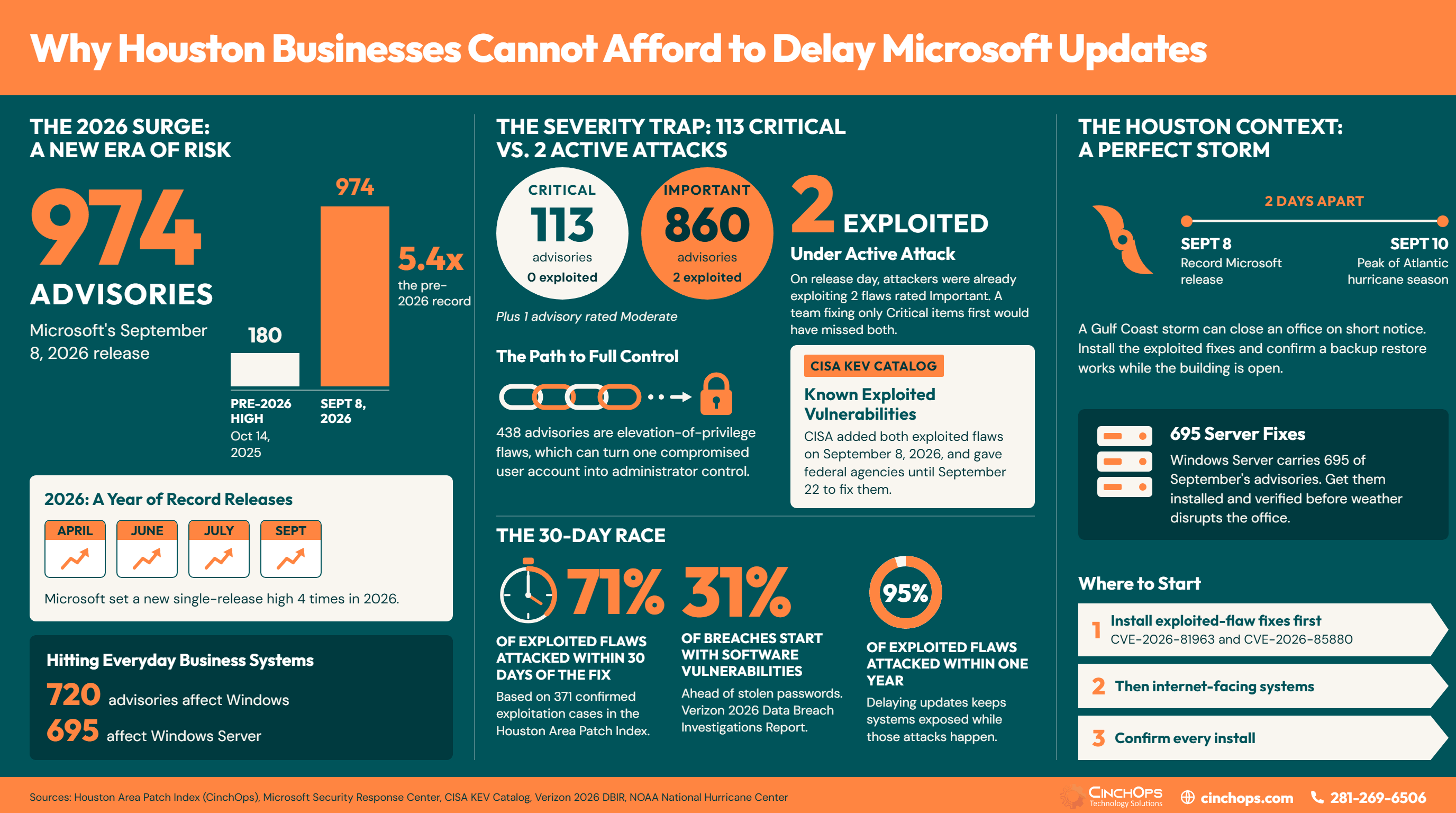
September 2026 Patch Tuesday was the largest single release Microsoft has shipped: 974 advisories on September 8, 5.4 times the biggest release before 2026. For a Houston business deciding what to install first, the size is the least useful number in it.
The useful number is 2. Attackers were already exploiting 2 of the 974 flaws when Microsoft published the fixes, and neither sat among the 113 advisories Microsoft rated Critical. A team working through the September release by severity score would have patched 113 items before reaching either flaw attackers were actually using.
CinchOps provides patch management and cybersecurity specifically for small and mid-sized businesses in Houston, prioritizing every Microsoft release against the CISA exploited-vulnerabilities list, with help desk requests answered in under 15 minutes.
Microsoft's September 8 Release Is the Largest on Record
How the September 8, 2026 release compares with every Microsoft Patch Tuesday the Houston Area Patch Index has tracked since January 2022.
Patch Tuesday is Microsoft's scheduled monthly security release, published on the second Tuesday of each month. The September 8, 2026 release carried 974 advisories, the largest single release in the Houston Area Patch Index and the largest of the 192 monthly releases in Microsoft's security update catalog.
Before 2026, the biggest Microsoft release in the index was October 14, 2025, at 180 advisories. September's release is 5.4 times that. It also passed the two releases that had just set new highs: July 14, 2026 at 662 advisories and August 11, 2026 at 456. The five largest Microsoft releases in the index all landed in 2026.
Most of that volume lands on the software every Houston office already runs. Of the 974 September advisories:
- 720 affect Windows, and 695 of those affect Windows Server
- 109 affect Office and the Microsoft 365 desktop apps
- 64 affect SQL Server
- 438 are elevation-of-privilege flaws, the largest category, ahead of 258 remote code execution flaws
The 2 Flaws Attackers Were Already Using Were Rated Important, Not Critical
What the 2 exploited September 2026 advisories were, why their severity ratings understated them, and what Houston businesses should install first.
CISA added CVE-2026-81963 and CVE-2026-85880 to its Known Exploited Vulnerabilities catalog on September 8, 2026, the same day Microsoft released the fixes. Microsoft rated both Important with a CVSS score of 7.8, and marked both as exploited at the time of release.
Both are Windows elevation-of-privilege flaws. CVE-2026-81963 sits in the Windows Update Stack, and CISA lists it as a link following vulnerability. CVE-2026-85880 sits in Windows Advanced Local Procedure Call (ALPC), and CISA lists it as a heap-based buffer overflow. Microsoft reported neither as publicly disclosed before the release.
Elevation-of-privilege flaws score lower than remote code execution because an attacker needs a foothold first. In practice, attackers pair them with a phished login or a malicious attachment, which turns one compromised user account into administrator control of the machine. The severity score measures the flaw on its own. Attackers do not use it on its own.
The timing matters on the Gulf Coast. NOAA's National Hurricane Center puts the peak of the Atlantic hurricane season on September 10, and Microsoft's largest release landed 2 days earlier. For a business in Houston, Katy, or Sugar Land, that put 695 Windows Server advisories into the same stretch when a storm can close the office on short notice. Get the 2 exploited fixes installed and a backup restore verified in the first maintenance window, while the building is still open.
A severity score tells you how bad a flaw could be. It says nothing about whether anyone is using it this week. September settled that argument: 113 criticals, and the 2 flaws attackers were actually using were not on that list.
What Is Patch Management and Why Does It Matter?
A working definition of patch management and the order a Houston business should apply the September 2026 release in.
Patch management is the process of finding which software updates apply to your systems, deciding which go first, installing them, and confirming they actually took. It matters because the 2026 Verizon Data Breach Investigations Report found that 31% of breaches start with software vulnerabilities, ahead of stolen passwords.
The Houston Area Patch Index measures how fast that risk arrives once a fix is public. Across 371 confirmed exploitation cases in the index, 71% were under confirmed attack within 30 days of the fix becoming available, and 95% within a year. A Houston business that patches quarterly is outside that window for most of the flaws attackers actually use.
For the September 2026 release, the working order is short:
- Exploited flaws first. The fixes for CVE-2026-81963 and CVE-2026-85880 go on every Windows PC and server within days. CISA gave federal agencies until September 22, 2026.
- Internet-facing systems next. Critical remote code execution fixes go on anything reachable from outside the network, including remote access and web-facing servers.
- Everything else on schedule. The remaining advisories follow your normal monthly maintenance window.
- Confirm every install. An update that downloaded but never finished its restart leaves the old code running.
In 35+ years doing this, the failure after a heavy release is rarely a missed download. The update arrives, the restart gets postponed a few times, and the machine keeps reporting itself as current. Servers take the worst of it, because nobody wants to reboot the file server in the middle of a workday, and September put 695 advisories on Windows Server.
Not Sure the September Fixes Actually Installed?
CinchOps checks install status on every PC and server, not just what was pushed, and answers help desk requests in under 15 minutes. See how CinchOps cybersecurity puts exploited flaws at the front of the queue.
Check your patch status with CinchOps →How CinchOps Can Help Houston Businesses Patch What Attackers Use First
CinchOps is a managed IT services provider based in Katy, Texas, serving small and mid-sized businesses across the Houston metro area. CinchOps specializes in cybersecurity, network security, managed IT support, VoIP, and SD-WAN for businesses with 10 to 200 employees.
- Through managed IT support, CinchOps applies each Patch Tuesday release on a set schedule and confirms every install instead of trusting the download.
- Through cybersecurity services, flaws on the CISA exploited list move to the front of the queue regardless of their severity score.
- Through business continuity and disaster recovery, backups are geo-redundant, stored outside the Gulf Coast flood zone, and restore-tested on a schedule rather than assumed.
- CinchOps supports managed IT in Houston, Katy, and Sugar Land.
- Patch schedules are built around how law firms, CPA firms, and engineering firms actually use their Windows servers during the work week.
Microsoft set a new single-release high 4 times in 2026, in April, June, July, and September. The businesses that come through a 974-advisory month cleanly are the ones that installed the 2 fixes that mattered first and checked that they took. If you cannot say with certainty that yours did, talk to CinchOps.
Frequently Asked Questions
Was September 2026 Patch Tuesday the largest Microsoft has released?
Yes. Microsoft's September 8, 2026 release carried 974 advisories, the largest single release in the Houston Area Patch Index, which tracks Microsoft releases back to January 2022. The biggest release before 2026 had 180. Microsoft set a new single-release high 4 times in 2026, in April, June, July, and September.
Which September 2026 updates should a Houston business install first?
Install the fixes for CVE-2026-81963 and CVE-2026-85880 first, on every Windows PC and server. Both were under active attack on release day, and CISA added both to its Known Exploited Vulnerabilities catalog on September 8, 2026, with a federal due date of September 22. Critical fixes on internet-facing systems come next.
Why were the exploited September flaws rated Important instead of Critical?
Both are elevation-of-privilege flaws, which Microsoft scores lower because an attacker needs a foothold first, such as a phished login. Severity measures how much damage a flaw can do on its own. It does not measure whether attackers are using it, which is why an exploited Important fix belongs ahead of an unexploited Critical one.
How can I tell whether the September updates actually installed?
Check each machine's update history for the September 2026 cumulative update and confirm no restart is pending, because a downloaded update does not replace running code until the restart finishes. Across many PCs and servers, that check needs central reporting, which a managed patch management service provides instead of trusting each machine to report itself.
What does patch management cost for a Houston business?
CinchOps includes patch management in its managed IT and security service at a flat monthly rate per user, from $100 to $250 per user per month depending on the service tier. The terms are Zero-Zero-Zero: no long-term contracts, no hidden fees, and no cancellation penalties, so the price holds when a record Patch Tuesday lands.
Discover More
Resource
Sources
- CinchOps, Houston Area Patch Index (updated September 12, 2026)
- Microsoft Security Response Center, September 2026 Security Updates release document
- Microsoft Security Update Guide, CVE-2026-81963
- CISA, Known Exploited Vulnerabilities Catalog (catalog version 2026.09.11)
- Verizon, 2026 Data Breach Investigations Report
- NOAA National Hurricane Center, Tropical Cyclone Climatology


