


State of AI for Business 2026: Is Your Team Ahead of Your Company?
How Houston Small Businesses Can Catch Up To Their Own Teams On AI – Is Your Staff Putting Client Data Into Personal AI Accounts?
What 2,109 professionals told SmarterX, and what it means for a 10 to 200 person Houston business.
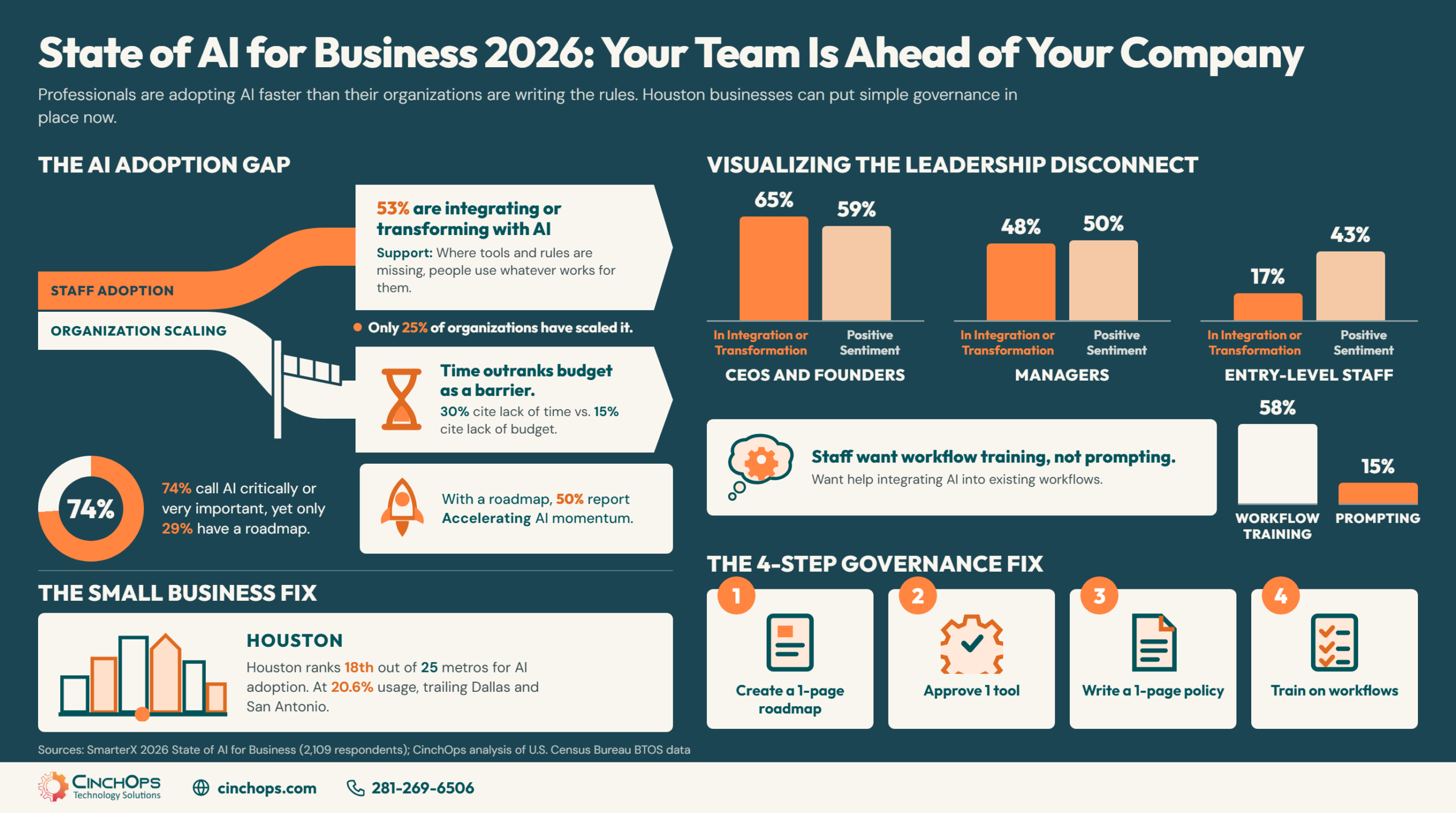
The State of AI for Business 2026 report from SmarterX says the people inside most companies are ahead of the companies themselves. More than half of the 2,109 professionals surveyed already work AI into their daily jobs, yet only one organization in four has moved past pilot projects.
That gap is the whole story for a Houston owner. Your office manager may already be drafting proposals with a personal ChatGPT account. Your estimator may be summarizing bid documents in a free tool nobody approved. The company, meanwhile, has no licensed tool, no written rules and no plan. SmarterX CEO Paul Roetzer calls this "shadow AI" in the report's opening letter: when companies fail to provide approved tools and training, "employees do not stop using AI."
One caution before the numbers. The survey was promoted through SmarterX and Marketing AI Institute channels, 32% of respondents work in marketing, and the report itself warns that its audience "may display higher levels of understanding and adoption of AI than the broader industry." Houston runs well behind that crowd. CinchOps' analysis of U.S. Census Bureau survey data puts Houston-area business AI use at 20.6%, 18th of the 25 largest metros and behind Dallas at 22.6% and San Antonio at 22.9%.
Read that way, the SmarterX findings describe the front of the line. For most Houston businesses with 10 to 200 employees, the habits have not fully set yet, which means the rules can still arrive before the mess does. CinchOps handles approved AI tools, a written AI use policy and data guardrails as part of managed IT for 10 to 200 employee Houston businesses, at a flat $100 to $250 per user per month with help desk answers in under 15 minutes.
How Far Ahead of Your Company Is Your Team on AI?
The SmarterX 2026 survey measured individuals and organizations separately, and the two numbers do not match.
In the 2026 State of AI for Business survey, 53% of professionals say they are in the Integration or Transformation phase of AI use, while only 25% say their organization has reached Scaling. Among the people furthest along, 62% work at a company that has not scaled AI yet.
The table below lines up what SmarterX respondents report doing against what their employers have put in place. Each row pairs an individual figure with an organizational one from the same survey.
| What is being measured | What individuals report | What organizations have in place | What a small business owner should read from it |
|---|---|---|---|
| How far AI use has gone | 53% in Integration or Transformation | 25% of organizations at Scaling; 47% still Piloting | Staff habits are forming faster than company rules |
| How much AI matters | 74% call AI critically or very important for the next 12 months | 29% have an AI roadmap for the next 1 to 2 years | Urgency without a written plan produces scattered pilots |
| Training | 58% want help integrating AI into existing workflows | 46% of organizations offer any AI training | Most teams are teaching themselves |
| AI agents | 51% want agent training; 40% say agents are the trend they follow most | 48% have generative AI usage policies | The riskiest tools are arriving before the rules |
| Ownership | 59% say executive leadership owns AI | 13% say no one owns AI; 3% are not sure | About one in six works where nobody is accountable |
The gap is widest at the top. Sixty-five percent of CEOs, founders and presidents in the survey sit in Integration or Transformation, with 37% in Transformation alone. Directors come in at 53%, managers at 48% and specialists or entry-level staff at 17%. SmarterX warns that the most advanced leaders "may underestimate how far behind the rest of the organization remains."
- Ask your team which AI tools they already use for work, and on which accounts. The answer is usually longer than the owner expects.
- Treat anything pasted into a personal AI account as data that has left the company, because on most consumer plans it has.
- Ask below the management layer too. The report found specialists and entry-level staff far behind their CEOs, so the owner's own comfort with AI is a poor guide to the office.
Does Company Size Change Which AI Tools and Rules You Need?
SmarterX broke its results out by revenue band, and the pattern splits cleanly by company size.
Company size changes both the AI tool a business provides and whether anyone governs it. In the SmarterX 2026 data, 73% of firms under $1M in revenue provide ChatGPT, while 73% of $1B+ enterprises provide Microsoft Copilot, and AI councils rise from 19% of the smallest firms to 64% of the largest.
The tool split tracks how software gets bought. Small firms pick tools the way the owner picks them: Gemini shows up at 62% of firms under $1M and Claude at 53%. As revenue climbs, ChatGPT falls to 37% at $500M to $1B while Copilot rises to 72%. SmarterX ties that to Microsoft's existing Office 365 and Azure relationships. A Houston business that already pays for Microsoft 365 is one license away from Copilot.
Governance climbs the same hill. Nineteen percent of firms under $1M have an AI council, 31% at $1M to $10M and 42% at $10M to $50M. Training follows the money too: 66% of respondents at $1B+ firms get AI training from their employer, against 40% at the smallest firms. The roadmap is the exception. Only 40% of $1B+ firms have one, which SmarterX reads as "a leadership and prioritization problem," not a resource problem.
A small business does not need a council. It needs the job a council does, done by two or three named people in an hour a month. The tool choice matters less than making one choice, licensing it properly and telling staff that personal accounts are off the table for client data.
Not Sure Which AI Tools Your Team Already Uses?
CinchOps can review the AI apps connected to your Microsoft 365 tenant and sort what is licensed, what is personal and what needs a rule.
Talk to CinchOpsIs Budget or Time the Real AI Barrier for a Small Business?
SmarterX split its old "lack of resources" answer in two for 2026, and the result points at the calendar, not the checkbook.
Time is the bigger AI barrier. In the 2026 State of AI for Business survey, 30% of respondents named lack of time as a barrier to AI adoption and only 15% named lack of budget. Education and training (38%) and awareness (35%) still lead the list.
The barrier changes as a company matures. SmarterX sorted the answers by organizational stage, and the number one barrier moves from "we don't know" to "we don't have the hours."
The training people ask for has moved past the basics too. Asked which AI topics they most want to learn, 58% picked integrating AI tools into existing workflows, 51% using AI agents and 45% building no-code assistants such as custom GPTs. Prompting, the staple of every 2024 lunch-and-learn, drew 15%. SmarterX puts it bluntly: a program still built around introductory prompting is "serving the needs of 2024, not 2026."
- Pick one workflow per department, such as quote follow-ups or month-end reconciliation notes, and train on that workflow, not on AI in general.
- Block the time on the calendar. An hour a week for four weeks beats a day-long seminar nobody applies.
- Hold agent experiments until the basics are written down, because agents act on your data rather than just summarizing it.
Every tool I have watched come into small business arrived the same way: staff first, policy second, cleanup third. AI is moving faster than any of them. The owners who write the rules this year get to skip the cleanup.
What Do Companies With Accelerating AI Have That Others Lack?
SmarterX cross-cut four governance questions against how respondents describe their company's AI momentum.
Companies with accelerating AI tend to have written governance. In the 2026 SmarterX survey, only 13% of organizations had all four foundations (an AI council, an AI roadmap, generative AI policies and an AI ethics policy), and half of them described their AI momentum as Accelerating. Among the 32% with none of the four, 19% did.
The roadmap is the clearest single signal. Where a roadmap exists, 50% of respondents describe momentum as Accelerating and 21% as Inconsistent or Siloed. Across the full sample those numbers are 28% and 41%. Training shows a smaller version of the same link: 37% Accelerating with training in place, 21% without.
For a small business, the four foundations shrink to something an owner can finish in a month. A roadmap becomes one page listing three use cases for the next 12 months. A council becomes a named owner plus one person from operations. The generative AI policy and the ethics policy become a single page that says which tool is approved, what data never goes into it, and who checks AI output before it reaches a client.
Shadow AI Is a Data Problem Before It Is a Productivity Problem
When staff paste client files, contracts or payroll data into personal AI accounts, that data sits outside your Microsoft 365 controls, your retention rules and your cyber insurance answers. CinchOps cybersecurity puts approved AI inside the same identity, MFA and data-loss rules as the rest of your tenant.
See how CinchOps secures AI use →How CinchOps Helps Houston Businesses Close the AI Gap
CinchOps is a managed IT services provider based in Katy, Texas, serving small and mid-sized businesses across the Houston metro area. CinchOps specializes in cybersecurity, network security, managed IT support, VoIP, and SD-WAN for businesses with 10 to 200 employees.
The SmarterX data describes a gap between people and companies. For a Houston business that already runs on Microsoft 365, closing it is mostly IT work: licensing, identity, data rules and training on the workflows people actually use.
- Through vCIO and CTO services, CinchOps writes the one-page AI roadmap and names the use cases worth funding first.
- Through managed IT support, CinchOps licenses the approved tool, including Microsoft 365 Copilot, and removes the guesswork about which account is the work account.
- With cybersecurity services, CinchOps applies MFA, conditional access and data-loss rules so approved AI stays inside your tenant.
- Business process automation from CinchOps turns one repeated workflow into an AI-assisted one, which is the training SmarterX respondents asked for most.
- CinchOps supports businesses in Houston, Katy, Sugar Land and The Woodlands, including engineering firms, CPA firms and construction companies.
Your team decided about AI months ago. The only open question is whether the company catches up on purpose or finds out during a client complaint, an insurance renewal or a data leak. A one-page roadmap and one approved tool is a small job that closes most of the gap, so talk to CinchOps about getting it done this quarter.
Frequently Asked Questions
What is the 2026 State of AI for Business report?
The 2026 State of AI for Business report is SmarterX's annual survey of how professionals and organizations use AI. It gathered 2,109 responses to 34 questions between February and April 2026. It is the first edition under that name, expanding the earlier State of Marketing AI report to all business functions.
Do the SmarterX numbers apply to a 25-person Houston company?
Partly. SmarterX says its audience leans toward AI education, and 32% of respondents work in marketing. CinchOps' analysis of Census Bureau data puts Houston-area business AI use at 20.6%. Treat the survey as the leading edge: the gap between staff and company rules likely exists in your office, only earlier.
Should a small business license ChatGPT or Microsoft Copilot?
If the business already runs Microsoft 365, Copilot is usually the simpler choice because it sits inside the identity and data controls you already pay for. SmarterX found ChatGPT leads at the smallest firms and Copilot at enterprises. Either works if you license one properly and ban personal accounts for client data.
What goes in a small business AI use policy?
A small business AI use policy names the approved tool, lists the data that never goes into any AI tool, such as client files, financials and passwords, and says who reviews AI output before it reaches a customer. One page is enough. Only 48% of organizations in the SmarterX survey have generative AI policies at all.
What does AI readiness support cost in Houston?
CinchOps includes AI tool licensing, policy and data guardrails in managed IT at a flat $100 to $250 per user per month, with no long-term contracts. Microsoft's own list prices, paid yearly, are $23.50 per user per month for Business Standard with Copilot and $32.00 for Business Premium with Copilot.
Will AI cut jobs at my company?
Nobody can promise either way. In the SmarterX survey, 71% of respondents expect AI to eliminate more jobs than it creates over three years, yet only 20% are concerned about their own role. Owners who explain plainly how AI will change each role keep more trust than owners who say nothing.
Discover More
Resource
Sources
- SmarterX, 2026 State of AI for Business Report - 2,109 respondents, fielded February to April 2026
- SmarterX, "The State of AI for Business: 10 Key Findings"
- CinchOps, Houston Small Business AI Adoption: The 2026 Census Report - analysis of U.S. Census Bureau Business Trends and Outlook Survey data
- U.S. Census Bureau, Business Trends and Outlook Survey data
- Microsoft, Compare All Microsoft 365 Business Plans - list prices checked September 2026


