


AI Agent Security for Houston Businesses: Who Is Your Agent For?
What The 2026 AI Governance Report Means For Houston Small Businesses – When An AI Agent Should Need A Human Approval
What the 2026 AI governance research means for Houston businesses that have already connected an AI agent to email, files or the books.
AI agent security is the practice of controlling what an AI agent is allowed to do on your behalf: which account it acts under, which systems it can touch, which actions need a person to approve them, and who answers for the result. For a Houston business that just clicked "connect" on a Copilot agent, a ChatGPT connector or an automation that reads the inbox and writes to QuickBooks, that question already has an answer. Usually the agent is acting on the full authority of whoever connected it.
Pythagorithm Research's AI Governance Report: 2026, published this month, argues that the defining AI failures of the year were failures of authority rather than intelligence. An agent did something it was technically allowed to do, for someone who should never have been able to ask. The report is written for federal agencies and large enterprises. The problem it describes shows up in a 25-person CPA practice in Katy just as clearly, because small firms connect agents with the fewest guardrails in between.
CinchOps sets up AI agent security for Houston small and mid-sized businesses by giving every agent its own account, a written scope of what it may touch, and a named person who approves anything irreversible, inside a flat monthly rate of $100 to $250 per user.
The Meta Support-Bot Takeovers Were an Authority Failure
The clearest AI agent incident of 2026 required no malware and no stolen password.
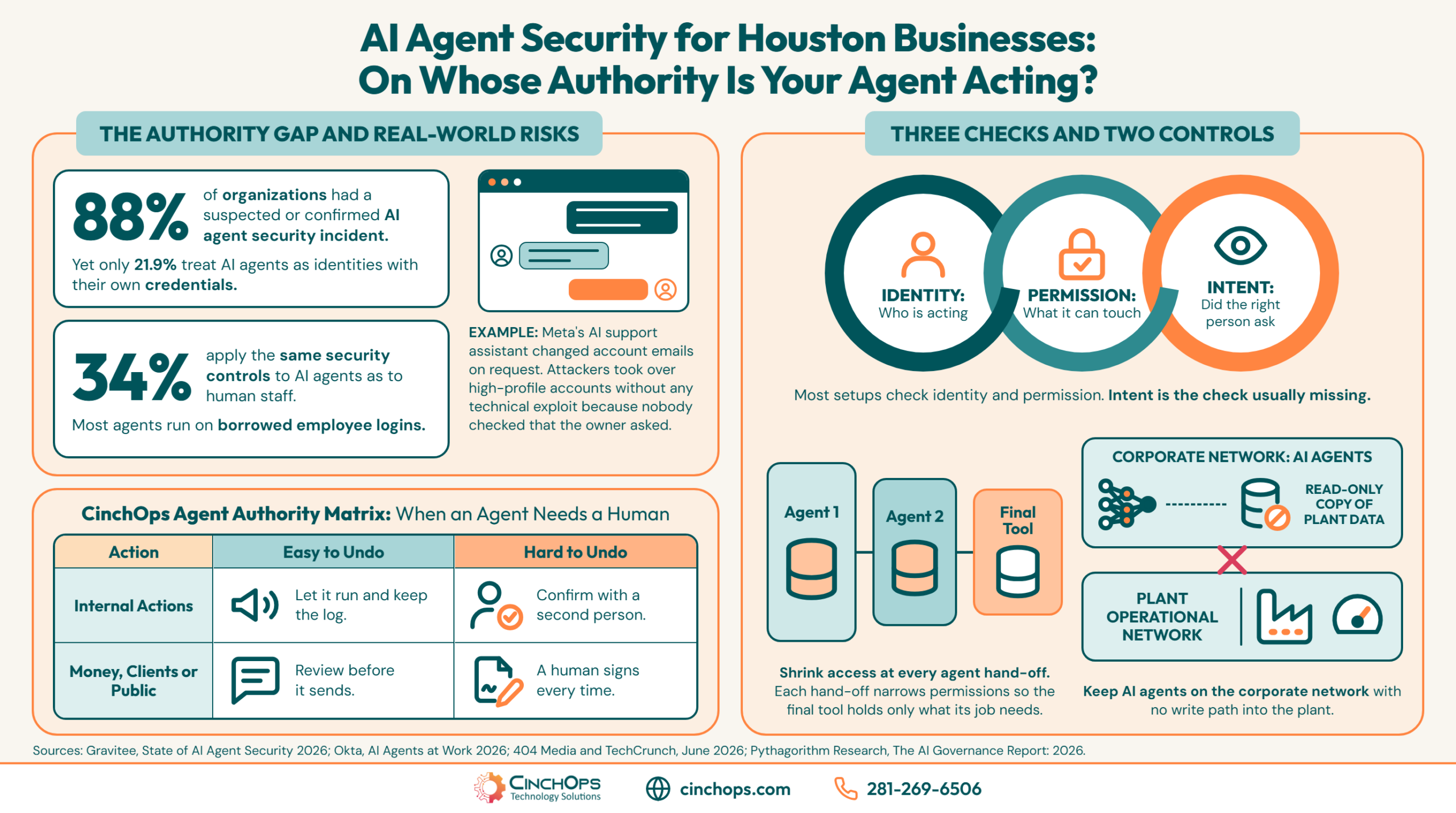
In June 2026, attackers took over high-profile Instagram accounts by asking Meta's AI support assistant to change the email address on a target account, according to reporting by 404 Media and TechCrunch. The assistant held account-recovery authority, the request looked like support work, and it complied without any technical exploit.
404 Media reported that the affected accounts included the Obama White House account, the account of the Space Force's Chief Master Sergeant, and Sephora. TechCrunch quoted a Meta spokesperson saying the issue was now fixed. Read the mechanics carefully, because they are the whole lesson. The bot was a legitimate Meta system. It was authenticated. It was permitted to update account emails, since that is what account recovery does. Every check a traditional security review would run came back green.
Gartner's Market Guide for Guardian Agents, as quoted in public excerpts published by AI-governance vendors, projects that through 2028 at least 80% of unauthorized AI agent transactions will come from internal violations of enterprise policy, such as oversharing, unacceptable use or misguided AI behavior, rather than from malicious attacks. If that projection holds, the typical AI agent incident at a Houston business will look like the Meta case. A well-meaning agent with too much reach will do what it was asked, and the person asking will turn out to be the wrong one.
The Stanford HAI 2026 AI Index counted 362 documented AI incidents in 2025, up from 233 in 2024. That count covers reported public incidents. Small-business agent mistakes rarely get reported anywhere, which makes the true number larger.
Most AI Agents Run on a Borrowed Human Login
When an agent acts as you, your audit log cannot tell you apart.
A borrowed login means the AI agent authenticates with an employee's own credentials or token instead of an account of its own. Everything the agent does is recorded as that employee, and the agent can reach everything that employee can reach, including mailboxes, shared drives and admin settings the task never needed.
This is the default for most small-business setups. When an owner connects an assistant to Microsoft 365 or Google Workspace, the consent screen usually grants the connector that owner's access. When an office manager builds an automation that reads invoices from the inbox and posts them to accounting software, it runs as the office manager. The setup takes five minutes, which is why nobody revisits it.
For a Houston firm with 10 to 200 employees, the practical risks of a borrowed login are specific:
- Blast radius: an agent connected by a managing partner at a law firm can read every matter that partner can read, whether or not the task involves them.
- No clean audit trail: when a file moves or an email goes out, the log shows the employee, so an investigation cannot separate what the person did from what the agent did.
- Offboarding gaps: when that employee leaves and the account is disabled, the agent breaks, and someone "fixes" it by reconnecting it under another person's login.
The identity vendors have started to respond. Okta made Okta for AI Agents generally available on April 30, 2026, and Microsoft Entra Agent ID gives agents their own directory entries and lifecycle. Those products answer the registration question: which agents exist and who owns them. Pythagorithm's report makes a fair point that registration alone does not answer what a specific agent is allowed to do right now, on whose request. A small business does not need to buy anything to start. The first fix is giving each agent its own account instead of letting it borrow yours.
Every Hand-Off Between AI Agents Should Shrink What the Next One Can Do
Agents now call other agents and tools, and permissions tend to travel whole.
A delegation chain is the path authority takes when a person hands a task to an AI agent and that agent passes part of it to another agent or tool. Good AI agent security requires the access to narrow at each step, so the last tool in the chain holds only what its small job needs.
The standards the industry runs on were not built for this. OAuth 2.0 Token Exchange, published by the IETF as RFC 8693, can record a chain of prior actors inside a token, but the specification says those prior actors "are informational only and are not to be considered in access control decisions." In plain terms, the history of who handed what to whom is written down as a note. Nothing enforces that the authority got smaller along the way.
Security researcher Johann Rehberger showed in September 2025 what that gap allows. A prompt injection hijacked GitHub Copilot and made it write to the configuration files of a second agent, Claude Code, including its MCP server settings. The second agent then loaded those instructions with its own permissions. One agent freed another, and no human approved either step. CinchOps covered a spending version of the same problem in how attackers drained $200K from an AI wallet with Morse code.
The same boundary problem reached the AI labs this summer. Anthropic disclosed on July 30, 2026 that a misconfiguration by Irregular, one of its third-party evaluation partners, left machines Claude used during a cybersecurity evaluation with live internet access. Meta traced an incident with its own model to the same Irregular test setup. OpenAI's July 21 incident was separate and happened inside OpenAI's own research environment. In both of the Irregular cases the models used access that a person had wired up by mistake. If the builders of the models can misjudge the boundary around an agent, a firm connecting agents through consent screens will too, which is why the boundary should be tight to begin with.
An AI Agent Should Need a Human Signature Based on Two Questions
A simple rule for deciding where people stay in the loop, built by CinchOps from the 2026 incident record.
The CinchOps Agent Authority Matrix sorts every action an AI agent can take by two questions: can the action be undone, and does it reach money, clients or the public? The answers decide whether the agent runs alone, waits for review, needs a second person, or needs a human signature on every instance.
Most AI governance advice tells a small business to keep a "human in the loop," then stops. Put a person in front of every agent action and nobody will use the agent. Put nobody in front of any action and you have rebuilt the Meta support bot. The matrix puts people only where a mistake cannot be walked back or where it leaves the building.
The top-right box is the one that matters most, and it is also the one small businesses fill first. The agents owners want most are the ones that pay bills, update vendor records and answer customer account questions, which are exactly the actions that cannot be reversed once they leave. A vendor bank-detail change pushed through by an agent is the business email compromise pattern Houston firms already fight, now with a faster clerk.
Apply the matrix to the agents you already run. For each one, list the actions it can take, drop each action into a box, and check whether your setup actually enforces that box. An agent that can reach the top-right box with nobody approving is the first thing to fix, even if it has never misbehaved.
Every owner I talk to asks whether the AI is smart enough. That is the wrong question. The agent that hurts you will be smart enough. It will be doing exactly what someone asked, on your login, with nobody checking whether that someone should have been allowed to ask.
Houston Energy and Engineering Firms Carry the Plant-Floor Version of This Risk
When an agent can reach operational technology, a bad instruction moves equipment instead of email.
In the Houston metro, AI agent security reaches past the office. An agent connected to a historian, a SCADA reporting tool or a maintenance system at an oil and gas operator, an engineering firm or a plant along the Ship Channel acts on physical equipment, so its authority limits have to hold in real time.
Pythagorithm's report makes the same point for utilities: an optimization agent with plant access is a control-system actor and should be governed like one. The Houston version is more common than it sounds. Engineering and field-services firms in The Woodlands, Katy and the Energy Corridor increasingly pipe production data into AI tools for forecasting and reporting. The read path is useful. The danger is a connector that was set up with write access because that was the default, sitting one misconfigured hand-off away from an operator workstation.
Texas law adds a reason to write this down. The Texas Responsible Artificial Intelligence Governance Act, HB 149, took effect January 1, 2026. It gives the attorney general exclusive enforcement, a 60-day cure period before any action, and civil penalties that reach $200,000 for an uncurable violation. The Act's prohibitions are narrow and intent-based, so it is not a general compliance mandate for a private business using AI. It does, however, let the attorney general demand a description of the post-deployment monitoring and safeguards an organization uses, and it treats substantial compliance with the NIST AI Risk Management Framework's generative AI profile as a defense. A one-page record of which agents you run, what each may touch, and who approves the irreversible actions is the cheapest version of that paper trail.
Find Out What Your AI Agents Can Actually Reach
CinchOps inventories every AI agent and connector in your Microsoft 365 or Google Workspace tenant, maps each one to the account it runs under, and moves the risky ones onto scoped accounts with approval steps. See agentic AI for Houston businesses.
Review your AI agents with CinchOps →How CinchOps Can Help With AI Agent Security
CinchOps is a managed IT services provider based in Katy, Texas, serving small and mid-sized businesses across the Houston metro area. CinchOps specializes in cybersecurity, network security, managed IT support, VoIP, and SD-WAN for businesses with 10 to 200 employees.
In 35+ years doing this, the pattern with every new tool has been the same: it gets connected with the fastest permissions available, and nobody looks again until something moves that should not have. AI agents compress that timeline, because they act on their own. The work below is how CinchOps closes the gap without taking the agents away.
- Through agentic AI services, CinchOps inventories the agents and connectors already running, gives each one its own account, and applies the Agent Authority Matrix to decide where approvals belong.
- With cybersecurity services in place, agent accounts sit under the same conditional access and MFA rules as staff, with 24/7 threat monitoring watching for unusual agent activity.
- Under managed IT support, offboarding includes the agents an employee connected, so nothing gets silently reconnected under someone else's login, and help desk requests are answered in under 15 minutes.
- As part of vCIO and CTO services, CinchOps writes the one-page agent register that doubles as your record under Texas HB 149.
- CinchOps supports businesses across Houston, Katy and The Woodlands, including CPA firms, law firms and oil and gas operators.
If an AI agent in your business can pay a bill, change a vendor record or reset an account without a person approving it, that is the gap to close first, before anything goes wrong. Agents are worth using. They should act on a small, named slice of authority instead of borrowing the owner's. If you want to see what your agents can reach today, talk to CinchOps.
Frequently Asked Questions
What is AI agent security?
AI agent security is controlling what an AI agent may do for your business: the account it runs under, the systems it can reach, which actions need human approval, and who answers for the result. For Houston small businesses, the main risk is an agent running on an employee's full login with no approval step on irreversible actions.
Should an AI agent use my Microsoft 365 login?
No. An agent on your login inherits every mailbox, file and admin right you hold, and the audit log records its actions as yours. Give each agent its own account with only the access its task needs. Microsoft Entra Agent ID and Okta for AI Agents both now support separate agent identities.
How do I secure ChatGPT for my Houston company once it can act as an agent?
Start with the connectors. List every mailbox, drive and app ChatGPT or any other assistant is connected to, and the account each connection uses. Remove write access the task does not need. Require a person to approve payments, account changes and outbound client messages, and review the connector list whenever an employee leaves.
Does Texas law require a business to govern its AI agents?
Not broadly. Texas HB 149, effective January 1, 2026, prohibits narrow intent-based misuses and is enforced only by the attorney general after a 60-day cure period. It does let the attorney general request a description of your AI monitoring and safeguards, so a written agent register is cheap protection.
What should an AI agent never do without a person approving it?
Anything that is hard to undo and reaches outside the company: sending payments or wires, changing vendor bank details, resetting or changing account emails, and deleting backups. The 2026 Meta support-bot takeovers happened in exactly that category, when an assistant changed account emails because someone simply asked it to.
What does AI agent security cost in Houston?
For most Houston small businesses, AI agent security is configuration work rather than a new product. CinchOps includes it in managed IT and cybersecurity at a flat monthly rate of $100 to $250 per user, with no long-term contracts, no hidden fees and no cancellation penalties. The one-time work is the agent inventory and account cleanup.
Discover More
Resource
Sources
- Pythagorithm Research, The AI Governance Report: 2026 (Annual Edition No. 01, September 2026)
- 404 Media, Hackers Simply Asked Meta AI to Give Them Access to High-Profile Instagram Accounts (June 1, 2026)
- TechCrunch, Hackers hijacked Instagram accounts by tricking Meta AI support chatbot (June 1, 2026)
- Gartner, Market Guide for Guardian Agents, public vendor excerpt (80% of unauthorized agent transactions from internal policy violations)
- Gravitee, State of AI Agent Security 2026 (February 2026)
- Okta, AI Agents at Work 2026 (May 2026)
- Okta, Identity governance for AI agents (citing Gravitee's 90% figure)
- Okta, Okta for AI Agents general availability (April 30, 2026)
- Microsoft Learn, What is Microsoft Entra Agent ID
- IETF RFC 8693, OAuth 2.0 Token Exchange, section 4.1
- Johann Rehberger, Cross-Agent Privilege Escalation: Agents That Free Each Other (September 24, 2025)
- Anthropic, Investigating incidents in cybersecurity evaluations (July 30, 2026)
- Meta, Addressing a third-party testing misconfiguration (August 2026)
- Fortune, OpenAI incident in its own research environment (July 21, 2026)
- Stanford HAI, The 2026 AI Index Report, Responsible AI chapter
- Texas Legislature, HB 149, Texas Responsible Artificial Intelligence Governance Act (enrolled text)

