


Houston Is Adding Businesses Faster Than It Adds People. Is Your IT Ready?
The Population Number Gets Quoted. The Business Number Is The One You Feel. – Eight Checks Between A Setup That Scales And One That Stops
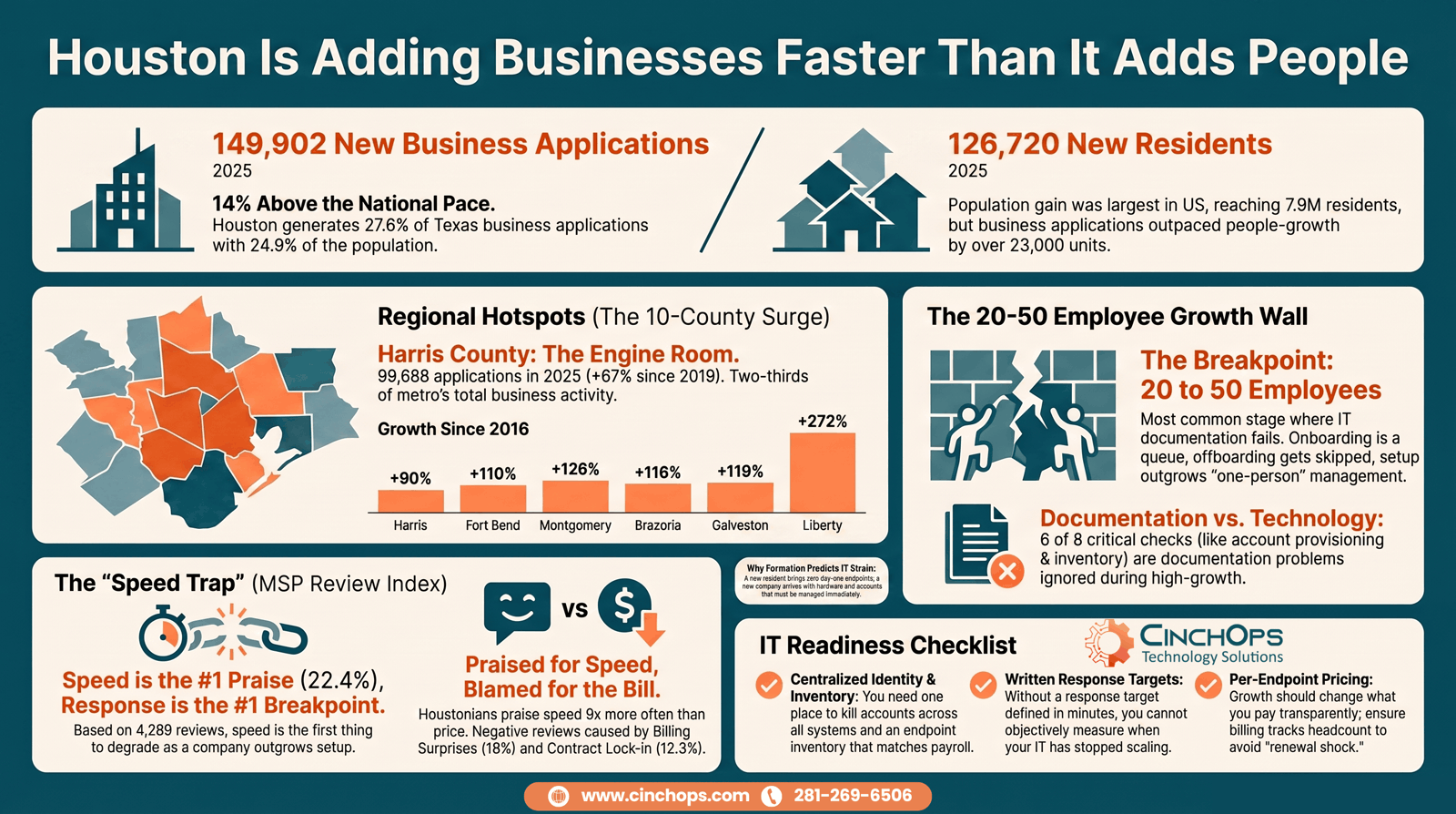
Census counted 126,720 new Houston residents and 149,902 new business applications. Eight checks tell you whether your IT is ready for that kind of growth.
The Houston metro added 126,720 residents between July 2024 and July 2025, the largest single-year numeric gain of any metropolitan area in the United States, according to the US Census Bureau's Vintage 2025 population estimates. Those people are customers, employees, and patients of Houston small businesses.
The estimate covers July 2024 through July 2025 and was released on March 26, 2026 - and it has been quoted in every Houston business publication since. It is still the wrong number to plan your IT around. A resident is not a customer, and a metro of 7,904,627 people tells a 40-person engineering firm in Katy nothing actionable about next year's help desk volume.
There is a second Census dataset, released on June 10, 2026, that almost nobody has looked at locally. It counts business applications, county by county, back to 2005. Summed across the 10 counties of the Houston metro it says 149,902 for 2025. Houston business growth 2026 planning gets considerably sharper when you work from that number instead, because business formation is the part of growth that arrives with laptops attached.
Houston's Growth Story Is Told With the Number That Predicts the Least
Two Census datasets, two different signals, and only one of them moves with your endpoint count.
Population growth and business formation are separate Census programs measuring separate things. Population estimates count people living in the metro on July 1. Business Formation Statistics count applications for a new employer identification number. For a small business owner deciding whether this is the year IT stops coping, the second series is the useful one.
The population side is settled and verified:
- 7,904,627 residents - the Houston-Pasadena-The Woodlands metro in 2025, fifth-largest in the country.
- +126,720 in a single year - the largest numeric gain of any US metro - plus 754,400 added since the 2020 census.
- Harris County: 5,045,026 - the #1 US county for numeric growth over both the one-year and five-year windows.
The formation side is newer. It is why this post exists. Census released annual business applications by county for 2005 through 2025 on June 10, 2026.
Texas filed 544,133 business applications in 2025 - the highest in the 21 years the county series covers. The Houston metro's 149,902 was its second-highest year ever, just under the 151,804 filed in the 2021 surge - and 842,507 have been filed across the metro since 2020.
Why Does Business Formation Predict IT Strain Better Than Population?
Because a new business arrives with endpoints, and a new resident does not.
Business formation is the count of new employer identification number applications filed with the IRS and published by the US Census Bureau. It predicts IT strain better than population because every application that becomes a real company arrives with laptops, email accounts, a domain, and a payroll system, while a new resident arrives with none of those.
Run the two Houston numbers against the state and something useful falls out:
- 24.9% of the Texas population lives in the 10-county Houston metro.
- 27.6% of the state's 2025 business applications were filed here.
- 19.0 applications per 1,000 residents, against 17.2 for Texas and 16.6 nationally.
Houston is not simply growing. It is converting growth into new companies at a rate roughly 14% above the national pace.
A metro that grows by adding residents puts gradual pressure on existing companies. A metro that grows by adding companies puts a different kind of pressure on everyone: more competitors bidding for the same crews and clients, more vendors to onboard, more software showing up on the network, and a tighter market for the technical people you would otherwise hire in-house.
In 35+ years doing this, the pattern that shows up over and over is that an owner does not feel a market getting busier through revenue first. They feel it through response times, theirs and everybody else's. Revenue is a lagging indicator of a busy market. Delay is the leading one.
One caveat, stated plainly: a business application is not yet a business. Many filings never become companies with employees, which is why Census tracks actual formations in a separate series. So 149,902 does not mean 149,902 new companies buying IT this year. What the number does measure is how much new commercial activity is entering the Houston market - and every one of those filings is a potential new competitor, a new vendor on your network, or the future employer of your next hire. The scale is what matters, and the scale keeps growing.
The Formation Surge Is Concentrated in the Counties Around Katy
Harris carries two thirds of it, but the sharpest percentage moves are in the exurbs.
Harris County filed 99,688 business applications in 2025, about two thirds of the Houston metro total and 18.3% of everything filed in Texas, from a county holding 15.9% of the state's people. Fort Bend filed 20,426 and Montgomery 13,861, which is where most Houston small business hiring growth is currently landing.
The percentage story sits further out, in the exurban ring:
- Liberty County: 1,622 applications in 2025, against 574 in 2019, in the third-fastest-growing county in America by population percentage at 32.41%.
- Waller County: 1,023, and Chambers County: 705, both up sharply on 2019 and both in the top 20 US counties by five-year population percentage.
- Brazoria: 6,380, and Galveston: 5,413, their strongest counts of the last decade, which is why Gulf-side businesses are seeing more local competition than the population numbers alone would suggest.
- Austin County: 404, and San Jacinto County: 380, the two smallest filers in the metro and the two oldest by median age, at 41.9 and 45.0.
For a Katy business this is not abstract. Katy straddles Harris, Fort Bend and Waller, and all three are growth leaders on both measures. A firm in Katy, Cypress or Sugar Land is sitting inside the densest formation corridor in the state, and the practical consequence is that the labor market, the vendor market, and circuit lead times all got tighter at the same time.
Harris County's application count is up 67.0% against 2019 - from 59,683 to 99,688. Whatever the eventual survival rate of those filings, a county running two thirds more new business activity than it did six years ago is not a place where a technology setup built in 2019 quietly keeps working.
Has Your Headcount Moved More Than 20% in Two Years?
If account provisioning, device inventory and your response target have not changed with it, that is the gap.
Talk to CinchOpsWhat Breaks First When a Houston Company Outgrows Its IT?
Not security, not the budget. Speed goes first, and Houston notices.
Response time breaks first. The CinchOps Houston MSP Review Index analyzed 4,289 Google reviews across 140 Houston-area managed IT providers, and responsive is the single most common theme in positive reviews at 22.4% of 3,705 positive reviews. It is what Houston businesses notice most, and it is the first thing that degrades when a company outgrows the setup it started with.
Figures in this post are from the July 2026 edition of the Houston MSP Review Index (140 providers, 4,289 reviews). The index has since been restated on an audited 217-provider roster with a September 2026 snapshot.
Speed is praised nearly nine times as often as price in that dataset. Pricing and value appear in only 2.5% of positive reviews. But when Houston businesses write a negative review, they largely do not write about speed.
When a Houston business writes a negative review, the leading themes are commercial, not technical:
- Billing surprises and hidden fees: 18.0% - the #1 complaint in the market.
- Contract lock-in: 12.3% - the #2 complaint.
- Failed projects: 10.7%, and slow or no response: 8.2% - speed sits only fourth.
Read the two panels together and a finding falls out that provider marketing never publishes: the thing that earns a Houston IT provider praise is not the thing that loses them the client. Speed earns the review. Commercial terms end the relationship.
Growth is what turns the left panel into the right one. A provider that answered in ten minutes when you had 18 endpoints is answering in two hours at 55, and the renewal conversation that follows is where the contract and the invoice finally get read closely. Nothing about that sequence is unusual. It is the predictable consequence of a relationship priced and staffed for the company you used to be.
Which is why the response target belongs in writing before the growth, not after it. If nobody has agreed what fast means in minutes, nobody can identify the month it stopped being true.
Eight Checks Separate a Setup That Scales From One About to Stop
Six of the eight are documentation problems, which is exactly why they get postponed.
A growing company outgrows its IT setup at the point where the person handling IT part-time can no longer keep the list of accounts, devices, and access in their head. Across the Houston SMBs CinchOps works with, that point usually arrives somewhere between 20 and 50 employees, and it arrives as a backlog rather than an outage.
By the time an owner searches for "best Houston IT companies for businesses with 25 to 100 employees," the breaking point is usually already behind them. And the ranking is the wrong place to start. Before comparing vendors, check whether eight specific things are handled - they decide how the next growth year goes no matter who runs your IT.
- One place to create and kill an account. If a departing employee's access lives in six systems, growth turns offboarding into a security gap.
- An endpoint inventory that reconciles against payroll. If you cannot match the device list to the employee list in an afternoon, you do not know your attack surface.
- An onboarding kit that beats the start date. Image, applications, and multifactor enrolled before day one, not during it.
- Wi-Fi and bandwidth sized to seats, not square footage. The most common Houston office complaint after a hiring run is a network built for half the people now sitting on it.
- A response target written down in minutes. Without a number, nobody can tell when the service stopped being fast.
- A second-site plan before the lease is signed. Circuit lead times in the Houston suburbs do not care about your move-in date.
- Backups that cover the tools people added on their own. Growth adds software faster than it adds policy.
- A quarterly review that reprices per user. Growth should change what you pay, and you should be able to see exactly how.
Six of those eight are documentation problems rather than technology problems, which is precisely why they get postponed in a busy year. They are also the six that decide whether adding 20 people is a good quarter or a quarter spent cleaning up after one.
Nobody calls us because they hit a headcount number. They call because a new hire sat for three days without a laptop and the owner finally saw the pattern. Growth does not announce itself in IT. It shows up as everything taking a little longer, until one day it does not work at all.
Growth Adds Endpoints Faster Than It Adds Policy
Every new hire, site, and application widens what has to be watched. CinchOps runs cybersecurity and managed IT support on a flat monthly rate per user, so the bill tracks headcount instead of surprising you at renewal.
See how CinchOps handles cybersecurity →How CinchOps Can Help a Growing Houston Business
CinchOps is a managed IT services provider based in Katy, Texas, serving small and mid-sized businesses across the Houston metro area. CinchOps specializes in cybersecurity, network security, managed IT support, VoIP, and SD-WAN for businesses with 10 to 200 employees.
CinchOps provides managed IT support for construction, CPA, and professional services firms across the Houston metro at a flat monthly rate per user, with help desk response under 15 minutes and no contracts, hidden fees, or cancellation penalties. Given that billing and contract lock-in are the two most common complaints Houston businesses actually write about IT providers, that structure is a deliberate answer to what the review data says rather than a marketing line.
- Through managed IT support, onboarding and offboarding run from one place, so a hiring run does not become a backlog or a security gap.
- Through cybersecurity and business continuity and disaster recovery, backups sit outside the Gulf Coast flood zone, which matters more with every site a growing company adds.
- Through SD-WAN and VoIP, a second location comes online without rebuilding the network or the phone system.
- For companies that already have internal IT, CTO and CIO services add capacity without adding headcount.
- CinchOps covers Houston, Katy, Sugar Land, Cypress, and The Woodlands, the corridors where the Fort Bend and Montgomery County formation numbers are concentrated.
- Industry-specific work for construction, CPA firms, engineering firms, and oil and gas covers the platforms those firms actually run.
Growth is a good problem and still a problem, and it does not wait for a planning cycle. The businesses that handle it well are the ones that fixed the boring things, account provisioning, device inventory, a written response target, while there was still slack in the system. If your headcount has moved more than 20% in the last two years and none of those three have changed, that is your gap. Talk to CinchOps and we will tell you which of the eight checks above you are already passing.
Frequently Asked Questions
How many new businesses were started in the Houston area in 2025?
The 10-county Houston metro recorded 149,902 new business applications in 2025, according to US Census Bureau Business Formation Statistics released June 10, 2026. Harris County accounted for 99,688 of them. That was the metro's second-highest annual total on record, just under the 151,804 filed in 2021.
At what headcount does a growing company outgrow its IT setup?
Most Houston small businesses hit the limit between 20 and 50 employees. The trigger is not a device count. It is the moment one part-time person can no longer hold every account, password, and device in their head. It shows up first as slow onboarding and skipped offboarding, not as an outage.
What does managed IT support cost in Houston?
CinchOps charges a flat monthly rate per user, so the cost tracks your headcount rather than a fixed contract tier, with no contracts, hidden fees, or cancellation penalties. For a current per-user range across Houston providers, see the 2026 Houston managed IT pricing breakdown.
Does business growth mean a higher IT cost per user?
Not usually. Total IT spend rises with headcount because you pay per user, but cost per user tends to flatten or fall as a company grows, since setup and monitoring overhead spreads across more people. The real risk in a growth year is unpriced scope, not a higher unit rate.
How fast should a Houston IT provider respond to a support request?
Fast enough that the target is written down in minutes. Responsive is the top praise theme in 22.4% of 3,705 positive reviews across 140 Houston-area providers, so speed is what local businesses judge on. CinchOps targets help desk response under 15 minutes and states it rather than leaving it to expectation.
Discover More
Resource
Sources
- US Census Bureau, Vintage 2025 Population Estimates for Counties and Metropolitan Areas (released March 26, 2026) - Houston metro population 7,904,627; +126,720 single-year; +754,400 five-year; Harris County 5,045,026; Liberty County +32.41%.
- US Census Bureau, Business Formation Statistics, Annual Business Applications by County, 2005-2025 (released June 10, 2026) - Houston metro 149,902 applications in 2025; Harris County 99,688; Fort Bend 20,426; Montgomery 13,861; Texas 544,133.
- CinchOps Houston MSP Review Index (July 13, 2026 snapshot) - 4,289 Google reviews across 140 Houston-area managed IT providers; responsive appears in 22.4% of 3,705 positive reviews, pricing in 2.5%; billing 18.0% and contract lock-in 12.3% of 122 negative reviews.
- Methodology: County-level business application totals for the 10-county Houston-Pasadena-The Woodlands metro (Harris, Fort Bend, Montgomery, Brazoria, Galveston, Liberty, Waller, Chambers, Austin, San Jacinto) were summed by CinchOps from the Census county file. Share-of-state figures and per-1,000-resident rates are CinchOps calculations joining that file to the Vintage 2025 population estimates.


