


The Houston MSP Review Index Is Live: What the Data Means
A Quarterly Report Card For Houston IT – What The Houston MSP Review Index Means For You
The New Houston MSP Review Index Proves It.
Houston finally has public market data on its IT providers: 4,289 reviews, 140 companies, refreshed quarterly.
The Houston MSP Review Index is a free public research page that charts 4,289 Google reviews across 140 Houston-area managed IT providers - what clients praise, why they leave, and how unevenly the market's reputation is distributed. It went live this week, and it will be refreshed quarterly.
CinchOps is a managed IT provider in Katy that publishes flat $100 to $250 per user monthly pricing and answers help desk requests in under 15 minutes, and we built this dataset for a selfish reason: competitive research. Somewhere between the 400th review and the 4,000th, the project changed shape. The patterns contradicted almost everything buyers assume about reading reviews, and they answered the question every owner asks us in a first meeting: how do I know who to trust?
So we published the whole picture at the Houston MSP Review Index. This post covers what the index is, and the three beliefs its data retires.
What Is the Houston MSP Review Index?
The launch, the boundaries, and why our competitive research became a public record.
The Houston MSP Review Index measures the public Google Business reviews of 140 Houston-metro managed IT providers: 4,289 reviews from a July 2026 snapshot, with 3,705 positive and 122 negative reviews carrying enough written detail to be themed by category. Every percentage on the page is a share of those themed reviews.
Just as deliberate is what the index refuses to do. No individual provider is named or ranked. The page publishes market aggregates only - theme percentages, distributions, tier structures - because the point is to teach buyers how to read the market, not to publish a scoreboard we grade ourselves on. Houston already has pay-to-play vendor lists. It did not need another one.
There was a real internal debate about publishing at all. Review data is expensive to collect, theme, and verify, and the obvious move is to keep the advantage private. The counterargument won: the aggregate patterns do not belong to us. They are 4,289 public statements by Houston businesses about what earns loyalty and what ends contracts. And the Review Index joins a family of free CinchOps research assets built the same way:
- Houston Area Security Index - external security scans of 2,420 Houston businesses, graded by region and industry.
- Houston Growth Index - Census data on the 10-county Houston boom, ranked and charted.
- Houston Area Patch Index - security advisories from 18 software vendors tracked since 2022, showing the patch load your stack creates.
- Houston MSP Review Index - the newest: 4,289 Google reviews across 140 providers, the market seen from the client side.
In 35+ years around this industry, I have learned to distrust any market study that hides its own limits, so this one prints them on the page: 122 negative reviews is a small sample, and the complaint percentages work as a ranked list of dealbreakers, not incidence rates.
Does a 5-Star Average Mean a Great Provider?
The first belief the data retires: that star ratings separate good IT companies from bad ones.
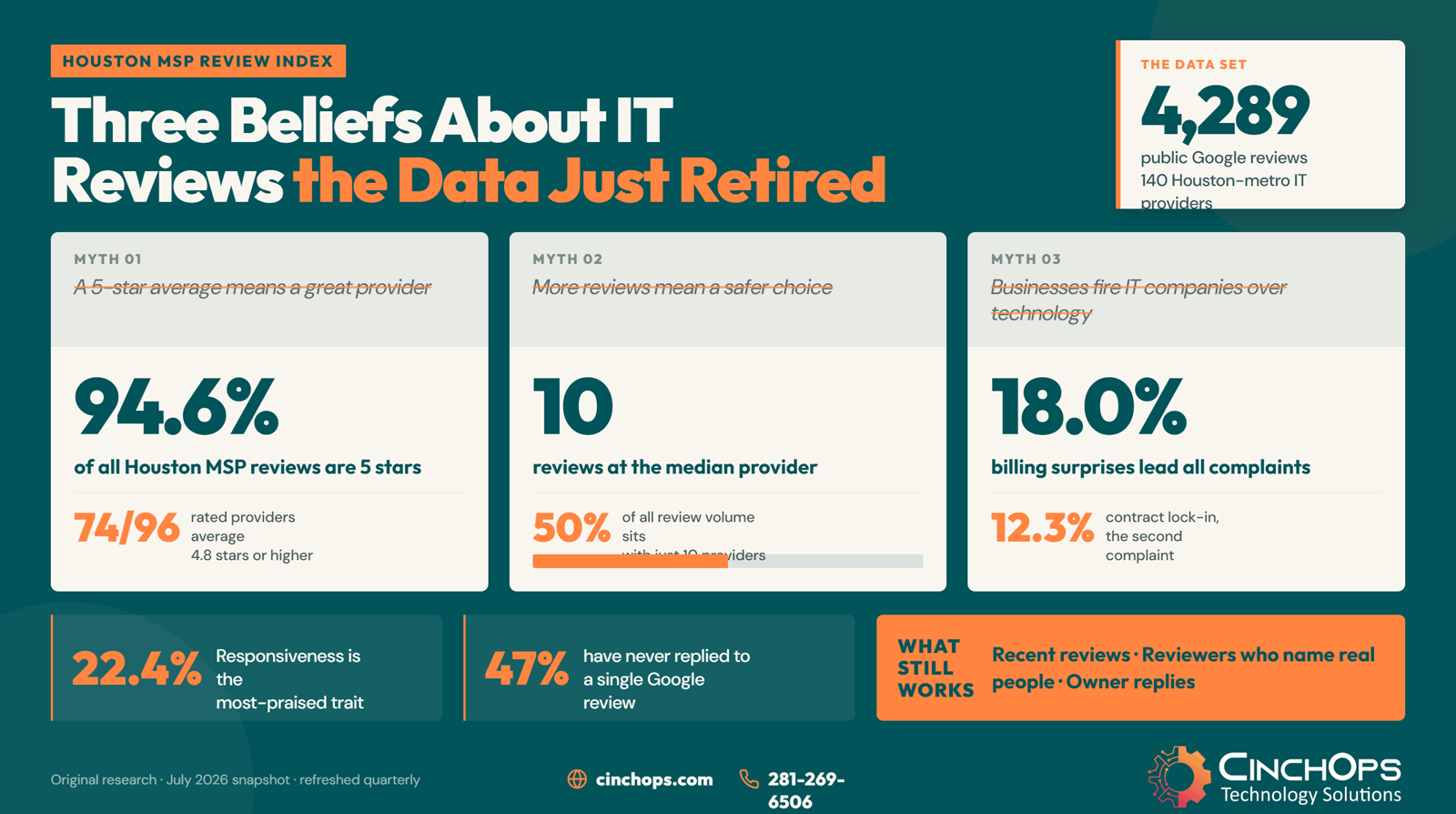
What buyers assume: a 5.0 average is proof of excellence. What 4,289 reviews show: 94.6% of every review in the Houston MSP market is 5 stars, 74 of the 96 providers with 5 or more reviews average 4.8 or higher, and 46 hold a perfect 5.00. When nearly everyone has the same grade, the grade stops carrying information.
This is grade inflation, and it has a simple mechanism. Happy IT clients review when the provider asks; unhappy ones usually just leave. The result is a market where the star average measures how diligently a provider requests reviews, not how it behaves in year 2 of a contract. Review velocity is climbing too - 786 new reviews across the market in the last 12 months, up 13.1% year over year - so the inflation is accelerating, not correcting.
Do More Reviews Mean a Safer Choice?
The second belief: that review count is a proxy for trustworthiness.
What buyers assume: 300 reviews beats 22 reviews. What the data shows: the median Houston MSP has just 10 Google reviews, the 10 most-reviewed providers hold 50.0% of the market's entire review volume, and count tracks company age and retail foot traffic far more than service quality.
Do Businesses Actually Fire IT Companies Over Technology?
The third belief - and the one that should change how Houston buys IT.
What buyers assume: providers get fired for outages and outdated tools. What 122 negative reviews show: billing surprises and hidden fees lead every complaint theme at 18.0%, contract lock-in follows at 12.3%, and technical capability barely registers. On the praise side, responsiveness leads at 22.4% while pricing is the rarest theme at just 2.5%.
Read as an industry report card, the complaint list is an indictment of habits, not capabilities. Surprise invoices, contracts that will not let go, sales engineers who vanish after signature, service that sags when a provider gets acquired - each one is a choice, not a skill gap. Which is oddly hopeful. It means a Houston business can avoid most of the market's failure modes with a handful of contract questions, and any MSP could fix its reputation risk without buying a single new tool.
It also reframes how you compare top managed IT providers in Houston: the differentiators that matter are published pricing, exit terms, response proof, and owner engagement - the exact 4 things the complaint data punishes. We see the same pattern twice a month in first meetings with Houston businesses. The final straw with the old provider was never the outage. It was the silence after it. And the market is concentrated enough that the habits of a few shape the whole reputation pool: 92 of the 140 tracked providers sit inside Houston proper, with Katy the largest suburban cluster at 24.
We invested the time and money to build this dataset for ourselves. Publishing it just means Houston businesses stop negotiating blind - the market gets better when everyone has the access to the same data and businesses can use that data in their assessments.
Use the index, then test us against it
The complaint data is a vetting checklist: published pricing, exit terms, response proof, owner engagement. CinchOps answers all 4 in writing - flat per-user pricing on the website, a 30-day money-back guarantee with no contracts, an under-15-minute help desk response, and an owner reply on our Google reviews. Hold any provider to that standard, including us, starting with managed IT services.
Explore the full Houston MSP Review Index →How CinchOps Can Help
CinchOps is a managed IT services provider based in Katy, Texas, serving small and mid-sized businesses across the Houston metro area. CinchOps specializes in cybersecurity, network security, managed IT support, VoIP, and SD-WAN for businesses with 10 to 200 employees.
The index is the data layer of a three-part set. For the buying decision itself, How to Choose an IT Company in Houston turns the complaint data into 7 green flags, 7 red flags, and 10 questions to ask before signing. For the review-count trap specifically, What 3,800+ Google Reviews Reveal About Managed IT in Houston goes deeper. And for the service side, start with managed IT services, cybersecurity, and IT support in Houston, or the local teams in Katy and Sugar Land.
The index gets refreshed quarterly, so the market's report card now has a paper trail - and every Houston business gets to see whether the industry's habits actually improve. If you want to know how your current provider measures against the data, or what switching would look like, talk to CinchOps. Bring your invoice and your contract. We will bring the numbers.
Frequently Asked Questions
What is the Houston MSP Review Index?
The Houston MSP Review Index is a free CinchOps research page charting 4,289 Google reviews across 140 Houston-area managed IT providers. It shows what clients praise, why businesses leave, star-rating and review-count distributions, and owner response behavior - market aggregates only, with no individual providers named or ranked. It refreshes quarterly.
Are Google reviews a reliable way to pick an IT company?
Only if you read past the stars. 94.6% of Houston MSP reviews are 5-star, so averages cannot separate providers. The reliable signals are patterns: steady review recency, reviewers who name people and projects, and owner replies. 47% of Houston MSPs have never answered a single review, which tells you plenty.
How was the Houston MSP Review Index data collected?
CinchOps exported the public Google Business reviews of 140 Houston-metro managed IT providers in July 2026 - 4,289 reviews in total. The 3,705 positive and 122 negative reviews with enough written detail were themed by category, and every percentage is a share of those themed reviews. No surveys or self-reporting are involved.
How should Houston businesses use the index?
Use it as market context before vetting any provider. The data says to check published pricing and exit terms first, because billing and lock-in are the top complaints, then read review patterns instead of star averages. The companion guide turns the findings into 7 green flags, 7 red flags, and 10 questions to ask before signing.
What does managed IT support cost in Houston?
Managed IT support in Houston typically runs $100 to $250 per user per month on a flat-rate agreement covering help desk, monitoring, patching, and baseline security. CinchOps publishes this range directly. The index shows why that matters: pricing earns praise in only 2.5% of positive reviews, so transparency is rare enough to be a signal.
Discover More
Resource
Sources
- CinchOps Houston MSP Review Index - original research: analysis of 4,289 public Google Business reviews (3,705 positive and 122 negative reviews themed by category) across 140 Houston-metro managed IT service providers, July 2026 snapshot, refreshed quarterly. Percentages are shares of themed reviews.
- CinchOps original research: Houston local search analysis, July 2026 - review count versus local map ranking observations referenced in the volume-myth section.

